Suburb sponsors a college bowl game, gets nearly 20 mentions, 6 commercials, and a lot of visuals on the field

Elk Grove Village sponsored a college bowl game. The Daily Herald tracked how often the community was mentioned during the game broadcast:

The 3½-hour telecast included nearly 20 mentions of the formal bowl game name that uses Elk Grove’s “Makers Wanted” tagline, and six commercials promoting the business park…

11:33 a.m. The players take the field, sporting the bowl game logo on jerseys. The logo, featuring the “Makers Wanted” slogan nestled in between two palm trees, is on the 50-yard line, while separate “Makers Wanted Elk Grove Village Illinois” logos are on the 25-yard lines. Similar banners are on sidelines behind team benches. Smaller sideline signs feature “Makers Wanted” and Elk Grove-based Stern Pinball, which gave pinball machines to each team.

11:54 a.m. Elk Grove airs its first TV commercial, which it gets as part of the sponsorship deal. “Why would Elk Grove Village sponsor the Makers Wanted Bahamas Bowl?” the announcer asks. “Because we’re proud,” mentioning the new technology park under development and access to transportation. The TV spot invites businesses to learn more “about how we can help your company grow at makerswanted.org.”…

2:32 p.m. Coming back from a break, ESPN shows scenes from Elk Grove’s municipal complex and park district and the watch party at Real Time Sports bar. “Good on the Makers Wanted people and all our friends watching in Elk Grove Village,” Levy says. “Need a place to set up and start a business and start a life? That’s an excellent place to go.”

Add in all the times viewers saw logos on the field and in the stadium and it sounds like the suburb received plenty of air-time.

Two related thoughts:

  1. It is interesting to see how the community tried to present itself. The whole point was to sell the business space and atmosphere of the community but that does not happen by just showing empty land and warehouses. So, if you are trying to promote a friendly community that is full of successful businesses and entrepreneurs, what else do you show? Based on the account above, they showed a party and a pinball competition hosted by a local company. Could those events happen anywhere? Would local residents recognize this as their community in terms of a pervasive local character or did it just cherry-pick a few pieces of the suburb?
  2. Imagine a future where more communities sponsor sporting events or other major events. The average American has never heard of most other suburbs. The average Chicago area resident likely knows little about Elk Grove Village outside of its location near O’Hare Airport. This could be a way for relatively small and unknown places to become more known. At the same time, such campaigns are unlikely to have major transformative effects on suburbs.

Gautreaux remediation may end soon in Chicago

Filed in the 1960s, decided in the 1970s, and with remediation lasting decades, a case involving a class-action lawsuit charging racial discrimination in public housing in Chicago may end in 2024:

The Chicago Housing Authority and lawyers representing CHA residents have asked U.S. District Judge Marvin Aspen to approve the agreement creating a road map for the CHA to complete its obligations under the so-called Gautreaux litigation.

Under the plan, the nearly 53-year-old case would come to a close by July 2024, marking an end to a landmark chapter in the national civil rights movement.

The settlement agreement provides a detailed timeline for the CHA to complete all planned mixed-income units and strengthen its housing voucher program to better enable families to move to more affluent areas if they choose to do so…

The lawsuit changed the face of public housing by instituting “scattered site” projects built on a small scale and dispersed in neighborhoods throughout the city — a stark contrast to the high-rise buildings constructed in the 1950s and 1960s.

This important lawsuit and ruling has both had significant effects on how policymakers have addressed concentrated poverty (more emphasis on scattering poor residents) as well as likely had limited effects because of the limited number of poor residents who have had and taken advantage of new opportunities to live in wealthier communities.

What is also striking about this is that the era of large-scale public housing and its associations with concentrated poverty are likely over. Hopefully, this does not mean less attention is paid to residential segregation and affordable housing issues but it is easier for the general public to ignore problems that are less visible.

Former Cabrini-Green site home to the fastest growing American neighborhood of residents making over $200k

A new analysis of Census data suggests the former home to Cabrini-Green housing project high-rises is increasingly the home of wealthy residents:

Cook County, which includes the county seat of Chicago, is home to the No. 1 and No. 7 fastest-growing concentrations of $200,000-plus households. No. 1 is, ironically, the area around where the Cabrini-Green public housing projects once stood. Cabrini-Green was notorious for violent crime, poverty and de facto racial segregation until its demolition beginning in the 1990s at the behest of the Chicago Housing Authority.

Even back then, authorities fretted that redevelopment plans might displace low-income families. They were right to be worried. Two decades later, the area’s concentration of $200,000-plus households has skyrocketed from zero to 39 percent. For some of the longtime residents who remain, the neighborhood’s transformation has been isolating.

Latanya Palmer, 53, grew up in the Cabrini Rowhouses. While she moved into a nearby mixed-income development in 2005, the hypergentrification has occasionally made her feel like a stranger in her own home. That sentiment echoes across the country, as poor and working-class Americans are increasingly pushed aside by frenzied development and prohibitive living expenses…

The census tract in question includes the still-standing, albeit largely vacant row houses where Palmer grew up. But now there are luxury condominiums and apartments, too. They sport rooftop terraces and sparkling views of the city’s affluent Gold Coast and Lake Michigan beyond. A three-bedroom penthouse can cost around $2 million.

This should be no surprise: the proximity of the land to both downtown and Lincoln Park meant that it is was highly desirable for developers and residents. Compare the clamor for the Cabrini-Green land to land where the Robert Taylor Homes once stood.

I would suggest there is a bit of revisionist history above. The claim that “authorities fretted” about the possible displacement of public housing residents is overstated. If anything, the city and Chicago Housing Authority probably could not wait to remove the high-rises (and other ones in the city, including the Robert Taylor Homes). Progress on replacing the units has been slow and with limited effects. The Chicago Housing Authority continues to have long waiting lists for housing. And many of the neighborhoods where public housing high-rises once stood are still relatively poor, even as a construction boom is taking place in the Loop and desirable nearby neighborhoods. In other words, some foresaw the potential for the Cabrini-Green site to be a wealthy neighborhood – and this what the city desired.

For more on why some Cabrini-Green residents fought hard to not be pushed out of their high-rises, see my earlier paper: “The Struggle Over Redevelopment at Cabrini-Green, 1989-2004.”

Yahoo News leads with Chicago murders and then says it is not the murder capital

If the point of a news story/video is to say something is not true, would you lead with the data from the not true side?

ChicagoMurderCapital121818.png

Here is the way this seems to work: grab your attention with a publicly available statistic that stands out. Oh my, how could there be so many murders in one city?? But, several sentences later, tell the reader/viewer that multiple other cities have a higher murder rate. And include in the last sentence that the murder number in Chicago has been down in recent years. So, wait: Chicago really isn’t the murder capital?

I’m trying to figure out how this adds to the public discourse. Here are a few possibilities:

  1. It is simply about clicks. Get people’s attention with a statistic and a video, throw in some data. Easy to produce, not much content.
  2. The goal is to highlight the still-high number of murders in Chicago.
  3. The goal is to point out that other cities actually experience more murders per capita.
  4. To give those who teach statistics an example of how data can be twisted and/or used without telling much of a story.


Popular HGTV show leads to local tourism boost – but what are the lasting effects?

Many HGTV shows are tenuously connected to actual communities – the focus is on the homes and personalities, not the neighborhoods and community. Fixer Upper and the efforts of the Gaines family in Waco, Texas may then be quite unique:

In 2015, they opened Magnolia Market, a home goods store that sells Mrs. Gaines’s mass-produced collections of bohemian farmhouse décor, and quickly followed with a bakery, garden shop and a turf-lawn park built near two old silos that had been constructed in 1950 by the Brazos Valley Cotton Oil Company. They also opened a nearby restaurant, Magnolia Table, in the former Elite Café, a longtime favorite that closed in 2016 after several different owners and renovations. When the Gaineses took it over, they installed subway tile along the walls, exposed the wood beams in the ceiling and stuck an ever-changing marquee sign out front. Naturally, the renovation was featured on their show.

No one’s complaining. The number of tourists to Waco has tripled in the four years since “Fixer Upper” first aired, with some 1.7 million people visiting in the first seven months of 2018 alone, and other local businesses have flourished with the influx. Carla Pendergraft, director of marketing for the Waco Convention and Visitors Bureau, said the appeal of the “Fixer Upper” brand has had a profound impact on the city.

Several quick thoughts::

1. The article touts increased tourism and a few local businesses that have benefited from the popularity of the show. Lacking are numbers about increased jobs and increased tax revenues.

2. The biggest bonus to Waco seems to be less about economics and more about status: the Gaines have helped make the city cool.

3. How long will this effect last? When Fixer Upper is done, will the family still exert the same pull on people? And if this trend dies down, how will the community of Waco respond? My guess would be that this uptick in tourism and interest will fade away if the Gaines are not as visible.

4. The concept of TV driven tourism is an intriguing one. People want to visit popular TV sites, like the Brady Bunch house for the Soprano’s home. Should more cities take advantage of shows that have strong connections to certain locations? Imagine Chicago building a full campaign around the Chicago Fire, Chicago P.D., and Chicago Med galaxy.

Naperville considers one of its last greenfield subdivisions

By the early 2000s, the large suburb of Naperville had relatively few large parcels of land where new subdivisions could emerge like they did regularly for decades. One such parcel of land is now up for discussion:

Single-family detached homes are proposed for about 105 acres of the site at Route 59 and 103rd Street, requiring the zoning be changed from agricultural to residential. The remaining eight acres would be rezoned for office, commercial and institutional use to accommodate a new Compass Evangelical Free Church, which already has two Naperville locations and one each in Bolingbrook and Wheaton.

Houses ranging in size from 2,300 to 3,539 square feet would be built on lots ranging from 6,838 to 20,065 square feet, according to plans submitted to the city. There would be multiple floor plans available, and Pulte plans on a “significant setback and buffer from Route 59 to lessen potential impacts on the properties,” the proposal said.

The two-story 38,000-square-foot church would be built at the corner of Route 59 and 103rd Street. It would have a 600-seat worship center, a children’s ministry space, a multipurpose room or gymnasium, second-floor offices, a 5,000-square-foot coffee shop and 307 parking spaces, according to plans.

The requested use deviates from the 2002 Southwest Community Area Plan, which identified the future land use as commercial, senior housing and mixed-density residential. That said, city staff found the Pulte development to be “well-suited and complementary” to the city’s long-term plans, city documents said.

Two reasons why this proposed development makes sense and fits with the existing character of the community:

1. A residential subdivision is consistent with Naperville’s development since 1960. While Naperville has also approved other kinds of developments in certain parts of the suburb, much of the land to the south and west of downtown is now within subdivisions of somewhat sizable homes.

2. The space for a church is not unusual and could be a preferable neighbor compared to commercial or industrial uses. While the church does not generate tax revenues like other possible uses, it also does not present the same kind of noise, light, and traffic issues to nearby neighbors.

One reason the proposal may not make sense for the community:

1. Without many big parcels left, Naperville has limited opportunities to promote other land uses. Another subdivision is consistent with the suburb’s character but is this the long-term direction Naperville wants to go? The reference to the Southwest Community Area Plan is notable as the suburb had thoughts of creating a mixed-use node and even second social center for the community (next to the downtown) on the far Southwest side. Instead, this subdivision will simply add more homes and residents.

In sum, while this may just be another suburban subdivision, this could be a momentous choice by a mature suburb. If Naperville uses this big parcel for homes, does this mean they will seek denser development in their downtown?

Old Navy map of Chicago emphasizes trendy, whiter areas while ignoring other areas

A shirt recently on sale at Old Navy made some interesting choices in displaying Chicago neighborhoods:

Freeman, 35, who does freelance writing on comedy for the Tribune, tweeted out a picture of the T-shirt on Thursday. He was out looking for pajamas for his young children last Saturday and saw the T-shirt at the Old Navy in Oak Park.

“May have found the worst Chicago map ever — on a shirt at Old Navy,” Freeman tweeted. “Wicker Park has its own listing but #2, #13 and #14 sum up the entire south and west sides.”

Indeed, every neighborhood from Galewood to Little Village to Lawndale to Austin and the Island is part of the “Far West Side,” according to the map. Englewood, West Englewood, Gresham, Marquette Park, Brighton Park and a host of other neighborhoods are part of the “Southwest Side.”…

A spokesman for the city department in charge of official maps pointed out that Old Navy has a presence in Chicago, which might excuse a mistaken T-shirt.

A few quick thoughts:

1. I wonder if this reflects what a suburbanite or a tourist might know. Most of the smaller areas are closer to the Loop and Lake Michigan. The O’Hare and Midway Area neighborhoods are named after the one location in each place that an outsider might ever visit.

2. Another possible defense for the neighborhoods listed: it would be harder to fit all 77 official community areas and 178 official neighborhoods on a shirt.

3. It would be interesting to know how well Chicagoans know all the community areas and neighborhoods.

4. How many of these shirts could Old Navy sell? Several thousand? Perhaps the company should know better but the map may have had more exposure through the media reports about it than through actual sales.

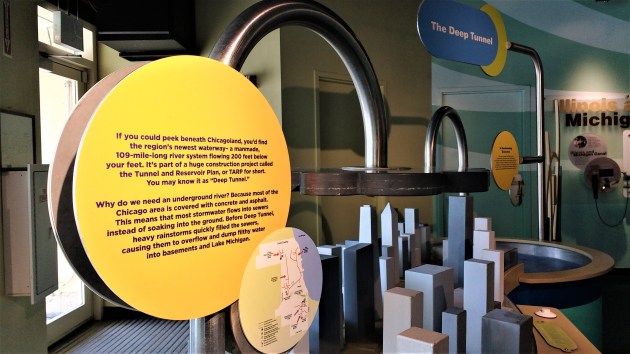
Teaching kids about Chicago’s Deep Tunnel project

Kids should know about one of the largest civil engineering projects in the world: the Deep Tunnel project in and around Chicago.

DeepTunnelNotebaertNatureMuseum

This is from the Riverworks exhibit at the Peggy Notebaert Nature Museum in Chicago. While some of the pieces of the exhibit failed to work the day we visited, I think I could see the purpose of the The Deep Tunnel exhibit: the floodwaters would be diverted away from the city.

The concept may appear simple and explainable to kids but the execution in real life is not. The exhibit suggests the flooding the past is now alleviated by Deep Tunnel. Yet, the problems are likely to go on in a region that continues to expand and change. Remediating water and flooding issues is a very difficult task compared to altering development at the beginning.

It is interesting to think how else this engineering feat could be presented to children. I could imagine a scaled model that kids could walk through to help give them a sense of the size of the sewers needed as well as the size of some of the water reservoirs. Deep Tunnel is not intended for minor amounts of water; this is supposed to help protect millions of people on a fairly regular basis. Communicating the sheer size could fascinate kids. Or, perhaps some sort of computer game where kids play the role of an engineer or expert as they make choices about where to divert water. Come to think of it, where is this version of Simcity or Roller Coaster Tycoon – “Infrastructure Builder” or “Sewer Wars” or something catchier.

Fox Valley Mall “near Naperville” Part 2 – development requirements

A store at Fox Valley Mall prefers to say they are “near Naperville” rather than the actual location in Aurora. How did this shopping center end up across the street from Naperville?

The Urban Investment and Development Corporation (UIDC) started purchasing property for a shopping center in 1966. At this point, Naperville was expanding to the south and southwest at a rapid rate but was nowhere near the size it is today. Similarly, Aurora had an established downtown but there was not a whole lot of development in this area. To help guide its growth, Naperville had developed regulations, particularly in residential subdivisions, to help ensure quality development.

In 1972, UIDC annexed the land they had purchased to Naperville. According to local officials in both communities, the developer chose Aurora in part because of fewer development regulations. Fallout from this choice ensued. Aurora and Naperville signed a boundary agreement to help limit such situations where a developer could play the two communities off of each other. The 1975 Naperville mayoral race included discussion of the loss of the mall. Additionally, the construction of the mall and the loss of status and sales tax money to Aurora helped spur Naperville leaders toward improving the community’s downtown. After the mall opened, Naperville was able to capture some status and money through the opening of stores on the east side of Route 59.

In sum, the developer of the Fox Valley Mall chose to locate in Aurora for some advantages in the early 1970s. Given the path of the two communities since then, I wonder if that developer would choose differently today. On one hand, a Naperville address would convey a certain status. On the other hand, locating just across the street might be the perfect solution: the developers could get benefits from Aurora while always claiming to be “near Naperville.”

Fox Valley Mall “near Naperville” Part 1 – status

I recently heard a radio ad for a store located at Fox Valley Mall which was said to be “near Naperville.” The mall is officially located in Aurora so why would a store there claim to be in the next suburb over? One word: status.

In this particular location, Aurora and Naperville are separated by Illinois Route 59. On the east side, containing a number of stores just across the street from the mall, is Naperville. On the west side, including the mall plus additional stores, is Aurora. Aurora is the bigger community – roughly 200,000 people – but Naperville is the wealthier, higher status community. Some of the figures: Naperville has a median household income of over $110,000 and 4.9% of residents are in poverty. In contrast, Aurora has a median household income of almost $64,000 and 14.0% of residents are in poverty. The communities also differ in race and ethnicity: Aurora is significantly less white (over 30%) and more Latino (35% more) and Black (5% more).

So, when a store says they are “near Naperville,” what are they trying to hint at? They want to associate their store and the shopping experience with a wealthier community rather than Aurora. They want people to think of an upscale and safe place, rather than the diversity of incomes and races/ethnicities of Aurora. Ultimately, they want shoppers to come and spend money like they have Naperville resources.

If it is the case that the store wants to associate with Naperville, why is it located in Aurora? The bigger question: why is the mall in Aurora? To be answered tomorrow.