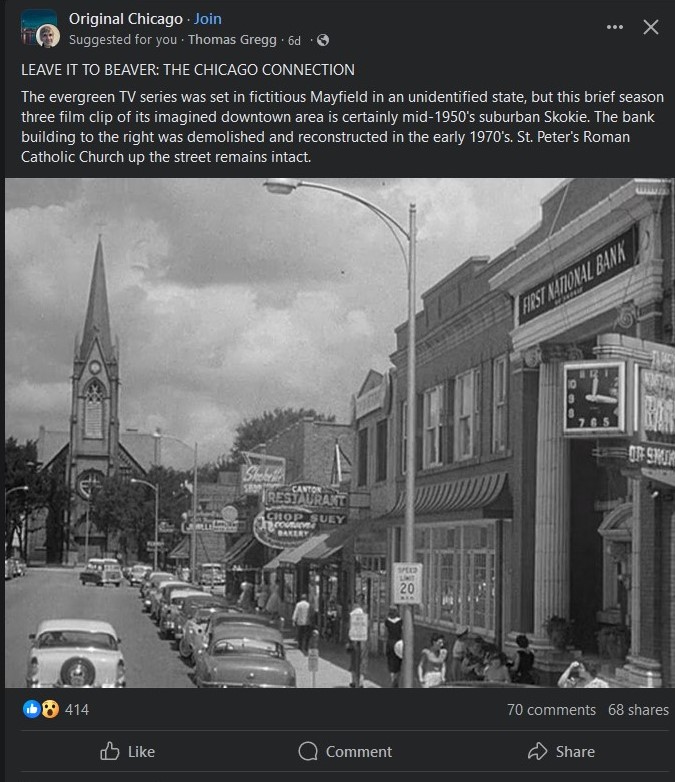
Television shows may use a variety of settings to film scenes. Given my research on suburbs depicted on television, this example struck me as it combines a famous suburban show and a Chicago suburb:
A variety of websites back up this claim (IMDB, blog). The first home in the show, what I describe as having “two stories, a one-car garage, three bedrooms, and at least two bathrooms (Bennett 1996),” was on a Universal Studios backlot. The show is often held up as an exemplar of suburban-set TV shows in the postwar era yet I noted that it “ran six seasons but never cracked the top 30” most popular TV shows.
As a fictitious show set in an unnamed community, it is interesting to consider why Skokie might have been chosen. Was there existing footage that could be used? Did someone connected to the show or studio have a personal connection to Skokie? Did Skokie represent the experiences of American suburbs at this time? Would someone watching the show then or now see this scene and connect to particular places?
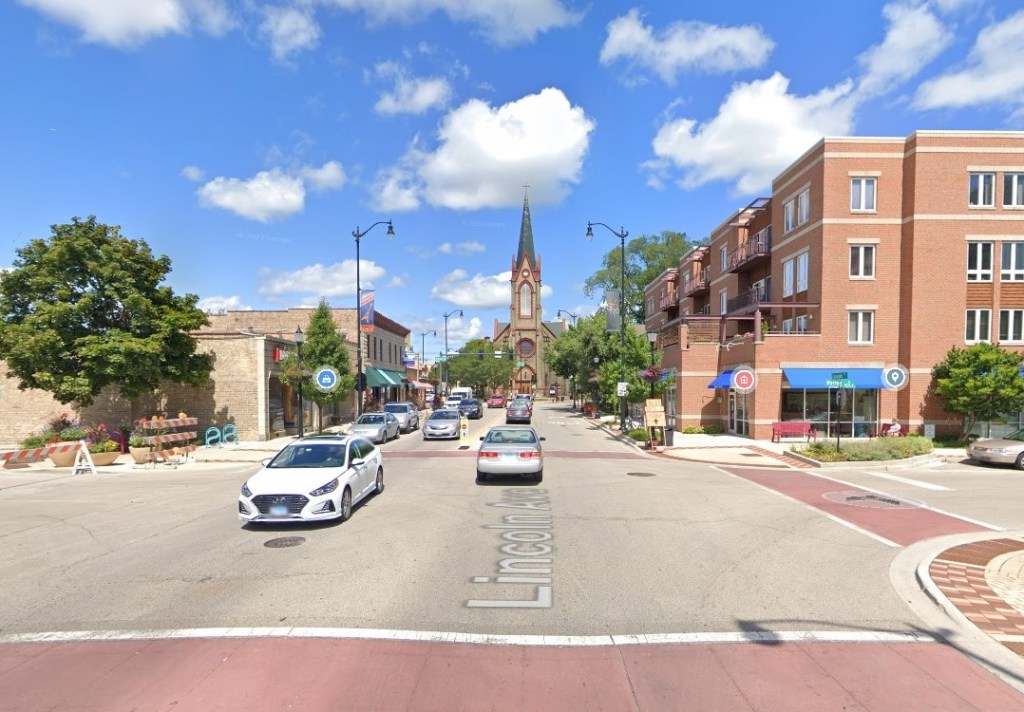
Here is a similar view from Google Street View in August 2019:
The sort of construction on the right – what looks like mixed-use four-story buildings – is common in suburban downtowns where they hope that increased numbers of downtown residents will patronize local businesses and restaurants in addition to those who want to visit such locations. These streetscapes have often replaced one- to two-story structures such as those in the top image.
On this winter day, there were at least a few people walking laps around the mall. Others sat in the empty food court. Security walked around.
The directory was about 5-6 years old. At that point, the mall still had a lot of retailers.
In the background of the image, you can see the Sears sign. Almost all of the anchor stores are long gone. Most storefronts are empty. The movie theater is shuttered.
The decline of this mall did not happen immediately. Combine online shopping, lots of shopping options in the Chicago region, and COVID-19 and you get a nearly empty mall. And it will take years to redevelop the property and incorporate the new elements into the community.
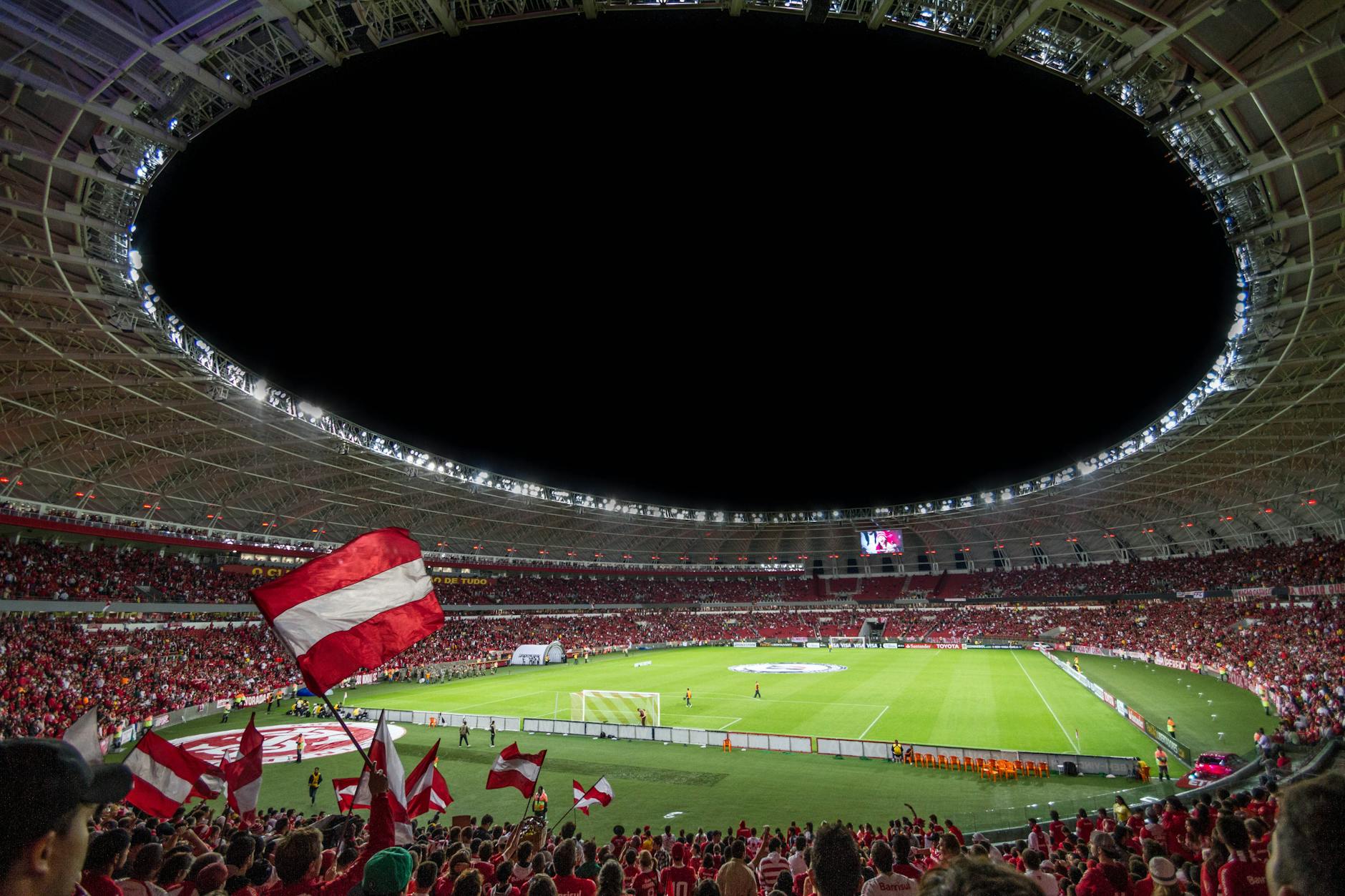
The 2026 World Cup final will be held at MetLife Stadium in East Rutherford, New Jersey, on July 19, world soccer governing body FIFA announced on Sunday…
“It’s going to be a special World Cup,” Berhalter said after the announcement was made. “To have the final in New York, New Jersey is a dream come true for me. Being from that area, and I’m sure for most people from that area, it’s an area with a rich tradition of soccer and producing players.
“To think about when I was little, going to watch the [New York] Cosmos and them selling out Giants Stadium, and now this stadium is going to host a World Cup final. It’s really special.”
MetLife Stadium is home to the New York Giants and Jets who play in suburban New Jersey. The stadium is about 9 miles northwest of Times Square and about 13 miles northwest of Wall Street. When the Super Bowl was played here in early 2014, I assume more TV shots and attention was paid to New York City rather than the New Jersey suburbs.
It might also be worth noting that the 1994 World Cup final, the only one in the United States thus far, also occurred in the suburbs:
In 1994, the United States played two of its group-stage matches at the Rose Bowl in Pasadena, California, and the other at the Silverdome in Detroit. The Rose Bowl also hosted the final that year — with Brazil topping Italy in a penalty shootout — and again in 1999 for the Women’s World Cup, when the United States beat China, also on penalties.
Set in Pasadena, the Rose Bowl is roughly 11 miles northeast of downtown Los Angeles. This region is famously sprawling – and the 2028 Summer Olympics will take advantage of the full region for all of the events.
All the talk of soccer taking off among kids in the American suburbs may find its peak in this experience.
Many previous presidents, especially Republicans, have long used Washington as a metaphor for all that is wrong with America. The city is an easy target in many federal campaigns, from both parties. And for all their efforts to get to the city as president, many commanders in chief often seem desperate to leave whenever they can. Franklin Roosevelt spent long periods at Warm Springs in Georgia, where he’d ease lifelong physical repercussions from polio and at his home at Hyde Park, New York. Lyndon Johnson and George W. Bush were always keen to swap the White House for their Texas ranches.
Trump made little effort to embrace the town, getting out to play golf at his course in Virginia or heading to his properties in Florida and New Jersey. Biden spends most weekends in his beloved Delaware. But Barack Obama bucked the trend, becoming the rare president to set up home in the capital after his tenure ended instead of returning to his previous adopted hometown, Chicago.
Some presidents have tried to treat DC like home while in office. Theodore Roosevelt went rock climbing in Rock Creek Park, and decades later, Ronald Reagan saddled up to burnish his cowboy persona and went horse riding there. Abraham Lincoln used to escape the swampy summers to a cottage in Northwest DC where he’d also visit with wounded Civil War soldiers. And of course, he went to the theater at least once, with tragic results. John Kennedy and Richard Nixon, who served as naval officers, loved to take the presidential yacht, the USS Sequoia, down the Potomac River. The vessel was decommissioned by Jimmy Carter, a former submariner who was perhaps more comfortable beneath the waves…
Presidents have also often ventured out of the White House for refreshment. Ulysses S. Grant, Andrew Johnson, Grover Cleveland, Theodore Roosevelt and Warren Harding are all said to have patronized Old Ebbitt Grill, which is open still just around the corner. During the Clinton and Obama administrations it was not unusual to see the presidential motorcade idling outside some of the city’s top restaurants in Georgetown and downtown. Trump, however, rarely went anywhere to socialize apart from his former hotel on Pennsylvania Avenue, whose bars and restaurants became a hot spot for administration officials and Trump-world figures like Rudy Giuliani and a must-see for MAGA tourists in the capital.
Americans as a whole have concerns about big cities. The country has a majority suburban population and often associates cities with particular opportunities and issues.
And the United States has a unique capital arrangement in that the country’s largest city – New York City, the #1 ranked global city – is not the political center. Originally, the city sat between the northern and southern portions of the first states. It was founded after a number of other cities. It could become a political center even as it embodied characteristics of other American cities.
In looking at the list of facilities in the presidential library system, few are located in the biggest cities in the United States. Some are in smaller big cities while more recent facilities are in big cities. Perhaps presidents as a group have not been urban dwellers – and this should not be too surprising given that the United States has never had a majority of its residents living in the biggest cities.
My guess at how Peoria or a similar city could truly boom is that a major, well-known company moves its operations to the city. While the opposite might seem to be happening in cities like Peoria – such as Caterpillar moving out – imagine a Silicon Valley company making Peoria home. Such a move could be good for its employees and help improve the fortunes of a different area.
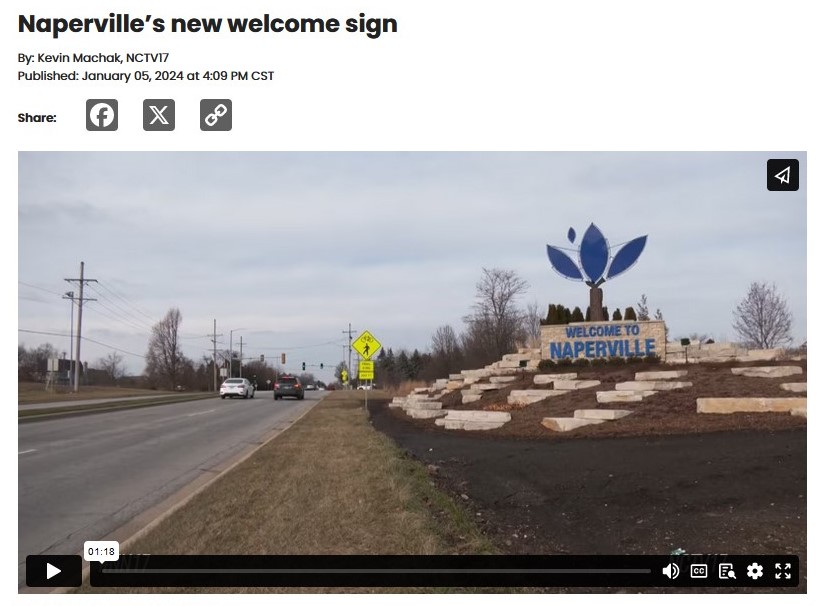
Naperville spent $100,000 for a unique sign welcoming people to the community along its border with Bolingbrook. Amid some concerns from residents about the price, here is information about the sign and the overall budget of the city for 2023. First, the sign:
A freshly-completed “Welcome to Naperville” sign sits along the entry route, just next to the trails among DuPage River Park and just across from DuPage River Sports Complex.
The design stems from the city of Naperville’s official logo of 50 years, which depicts a tree with water running underneath. Surrounding the sign are limestone slabs. The city plans to add fresh vegetation to the area in the spring.
The new greeting, which costs $100,000, is just one of a number of beautification projects that have been planned for since 2021 and officially budget-approved for since the fall of 2022. At that time, the city council approved of $250,000 for the Department of Public Works to make multiple improvements throughout the city…
Keeping the current economic climate, our mission, and strategic priorities in mind, the 2023 City of Naperville budget is recommended at $603.46 million, an overall increase of 11.6% from the $540.58 million 2022 budget. Additional capital expenses are the primary driver behind this increased investment in our organization and community. It is worth noting that the 2023 budget leverages existing revenue streams and fiscal policies. No new taxes, fees, or other revenues are recommended to support the 2023 budget proposal.
From my math, this means the sign cost less than one-tenth of one percent of the city’s budget. Even building one of these on each other side of the city – north, east, west – would not take much money.
Is this an unnecessary expenditure? That is a different question. Signs are not necessarily cheap and they can be bland or strange. For example, see this recent one in Naperville for a new subdivision. This new one welcoming people to the suburb is unique with its 3D form and landscaping. Naperville has a history of spending money for parks and beautification: just look at the Riverwalk over time (and I would guess many would say this was a good investment). Additionally, Naperville is a unique suburb that sees itself as having a particular status.
If the goal is to continue to brand the community in a particular way, this sign stands out and is a small fraction of the budget.
Buffalo, New York is projected to be the hottest housing market of 2024, according to an analysis from real estate company Zillow.
Zillow called affordability the “most powerful force driving real estate,” bringing lower-cost markets in the Great Lakes, Midwest and South regions to the top of the company’s 2024 rankings.
“Housing markets are healthiest where affordable home prices and strong employment are giving young hopefuls a real shot at buying and starting to build equity,” said Anushna Prakash, data scientist for Zillow Economic Research…
According to Zillow’s analysis, Buffalo has the highest number of new jobs per home permitted – a measure of expected demand, as new jobs often mean new residents.
The key seems to be the expected job growth in Buffalo. Yes, there is cheaper housing in the region but a growth in jobs means more people which means more demand for housing. How many people would choose a job in Buffalo because of the cheaper housing instead of going elsewhere where housing would be more expensive?
On the list of the predicted top ten housing markets are 6 regions in the Midwest or Northeast – the Rust Belt. This includes Buffalo, Cincinnati, Columbus, Indianapolis, Providence, and Cleveland. If this prediction comes true, would this help create more momentum in these places for a brighter future?
For example, Buffalo’s population peaked in 1950 with over 580,000 residents. In the 2020 Census, Buffalo had over 278,000 residents. The metropolitan region peaked in population in 1970. Similarly, Cincinnati (#2 on the predicted list) peaked in population in 1950 and has lost nearly 200,000 residents since (even as the metro area has grown slowly since then).
In considering places in the United States, is it better to study a community in-depth and get at its uniqueness? Or, is it better to look for patterns across places, focusing more on what joins types of communities compared to other types?
I have tried in my own work to do some of both when studying places and buildings. Two examples come to mind. In 2013, I published an article titled “Not All Suburbs are the Same: The Role of Character in in Shaping Growth and Development in Three Chicago Suburbs.” I built off in-depth research on three suburbs to compare how internal understandings of character affected how they responded differently to changes in the Chicago region and changes to suburbs more broadly. On one hand, these suburbs that shared important similarities have different character and on the other hand they still fit within the category of suburbs that sets them apart from different kinds of places.
As a second example, take the book Building Faith I co-authored with Robert Brenneman. We provide case studies of particular religious congregations as they navigate constructing and altering buildings as those physical structures shape their worship and community. These case studies among different religious traditions and in different locations highlight unique patterns in these congregations and places. Yet, we also look across places, considering patterns of religious buildings in suburbs, in Guatemala, and a few other places.
In both works, knowing the particulars and examining the broader patterns are helpful. Different researchers might go other routes; why not investigate even further in these particular cases? What else is there in archives, interviews, ethnographic observation, etc. that could reveal even more details? Or, go the other direction: look at patterns in hundreds or thousands of places to find commonalities and differences across more settings.
But, I find that the particularities of a certain place make more sense in light of broader patterns and those broader patterns make more sense knowing some local or micro patterns. Having a sufficient number of cases or a varied enough set of cases to make these links can be tricky. Yet, I enjoy approaching places this way: digging into both the histories of particular communities and seeking broader patterns that hold across communities.
After seeing SNPJ, Pennsylvania on the map and recently reading Radical Suburbs by Amanda Kolson Hurley (recommended), I thought about this question: how many more histories of communities in the United States should we know? SNPJ appears to have a unique background and purpose and Hurley considers multiple suburbs with different visions of what a suburban community could be. But, there are thousands of communities in the United States – are they all unique enough to pay attention to?
One way to consider this is to think about patterns in we might pay attention to some communities and not others. In the United States, population size and growth is often emphasized. Bigger places often receive more attention and their unique histories and features are more known. At the same time, it takes efforts by numerous actors for history to become known and narrated over time. Discrimination, a lack of power, and limited resources mean some histories are not as known.
There is certainly value for people living in a community to know their own local history. I have written about seven steps for knowing your suburb and how to take additional steps. This local knowledge can help longstanding members of a community, new residents, and visitors. It can take some digging to hear multiple voices, see what is told and not told, and think about how a community came to be.
In the next post, I will explain why I see value in both larger categories – such as examining suburbs as distinct places compared to cities and rural areas – and looking at specific histories and characters of communities. In my own work, I found linking these two levels can provide further insights into places and experiences within them.
On drives from the Midwest to locations further east, we often pass a community with an interesting name: SNPJ, Pennsylvania. This is an unusual name. No vowels. An acronym? A misprint? Wikipedia suggests this is an unusual place with just 15 residents:
S.N.P.J. stands for “Slovenska Narodna Podporna Jednota” (Slovene National Benefit Society), a fraternal society and financial co-operative based in North Fayette, Pennsylvania. The society applied to have their 500-acre (200 ha) recreation center in western Pennsylvania designated as a separate municipality in 1977. The S.N.P.J. borough was created so that the society could, among other things, get its own liquor license. North Beaver Township, the municipality in which the center was originally located, restricted the sale of alcohol on Sundays (blue law)…
It is more of a recreation complex than a community, and has 60 rental cabins, 115 mobile home slots, and an artificial lake. It is open to the public as a summertime resort and facility for bingo, weddings, and dances. Members of the society get a discount on the events.
Wikipedia offers few additional details but there is enough here to hint at an interesting history: a fraternal group for a white ethnic group, efforts to bypass liquor laws, providing recreational opportunities, and very few permanent residents.
This leads to the post for tomorrow: how many communities across the United States have unique histories worth knowing? How many communities are like SNPJ and does it matter if there are just a few or a lot?