Residential segregation – by political party

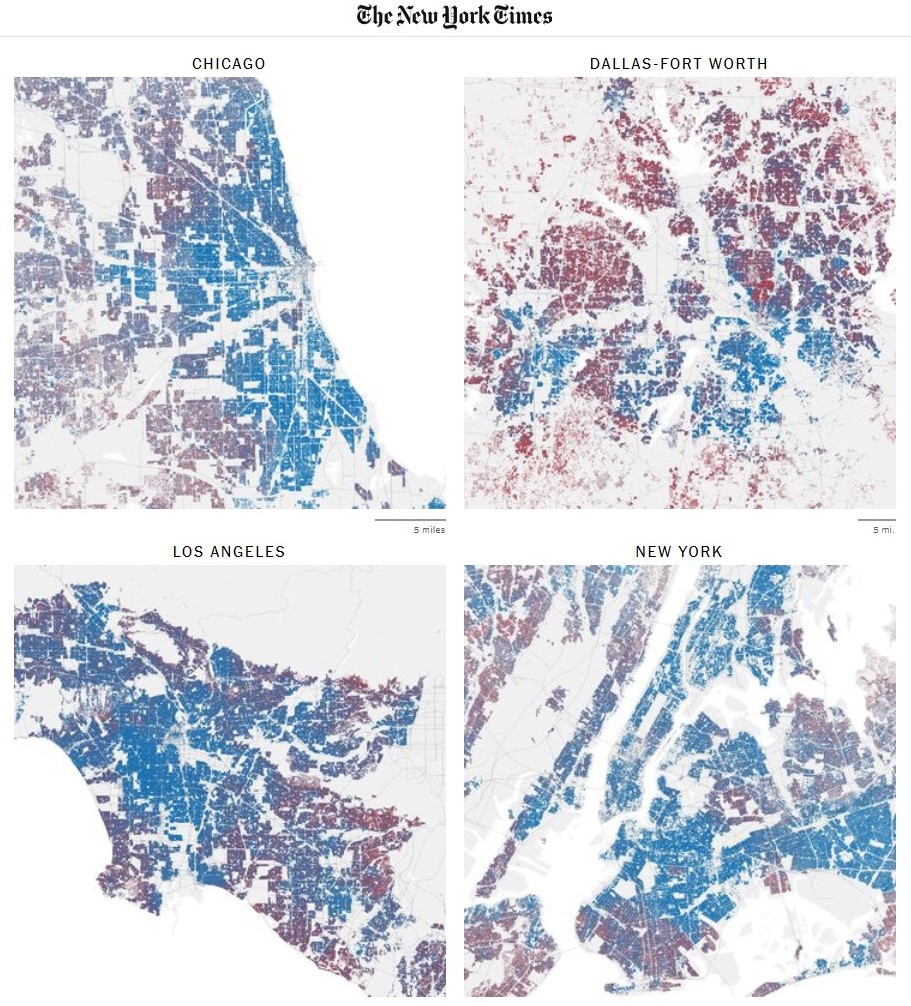
Residential segregation by race is a large issue and voting patterns in recent elections generally show Democrats winning in cities and close suburbs and Republicans winning in outer suburbs and rural areas. Put these two ideas together and you have residential segregation by political party.

https://www.nytimes.com/interactive/2021/03/17/upshot/partisan-segregation-maps.html

As new research has found, it’s not just that many voters live in neighborhoods with few members of the opposite party; it’s that nearly all American voters live in communities where they are less likely to encounter people with opposing politics than we’d expect. That means, for example, that in a neighborhood where Democrats make up 60 percent of the voters, only 50 percent of a Republican’s nearest neighbors might be Democrats.

Democrats and Republicans are effectively segregated from each other, to varying degrees by place, according to the Harvard researchers Jacob Brown and Ryan Enos. And at least over the past decade, they believe this partisan segregation has been growing more pronounced…

For each individual voter, tied to an address, the researchers looked at their thousand nearest voters, weighting those next door more heavily than those a mile away. Drawn this way, about 25 million voters — urban Democrats especially — live in residential circles where at most only one in 10 encounters is likely to be with someone from the opposite party. Democrats in parts of Columbus, Ohio, and Oklahoma City live this way. So do Republicans in the reddest parts of Birmingham, Ala., and Gillette, Wyo…

These studies together suggest that as places become more politically homogeneous, people there are more likely to conform and to publicly signal their partisanship. Maybe no one says, “I want to move here because of all these Biden yard signs.” But perhaps one neighbor is swayed by the people who put them up, and another neighbor concludes, “This isn’t the place for me.”

Lots of confounding variables to examine across a lot of locales. But, the underlying patterns are fascinating to consider: do geographic communities, even in an era of reduced neighborly contact and participation in local institutions, influence people’s political belief and behavior? With more focus in recent years on how online and social media behavior influences politics, this connection to geography has the opportunity to reinvigorate conversation about the power of local communities.

I would be interested to see how this plays out among local governments of communities with similar traits. Take a suburb closer to a big city that leans Democrat and a suburb further out that leans Republicans. Are the local decisions made that different? Do local elections look different?

Or, how often are there tipping points across communities and neighborhoods where a majority of voters are of one party or another? The patterns now show some stability but these have changed in the past and could change again in the future. What happens when they do change and does the character of the community change?

Abolish townships or worry about turning them blue (or keeping them red)?

Illinois has many taxing bodies and government units. Illinois moved to stop creating new government bodies and DuPage County resolved several years ago to work to reduce the number of government bodies. Townships are a common target; they exist above municipal governments and below counties so are they necessary?

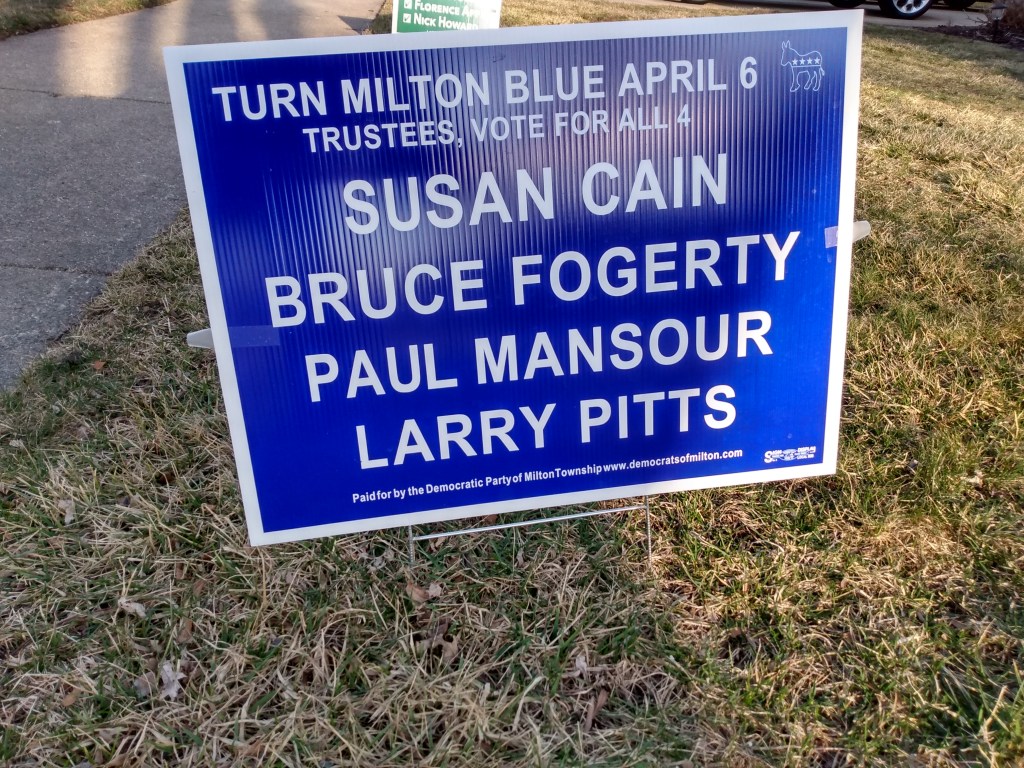
I thought of this recently with the lead-up to the upcoming local elections. On one side, I have seen signs urging voters to “Turn Milton Blue.”

This might be a strategy to boost local turnout and connect to broader political patterns. But, I do not know what these candidates want to do at the township level. What significant changes are needed?

On the other hand, I have seen campaign material for Republican candidates for Milton Township. This material listed all the things that the township does, presumably because of the Republicans there. For a party that at least talks sometimes about limited government, should they argue townships are unnecessary rather than fighting for political seats?

More broadly, how much do these township races benefit the people and communities of Illinois? In a time of budget deficits before COVID-19 plus further issues because of COVID-19, is it more important that one party or another holds the majority of seats in townships?

Functional religion in the form of American politics

I have seen some version of this argument several times recently. Here it is in The Atlantic: Americans have replaced religion and its associated features with politics.

Photo by Luis Quintero on Pexels.com

But if secularists hoped that declining religiosity would make for more rational politics, drained of faith’s inflaming passions, they are likely disappointed. As Christianity’s hold, in particular, has weakened, ideological intensity and fragmentation have risen. American faith, it turns out, is as fervent as ever; it’s just that what was once religious belief has now been channeled into political belief. Political debates over what America is supposed to mean have taken on the character of theological disputations. This is what religion without religion looks like.

Not so long ago, I could comfort American audiences with a contrast: Whereas in the Middle East, politics is war by other means—and sometimes is literal war—politics in America was less existentially fraught. During the Arab Spring, in countries like Egypt and Tunisia, debates weren’t about health care or taxes—they were, with sometimes frightening intensity, about foundational questions: What does it mean to be a nation? What is the purpose of the state? What is the role of religion in public life? American politics in the Obama years had its moments of ferment—the Tea Party and tan suits—but was still relatively boring.

We didn’t realize how lucky we were. Since the end of the Obama era, debates over what it means to be American have become suffused with a fervor that would be unimaginable in debates over, say, Belgian-ness or the “meaning” of Sweden. It’s rare to hear someone accused of being un-Swedish or un-British—but un-American is a common slur, slung by both left and right against the other. Being called un-American is like being called “un-Christian” or “un-Islamic,” a charge akin to heresy.

This is because America itself is “almost a religion,” as the Catholic philosopher Michael Novak once put it, particularly for immigrants who come to their new identity with the zeal of the converted. The American civic religion has its own founding myth, its prophets and processions, as well as its scripture—the Declaration of Independence, the Constitution, and The Federalist Papers. In his famous “I Have a Dream” speech, Martin Luther King Jr. wished that “one day this nation will rise up and live out the true meaning of its creed.” The very idea that a nation might have a creed—a word associated primarily with religion—illustrates the uniqueness of American identity as well as its predicament.

The particular form of religious activity and civil religion in the United States is unique. But, more broadly, this discussion gets at what religion is. Is it about belief in a transcendent being or a supernatural realm? Or, is it more about what religion does in terms of particular practices?

Such discussions remind me of the work of sociologist Emile Durkheim. In his work, religion serves a cohesive function in society. Here is an earlier post about how functional religion could explain devotion to Apple:

The argument is one that can be applied to many things that take on the functions of religion such as providing meaning (Apple vs. other corporations, beauty vs. functionality), participating in common rituals (buying new products), and uniting people around common symbols (talking with other Mac users).

Politics can do some of these same things. Politics provides meaning in particular beliefs, policy positions, activities, and group identities. Politics has its own set of common rituals and ceremonies, which could even extend to today’s patterns of reacting to political news via Twitter and other forms of social media. There are common symbols ranging from particular visual images to personas to slogans. Political camps can have their own sacred narratives about how the world works.

Durkheim also had ideas about religion giving way to other forms of cohesion. For example, an expanding division of labor would increase interdependence on each other. Science could help address particular issues that used to be addressed by religion. Is politics – particularly in the form right now in the United States that is marked by polarization – an advancement and a move away from religion?

Will turnout increase for upcoming local elections?

Election season is near in our area. Local elections often have really low turnoutsuburban municipal officials can be elected by just a small fraction of the population. But, perhaps this year will be different for a few reasons:

Photo by Element5 Digital on Pexels.com
  1. Local battles over COVID-19. With disagreement with and mistrust of national responses, local elections offer an opportunity to weight in on local responses. In particular, decisions about school reopenings are hot issues in elections for school boards. Add in debates about local businesses and eateries and voters might want to weigh in.
  2. Carryover from national elections and political polarization. Traditionally, local elections are non-partisan. Yet, the rancor at the higher levels could carry over. For example, I saw a large sign today looking to turn township positions blue. How much local officials might actually be able to do in regards to these debates is likely limited but it could help some voters and officials feel better.
  3. The activism of Black Lives Matter in suburbs plus responses to it could send more voters to the polls. How should communities address inequalities or disparities?
  4. Concern about municipal budgets. COVID-19 has created new problems and a number of communities already faced issues. How should money be spent and what could be done to bring in more revenue? The competition might just be heating up among suburbs to find government and tax revenues.

In other words, these are not typical local elections during good times. The local election turnout malaise might not be there. Since suburbanites tend to like local government, will they turn out this time when there are multiple pressing issues?

The Limbaugh soundtrack to suburban life

For decades, the suburbs were said to be more politically conservative. One writer describes hearing Rush Limbaugh in his suburban childhood:

Photo by rikka ameboshi on Pexels.com

As a kid growing up in Sacramento, I had a few friends I liked, but dreaded going to their houses to play. I suggested riding bikes, playing tag or hide and seek — anything to avoid their homes. I avoided their houses because their families usually had the radio tuned to KFBK, listening to a guy who was always furious about nothing, as though he was pleasant background noise — elevator music for single family, one story homes in the suburbs.

To my young ears, there was an uncanny vibe about his voice. He sounded like Santa Claus if Santa swallowed another Santa whole, but that Santa got stuck in his throat. Boots, beard, and furry coat, all jammed against his larynx as he croaked on and on, complaining about “illegal” elf workers wanting fair pay, health care and for him to stop grabbing their tiny butts.

My friends’ “nice” families had him on, all the time, stinking up their homes with hate the way others baked to make homes smell like cookies.

I wondered what that did to us, constantly breathing in his vitriol — for non-white people, for women, for gay people, especially if they were richer, smarter or more powerful than him. I wondered what he’d think of me, what they all think me — a Black kid with a working mom and absent dad — skin so light it sometimes camouflaged me from their sight.

The main contrast here is between the “nice” suburban families and the constant sounds of Rush Limbaugh. On the whole, the suburbs are often pitched as idyllic: single-family homes for families, middle-class people who have made it, green lawns and a quieter life compared to cities. The suburbs are supposed to be the retreat from the difficulties of the world.

Yet, from the beginning, whether the suburbs have delivered on these claims is debatable. Who could make it to these locations? How idyllic was it really or was it perceived to always be under threat? Did the gloss of suburbia cover up darker truths involving race, class, gender, broken families, and more?

It would be interesting to back and see if there is evidence of suburban talk radio listening patterns. Or, to mirror current political patterns, was Limbaugh more popular in exurbs and the outer suburbs and his listernship dwindled closer to the big city?

Political pollsters sitting out the holidays in Georgia

The Senate run-offs in Georgia are attracting a lot of attention but pollsters are largely not participating:

Photo by Nate Hovee on Pexels.com

After a disastrous November election for the polling industry, when the polls again underestimated President Donald Trump (who lost regardless) as well as GOP candidates down the ballot, pollsters are mostly sidelined in the run-up to the Jan. 5 Georgia elections, which most observers regard as toss-ups.

The public polls that drove so much of the news coverage ahead of November — and generated tremendous distrust afterward — have all but disappeared in Georgia, and they are set to stay that way:Some of the most prolific, best-regarded media and academic pollsters told POLITICO they have no plans to conduct pre-election surveys in Georgia…

Part of the reason public pollsters are staying away from Georgia is the awkward timing of the races. With the elections being held on Jan. 5, the final two weeks of the race are coinciding with the Christmas and New Year’s holidays — typically a time when pollsters refrain from calling Americans on the phone. The voters who would answer a telephone poll or participate in an internet survey over the holidays might be meaningfully different from those who wouldn’t, which would skew the results.

Most major public pollsters are choosing not to field surveys over that time period, but the four campaigns don’t have a choice in the matter. The closing stretch of the races represents their final chances to shift resources or make changes to the television and digital advertising — decisions that will be made using multiple data streams, including polling.

Trying to reach members of the public via telephone or text or web is already hard enough. Response rates have been dropping for years. New devices have new norms. Figuring out who will actually vote is not easy.

Imagine trying to get a good sample during the holidays. On one hand, more people are likely not working and at home. On the other hand, this is time for family, getting away from the daily grind, relaxing. How many people will want to respond to talk about politics? Add in the post-national election letdown, COVID-19 worries, and this could be an extra challenging task during December 2020.

I know answering the door is not in vogue, even before COVID-19, but I wonder how well a door-to-door strategy for polling in Georgia might work. Such an approach would require more work but the races are limited to Georgia. Given that people are likely to be at home, this could reach some people.

Combating abysmally low response rates for political polling

One pollster describes the difficulty today in reaching potential voters:

Photo by Breakingpic on Pexels.com

As the years drifted by, it took more and more voters per cluster for us to get a single voter to agree to an interview. Between 1984 and 1989, when caller ID was rolled out, more voters began to ignore our calls. The advent of answering machines and then voicemail further reduced responses. Voters screen their calls more aggressively, so cooperation with pollsters has steadily declined year-by-year. Whereas once I could extract one complete interview from five voters, it can now take calls to as many as 100 voters to complete a single interview, even more in some segments of the electorate…

I offer my own experience from Florida in the 2020 election to illustrate the problem. I conducted tracking polls in the weeks leading up to the presidential election. To complete 1,510 interviews over several weeks, we had to call 136,688 voters. In hard-to-interview Florida, only 1 in 90-odd voters would speak with our interviewers. Most calls to voters went unanswered or rolled over to answering machines or voicemail, never to be interviewed despite multiple attempts.

The final wave of polling, conducted Oct. 25-27 to complete 500 interviews, was the worst for cooperation. We could finish interviews with only four-tenths of one percent from our pool of potential respondents. As a result, this supposed “random sample survey” seemingly yielded, as did most all Florida polls, lower support for President Trump than he earned on Election Day.

After the election, I noted wide variations in completion rates across different categories of voters, but nearly all were still too low for any actual randomness to be assumed or implied.

This is a basic Research Methods class issue: if you cannot collect a good sample, you are going to have a hard time reflecting reality for the population.

Here is the part I understand less. This is not a new issue. As noted above, response rates have been falling for decades. Part of it is new technology. Some of it involves new behavior, such as ignoring phone calls or distrust of political polling. The amount of polling and data collection that takes place now can lead to survey fatigue.

But, it is interesting that the techniques used to collect this data are roughly the same. Of course, it has moved from land lines to cell phones and perhaps even texting or recruited online pools of potential voters. The technology has changed some but the idea is similar in trying to reach out to a broad set of people and hope a representative enough sample responds.

Perhaps it is time for new techniques. The old ones have some advantages including the ability to relatively quickly reach a large number of people and researchers and consultants are used to these techniques. And I do not have the answers for what might work better. Researchers embedded in different communities who could collect data over time? Finding public spaces frequented by diverse populations and approaching people there? Working more closely with bellwhether or representative places or populations to track what is going on there?

Even with these low response rates, polling can still tell us something. It is not as bad as picking randomly or flipping a coin. Yet, it is not accurate enough in recent years. If researchers want to collect valid and reliable polling data in the future, new approaches may be in order.

From Brookings: Biden wins through suburban voters

William Frey looks at presidential voting by geography and concludes that suburban voters gave Biden his victory:

In the 2016 election, rural and nonmetropolitan America gave Donald Trump enough of a margin to beat Hillary Clinton in seven key states. Ahead of the 2020 election, Republicans worried that Trump would lose his rural edge, in light of reduced support there in the 2018 midterm elections. But this was not the case. Instead, Trump’s loss to Joe Biden was due mostly to voters in large metropolitan suburbs, especially in important battleground states…

However, large suburban areas in 2020 registered a net Democratic advantage for the first time since Barack Obama’s victory in 2008. This is significant because more voters reside there than in the other three categories. In terms of aggregate votes in these large suburban counties, there was a shift from a 1.2 million vote advantage for Trump in 2016 to (at last count) a 613,000 vote advantage for Biden—a nearly 2 million vote flip. In addition, Biden benefitted from more modest Republican margins in small metropolitan areas. These advantages for the President-elect were even greater in key battleground states…

The three northern battleground states of Michigan, Pennsylvania, and Wisconsin—which flipped to Trump in 2016—again entered the Democratic fold in 2020. Here, even more than in the national analysis, the 2016 to 2020 suburban shifts to either greater Democratic or smaller Republican support were instrumental in Biden’s victory…

Suburban voting patterns also made a difference in the Sun Belt, especially in large southern states where suburbanization has been rampant. The focus here is on two such states: Georgia, where Biden is ahead and a recount has been announced; and Texas, which Trump won, but where urban and suburban voting patterns closed the longtime Republican-Democratic gap.

This is the most detailed analysis I have seen thus far. The predictions were right: the 2020 presidential election depended on the suburbs!

It also brings several other features of American and political life into relief:

  1. Joe Biden was nominated in part because of his electability. In the long run, his electability in one particular kind of place was particularly important: suburbs. Trump, to some degree, knew this but his approach was more combative and did not have the appeal he hoped.
  2. While political analysis suggests middle suburbs are battleground areas, I wonder if this signals that these suburbs are also in the middle of all sorts of other trends including demographic changes, cultural tastes, and suburban inequality. To build on earlier posts, perhaps finding middle America right now involves going to a Walmart in a middle suburb or an emergency room in a middle suburb.
  3. Many people have discussed the electoral college in recent years. Here is a crazier proposal based on more recent trends: instead of the electoral college by states, how about an electoral college by cities, suburbs, and rural areas? With concerns on either side that cities or rural areas are controlling political outcomes, could there be some way to weight the results such that all three geographies could influence the outcome? Grouping votes by states obliterates any distinctions between places.

Changing political party control at the county level: DuPage County in 2020, the 1930s, and 1856

Voters in DuPage County appear to have supported Democrats more than Republicans at every level in the 2020 election:

Photo by Kelly Lacy on Pexels.com

DuPage County, once known as one of the most solidly Republican areas in the country, appears to have given Democrats control of the County Board for the first time since the 1930s. Two more Democrats are leading their races for countywide office, and could be joined by another when the final votes are tallied.

DuPage voters also backed Democrats in every federal race from president to U.S. representative, as well as every state senator and nine of 13 state representatives.

It’s a stunning turn of fortune two decades in the making, observers say, the result of shifting demographics, shrewd campaigning and the divisive reign of President Donald Trump.

The article above tells of recent changes in DuPage County with new residents and a desire for a new party in charge.

But, as the article also notes, this is not the first time such a shift has happened in DuPage County. I do not know much about what happened in the 1930s – I assume the Great Depression and the New Deal were involved – but I have read more about what happened in the 1850s.

In the early decades of DuPage County, which was officially founded in 1839, local political leaders were Democrats. For example, Joseph Naper, founder of Naperville, served in several political positions as a Democrat. Local historian Leone Schmidt details this state of affairs in her 1989 book When the Democrats Ruled DuPage.

This Democrat hold on DuPage politics lasted about two decades. Schmidt concludes her book with the changes that came with the first Republican party candidates in the 1856 elections.

Historian Stephen J. Buck further describes the shift in a 2019 article in the Journal of the Illinois State Historical Society:

In “Free Soil, Free Labor, and Free Men: The Origins of the Republican Party in DuPage County, Illinois,” Stephen Buck synthesizes many of the widely accepted explanations for the Republican Party’s emergence in the 1850s, including the powerful ideal of free-soil in the trans-Mississippi West; opposition to the political clout of the “Slave Power” nationally; and genuine moral commitments to the abolition of Slavery. DuPage County, in Buck’s retelling, serves as a sort of case study in the steady growth of free-soil principles in northern Illinois beginning in the 1840s. Buck finds that by the time of the Lincoln-Douglas debates in 1858, the sectional crisis was so encompassing that it deeply inscribed party identification, even in elections to town and county offices.

This work builds on Buck’s 1992 dissertation where he goes into detail regarding the changes. The issue of slavery and free soil was important in DuPage County and when the Republican Party started in 1854, it quickly attracted support in northern Illinois. In the 1856 elections, Republicans convincingly beat Democrats in local races. And this trend continued in subsequent elections.

Comparing the current shift toward the Democrat party in DuPage County to past shifts, this one seems to be longer in the making. It takes time for suburban populations to change dramatically as different communities attract different residents and national and state politics and forces interact with local conditions. Yet, DuPage residents of the future may well look to the elections of 2016 and 2020 where DuPage turned to the hands of Democrats.

Suburban shift: 49-45 for Trump in 2016, 51-48 in 2020 for Biden

In 2020, the tight suburban vote swung opposite of 2016 and slightly in favor of Joe Biden:

Photo by Element5 Digital on Pexels.com

While there was much attention paid to late-counted mail ballots in urban areas that put Biden over the top in states such as Michigan, Pennsylvania and Wisconsin, the bigger shift was in the suburbs. In fact, there’s evidence that Trump actually improved his lot slightly in urban areas, which made the suburbs crucial for Biden.

In 2016 exit polls, Trump won the suburbs by four points, 49 to 45. This time, Biden won them 51 to 48 — a seven-point shift in the margin. Biden also joins Obama as the only Democratic presidential candidate to carry the suburbs since 1992, if the exit polls don’t shift from now. The New York Times has a great visualization of the shift from 2016.

Democrats’ suburban edge was also slightly bigger than in the 2018 election in which they won the House, when those areas split about evenly. And given that the suburbs account for about half the votes these days — and growing — Democrats will want to keep that going.

The only problem for them — and it’s a big split between the presidential race and down-ballot — was that this performance didn’t stretch to the conservative-leaning suburban seats Democrats were hoping to take from Republicans. So Democrats need to ask themselves whether this is really about the new reality or whether it was just about Trump, who underperformed his party in many ways, but particularly in these areas.

Two takeaways from these four paragraphs:

  1. The suburbs will continue to be a battleground in presidential, congressional, state, and local races.
  2. There appears to be a shift in 2020 compared to 2016 but this was a relatively minor shift. What happens in subsequent elections will help indicate whether a suburban shift is longer-lasting.

In other words, expect more of the same in 2022 and 2024 with campaigns and pundits focused on suburban locations in the swing states of the 2016 and 2020 elections as well as some other possible locations (like Texas). And county level analysis will be helpful but more fine-grained study will reveal where some of the important divides or pockets of different voters are in sprawling geographic areas.