Patterns in political yard signs

A new book by three political scientists look at how Americans have deployed and reacted to yard signs in recent election cycles:

We just started being puzzled about it. We did things like code the amount of traffic on a given street, and we thought maybe people on a street with high traffic would be more likely to put up signs. But you find out that those people wanted to let other people know where they stand- that it wasn’t just about catching the eye of passing traffic [to try to get out the vote for a candidate]. We found out that there’s a combination of expressive and communicative motives…

One of the things that was really clear from our studies is that signs are really important to people who display them. They’re emotionally invested in these dynamics and are more likely than people who don’t put up signs to say that it’s a good thing, or a reasonable thing, for neighborhoods to be doing.

I also think this is why we hear about these stories of theft and vandalism-people going to extremes around signs. At least seemingly, in news reports, it can accelerate fast, from people putting up signs to some kind of an altercation, a police report, a fight on the street. I think it’s because people view it as a real affront when someone messes with their expression of self…

You really notice, when you’re walking around, those places where signs are battling one another. But when we did spatial analysis to look at the clustering of signs systematically, in a way that would cut through those strong anecdotal impressions, we found that, really, there wasn’t much evidence of the intermingling of signs-the famous Sign Wars, where there’s a Biden sign at one house and a Trump sign next to it. Really, it was more about like-minded clustering: pockets of Biden supporters signaling to one another, pockets of Trump supporters signaling to one another. More solidarity than outright conflict.

I appreciate the systematic approach for a phenomenon that lends itself to anecdotes. This is how social science can be really helpful: many people have experiences with or have seen yard signs but unless researchers approach the issue in a rigorous way, it is hard to know what exactly is going on.

For example, I regularly walk in two different places in my suburb and I have been keeping an eye on yard signs. At least in the areas I walk, the signs are primarily in favor of one party in the national election while local election signs are more varied. Furthermore, the number of people who have signs is still pretty limited even in a heated political climate. But, just based on my walks, I do not know if what I am seeing match my suburb as a whole let alone communities across the United States. And unless I interact in some way with the people with (and without) yard signs, I have little idea of what is motivating them.

I wonder how the behavior of putting out political yard signs relates to other political behavior. If a political yard sign is expressive, how much does this carry over to other parts of life? Are these the people who are most active in local political activity? Are they the most partisan? Are they the ones always bringing up politics at family gatherings or among friends?

I would also be curious to how this relates to social class and particular neighborhoods. Lawns, in some places, are sacred: they should be green, free of weeds and leaves. Property values are important in many places. Political signs might mess up particular aesthetics or introduce the idea of conflict when suburbanites just want to leave each other alone.

Population density as a factor in deciding suburban votes

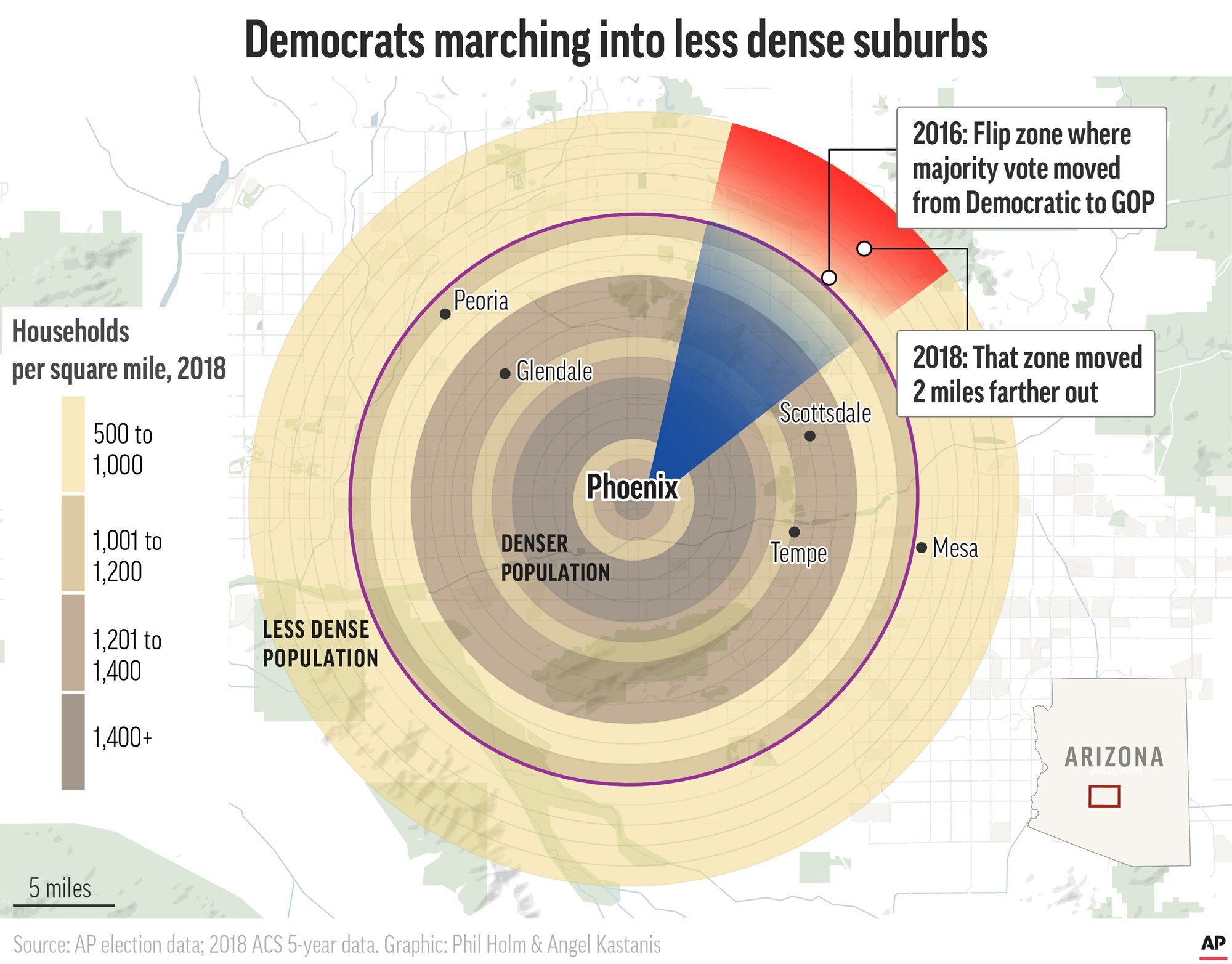
An AP story highlights how “Democrats march deeper into suburbia” and discusses the role of density:

https://apnews.com/article/election-2020-virus-outbreak-phoenix-suburbs-health-care-reform-76dea954e5f5dc13b3ad65fd29ac678c

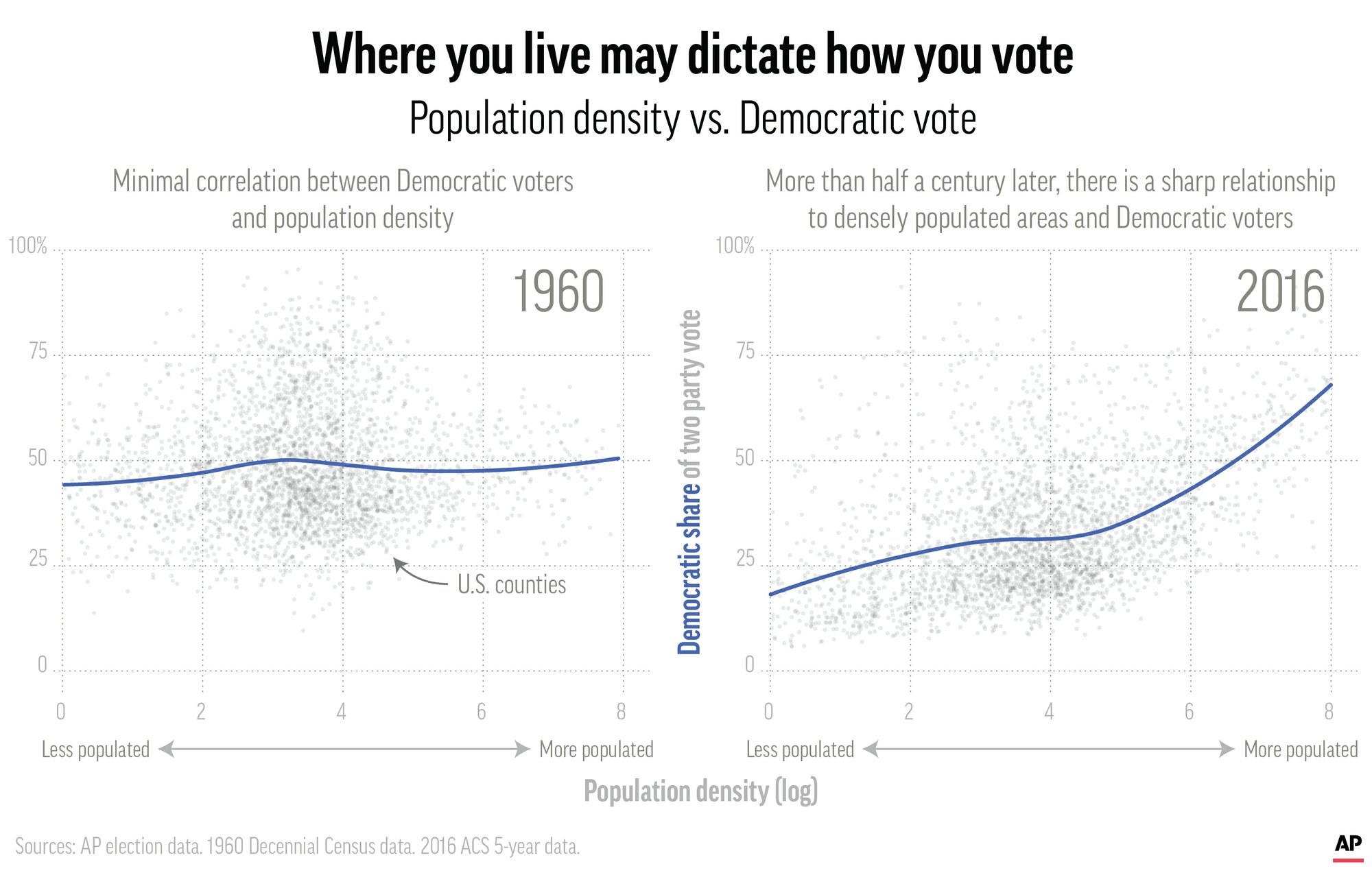
For decades, an area’s population per square mile has been a reliable indicator of its political tilt. Denser areas vote Democratic, less dense areas vote Republican. The correlation between density and voting has been getting stronger, as people began to sort themselves by ethnicity, education, personality, income and lifestyle.

The pattern is so reliable it can quantified, averaged and applied to most American cities. At around 800 households per square mile, the blue of Democratic areas starts to bleed into red Republican neighborhoods.

A purple ring — call it the flip zone — emerges through the suburbs…

In Dallas, the purple ring through the suburbs was 18.7 miles in 2016 out from city hall, at an average of 714 households per square mile. The border runs close to AT&T Stadium in Arlington, where the Dallas Cowboys play. Arlington is a so-called boomburb that morphed through new construction from a suburb to a city of 400,000.

A few thoughts on the potential role of density. First, an additional graphic (see below) works with the last paragraph cited above to draw concentric circles a city. This, however, suggests density is linear as one moves further out from the city. In general, this may be true but it would be interesting to see how pockets of higher density suburbs at different distances from the city affect these patterns.

https://apnews.com/article/election-2020-virus-outbreak-phoenix-suburbs-health-care-reform-76dea954e5f5dc13b3ad65fd29ac678c

Second, Is it density that predicts these outcomes or factors related to density? A third chart in the story looks at the population demographics at different densities and shows differences. Does the density come first or the population changes? The analysis here suggests a relationship or correlation but it is not clear whether this analysis accounts for other possible factors.

In the larger picture, what do Americans think about having these “flip zones” or middle suburbs be the current political battleground? For example, one current argument about getting rid of the electoral college suggests certain parts of the country should not a disproportionate sway over other more populous parts of the country. Right now, these middle suburbanites, particularly in swing states, have the influence and both parties want their votes. Are the interests of these suburban voters the interests of the entire country?

Trying to use statistics in a post-evidence political world

Ahead of the presidential debate last night, my Statistics class came up with a short list of guidelines for making sense of the statistics that were sure to be deployed in the discussion. Here is my memory of those strategies:

Photo by Pixabay on Pexels.com
  1. What is the source of the data?
  2. How was the statistic obtained (sample, questions asked, etc.)?
  3. Is the number unreasonable or too good/too bad to be true?
  4. How is the statistic utilized in an argument or what are the implications of the statistic?

These are good general tips for approaching any statistic utilized in the public realm. Asking good questions about data helps us move beyond accepting all numbers because they are numbers or rejecting all numbers because they can be manipulated. Some statistics are better than others and some are deployed more effectively than others.

But, after watching the debate, I wonder if these strategies make much sense in our particular political situation. Numbers were indeed used by both candidates. This suggests they still have some value. But, it would be easy for a viewer to leave thinking that statistics are not trustworthy. If every number can be debated – methods, actual figures, implications – depending on political view or if every number can be answered with another number that may or may not be related, what numbers can be trusted? President Trump throws out unverified numbers, challenges other numbers, and looks for numbers that boost him.

When Stephen Colbert coined the term “truthiness” in 2005, he hinted at this attitude toward statistics:

Truthiness is tearing apart our country, and I don’t mean the argument over who came up with the word …

It used to be, everyone was entitled to their own opinion, but not their own facts. But that’s not the case anymore. Facts matter not at all. Perception is everything. It’s certainty. People love the President [George W. Bush] because he’s certain of his choices as a leader, even if the facts that back him up don’t seem to exist. It’s the fact that he’s certain that is very appealing to a certain section of the country. I really feel a dichotomy in the American populace. What is important? What you want to be true, or what is true? …

Truthiness is ‘What I say is right, and [nothing] anyone else says could possibly be true.’ It’s not only that I feel it to be true, but that I feel it to be true. There’s not only an emotional quality, but there’s a selfish quality.

Combine numbers with ideology and what statistics mean can change dramatically.

This does not necessarily mean a debate based solely on numbers would lead to clearer answers. I recall some debate exchanges in previous years where candidates argued they each had studies to back up their side. In that instance, what is a viewer to decide (probably not having read any of the studies)? Or, if science is politicized, where do numbers fit? Or, there might be instances where a good portion of the electorate thinks statistics based arguments are not appropriate compared to other lines of reasoning. And the issue may not be that people or candidates are innumerate; indeed, they may know numbers all too well and seek to exploit how they are used.

Looking at which way Midwest suburban swing-state voters are leaning

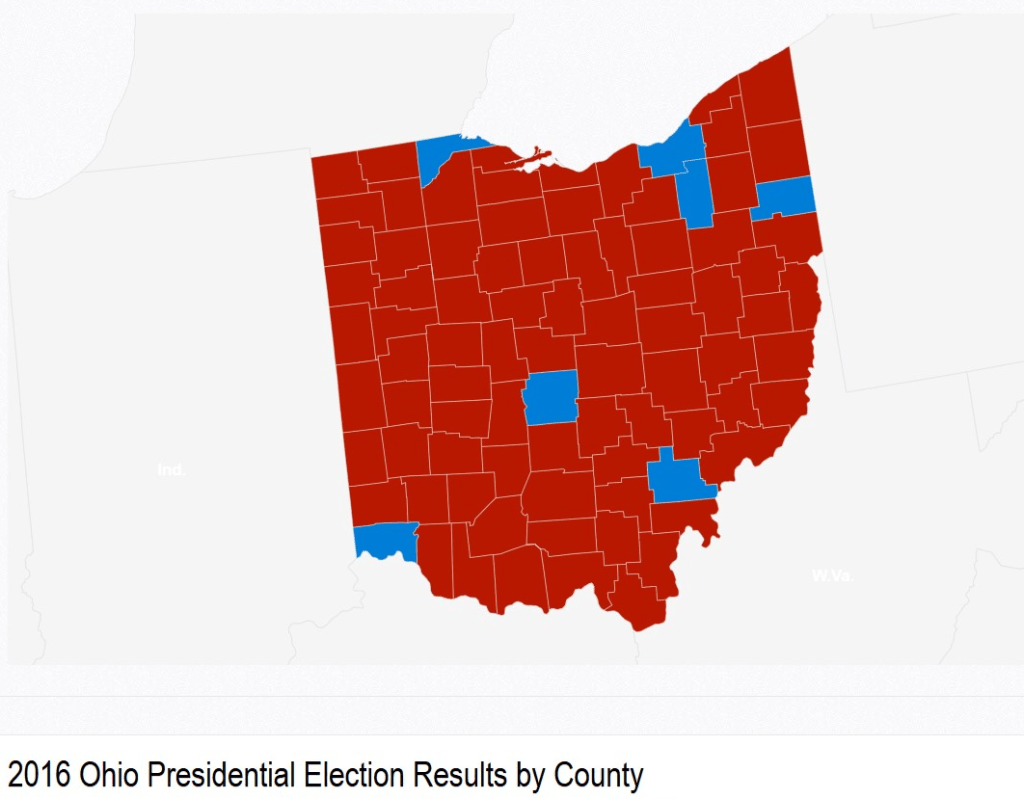
Here is an update on the landscape of suburban voters in Midwest swing states ahead of the 2020 presidential election:

https://www.politico.com/2016-election/results/map/president/ohio/

Trump’s chances for a second term rest heavily on being able to maintain the margins he won by in 2016, particularly in suburban areas. He plans to campaign outside Toledo on Monday, as liberal Supreme Court Justice Ruth Bader Ginsburg’s death stokes questions of whether the sudden court vacancy would energize more suburban voters who support abortion rights or social conservatives in small-town and rural areas who oppose them.

Republican lawmakers and strategists in Ohio say they are seeing research that shows a near-uniform drop in support from his 2016 totals across every suburban region of the state…

There is less debate in other states. Pennsylvania Republicans say across the longtime GOP stronghold of Chester County west of Philadelphia, for instance, Trump has slipped as far as he has in Ohio’s suburbs, though in more populous towns and in a state he carried by fewer than 45,000 votes…

A central question is whether Trump can, as his campaign predicts, spur even more support than in 2016 from rural voters in Pennsylvania, Michigan and Wisconsin.

Several quick thoughts:

  1. The Trump campaign has tried to appeal to suburban voters – see the rhetoric about Democrats wanting to “abolish” suburbs – yet also seems committed to trying to get as many votes as possible from more rural areas.
  2. These suburban locations in the Midwest are an interesting mix of prosperity and problems. They are located within Rust Belt states where changing economic conditions, particularly the loss of manufacturing jobs, have threatened what were once growing, prosperous states. On the other hand, many of these suburban voters are in relatively good position compared to others in their metropolitan region or their state.
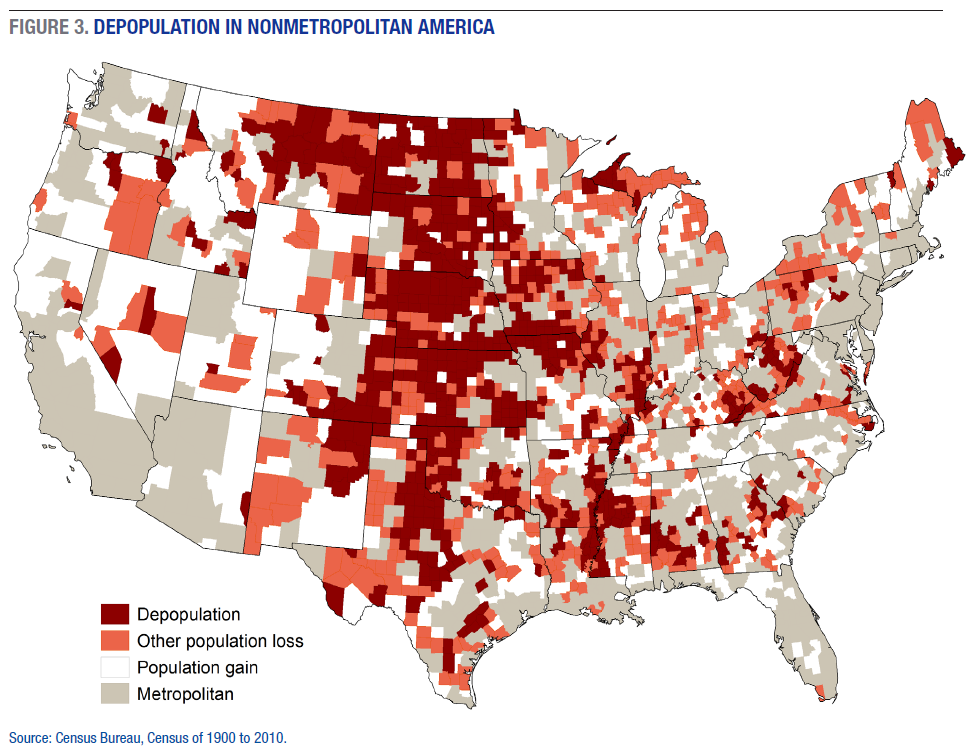
  3. As Trump courts rural voters, population change in rural America is more complex than just saying the rural population is declining. See this 2019 research:
Figure 3
https://carsey.unh.edu/publication/rural-depopulation

Our research provides clear evidence of depopulation across a broad swatch of rural America. Depopulation seemingly is now built into the demographic fabric of some parts of rural America—a result of chronic outmigration among young adults of reproductive age, along with population aging and high mortality rates. Yet, depopulation is far from universal. Many rural regions continue to grow, often rapidly, including exurban areas just beyond the metropolitan suburban fringe, and high-amenity recreational and retirement areas. These counties are likely to hold their own demographically in the future. The situation is much different for the depopulating rural counties caught in a downward spiral of population loss.

Patterns in suburban Chicago rallies for in-person schooling, sports

The suburbs are not typically considered hot spots for protest activity. Yet, in the Chicago region, in the past few weeks several suburban rallies have taken place in support of a return to school. The latest one on Monday in Barrington:

Holding signs like “Schools not screens” and “Stop playing politics, start playing ball,” more than 200 parents and students in Barrington Area Unit District 220 took part in a rally Monday evening asking the district to allow in-person schooling and sports…

A survey conducted by the district earlier this summer showed 70% of parents wanted their children in school, he pointed out. “So why are they not in school?” he said, getting applause and cheering from the crowd.

This comes less than a week after a protest with a similar theme in Wheaton:

As students across the Western suburbs begin the school year with remote learning, hundreds of parents and students rallied in a downtown Wheaton park Tuesday night to demand a total return to classrooms and sports…

The gathering in Wheaton’s Memorial Park drew participants from as far away as Mokena and Orland Park, Western Springs and Huntley.

Along with students, some teachers and coaches, parents at the rally made the case for reopening classrooms, arguing that the loss of social interaction in schools hurts their children’s emotional, mental and social well-being.

A few thoughts on these protests:

  1. Given how COVID-19 has been politicized, would it be fair to characterize as these rallies as a conservative response to current conditions? If so, this could join a pro-police rally in Oak Brook a few years ago. This is in contrast to “liberal” suburban rallies in Naperville (example here) and in other suburbs. (NIMBY protests in the Chicago suburbs may be bipartisan.)
  2. Do suburban protests tend to take place in wealthier suburbs? I have made the case that Naperville draws particular attention for protests because it is large and has a lively downtown. Would suburban protests in more working class communities draw the same attention?
  3. Do we know if there is a recent (last five years or so) increase in suburban rallies and protests? We would need to have a baseline of collective activity over time and then compare. If there is an increase, it might be due to multiple factors: increasing diversity in suburbs and changing communities as well as ongoing battles for suburban voters.

Bipartisan white suburban support for fewer apartments, more homes

A political scientist shares research findings on how political views affect suburban support or opposition to different kinds of development:

Photo by SevenStorm JUHASZIMRUS on Pexels.com

As a political scientist who has studied local land-use regulations, I’m surprised to see a national political campaign in 2020 place such an emphasis on the issue—which hasn’t figured much in presidential races in half a century. The Trump campaign isn’t wrong to think that white suburban voters—the obvious target of the McCloskeys’ speech—would oppose apartment construction in their neighborhoods. In a nationally representative survey of metropolitan areas that I conducted last year, a substantial majority of homeowners revealed a strong preference for single-family development and opposition to apartments. They also overwhelmingly agreed that residents of a community should get a vote on what is built there…

And yet the history of exclusionary zoning reveals that it has long been a bipartisan activity. Obama’s Affirmatively Furthering Fair Housing rule was the first major action taken by any presidential administration to enforce the 1968 Fair Housing Act, which despite its lofty promises has not resulted in an integrated America. During the 1976 presidential campaign, Jimmy Carter assured voters that he was not “going to use the federal government’s authority deliberately to circumvent the natural inclination of people to live in ethnically homogenous neighborhoods.”

My survey data revealed no significant difference between white Republican and white Democratic homeowners in their opposition to high-density housing. I also found overwhelming agreement that apartment complexes would increase crime rates, decrease school quality, lower property values, and degrade the desirability of a neighborhood…

What this means is that Trump’s approach could conceivably appeal to white suburbanites more broadly, not just Republicans. And yet the evidence suggests that this is unlikely. Most white Democrats support the development of affordable and subsidized housing in the abstract and will feel comfortable rejecting Trump’s similarly abstract opposition to it. Where white Democrats oppose such development is when it arrives in their own backyards. But they do not need Trump to block it.

The Americans suburbs are based around single-family homes, exclusion, and local control (in addition to other factors). Opposition to apartments can be about both changes in aesthetics and character of a suburb and the kinds of people who are assumed to live in apartments.

But, as is hinted above, the real battleground over apartments and affordable housing and residential segregation really is about the local level. Federal or state guidelines could require certain things for municipalities. This is the first line of defense for those opposed to housing or any other development they do not desire. And these are abstract levels of government until local development pressure starts up. Even if such regulations passed, where exactly apartments might be located, in what scale and with what design, and how local residents and officials respond is the real pressure point.

If I am interpreting the last paragraph cited above correctly, white suburbanites in general will mobilize to oppose local development they do not want. This can have multiple effects: (1) it stops apartments and affordable housing from being built; (2) it can push such development into communities that are less able to mobilize or where there is already cheaper housing; and (3) it can create long-standing tensions between community members and prospective residents. In the long run, it means that some of the same patterns that suburbanites might criticize in big cities – uneven development, residential segregation – are replicated in suburbs.

Research on the power and influence Democratic mayors do or do not have

Emily Badger sums up research looking at how much big cities are affected by having a mayor from a particular political party:

https://www.nytimes.com/2020/09/02/upshot/trump-democratic-cities.html

Numerous studies suggest that the partisanship of mayors has limited effect on much of anything: not just crime, but also tax policy, social policy and economic outcomes.

The researchers Justin de Benedictis-Kessner and Christopher Warshaw have found that Democratic mayors spend more than Republican mayors. “But the differences are pretty small,” said Mr. Warshaw, a political scientist at George Washington University. “They’re not enough to drive large differences in societal outcomes in things like crime rates.”

This is partly because mayors are constrained in their ability to execute ideological agendas. Cities can’t run deficits. States limit their authority to raise taxes and enact laws on many issues. And cities lack the power the federal government has to shape labor laws, or immigration policies that can affect their population growth…

Cities have been faced with problems far beyond their making. Deindustrialization and globalization wiped out many middle-class factory jobs, destabilizing neighborhoods of blue-collar workers. The federal policy of highway construction enabled both taxpayers and employers to leave cities. Federal housing policies dissuaded or prevented Black residents initially from joining them, cementing patterns of racial and economic segregation that persist to this day…

There are plenty of fair critiques of decisions that Democratic mayors do control — regarding charter schools, or how equitably they deploy city resources, or whether their zoning laws and school policies perpetuate segregation. And there is room to criticize the Democratic Party’s failure to devise a coherent federal urban policy.

Disentangling this from the current political moment and debate about running cities, a few themes from the article stuck out to me:

  1. One argument is that mayors are more interested in pragmatic day to day city processes than larger ideological concerns. Mayors themselves make this argument. If a mayor cannot help solve a particular local problem, they may not be in office for long, regardless of what party they align with.
  2. Cities are stuck between multiple bodies of government. A city may be nested within a county (and this is what might make city-county mergers appealing), a state, and then the federal system. On one hand, cities are essential to our modern society – they are economic engines, centers of culture, gathering places for residents and jobs, anchors of entire regions, etc. – but their city interests must be negotiated with other bodies of government above them. Putting it in more sociological terms, cities are between macro and micro social scales yet often are viewed as macro entities and have some capabilities at the macro level (I am thinking of conferences of mayors, transnational conversations between mayors and other mayors or heads of government, etc.)
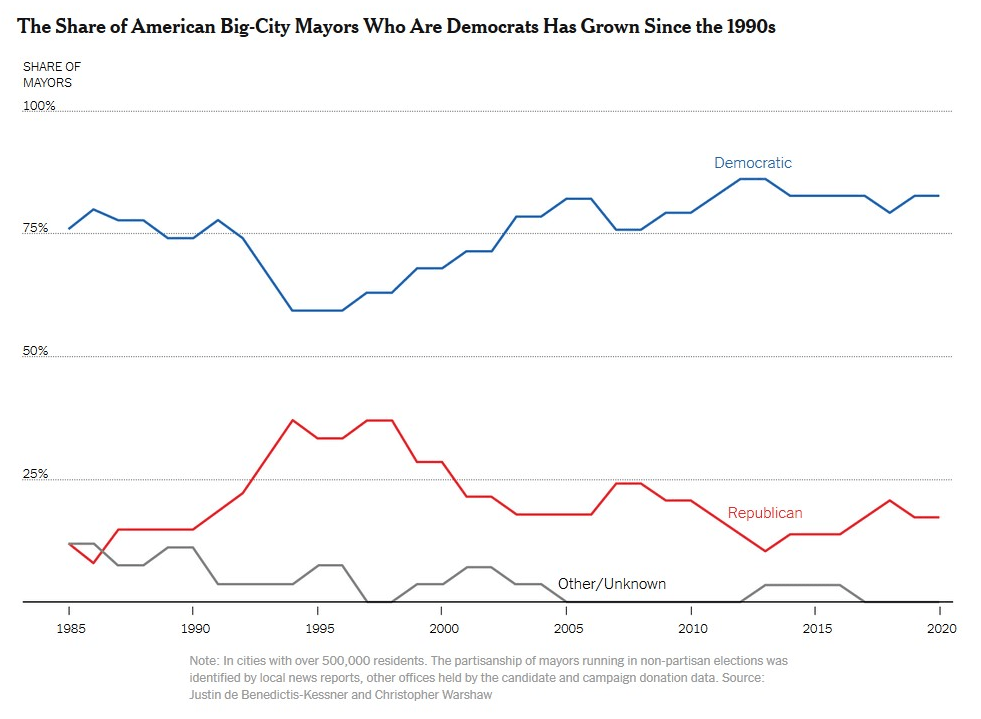
  3. As a graph in the article shows, there are more Democratic big city mayors than Republican big city mayors and this has been true for decades. Do Republicans want to be mayors of big cities? Also noted in the story: Republican policies and appeals have been made to suburbanites and rural voters for decades, less so to urban residents.
  4. This is not a new political issue; the United States has a long-standing divide regarding cities that goes back to the founding of the country. For more on this as it played out in the twentieth century, I recommend the 2014 book Americans Against the City by historian Steven Conn.

The start of municipal budget issues due to COVID-19? The case of Chicago

COVID-19 has disrupted a lot of life in the United States and it will have consequences for municipal budgets. Here is how Chicago mayor Lori Lightfoot describes the fiscal impact:

Google Street View of Chicago City Hall, June 2018

Citing the “catastrophic collapse of our local and national economy” because of COVID-19 and damage to local businesses from civil unrest, Mayor Lori Lightfoot on Monday laid out a $1.2 billion shortfall for what she called Chicago’s “pandemic budget” in 2021…

The ongoing coronavirus crisis has also spiked the 2020 budget shortfall to nearly $800 million, Lightfoot said. She said that deficit would be filled using relief funds and other unspecified aid from the federal government, in addition to debt refinancing, and borrowing…

In laying out the 2021 shortfall, Lightfoot cited dire numbers — more than 900,000 Chicago-area residents filed for unemployment since the start of the pandemic, while personal services, hospitality and tourism industries “are still seeing a fraction of their typical revenues and some businesses have sadly closed with no hope of coming back.”…

The bad news has seemed inevitable for months, as tax receipts plummeted with large parts of the economy shut down and spending in Chicago by tourists and conventioneers cratered throughout the summer because of the pandemic.

Chicago has its own particular challenges but the COVID-19 shortfall is one that many communities in the United States, big and small, will experience. Local governments tend to want to diversify their tax base so that they are drawing tax revenues from multiple sources. COVID-19 interrupts or limits a number of these streams: money from visitors (who stay in hotels, visit sites, eat), sales tax revenues (derived from businesses from residents and visitors, who are affected by employment and travel opportunities), and property tax revenue (could be affected if people are moving in or out affecting demand plus whether residents and landlords are able to pay their bills). Furthermore, right now this is posed as an issue for the current budget; what is the effect for months or years down the road as cities and communities try to rebound and/or continue to battle COVID-19?

Closing these COVID-19 shortfalls will provide unique opportunities for politicians. This article suggests all options are on the table; yet, I am sure most, if not all of the politicians involved, have particular budget options they would not consider. Many municipal governments will hope there are extra resources available from above, perhaps from the county, state, and federal governments. Yet, all levels of government are likely to feel the impact of COVID-19. And with the current discord between the White House and big city leaders, it is hard to imagine what a palatable plan for the federal government and municipal governments to work together would look like. Could this/should this be a major issue on the November 2020 campaign trail as multiple levels of government look to address COVID effects?

The coming budget reckoning for big cities

A new analysis suggests particular big cities will suffer losses in tax revenues due to COVID-19:

Describing the study results more:

What matters more in this pandemic moment is how a city generates money: Those highly dependent on tourism, on direct state aid or on volatile sales taxes will hurt the most. Cities like Boston, which rely heavily on the most stable revenue, property taxes, are in the strongest position — for now.

The estimates, to be published in the National Tax Journal by Mr. Chernick, David Copeland at Georgia State University and Andrew Reschovsky at the University of Wisconsin, are based on the mix of local revenue sources, the importance of state aid and the composition of jobs and wages in each city. The researchers predict average revenue shortfalls in the 2021 fiscal year of about 5.5 percent in a less severe scenario, or 9 percent in a more severe one.

Tax revenues can come from a variety of sources. Like recommendations for individual investors to diversify their portfolio, municipalities can benefit from a broad tax base that is not too reliant on any one sector. As the analysis suggests, relying on one single source can cause problems when that area experiences a downturn. (At the same time, creating such a robust and resilient local economy might be very difficult to do given historical patterns, current conditions, and competition in the future.)

The color coding of the graph above is interesting in that it implies that there are a number of cities that Republicans should care about helping. I wonder how this will play out: even as Republican senators would want more municipal tax revenues, it does not necessarily mean that they are pro-city or would want to go out of their way to provide funding. Are Republicans more in favor of seeing the fate of cities and suburbs as tied together when their cities are at risk?

President Trump suggests suburbs can exclude and exercise local control

In a June 30th tweet, President Trump expressed disagreement with policies enacted under President Obama involving desegregating housing:

TrumpSuburbsTweetJun3020

President Donald Trump on Tuesday said he would reverse a federal rule that promotes fair housing and sets desegregation as a national priority. The policy is known as Affirmatively Furthering Fair Housing, or AFFH; it’s a provision of the Fair Housing Act of 1968, signed into law a week after the assassination of Martin Luther King Jr.

“At the request of many great Americans who live in the Suburbs, and others,” Trump tweeted, “I am studying the AFFH housing regulation that is having a devastating impact on these once thriving Suburban areas. Corrupt Joe Biden wants to make them MUCH WORSE. Not fair to homeowners, I may END!”

Trump was specifically aiming at an Obama rule about how to finally implement the policy, a mandate (on paper only) for more than 50 years due to federal reluctance to address racial segregation. It might come as a surprise to the president, but his administration has already tackled this policy: The White House took steps starting in 2018 to gut the rule by arguing that it was too burdensome—not because desegregation would have a “devastating impact” on suburban America.

As he’s done time and time again, Trump said the quiet part out loud. The U.S. Department of Housing and Urban Development has taken numerous steps to undermine key rules and policies that promote desegregation as a requirement for jurisdictions that receive federal housing dollars. But under Housing Secretary Ben Carson, the agency has carefully framed those revisions in procedural terms—namely as ways to reduce the paperwork load for housing authorities. In his tweet, Trump essentially admitted that there’s a different motive: Eliminating the rule will reduce the pressure on local governments to provide space and opportunity for Black families in affluent white neighborhoods.

Several thoughts:

1. The suburbs were built in part on exclusion – by race/ethnicity and social class – as well as on local control where suburbanites could avoid regulation from outside parties.

2. This continues conservative opposition to President Obama’s policies regarding cities and suburbs and might give hope to those who hoped President Trump would inaugurate a new wave of suburban development.

3. As the article notes, Trump has not said much else recently about housing or suburbs. It is not an easy national policy issue to address and Democrats have not spent much time on the issue in this election cycle. Yet, Trump’s tweet fits with other things he has said about law and order, racial issues, and cities. If I had to guess, he is trying to win over some suburban voters by suggesting he would allow suburbanites to dictate their own community’s fate. Whether he has the ability to appeal to suburban voters by November given his approach and positions is something to watch.

4. I’m on the record saying addressing issues of race in the United States requires addressing residential segregation. Even as suburbs as a whole have become more diverse by race and class, this does not necessarily mean opportunities in wealthier suburbs are available to all or even many.