Cruz campaign using psychological data to reach potential voters

Campaigns not working with big data are behind: Ted Cruz’s campaign is working with unique psychological data as they try to secure the Republican nomination.

To build its data-gathering operation widely, the Cruz campaign hired Cambridge Analytica, a Massachusetts company reportedly owned in part by hedge fund executive Robert Mercer, who has given $11 million to a super PAC supporting Cruz. Cambridge, the U.S. affiliate of London-based behavioral research company SCL Group, has been paid more than $750,000 by the Cruz campaign, according to Federal Election Commission records.

To develop its psychographic models, Cambridge surveyed more than 150,000 households across the country and scored individuals using five basic traits: openness, conscientiousness, extraversion, agreeableness and neuroticism. A top Cambridge official didn’t respond to a request for comment, but Cruz campaign officials said the company developed its correlations in part by using data from Facebook that included subscribers’ likes. That data helped make the Cambridge data particularly powerful, campaign officials said…

The Cruz campaign modified the Cambridge template, renaming some psychological categories and adding subcategories to the list, such as “stoic traditionalist” and “true believer.” The campaign then did its own field surveys in battleground states to develop a more precise predictive model based on issues preferences.

The Cruz algorithm was then applied to what the campaign calls an “enhanced voter file,” which can contain as many as 50,000 data points gathered from voting records, popular websites and consumer information such as magazine subscriptions, car ownership and preferences for food and clothing.

Building a big data operation behind a major political candidate seems pretty par for the course these days. The success of the Obama campaigns was often attributed to tech whizzes behind the scenes. Since this is fairly normal these days, perhaps we need to move on to other questions: what do voters think about such micro targeting and how do they experience it? Does this contribute to political fragmentation? What is the role of the mass media amid more specific approaches? How valid are the predictions for voters and their behavior (since they are based on certain social science data and theories)? How does this all significantly change political campaigns?

How far are we from just getting ridding of the candidates all together and putting together AI apps/machines/data programs that garner support…
 

Shift in US toward more inequality across cities

The differences in per capita incomes across US cities have grown in recent decades:

Until the early 1980s, a long-running feature of American history was the gradual convergence of income across regions. The trend goes back to at least the 1840s, but grew particularly strong during the middle decades of the 20th century. This was, in part, a result of the South catching up with the North in its economic development. As late as 1940, per-capita income in Mississippi, for example, was still less than one-quarter that of Connecticut. Over the next 40 years, Mississippians saw their incomes rise much faster than did residents of Connecticut, until by 1980 the gap in income had shrunk to 58 percent…

Yet starting in the early 1980s, the long trend toward regional equality abruptly switched. Since then, geography has come roaring back as a determinant of economic fortune, as a few elite cities have surged ahead of the rest of the country in their wealth and income. In 1980, the per-capita income of Washington, D.C., was 29 percent above the average for Americans as a whole; by 2013 it had risen to 68 percent above. In the San Francisco Bay area, the rise was from 50 percent above to 88 percent. Meanwhile, per-capita income in New York City soared from 80 percent above the national average in 1980 to 172 percent above in 2013.

The article has a long discussion of the various reasons behind this. But, I think the conclusion is correct:

Growing inequality between and among regions and metro areas is obvious. But it is almost completely absent from the current political conversation.

Inequality may be a broad issue for the entire country to address but what is happening in different places is unique. This may make it difficult to address variations within a presidential race where the candidates are supposed to represent everyone. Imagine a Republican or Democrat trying to appeal to a particular metropolitan region: “my platform is built around what Detroit needs!” or “the success I’ve helped create in Burlington, Vermont is what we should bring to the entire country!” (This does highlight the unique role mayors or former mayors could play in national elections. They are likely to think more at the city or metropolitan level but it is really hard for such experience to translate into national electoral success.) But, city-level issues certainly could be addressed by Congress or by states.

“Pollsters defend craft amid string of high-profile misses”

Researchers and polling organizations continue to defend their efforts:

Pollsters widely acknowledge the challenges and limitations taxing their craft. The universality of cellphones, the prevalence of the Internet and a growing reluctance among voters to respond to questions are “huge issues” confronting the field, said Ashley Koning, assistant director at Rutgers University’s Eagleton Center for Public Interest Polling…

“Not every poll,” Koning added, “is a poll worth reading.”

Scott Keeter, director of survey research at the Pew Research Center, agreed. Placing too much trust in early surveys, when few voters are paying close attention and the candidate pools are their largest, “is asking more of a poll than what it can really do.”…

Kathryn Bowman, a public opinion specialist at the American Enterprise Institute, also downplayed the importance of early primary polls, saying they have “very little predictive value at this stage of the campaign.” Still, she said, the blame is widespread, lamenting the rise of pollsters who prioritize close races to gain coverage, journalists too eager to cover those results and news consumers who flock to those types of stories.

Given the reliance on data in today’s world, particularly in political campaigns, polls are unlikely to go away. But, there will be likely be changes in the future that might include:

  1. More consumers of polls, the media and potential voters, learn what exactly polls are saying and what they are not. Since the media seems to love polls and horse races, I’m not sure much will change in that realm. But, we need great numeracy among Americans to sort through all of these numbers.
  2. Continued efforts to improve methodology when it is harder to reach people and obtain representative samples and predict who will be voting.
  3. A consolidation of efforts by researchers and poling organizations as (a) some are knocked out by a string of bad results or high-profile wrong predictions and (b) groups try to pool their resources (money, knowledge, data) to improve their accuracy. Or, perhaps (c) polling will just become a partisan effort as more objective observers realize their efforts won’t be used correctly (see #1 above).

Chicago keeps a low residential property tax rate to keep residents?

As the Chicago Tribune highlights the low residential property tax in Chicago compared to nearby communities, could this be a tactic to stem the population decline of the city?

Chicago homeowners pay less in property taxes than the vast majority of their suburban neighbors, even with Mayor Rahm Emanuel’s record property tax increase applied. But business properties are taxed differently in Cook County, resulting in higher tax rates on those parcels in Chicago than nearly all collar county suburbs. Those conclusions emerge from a Tribune analysis of tax rates applied on 2015 bills in 388 city and suburban locations in Cook and the five collar counties.

While housing owners pay less, the business owners of Chicago pay more than their counterparts in the suburbs:

The story is different, however, for those who own city manufacturing plants, offices and shopping centers. They already pay more in property taxes than their counterparts in most suburbs outside Cook County. That gap will only become wider after Emanuel’s tax hike, with Chicago business property owners being taxed at higher rates than those in all but seven collar county towns…

There are plenty of collar county suburbs with room for all types of business development that start to look even more attractive than Chicago, at least in terms of property taxes. In places like Joliet, Downers Grove and Naperville, tax bills on business properties would be half that of equally priced parcels in the city…Deputy Mayor Steve Koch dismissed the business tax differences found in the KPMG study, saying they were not enough to sway business location decisions. He noted recent decisions by Motorola Solutions to move to the city from Schaumburg and ConAgra Foods to move to Chicago from Omaha, Neb., when everyone knew the big property tax hike was coming.

The Tribune suggests one reason for the low residential property tax rates is to not anger voters:

“Because we didn’t have in our leadership the political will to actually tell taxpayers and voters that (more money was needed), frankly folks were sold some snake oil, and they got to believe they could have very low taxes and still have adequate service, and after a while that doesn’t really work,” Martire said. “They should have been (raising property taxes) for a long time, and the pain would have been significantly lower.”

Politicians do need votes. But, to return to the suggestion I made in the opening sentence, I wonder if this is also about keeping residents in Chicago. City leaders argue that businesses are not going to avoid Chicago just because of higher taxes. Chicago has other benefits including other notable businesses, lots of office space, lots of human capital, and numerous attractive cultural and entertainment options. In other words, enough businesses will pay these higher property tax rates in Chicago because there is still money to be made in the city.

Yet, homeowners also consider property tax rates as they look for housing. While Chicago doesn’t suffer from the kind of affordable housing issues as San Francisco or Manhattan, it is still quite expensive in some neighborhoods while suburbs throughout the region provide all sorts of additional housing options as well as jobs and other amenities. Why should many residents stay? Lower property tax rates may just help. And for its international prestige – the seventh-rated global city – Chicago has lost plenty of people in recent decades with a peak of just over 3.6 million in 1950 to just over 2.7 million people today.

Votes and people staying could go together: residents who think the politicians are on their side and then show it by not raising their residential property taxes may be more likely to stay in Chicago.

Dreaming of pres. candidates competing in other TV formats

As the presidential candidate debates continue, I thought of some other TV formats that might be both entertaining and tell us more than the repeated talking points. Americans like the drama of multiple candidates and they like TV so why not try some other options?

  1. A game show format. Want to see who is smarter? Jeopardy. How well they know Americans based on survey results? Family Feud. Want to see them all live together and who can form alliances? Big Brother or Survivor. Want to see some physical competitions? American Ninja Warrior. In any game show, we would see their competitive side and a particular ability.
  2. A reality TV format. How would they each get along with the Dance Moms? Or on The Biggest Catch? Or tracking down online personas in Catfish? Or looking for homes on a HGTV show? Though the show has particular setup, the candidates could act “natural.”
  3. A hidden camera show. The show could try to catch candidates in situations that push them to respond – like What Would You Do? – or it could be more of a comedy like Candid Camera. This could give viewers some idea of how candidates would react in particular situations.
  4. Some sort of presidential simulation. Lock them in a sound stage that mimics the White House or some other government facility. What would they do after two or three nights with little sleep in reaction to a military threat against the United States? How would they act toward a set of Congressional leaders who are tough negotiators? How would they treat their staff after weeks of tension?

I get why most candidates would be very hesitant about many of these. At the same time, debates where the candidates stand around talk/interrupt/respond to questions aren’t necessarily favorable to everyone. Additionally, we know what debates can tell us but these other TV options could offer very interesting (and entertaining) insights into the candidates. These don’t have to be a joke if they are well-designed and the candidates take them seriously.

Housing policy that encourages both affordable housing and rising home values

This article points out a contradiction in housing policy: can we promote affordable housing while at the same time suggesting housing should be a good investment?

So how are these two conflicting ideas to be reconciled? Well, that’s the basic challenge of housing policy. Perhaps a start would be to acknowledge that there is, in fact, a tension here—that “protecting” or “promoting” property values is the same thing as “making housing more expensive.” It’s somewhat discouraging, for example, when community organizations claim that “affordability doesn’t mean housing values have to remain stagnant,” without acknowledging that if housing values aren’t stagnant—i.e., they’re growing—that means they’re also becoming less affordable.

But there is some hope. One thing that could help is robust production of housing that isn’t priced by the market, and therefore isn’t affected by rising market prices. That can be accomplished through public housing, privately-developed affordable housing with programs such as the low-income housing tax credit and housing vouchers. At the moment, few places produce non-market housing at anything close to a scale that would provide broad affordability, but there are encouraging examples: Portland, for instance, has created 2,300 units of affordable housing in its redeveloping Pearl District, adjacent to downtown, financed largely by taxes.

In many places, having a wide variety of housing types and sizes can also make room for people with a wide variety of incomes. My street in the Edgewater neighborhood of Chicago, for example, contains a handful of single-family homes, whose value at this point probably reaches into the six figures; expensive newer condo buildings; older multifamily buildings, some of which have large, luxuriously updated units, and others whose apartments are somewhat smaller, or have less up-to-date finishes; and a few single room occupancy buildings, with minimal accommodations. As a result, there is market-rate housing for everyone from upper-middle-class professionals to working-class immigrant families to low-income elderly adults. Of course, that sort of diversity is typical of a pre-zoning “illegal neighborhood”: A vanishingly small proportion of American neighborhoods allow that sort of mix to be created today, which is a large part of the problem. Making these kinds of neighborhoods more common might make America’s housing policy a little more cohesive and less contradictory.

In the explanation of why we have two contradictory positions, I think two key pieces are missed. One is the political dimension of these two goals for housing. Both have broad appeal – people want to be able to move to better neighborhoods even as they want higher housing values – and politicians continually push homeownership for the average American.  This has been a common theme going back to the 1920s (see an example from 1931). To put it bluntly, it helps secure votes. Second is the role of residents themselves who continue to want both outcomes. Policy, particularly at the federal level, is important here and a number of scholars have noted how decisions about mortgages and urban renewal privileged homeownership in the suburbs. Still, numerous residents practice NIMBY behavior, resisting change once they have their secure position within the home and neighborhood they want. Given the amount of money required to buy a home – it is the biggest single investment many people will make – this is understandable but it certainly doesn’t help others.

Both of the proposed solutions above are difficult to pull off. Using public money for public housing or affordable housing has been opposed since the early 1900s. Having mixed use and mixed income neighborhoods may be popular with some (New Urbanists, young people moving to the city) but it doesn’t get the same level of support from the broader public. To have housing for all or many would mean giving up some on the idea of housing as investment but those with more means – from the middle class on up – will not like this idea one bit.

Growing troubles in surveying Americans

International difficulties in polling are also present in the United States with fewer responses to telephone queries:

With sample sizes often small, fluctuations in polling numbers can be caused by less than a handful of people. A new NBC News/Wall Street Journal national survey of the Republican race out this week, for instance, represents the preferences of only 230 likely GOP voters. Analysis of certain subgroups, like evangelicals, could be shaped by the response of a single voter.Shifting demographics are also playing a role. In the U.S., non-whites, who have historically voted at a lower rate than whites, are likely to comprise a majority of the population by mid-century. As their share of the electorate grows, so might their tendency to vote. No one knows by how much, making turnout estimates hard…

To save money, more polling is done using robocalls, Internet-based surveys, and other non-standard methods. Such alternatives may prove useful but they come with real risks. Robocalls, for example, are forbidden by law from dialing mobile phones. Online polling may oversample young people or Democratic Party voters. While such methods don’t necessarily produce inaccurate results, Franklin and others note, their newness makes it harder to predict reliability…

As response rates have declined, the need to rely on risky mathematical maneuvers has increased. To compensate for under-represented groups, like younger voters, some pollsters adjust their results to better reflect the population — or their assessment of who will vote. Different firms have different models that factor in things like voter age, education, income, and historical election data to make up for the all the voters they couldn’t query.

The telephone provided new means of communication in society but also helped make national mass surveys possible once a majority of Americans had them. Yet, even with cell phone adoption increasing to over 90% in 2013 and cell phones spreading as fast as any technology (comparable to the television in the early 1950s), the era of the telephone as an instrument for survey data may be coming to an end.

Three other thoughts:

  1. Another issue at this point of the election cycle: there are so many candidates involved that it is difficult to get good data on all of them.
  2. If the costs of telephone surveys keep going up, might we see more door-to-door surveys? Given the increase in contractor/part-time work, couldn’t polling organizations get good idea from all over the country?
  3. If polls aren’t quite as accurate as they might have bee in the past, does this mean election outcomes will be more exciting for the public? If so, would voter turnout increase?

When conservatives move to squash local control

Republicans are typically known as the party in favor of more powerful local governments. Yet, this may not be the case in places where local governments limits their quest to power:

The strange spectacle of Republicans trying to roll back local control makes a bit more sense in context. For years, Democrats mostly controlled both the statehouse and the governorship. But Republicans captured the legislature in 2010, and the governor’s mansion two years later. Ever since, they’ve been busily passing a series of very conservative measures, some of which I explained here. The rightward shift inspired a prolonged series of protests in Raleigh and other major cities called “Moral Mondays.”

The large demonstrations, combined with their general impotence to stop the legislature—internecine GOP struggles, and not public opposition, have generally killed the most controversial measures—illuminate what’s going on. Rural-urban divides are a fixture of American politics, and they’re a particularly powerful force in North Carolina right now. Its urban centers tend to be far more liberal, while the rest of the state is far more conservative. The liberals can gather large, impassioned crowds to rally against conservative moves, but they don’t have the numbers (so far) to elect a majority in the state legislature—especially after post-2010 redistricting that made the map more favorable for Republicans. (Barack Obama narrowly won the state in 2008 but lost it in 2012.)

Despairing of Raleigh, progressives have often pursued their priorities at the local level. That’s exactly what the state bill was intended to stop. When Congress does this to state and municipal governments, it’s known as preemption—it’s a bedrock constitutional principle that federal laws trump state laws. With a Democrat in the White House, though, there are limits to what the Republican Congress can pass. But the GOP has been gaining seats at the state level for years, and now controls most state legislatures. Cities often tilt left, even in very red states, but conservative state governments around the country have begun passing laws that preempt municipal legislation. Last year, for example, Matt Valentine chronicled how state governments are overturning much stricter gun laws passed by cities with preemption laws…

In other words, it’s a classic case for big-government uniformity. Faced with these bills, Democrats in turn tend to make a strikingly conservative argument: Local people know best, and they ought to have the right to make their own rules about how they live, as long as it isn’t negatively affecting their neighbors.

Local control is very important to many Americans, particularly if you have some means to get to a community where you can have a voice or be assured that local government generally agrees with what you want.

Let’s be honest: both parties today are willing to forgo some (most?) principles if it means that they can use their particular tool of power to get what they want. Opposed to executive power when your party is out of the presidency? Just argue your interests are too important when your party is in office. Control Congress while another branch isn’t doing what you want? Try to bypass their power and/or limit their abilities. This leads to a rhetorical question: how well can these levels of government or different branches work together to get things done if the primary goal is just to exert power?


Historian argues American public housing had successes

In a new book, a historian looks at the positive potential of American public housing:

“The story of American public housing is one of quiet successes drowned out by loud failures,” writes Ed Goetz, a professor at the University of Minnesota, in his book New Deal Ruins: Race, Economic Justice and Public Housing Policy

But as Maddie Garrett’s experience shows, and as Goetz details in his book, public housing had—and still has—a lot of potential. It’s just that seemingly no one—not politicians, not Congress, not home builders—wants it to succeed…

In some small cities, though, public housing has worked and continues to work. That includes Austin, the site of one of the first public-housing complexes in the nation, which still stands today. The Housing Authority of the City of Austin has been recognized as a “High Performer” by HUD for 15 years in a row, and, rather than depending on the federal government for help, it has embarked on a few entrepreneurial programs to raise money…

By and large, smaller agencies across the country have been more successful at providing good public housing for residents than giant city agencies have, Goetz says. The example of Austin and other cities such as Cambridge, Massachusetts; Portland, Oregon; and St. Paul, Minnesota; indicate that public housing didn’t have to fail. And perhaps with some tweaking—dividing big public-housing authorities into smaller, regional ones, or spending more money on housing for the poor in good neighborhoods—it doesn’t have to fail in the future, either.

Much of the article summarizes some of the history of American public housing which has had vociferous opponents throughout its existence. Given this opposition – involving charges of socialism, becoming intertwined with race, criticism of poor architectural choices, to corrupt management – maybe we should be surprised that there were any successes at all.

But, the finding that smaller agencies did better might provide insights into how to limit this opposition. The scale of public housing in these cities was likely smaller. The political stakes were probably lower. These smaller cities may not have had the same legacies of residential segregation. The local governments may have been able to maintain stronger control over the public housing instead of it being lost within the big city bureaucracy. Smaller cities have smaller media contingents that can’t quite bring the same negative attention to troubled public housing choices in the same way that big city media can.

Whether lessons from this can be productively used in the future remains to be seen. Public housing still doesn’t seem to have much of a chance in major cities.

Census Bureau releases supplemental poverty figure

There is the official poverty rate from the Census Bureau – and now also a supplemental measure.

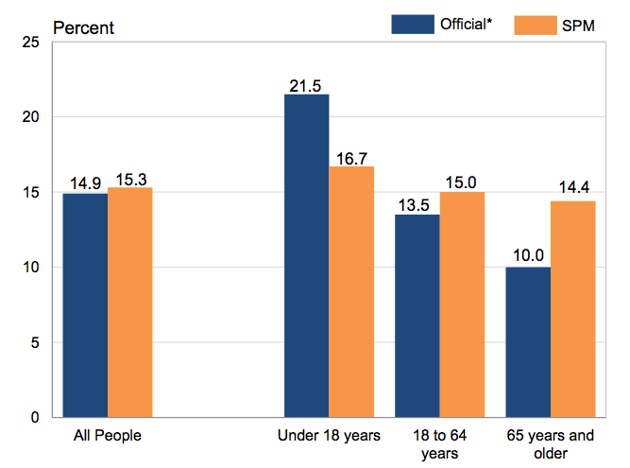
That’s why for the first time, the bureau released a supplemental poverty measure along with its official figures. According to the supplemental data, the poverty rate in the U.S. was about 15.3 percent—0.4 percentage points higher than the report’s official rate. But the additional measure shows differences in age groups. For instance, those under the age of 18 have a poverty rate of 16.7 percent—quite a bit lower than the 21.5 percent reported in the main findings. For older Americans, the tweaked metrics paint a grimmer picture, with the share of seniors living in poverty reported as nearly 5 percentage points higher than the official measure.


Poverty Rates: Official Versus Supplemental

Census

The more inclusive measures might  help monitor the effectiveness of programs meant to increase the well-being of specific populations, such as children or the elderly. Still, the use of an official, blanket income level remains a crude means of identifying families that are having a difficult time putting roofs over their heads or food on the table, especially considering the vast differences in cost of living around the country. To better understand the persistent poverty problem requires greater attention to nuanced and localized data that can better illustrate areas where the cost of essentials are outstripping income and benefits, and where families continue to suffer.

An interesting development. Now the vetting of the new measurement tool can begin and I’m guessing that this won’t satisfy too many people.

A political question: would any administration allow the official government definition of poverty to change if it meant that the rate would increase during their time in office? This isn’t just about measurement; there are political considerations as well.