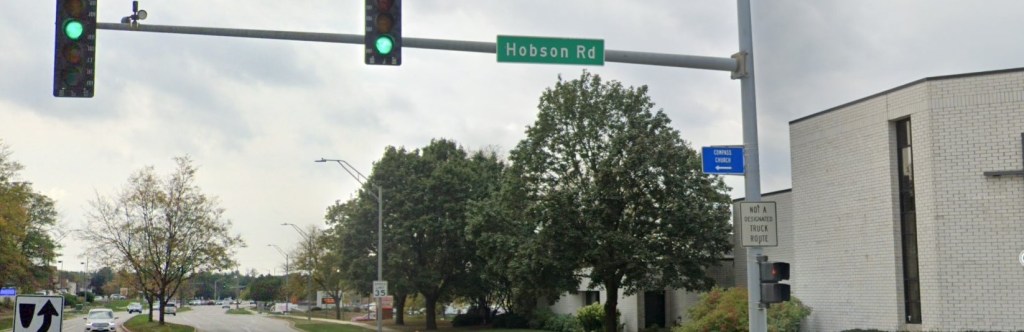
Drive through a community in the Chicago area and you see a lot of signs. One small set of these direct travelers toward religious congregations. Here is one example from Google Street View:
Image from Google Street View
See the small blue sign on the traffic light pole? It directs people to a church a half a mile down the road.
A few observations in seeing such signs:
Not all congregations have a sign. Could all congregations request one and then have at least one pointing toward them?
The signs are pretty small. How many drivers see them.
The signs tend to be posted at busier intersections. Some drives from those intersections are shorter and easier to navigate than others. For example, a driver might see a sign pointing in a direction but it may take a little while before finding the congregation roughly in that direction.
Given that these signs are likely provided as a community good, can their use be improved in significant ways?
–From Super Bowl MVP Patrick Mahomes: “I give God the glory. He challenged us to make us better. I am proud of my guys. They did awesome. Legendary.”
In early sociological work, theorists discussed the boundaries between sacred and profane. In the Super Bowl, these lines can get very blurry. Is this just an athletic event or is it about our collective lives together and supernatural forces? Can advertising for religious groups and beliefs break through the noise of food and football? Should all of these forces be mixed or is there a time and place for each?
This is not new but it does highlight the ongoing interactions in American society between religion and other spheres. Similar things can and have been said about politics. A football game is not just a football game; it is an opportunity for numerous actors to put their own stamp on what we are doing together.
Seeking to grow revenue and do good, faith-based organizations are increasingly turning to their unused land and underused buildings as a solution to affordable housing. By the time Ms. Goff arrived at Arlington Presbyterian Church in 2018, Gilliam Place was already under construction.
“Our congregation had begun to ask itself, ‘What’s the point of us?’” Ms. Goff said. “It’s a big, existential question, and they had the sense that affordable housing was an issue they could do something about.”…
State and local governments are also recognizing the potential to increase housing stock. Andrew Gounardes, a New York State senator who represents southern Brooklyn, introduced a bill in December that, he said, would “streamline the process and the way in which religious institutions that want to help contribute to solving the state’s housing crisis will be able to develop affordable housing on their property.”…
Regardless of state laws, projects often face make-or-break decisions at the local level. Neighborhood buy-in is one small step in the journey, said the Rev. David Bowers, vice president of faith-based development initiative for Enterprise Community Partners, a national nonprofit developer. “There is NIMBYism, zoning approvals,” he said. “It’s the nature of the beast.”
Then there’s the financing question. Banks are “hesitant to do business with churches for fear of default,” said Bishop R.C. Hugh Nelson, lead pastor at Ebenezer Urban Ministry Center in Brooklyn, who worked with Brisa Builders Corporation on Ebenezer Plaza, a project that includes 523 affordable apartments, 43,000 square feet of sanctuary and ministry space, and 21,000 square feet of commercial space in Brownsville.
Two thoughts come to mind:
The combination of doing good for the community and generating revenue are interesting to consider together. Are there congregations where one of these is more of the driving force? What if more congregations from their beginnings saw housing as one of the ways they lived our and/or shared their religious faith?
How might congregations not just build housing but develop larger communities around faith, rituals, and community life? Housing is good but so is community and the possibilities of developing a local life involving the congregation.
Many features of atheist churches in the U.S. are directly borrowed from religious organizations. At Sunday Assembly, where I spent three years doing research, services include collective singing, reading inspirational texts, silent reflection and collecting donations. They center around a central lecture given by a member of the congregation or a member of the larger local community. I attended one service where an astronomer gave a talk about the New Horizons spacecraft’s mission to Pluto. At another service, a member of a local community garden organization talked about building community through her community garden program.
Atheist church organizers I met told me that they intentionally borrow the structure of a church because they see it as a good model for building effective rituals and communities. More generally, the structure of a “congregation” is popular and familiar to most attendees.
However, there are key differences. Sunday Assembly has no hierarchical structure, and there is no pastor or minister, meaning that decisions are made by the community. Attendees share duties for running the services and finding speakers and readings.
The other key difference is the complete lack of reference to the supernatural. Lectures and rituals I have encountered at atheist church services are centered around affirming atheistic beliefs, celebrating science, cultivating experiences of awe and wonder for nature, and creating communities of support.
Communities and rituals are pretty important to human beings. So are religious beliefs and practices.
I wonder how much the decline of civic organizations and engagement also contributes to these kinds of congregations. Yes, there is a decline in religiosity – but there is also less engagement with civic groups and community life.
Additionally, will the same sorts of issues that religious congregations face – disagreements and fracturing, abuses of power, difficulties acquiring resources – be ones that secular congregations encounter?
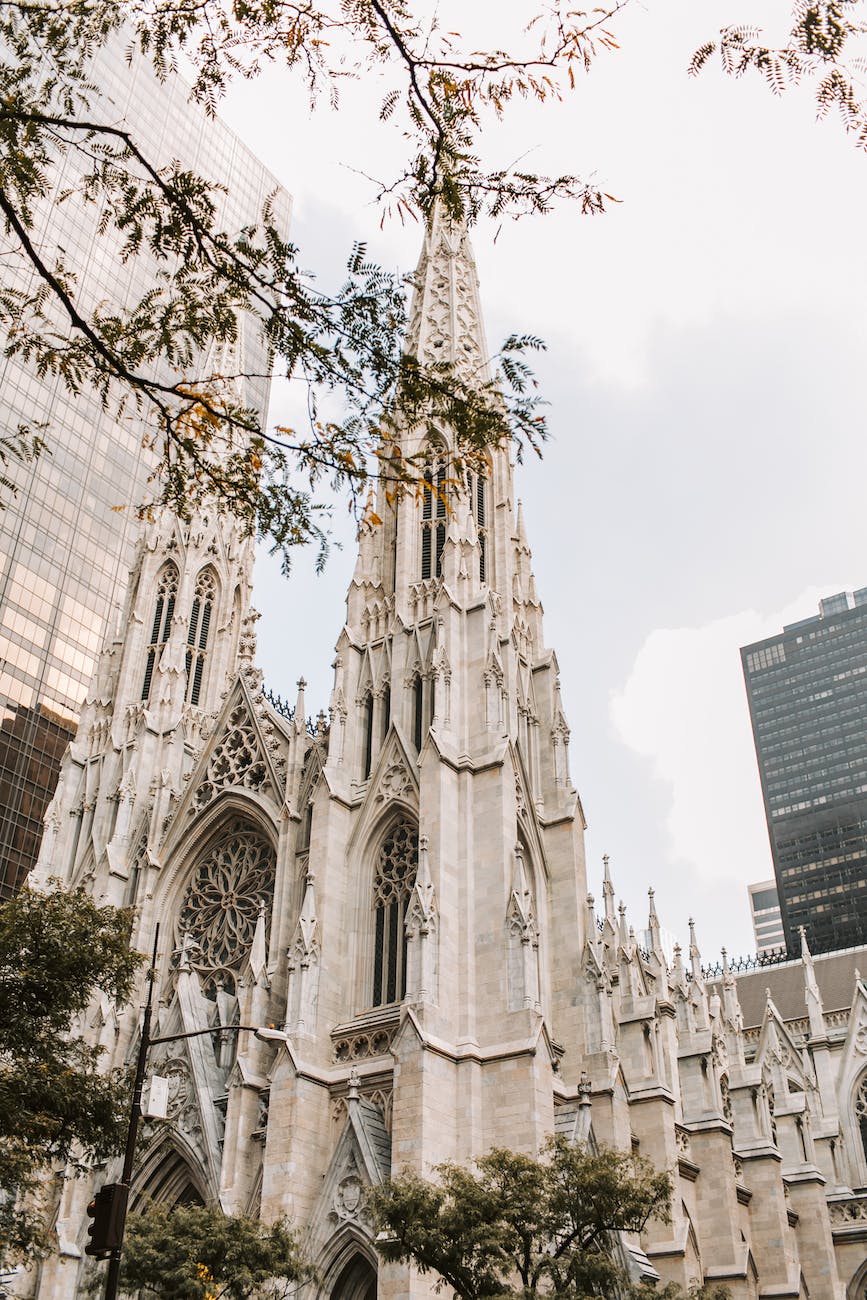
This is not an unknown story in New York City: a congregation sells part of its property or air rights to help fund its operations. This time it is St. Patrick’s Cathedral:
Citadel’s Ken Griffin and Steve Roth’s Vornado Realty Trust agreed to buy up to 525,000 square feet of air rights from the Roman Catholic Archdiocese of New York to facilitate the development of 350 Park Avenue, PincusCo reported…
The per square foot basis of the deal is arguably more important than the total purchase price, because that hasn’t been determined. Under the agreement, the developers can buy up to 525,000 square feet of air rights, but could also buy as little as 315,000 square feet. That means the purchase price ranges from $98.4 million all the way up to $164 million…
Representatives of Griffin, Vornado and Rudin did not respond to a request for comment from The Real Deal. A spokesperson for the Archdiocese of New York said that it is the church’s “hope that the money will go to the continued upkeep of the Cathedral.”…
Griffin’s Citadel is working to develop a 51-story tower at 350 Park Avenue, designed by Norman Foster. Griffin’s firm is redeveloping properties master leased from Vornado and Rudin. Citadel would occupy roughly 54 percent of the 1.7-million-square-foot property, which would stand 1,350 feet tall.
I remember at least a few of these stories while examining zoning conflict in the New York City. For a congregation with an older building and perhaps an aging congregation, allowing others to make use of their property in different ways could help pay the bills. Here, one of the wealthiest people in the United States wants to build a skyscraper, the church has the air rights, and the money paid to the church can help the Cathedral into the future.
This reminds me of some of the reasons many churches left Chicago’s Loop by the early twentieth century. Land prices were high, people had moved out of the central business district, and they could relocate to quieter, more residential streets. That left very few congregations in the downtown.
And even though this point was passed long ago, the contrast of a 51-story skyscraper near a landmark church is interesting to consider. No longer is religious activity at the center of big cities. Is this a physical manifestation that shows America’s leading religion is business?
I like to read and I see a lot of texts and information. But, sometimes a sentence or paragraph or idea sticks out and makes me stop. Here is one such recent example:
Adam Smith wrote the Wealth of Nations (1776) in a mercantilist era, when the only free market was the slave trade, about which he wrote nothing (Appleby 2010). He was thus not describing existing conditions. Instead, he was proposing an answer to the most important question to thinkers of his time: how to sustain a social order outside of a theological framework in which God served as both keystone and source of legitimation (Dumont 1977; Rosanvallon 1979; Carrier 1997). Early industrialization and the rise of the bourgeoisie had threatened the theological foundations of monarchical and noble rule. In response, Enlightenment political philosophy produced two conceptual pillars for the new society. One was the State, founded on popular sovereignty and the social contract. The other was the Market, based on a supposed natural right to property and the freedom to exchange (Donegani and Sadoun 2007; Audard 2009). The Classical economists’ ideal, self-regulating market, in other words, was a mechanism to replace God. (Gauthier, Francois and James Spickard. 2023. “”Pay No Attention to That Man Behind the Curtain”: a Critique of the Rational Choice Approach to Religion.” Method and Theory in the Study of Religion 35:151)
I do not have the expertise to weigh these claims. But, the final sentence caught my attention: in the shift away from religion, the market could be a substitute. Appealing to the workings of the market could fit where previously people and institutions might have appealed to religion. Where might this fit with Weber’s argument that the intertwining of religion and capitalism faded away as economic and rational logic took over? How does this fit with certain religious traditions and institutions that embrace a free market logic that might have attempted to replace them?
Because it is the end of the semester, I have limited time to follow up on this. Yet, I will explore more later. And I can clearly remember other books and articles that produced “aha” moments or unlocked a series of thoughts and other ideas that proved interesting. Maybe someday I will compile a list of such sources; they do not necessarily come along often and they are worth noting.
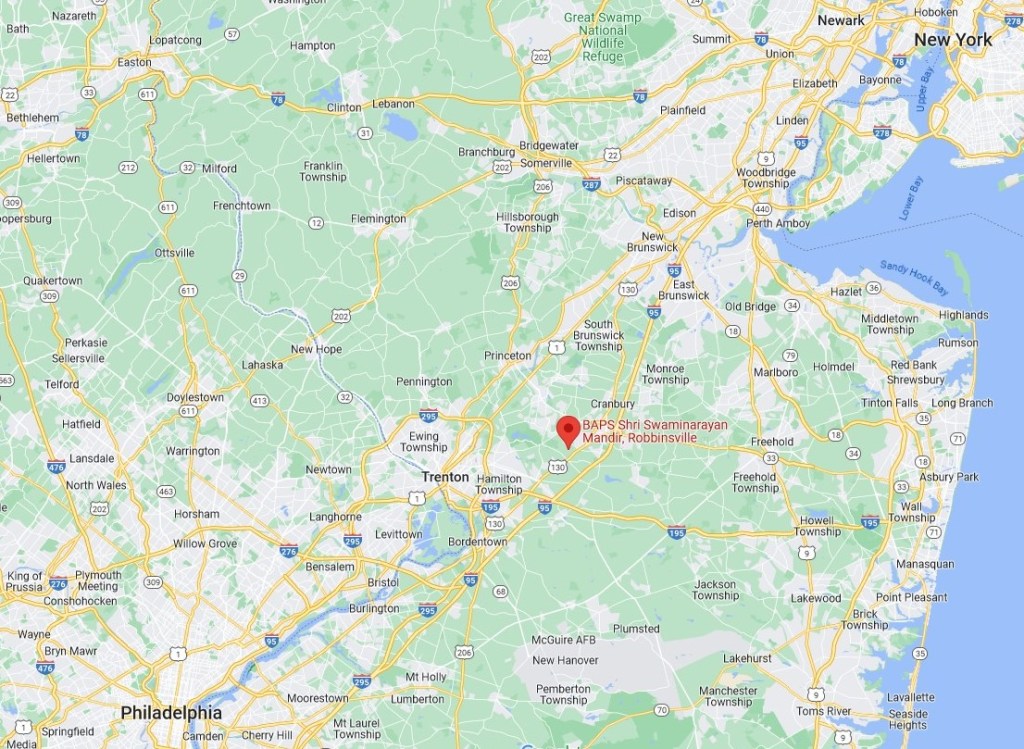
The official inauguration for BAPS Akshardham, the massive 87,975 square-foot, 191-feet tall temple in Robbinsville, New Jersey, is scheduled for Sunday…
Spanning 185 acres, the grand temple is dedicated to Bhagwan Swaminarayan, a revered Hindu spiritual leader from the 19th century.
The temple is made of stoned of Marble, granite, and limestones – sourced from various places in Europe and shipped to India, where artisans carved intricately.
Stone pieces were then shipped to the U.S. and assembled by volunteers from all over the world under guidance of artisans from India…
The New York tri-state area is known for its large Hindu American population and community of Hindu devotees.
According to Wikipedia, this suburban location is part of the New York City region but it also right next to the Philadelphia region:
Yet, I suspect such a building would surprise many who do not think of suburbs in the United States this way. With new populations in the suburbs and new religious groups, many suburban communities have changed in recent decades. Suburbs do not only consist of white bedroom communities; suburbs are more racially, ethnically, and religiously diverse.
Among the nones who say they are also not personally religious, 68% cited their dislike of organized religion as a very or extremely important reason. For 63%, a top reason is their dislike of the stances religious faiths take on social and political issues, while 54% say the same about reports of abuse or misconduct by religious leaders. Forty-six percent cite disbelieving in God as a top reason. That was true of 81% of atheists, but just 40% of agnostics and 32% of nothings in particular.
The last paragraph suggests there are multiple influential reasons the nones cite, with a dislike for organized religion leading the way.
It is interesting to see this alongside recent figures showing declines in trust in all sorts of institutions in American life.
This also makes me think about how religious or spiritual ideas can begin or start and then there are processes that transform them into institutionalized religion. Beyond just leaving religion and spirituality solely up to individuals, how do different religious groups push against institutionalization and rationalization?
DuPage County, Illinois is a vibrant suburban county with over 930,000 residents, lots of jobs, and numerous communities. Like many suburbs, it has become more complex in recent years due to demographic, cultural, economic, and social changes. It is also home to hundreds of religious congregations.
Brian Miller (Professor of Sociology, Wheaton College, and co-author of Building Faith: A Sociology of Religious Structures) is using a quantitative approach focusing on DuPage County in Illinois, which is home to hundreds of religious organizations. He is documenting the number and types of transitioned congregations in the suburban context, looking for patterns of building usage and community impact.
I have started looking at sources that will help with the project. Here are two that are proving very helpful:
This builds on earlier work I have done regarding religious buildings. Based on existing research, I would expect a variety of outcomes for former religious buildings from no building present on the site to empty structures to buildings converted for other uses.
1. Allow Area N to remain a wetland and preserve the open space in line with the South Barrington park district’s overall mission.
2. If Area N will be sold for a development, access should not be granted through Acadia Drive. Acadia Drive is within a residential community that has no sidewalks and permitting access to the development through the residential community, without sidewalks (the Woods of South Barrington), presents a nuisance and would be grossly negligent on behalf of the Village and the South Barrington park district. There is a walking trail (that is accessed from Acadia Drive or feeds residents onto Acadia Drive) where the access would be granted and children and residents are outside after school, on weekend and holidays. These are all peak worship times. The school also presents this same safety issues at the end of the school day where children who live in the residential community are walking home from being dropped off by the school bus. The residential community should remain residential and not be subject to increased development traffic. As repeatedly noted, this is a significant safety concern. The safety of our children and residents should be top priority for the Village and the South Barrington park district.
3. Further we request access not be granted on Bartlett road at all to preserve the surrounding residential communities from the same safety concerns.
Additionally, some of those signing the petition offered reasons they do not want this particular church in their community.
While this is about a particular piece of land and a particular religious group working within a particular suburban community, these reasons are fairly standard from what I have seen in my research. They have concerns about losing open space/natural space and park land. They are worried about traffic in residential neighborhoods. They do not want a group that multiple commenters call a cult in their community.
This will work its way through the legal system and local government bodies. Suburbanites who do not want certain land uses nearby can be quite persistent in their efforts to make sure proposals they do not like reach a certain outcome. Whether they can guarantee the outcome they want is another matter.





 Legally Sociable