If Americans moved less in 2020, the stories of people moving from places were specific to particular locations

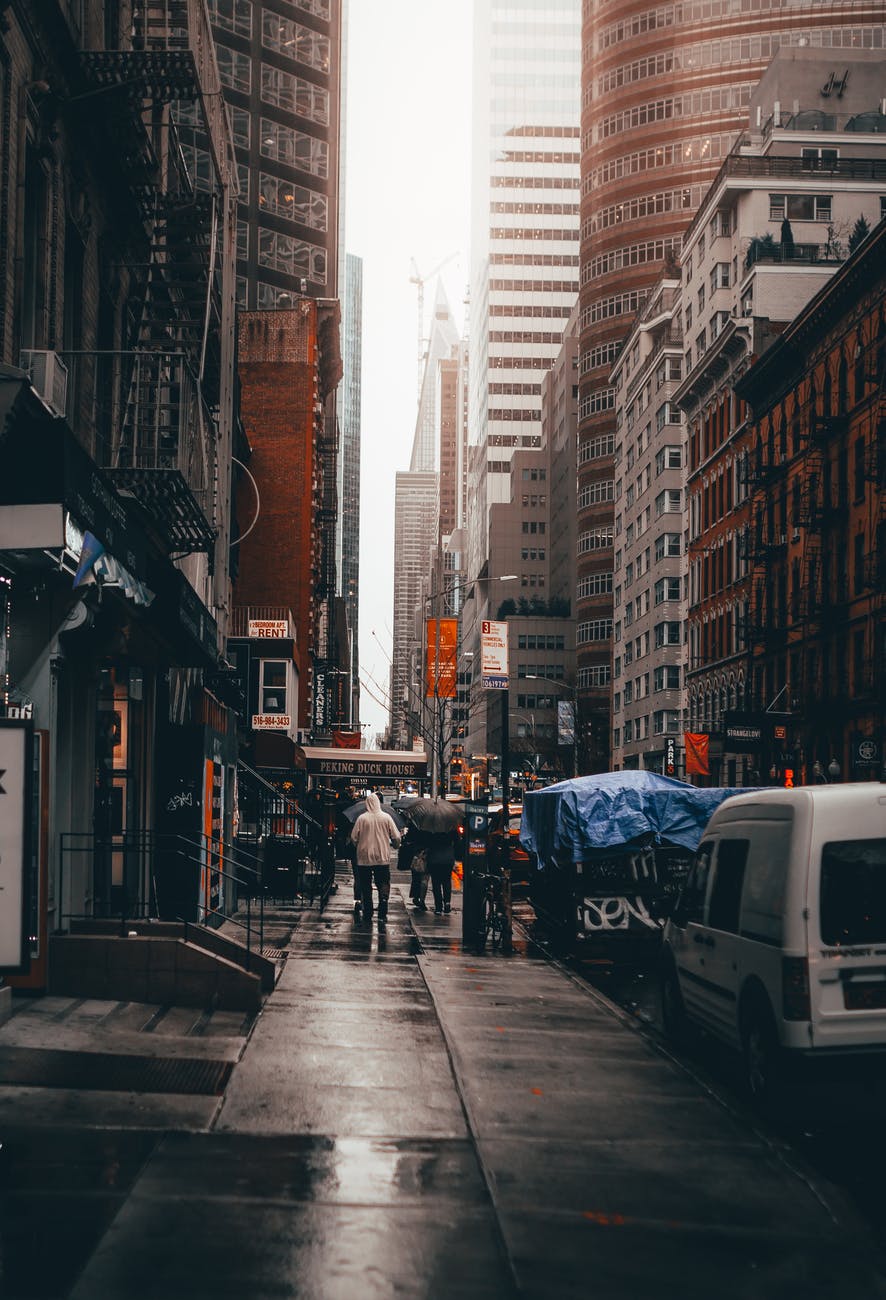
One consistent pandemic story was that people fled urban neighborhoods for less dense locales. This narrative held for New York City and San Francisco, among other places. But, in light of mobility data from 2020 that showed just under 8.5% of Americans changed addresses, what really happened?

Photo by Helena Lopes on Pexels.com

Two recent stories help make sense of the patterns. Story number one:

“Millennials living in New York City do not make up the world,” joked Thomas Cooke, a demographic consultant in Connecticut. “My millennial daughter’s friends living in Williamsburg, dozens of them came home. It felt like the world had suddenly moved, but in reality, this is not surprising at all.”…

Demographic expert Andrew Beveridge used change-of-address data to show that while people moved out of New York, particularly in well-heeled neighborhoods, at the height of the pandemic, those neighborhoods recouped their numbers just months later. Regarding the nation as a whole, Beveridge said he’s not surprised migration declined.

Put together the attention New York City and millennials receive and that residents may have left for a while but not permanently, the population did not change dramatically.

Story number two:

Lake Forest has seen a dramatic uptick in the number of people relocating to the northern suburb during the coronavirus pandemic.

“We’ve had over a thousand new families move to Lake Forest in the last 18 to 24 months,” said Mayor George Pandaleon.

He attributes the surge to four things: space, schools, safety and savings…

The mayor also noted the suburb’s real estate market was soft, meaning there was a large inventory that made it relatively easy for people to find a place to live.

This relatively small and wealthy suburb – around 20,000 residents, median household income of over $172,000 – grew as it had multiple factors in its favor.

Put these two stories together and other data and what do we have of the great COVID-19 migration of 2020? Here is my guess:

-The media and the public were very interested in what might happen because of COVID-19. It seems plausible that COVID-19 might prompt people to move given fears about transmission through the air.

-Certain people in certain locations could afford to move: those with resources to buy homes and those with flexible work arrangements. Those with fewer opportunities could not. The same residential segregation and uneven development present at normal times affected COVID times as well.

-Millennials seem to get a lot of news coverage as the next generation as well as one supposedly holding different values than previous generations.

All of this did not add up to significant mobility across the United States or across many groups in the United States.

Thankfulness for libraries and all they provide access to

This Thanksgiving, I am thankful for libraries. Throughout my life, public libraries and school libraries have provided endless hours of reading, learning, entertainment, and programs. While sociologist Eric Klinenberg celebrates libraries as important public spaces, I am grateful for their physical presence as well as the knowledge they contain and provide for users in a variety of formats. Here are some ways libraries have mattered in my life:

Photo by Pixabay on Pexels.com

-As a kid, my family would go to the public library in our community once a week. The first public library was a home that had been converted into a library. It had did not have much open space but there were plenty of books to pique my interests. I recall leaving with large stacks of books to read. The second and current public library was a completely new space with more openness that enabled larger collections, providing plenty of material for me to find.

-I have experience with two academic libraries and have benefited greatly from my interactions with both. One of the underestimated perks of involvement with colleges and universities is the ability to access so much material, both on-site and from other libraries. I have used these borrowing privileges a lot, enabling research and learning from thousands of materials that would have been difficult or impossible to obtain otherwise. While I have not used library space for studying as much as some, it is always helpful to have a place to go where learning is encouraged.

-Now with my own kids, the library provides learning, opportunities, and materials to enjoy at home. The fun it is to browse through books, new areas of knowledge, and activities all in one building. I hope they enjoy both the library as a space different than other spaces and a place to enjoy learning.

In sum, I think libraries are worth every penny of my individual tax dollars as well as deserve the support of the full community. Even in a world of smartphones and computers that can provide you access to information and material in no time, having a physical space dedicated to learning and books remains very important.

(One note: none of my school libraries pre-college stand out to me. This could be partly due to my reading choices when younger which veered more toward non-fiction. Or, perhaps because of my time in them was part of organized activity as opposed to operating on my own.)

Americans continue to move from one address to another less and less

By one measure, American mobility is down to its lowest level since 1948:

Photo by Artem Podrez on Pexels.com

New data from the U.S. Census Bureau shows just 8.4 percent of Americans live in a different house than they lived in a year ago. That is the lowest rate of movement that the bureau has recorded at any time since 1948.

That share means that about 27.1 million people moved homes in the last year, also the lowest ever recorded.

The number of Americans who move from one home to another has been falling for decades, said Cheryl Russell, who authors the Demo Memo blog on demographic trends. In the 1950s and 1960s, about one in five Americans moved homes in a given year. That dropped to 14 percent by the turn of the century, and to 11.6 percent a decade ago.

The more sedentary population is a product of a handful of demographic factors that have grown as the American population gets older, as fallout from the Great Recession a decade ago continues to play out and as the pandemic put the brakes on many people’s plans.

The postwar era was one of a lot of mobility, particularly as those who could moved to the growing suburbs. The car and expanding networks of highways made it possible to access many destinations and workplaces did not necessarily have to be near homes.

Since then, mobility has declined for the reasons cited above. People can still move about on a daily basis but they are not moving addresses as much. Even as parts of the United States are growing in population and others are not, fewer people are moving overall.

Even as I have watched reports on this trend in recent years (see earlier posts here and here), I have seen little discussion of what this means or whether reduced geographic mobility is desirable or not. In a society that often celebrates mobility more broadly – social, economic, geographic – does this trend signal something troubling? Or, does this mean more Americans have an opportunity to develop roots and relationships within their communities?

Is there another possible explanation? Technological change, particularly smartphones and the ability to work from home, reduces the need for moving locations. More and more can be experienced and interacted with from anywhere with Internet and data access.

Only megachurches and “minichurches” in the United States?

Recent data suggests there may be two very different sizes of churches in the United States:

Photo by Emily Hopper on Pexels.com

According to the recently released Faith Communities Today study, half of the congregations in the United States have 65 people or fewer, while two-thirds of congregations have fewer than 100…

“Shrinking attendance figures coupled with an increase in the number and percent of small congregations obviously indicates that a good many congregations are not growing,” the study’s authors found. “Indeed, the median rate of change between 2015 and 2020 was a negative 7%,” meaning half of all congregations declined in attendance by at least 7%.

While most congregations are small, however, most worshippers attend a larger congregation. Another prominent report, the National Congregations Study, found that while the average congregation is small — about 70 people — the majority of churchgoers are worshipping in a congregation of about 400 people.

The report reflects the reality that religious Americans are being sorted into two kinds of churches — megachurches, and minichurches like Cornerstone.

Are they being sorted or has this been going on for a while? On the larger end are megachurches, congregations with more 2,000 members. Megachurches have been a phenomena for at least a few decades. Megachurches get a lot of attention due to their size, their programs, and leaders. Since each one attracts many attendees, they could equal dozens of smaller churches in terms of people there for services. Megachurches have been a phenomena for at least a few decades.

If the primary marker of a religious congregation is size and growth, then megachurches are more successful. The article goes on to talk about different reasons why people and leaders might choose smaller congregations. The megachurch experience is not for everyone. Whether there is much left for small congregations if much of the resources and attention is going to larger congregations is another story.

And the answer regarding this competition between megachurches and minichurches might be in between. The big megachurches are known, small congregations are everywhere, and a sizable set of Americans worship in congregations of several hundred. These medium sized congregations can offer some of the amenities of the biggest churches while staying at an approachable size.

The difficulty in removing racial covenants from deeds

Many properties in the United States had racial covenants written into their deeds where it was stated that the property could not be sold to people of particular racial and ethnic groups. Removing those statements on deeds today can be a difficult task:

Photo by Andrea Piacquadio on Pexels.com

Cisneros, who is white, said she wanted the covenant removed immediately and went to the county recorder’s office. What she thought would be a simple process actually was cumbersome, expensive and time-consuming. She took time off work and had to get access to a private subscription service typically available only to title companies and real estate lawyers. There were forms to fill out that required her to know how property records work. She also had to pay for every document she filed…

In the end, Cisneros learned that the offensive language couldn’t be removed. That is often the case in other cities if officials there believe that it’s wrong to erase a covenant from the public record. Instead, the county agreed to attach a piece of paper to Cisneros’ covenant disavowing the language…

Sullivan knew the only way to rid the language from the record was to lobby elected officials. She teamed up with a neighbor, and together they convinced Illinois Democratic state Rep. Daniel Didech to sponsor a bill. The lawmaker found an ally in Democratic state Sen. Adriane Johnson. The bill allows property owners and homeowners associations to remove the offensive and unlawful language from covenants for no more than $10 through their recorder of deeds office and in 30 days or less, Johnson said. Illinois Gov. J.B. Pritzker, a Democrat, signed the bill into law in July. It takes effect in January 2022…

Illinois becomes the latest state to enact a law to remove or amend racially restrictive covenants from property records. Maryland passed a law in 2020 that allows property owners to go to court and have the covenants removed for free. And in September, California Gov. Gavin Newsom, a Democrat, signed a bill that streamlines the process to remove the language. Several other states, including Connecticut and Virginia, have similar laws.

I could see how many Americans today would want to strike the racial covenant from their current property but their ability to do so depends on local laws. Righting past wrongs is no quick task, even when later actions have nullified the effects of the earlier language in these deeds.

And there could be a lot of racial covenants out there:

It’s impossible to know exactly how many racially restrictive covenants remain on the books throughout the U.S., though Winling and others who study the issue estimate there are millions. The more than 3,000 counties throughout the U.S. maintain land records, and each has a different way of recording and searching for them. Some counties, such as San Diego County and Hennepin County, which includes Minneapolis, have digitized their records, making it easier to find the outlawed covenants. But in most counties, property records are still paper documents that sit in file cabinets and on shelves. In Cook County, Illinois, for instance, finding one deed with a covenant means poring through ledgers in the windowless basement room of the county recorder’s office in downtown Chicago. It’s a painstaking process that can take hours to yield one result.

The deeds and the potential racial covenants contained therein highlight how land and property is acquired, obtained, and passed along in the United States. There is much to consider there: how was the land acquired and from whom? Who does it benefit now and in the future?

The academic rabbit trails to watching a particular TV show for fun/analysis

In a recent trip to the campus library, I checked out the first season of a television show. I briefly interacted with the checkout clerk who remarked that I was in for a good viewing experience. My path to this show was not a straightforward one; rather, it involved reading, my own research, and a lot of time. Here is the path to this one TV show:

Photo by Jean van der Meulen on Pexels.com
  1. I develop an interest in the sociology of culture as an undergraduate studying both sociology and anthropology. The study of the “processes of meaning-making” becomes one of my primary graduate school interests and I continue to work within this subfield today. In my daily life, any cultural product or expression can then be both experienced and analyzed. This can be applied both to cultural activity as well as places, connected to my interest in suburbs and cities.
  2. Even as I continue with the sociology of culture, I also run into media studies, a field that combines insights from multiple fields and tackles all sorts of media. I teach a class titled “Culture, Media, and Society” where we consider multiple media and cultural forms including documentaries, films, television, comics, theater, music, art, news coverage, social media, and other phenomena. In conducting research on social media (several studies here, here, and here), I also encounter media studies research and journals.
  3. Several years later, I combine an interest in places and media by publishing two studies: one considers television shows set in suburbs and one examines the role of McMansion on The Sopranos. These works straddle the lines between sociology and media studies.
  4. In the summer of 2021, I read the book Divine Programming by television studies scholar Charlotte Howell. I watch one television shows Howell points out treats religion seriously (see posts here and here).
  5. With a little more flexibility in my schedule as we reach the holidays and approach the end of the semester, I decide to watch a second show featured in Howell’s book to continue to explore and enjoy how religion is depicted in television.

There are certainly other ways to come to a television show, including receiving recommendations from friends and family, reading a review, browsing or receiving a recommendation on a streaming service, and more. My path is probably not a typical one. But, I am also reminded of the ways that knowledge and studies develop as an academic: there is not necessarily a linear path toward a predetermined goal and a guaranteed outcome plus there can be a lot of time involved as ideas and projects wax and wane.

Wrestling with the ongoing – and increasing – numbers of pedestrian deaths in the United States

After a pedestrian death in her neighborhood, one writer considers the issue in the United States:

Photo by Josh Hild on Pexels.com

My neighborhood isn’t unique. So far this year, 15 pedestrians have been killed by drivers in the nation’s capital, and total traffic fatalities are up to 37-the highest number since 2008. This is all despite Mayor Muriel Bowser’s goal to end traffic deaths by 2024 as part of the Vision Zero program signed on to by leaders of D.C. and other major U.S. cities. The District Department of Transportation has made some changes to protect walkers and cyclists, such as reducing speed limits and installing more bike lanes. Ironically, total traffic fatalities have increased steadily since the program began.

The same trend is reflected in cities across America. Part of the increase in pedestrian deaths is probably because our vehicles are bigger than ever. “Our pickup trucks and SUVs are gigantic compared to the sizes they used to be,” giving drivers less visibility and a greater sense of security, which makes them more aggressive on the road, says Rohit Aggarwala, a fellow at the urban Tech Hub at Cornell Tech and the former director of long-term planning and sustainability for New York City. During the pandemic’s early days, as fewer Americans drove to work or school, it seemed safe to assume that fewer pedestrians would die Instead, fatalities have jumped. Conclusive research isn’t out yet, but the increase is likely at least in part due to a drop in traffic congestion and an ensuing increase in speed: “People were still walking around their neighborhoods during lockdown, and you had a [small] number of people on the streets driving very, very fast,” Aggarwala told me. Older adults, people walking in low-income areas, and Black and Native Americans are all overrepresented in pedestrian-death statistics.

Most pedestrian deaths are preventable, and experts believe that the solutions are straightforward. Aggarwala and his team at Cornell Tech are pushing for three major changes to America’s driving infrastructure: more robust traffic-camera enforcement, to capture not just speeding but all kinds of moving violations; road redesign that would decrease lane size and add speed bumps to nudge drivers to slow down; and finally, upping the standards for vehicle safety. Car manufacturers in Europe are required to test cars for pedestrian impact; they design hoods to slope downward so that drivers can see anyone who might wander into the road. American automakers could do the same, or add pedestrian-detection systems or speed limiters to cars. Many of these changes would not only make roads safer for pedestrians but also could reduce police violence at the same time. “The U.S. hasn’t considered any of this,” Aggarwala said. “We have a tradition of focusing on vehicle safety as only being about the occupant.”

This is an ongoing issue as long as roads are primarily for cars and vehicles. The priority for decades in the United States has been to make roads optimal for vehicles. Pedestrians and other street level activity is, on the whole, not as important.

When I read this, I thought about the efforts to include equipment in all new cars that would test to see if the drivers was driving impaired. How did this come about? Drunk driving has been a recognized issue for years with organized groups making sure it was on the public’s radar screen. Is a social movement against pedestrian deaths and promoting pedestrian safety necessary to make significant changes? The solutions might be straightforward but the political and societal will is lacking.

Where is the construction of cheaper homes in the United States?

One recent analysis suggests a major contributor to the lack of homes for sale is limited construction of new homes:

Photo by Burst on Pexels.com

Earlier this year, Realtor.com estimated the gap between the number of homes needed and the number of homes available at 5.24 million. That estimate in June represented an increase of 1.4 million above the estimated 3.84 million gap in 2019, primarily because residential construction hasn’t kept up with household formations.

From January 2012 to June 2021, 12.3 million new American households were formed, but just 7 million new single-family houses were built, according to Realtor.com.

The housing shortage is particularly acute in the more-affordable range. Newly built houses with a median sales price of $300,000 represented just 32 percent of builder sales in the first half of 2021, compared with 43 percent during the first half of 2018, according to Realtor.com. To close the gap between demand and supply, builders would need to double their pace of construction for five or six years, Realtor.com economists estimate.

I have been trying to keep track of this for several years now: where are the new cheaper homes? If home builders are interested in selling homes, why not also create products for this part of the market?

There could be lots of reasons for this present state. But, this is not just a problem of 2021; this has been going on for at least a few years. Who can or will act to address this? Is this a pressing social concern that requires attention or just something to note every so often?

Imagine a time in the near future after this trend of the last ten years or so has truly piled up. How will younger adults pursue homeownership, a goal many Americans still say is desirable? Will a lower end of the housing market simply disappear to be overshadowed by more expensive, larger homes that truly generate profits?

If this continues, I would not be surprised to see more calls for housing interventions beyond the market.

Acknowledging that a building proposal from a religious group can lead to a “painful” process

Religious groups regularly propose changes for land and buildings and I have studied this both in the western suburbs of Chicago and the New York City region. After a City Council vote to approve changes to land owned by the Islamic Center of Naperville (see earlier posts on the unusual amount of attention this drew and approval by the planning and zoning commission), the mayor of Naperville acknowledged that it had been a difficult process:

A large crowd in the city council chamber erupted in applause when the vote was completed. Each council member and Chirico expressed gratitude for the work put in by all parties throughout the process that played out over nine months in the city’s planning and zoning commission with 500 speakers in 15 meetings.

“We all know it was painful,” Chirico said. “There were times where I was entertained. There were times where I was angry. There were times where I was throwing my shoe at the TV. Every emotion it seemed like it went through.”

Even as life will now continue with the different actors involved, acknowledging the difficult process is noteworthy. In my study of such proposals, the religious groups do not always reach the outcome they desire nor do communities and residents always get what they want. Here, describing the process as “painful” could refer to a number of things – the time it took, figuring out the particulars, working with all of the interested parties, etc. – and very involved may have attained exactly what they wanted at the beginning.

It is also worth noting that the same group and site may be up for conversation again in the future. In order to help the proposal succeed, the Islamic Center of Naperville agreed to submit future changes for the building and property for review:

The final step pushing the proposal over the finishing line was a concession by the Islamic Center to submit its third, fourth and fifth phase to additional city council review when the time comes. A group representing the nearby subdivisions of Ashwood Pointe, Pencross Knoll and Tall Grass agreed to accept the proposal with those conditions.

Will the process at that point be less painful? The group has made two proposals and both times has encountered numerous questions from neighbors and community members. Some of the particular actors involved in those two discussions may be gone but the underlying questions may not.

Connecting urbanization and the strong commitment to a seven day week

A historian with a new book on the creation of a seven day week suggests urbanization in the modern helped make this happen:

Photo by Julia M Cameron on Pexels.com

If you were to single out one factor, I would say urbanization. This really is a social phenomenon: It’s about people wanting to be able to make schedules with others, especially strangers, either in a consumer context or socially. When most people lived on farms or in small villages, they didn’t need to coordinate many activities with folks whom they didn’t see regularly.

It’s become much more important to know what day of the week it is. Today, a lot varies between one day of the week and the next—entertainment schedules, violin lessons, custody arrangements, or any of the millions of things that we attach to the seven-day cycle.

This would go along with the creation of time zones which similarly attempted to standardize time for the benefit of all the people who were now interacting and traveling. I wonder if this is also related somehow to the earlier adoption of clocks in cities in the Middle Ages. With more people gathered in a single community, having a common time and calendar could be useful for organizing activity.

More broadly, the shift to cities had significant impacts beyond geography and physical locations. The change to city life, specifically big city life, prompted new ways of understanding the world plus new methods for organizing people and knowledge. How people related to each other changed. How government operated changed. Daily activities and the meaning of those changed.

This is why I often start my Urban Sociology course with highlighting how some of the first sociologists in Europe – Marx, Durkheim, Weber, and a few others – noted and commented on urban life. Could you have the capitalism described by Marx without big city life? Durkheim contrasted organic and mechanical solidarity. Weber defined cities as market centers. And so on. The big city as the center of social, economic, political, and religious life had numerous implications for society.