The Chair follows a new English Department chair as she navigates crises and pressure from administrators and faculty. On one hand, it is about a unique academic position where the department chair is caught between the interests of the institution and the interests of faculty. On the other hand, the six episode season considers some of the large issues facing higher education in 2021. These include:
-Hiring, retaining, promoting, and celebrating female faculty and faculty of color.
-Responding to student interests amid faculty and institutional expertise and will that might or might not line up with those interests. This can come out in discussions about attracting students and majors or whether programs and faculty are contributing to or harming the school’s brand.
-The personal lives of faculty juggling family, teaching, research, and other commitments.
-Generational change within departments and institutions.
-Addressing social change, new ideas, and controversies when expertise takes time to develop and research cycles are long.
These may not be new questions in academia but relatively few television shows, movies, or other cultural products grapple with issues in what might seem to outsiders to be a strange world.
By a wide margin, three skyscrapers in the East stood out for repeated lightning strikes between the years 2015 and 2020. At 1,776 feet tall, the tallest building in the U.S., One World Trade Center in New York City, was struck 189 times between 2015 and 2020, but it wasn’t the most frequently hit building in the nation…
Yet the Big Apple isn’t the U.S. city with the most frequently struck building. That distinction goes to the Willis Tower in Chicago, which ranks third in the U.S. for height, towering at 1,451 feet above the Windy City. That skyscraper was hit with 250 lightning strikes between 2015 and 2020, making it Thor’s favorite target, so to speak.
Why Willis and not World Trade? Lightning strikes vary based on building height, material, and suppression systems. Chris Vagasky, a meteorologist for Vaisala, told AccuWeather that location may be to blame as well.
“Chicago gets more lightning in an average year than New York City,” Vagasky said. “So when you stick a tall building in a place with a higher lightning density, it’s more likely to be struck than a tall building in a place with a lower lightning density. Willis Tower is only slightly shorter than One World Trade, by about 35 feet.”
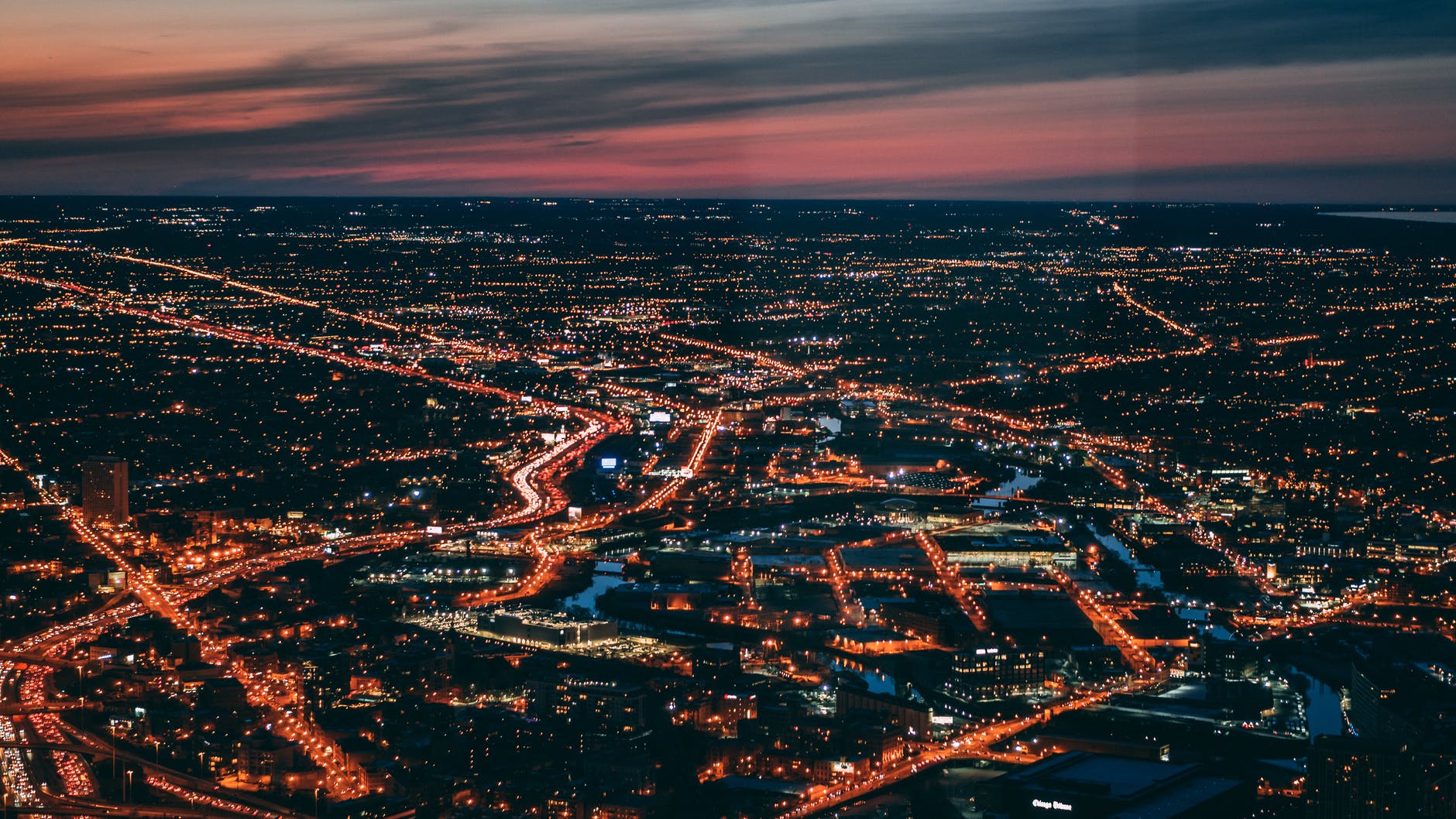
This is a timely write-up given the number of storms the Chicago area has experienced in the last week or so. With summer heat and humidity in a humid continental climate, big dark clouds and rain have swept over the Chicago region.
The pictures that capture lightning striking the Willis Tower highlight the height of the building above the rest of the (impressive) Chicago skyline. Additionally, they also show the resilience of the structures – explained elsewhere in the article as large Faraday cages – in the midst of a natural phenomena that can be quite destructive.
All signs point to a second Amazon Fresh grocery store opening soon in Naperville.
While city officials haven’t been notified of definitive plans for the site at 1351 E. Ogden Ave., Naperville Director of Communications Linda LaCloche said Amazon Fresh recently applied for a liquor license at the location. An opening date is unknown, but the building is currently being renovated and looks similar to the city’s other Amazon Fresh location on Route 59.
Naperville would become the first city in the country with two Amazon Fresh grocery stores…
According to Amazon’s website, there are only four Amazon Fresh locations in Illinois. In addition to Naperville, there are stores in Bloomingdale, Oak Lawn and Schaumburg.
Naperville may not be the only two store location for long and being the first means something. What is so attractive about Naperville as a location? Here are a few possible reasons:
-It is a wealthy and large community: over 148,000 residents with a median household income of nearly $126,000 (both 2019 estimates). This adds up to a lot of potential customers. Naperville is known for high white-collar jobs and tech jobs. These could also provide a good customer base.
-Naperville as a community has received many accolades. It has a high quality of life, high performing schools, and a vibrant downtown. It is a high status community and companies like to associate with such communities.
Aurora Mayor Richard Irvin said this week the city will continue its fight to get what it considers a more accurate census count…
[The 2020 Census] showed Aurora had lost about 17,000 residents during the past 10 years – about the equivalent of one of the city’s 10 wards – and officials have said they doubted that kind of population loss would have gone unnoticed among other city metrics, such as housing stock, water customers and traffic counts…
The big concern is that the city has estimated the new count could cost Aurora about $31 million a year in lost distributions of motor fuel tax, sales tax, income tax and money from federal programs for housing and education…
He has called for a review of the numbers by the government, and has even said the city could call for a special census down the line.
Another loss for the large suburb: no longer being able to highlight the growth of the community. Looking at the dicennial Census figures on Wikipedia, Aurora has never lost population over a decade until the 2020 count. And the growth has been particularly strong since 1990; the city had 99,581 residents then before growing to 142,990 in 2000 (43.6% increase) and then to 197,899 in 2010 (38.4% increase). In American communities, “growth is good” so a population loss is a sign of something wrong.
A special census could be worth calling for given the money and status at stake. I recall that neighboring Naperville had at least a few special censuses in recent decades as they sought to benefit from a rapidly growing population. The goal would be similar here – acquire more resources – but also different in that the population may have dropped rather than increased.
For roughly a year and a half, numerous Americans have quarantined themselves not just from work or school but from the other members of their households. Having more room in the residence and having particular floor plans would seem to help.
First, having more square feet would allow the residents to keep more distance and could provide the quarantined person more space to operate. Quarantining for a week or two could feel more burdensome if someone is restricted to a small room or portion of a residence. Space provides options for rearrangement.
Second, square footage might not be everything as the floor plan can matter. Large common spaces, a regular feature of many newer homes, would be off-limits. A more closed-off floor plan with separated rooms might work better. Even better could be a separate wing – imagine a bedroom and bathroom on one side of the house or on another level than the other bedrooms. For example, a split-level could be split between the quarantined and everyone else. Or, an in-law suite or numerous bedrooms with en suite bathrooms. In contrast, a ranch home with all the bedrooms near each other and a large living space might limit options.
Few people likely purchased their homes or rented particular places with a pandemic in mind. But, considering medical issues is not out of the question for many when looking for a place to live. Think of mobility concerns or aging in place. Or, if someone has a serious illness, where might a hospital bed fit or how would an alternative sleeping arrangement work out?
All I have is anecdotal evidence on this through observing the setups of people on social media. It appears most just block off a bedroom or office type of space in the home for the quarantined person. This works well if you have extra space or a room that is used occasionally. I suspect this is not so easy with less space or a layout that makes it difficult to isolate a single person.
I recently saw a Letter to the Editor in the Chicago Tribune that highlighted the savvy use of technology by a seven year old:
Kids can access their parents multiple ways today and vice versa. This letter suggests the observer was “captivated” by this technology use, hinting at the resourcefulness of the boy.
This response is interesting to compare to the findings of a sociology book I recently browsed. In Digital Divisions: How Schools Create Inequality in the Tech Era, Matthew Rafalow found that schools differed less on their access to or use of technology in learning but in how they treated the student’s creative use of that technology. From the conclusion:
The students that I profiled in the previous chapter suggest that kids’ potential as budding technologists gets bifurcated as they pass through middle school. Despite the fact that digital play with peers led to the development of digital skills with online communication, media editing and production, and even the basics of programming logic, these eighth-graders reported different conceptions of whether online play was acceptable or even welcome in schools. While students at a school for mostly White and wealthy youth came to see digital play, including social media and video games, as fun and even necessary for achievement, students at schools serving less privileged and mostly students of color were taught that play at school was either irrelevant or threatening to schooling. Schools differently disciplined digital play, and in doing so, they different shaped how young people came to evaluate their own digital self-worth in these settings. (135)
Restating the argument a few pages later:
My takeaway from this project is that cultural resources are not like a currency you can hand to anyone in exchange for rewards. The students in this study varied by race-ethnticity and social class, and each developed a set of digital skills in online communication, collaboration, and digital production from play with friends online. Despite each student’s access to this knowledge, only students at the school serving wealthy and predominantly White children were given the right to treat their digital knowledge as currency to be exchanged for achievement. The school organizational context determines not only what ideal cultural resources are but also who the buyer can be to facilitate the exchange. Working- and middle-class Latinx and Asian American youth at Chávez and Sheldon had the same resources but were not permitted to exchange them for a reward. (154)
As Rafalow notes, this is what class reproduction – intersecting with race and ethnicity – looks like in today’s world. Just as Bourdieu suggested with art and music, digital technology is widely available but who it is for and how it is supposed to be used differs by group. Is digital creativity lauded and celebrated for a kid who people think might be headed for success and a creative class career or is it discouraged or punished because it is distracting from acquiring necessary skills?
What solves all of these problems—the high return rates, the cost-prohibitive last-mile freight, the logistics nightmares, the buyer frustration, and the monumental volume of consumer waste it all sends to landfills—on some level? Stores. Going to a store. In America especially, this notion was obvious for more than a century. Department stores were actually such a good idea, something that people like so much and that works so well, that the Gilded Age barons who invented them used their stores to create middle-class identity from near whole cloth and keep it going for generations.
Amazon helped kill most of those stores, but that has only created a vacuum into which more Amazon products and services are ready to be inserted. If Silicon Valley has taught us anything in the past two decades, it’s that if you have a bottomless pit of money, you can remake an industry in your image. You can acquire customers so quickly that they might not realize they don’t totally love everything you’re doing, and you can embed yourself in their lives in ways that would be tangled and inconvenient to remove, largely by snuffing out competition. Which leaves the retail industry in a precarious position: Amazon, and maybe a handful of its largest competitors, will go about deciding how you get to buy the things you need, with very little meaningful pushback. They’ll set prices, they’ll set labor conditions, and they’ll decide which things are too inefficient for you to buy online. Apparently, those things will go into a store.
Amazon and the companies like it invent the solutions to the problems they created, and you pay for them to be implemented. At least in some cases, physical stores may ultimately win out. You can try on your new pants, sit on your new couch, and leave with the thing you wanted immediately, which, it should be noted, is considerably faster than two-day delivery. Yes, you have to go to the store, but doing so will likely obviate the need for you to go to the post office—the dreaded post office—next week. Work smarter, not harder. It’s what Amazon would do.
A physical location offers certain conveniences. But, do not discount the embodied experience of shopping compared to online shopping. In a building, you can:
See and possibly touch the item you want to purchase. This may matter more for some consumer goods than others.
Browse and bump into things – literally. You can end up following rabbit trails online but this is different than seeing something unexpected or just look around.
Be around other shoppers and enjoy the atmosphere. I wrote about this at Christmas; part of the fun is being around people and activity.
Physical spaces can project status and emotions in ways that online portals cannot. The size and layout of department stores can impress and invoke particular feelings. Would you rather think about a soulless and endless Amazon warehouse or a fashionable and high-tech store?
Of course, some of these things can go awry. The item might not be in stock, you do not find what you are looking for, you have negative experiences with other patrons, and the experience is off-putting rather than exciting. But, Amazon might be at the point where they can offer compelling experiences in both realms in ways that others could not.
“Our financial goal is to drive rapid growth at scale with sustained improvement in our profitability,” Opendoor, the industry pioneer, wrote in its letter to shareholders this week. After going public last year, Opendoor has now expanded into more than 40 markets and purchased 8,500 homes in the second quarter, more than any other quarter by almost 50%. The company, which is reportedly searching out a new $2 billion revolving credit facility, also announced this week that it is now willing to purchase the majority of homes in every one of its current markets.
Zillow announced similarly ambitious plans during its recent earnings call. While it bought only 3,800 homes in the second quarter, Zillow is gearing up to scale massively through the rest of 2021, saying that it expects its Homes division to bring in around $1.4-1.5 billion in revenue next quarter, roughly double what the division made this quarter…
iBuyers say that in exchange for money they offer convenience, quickly offering a number to homeowners who, if they accept, can then pick their exact move-out date, avoid showing their home, and use the money to immediately go house hunting. (Zillow says its goal is become a “housing market maker.”)…
Still, it’s difficult to deduce at this early moment whether adding high-tech firms to the real-estate market will be a net positive or negative for the typical American family, said Roberto G. Quercia, a professor of city and regional planning at the University of North Carolina at Chapel Hill. Residential real estate remains the dominant form of wealth for such families, making up roughly 70% of median household net worth, so the answer could have potentially enormous ramifications for the country.
The biggest factor seems to be the marriage of tech capabilities and money. There are other actors in the market who have plenty of cash to use. There are plenty of websites and apps for real estate. Does putting them together offer unparalleled convenience or particular knowledge through algorithms and real estate data?
There are multiple sets of consequences to figure out. As the article notes, it is not clear if these new home selling options benefit consumers. More options or more competition could be good. What do other actors like lenders, developers, and realtors think about this? Additionally, many communities might have concerns about institutional buyers who can leverage technology and scale but do not necessarily have local knowledge or concern about local markets. Could these actions drive up prices beyond what regular buyers could afford?
The city, of course, rose from this disaster. But there is a thin line between celebrating and memorializing. One hundred and fifty years is a very long time, time enough, I suppose, for the fire to be viewed dispassionately, without alarm or pain or tears. But we are almost daily reminded that fires are ferocious and deadly, a realization that comes sweeping at us on television as Western portions of our country burn and burn and burn.
Yes, 150 years is a long time and we have grown so comfortable with — even proud of — our Great Fire legends that we don’t want them revised, even if such revision proves more historically accurate. The fire is among our most cherished, because it comes wrapped with enough historical substance to have withstood time’s test.
Perhaps turning attention to rebuilding was necessary to help stop agonizing over the tragedy. Perhaps this is an instance where American boosterism, promoting the growth and status of one’s community, ran and continues to run amok. Perhaps this is just the dominant narrative that we know now; of course the third largest city in the United States and an important global city came back from a fire.
The Chicago Fire was horrific:
The fire ran and it grew, swept by a strong wind from the southwest, eating its ravenous way north and toward downtown and beyond. People ran to the lake for shelter as the city became a vast ocean of flame. After that horrible night and the equally terrifying and destructive day and night that followed, the fire finally burned itself out. The city awoke Tuesday to find more than 18,000 buildings destroyed, much of the city leveled, 90,000 people homeless and 300-some people dead.
I am having a hard time thinking of a more recent urban tragedy that has followed a similar trajectory where despair turned to celebration of rebuilding and activity. Time might help but urban disasters or crises can strike quite a blow and the effects can linger a long time.
It is not a coincidence to see two recent articles about effects of growth in Texas communities as this part of the country – and the Sun Belt more broadly – is growing fast. One is the story of a big city where housing is in high demand while the second is a small town that is now a booming suburb.
Nearly 2,700 homes in the Texas capital have sold this year for $100,000 or more above their initial listing price, according to an analysis by Redfin Corp. that examined sales through Aug. 11. While a few other U.S. cities have had more properties sell at that premium to the asking price, none have experienced as big a percent rise in homes transacting at that lofty an increase, Redfin said…
The number of homes sold year-over-year for at least $100,000 over asking price has grown nearly 10-fold in Seattle, and fivefold in Oakland, according to Redfin. In Austin, that figure grew by 57 times the number for last year at this time.
The jump in these sales at six figures above the listed price shows how Austin, which has attracted young professionals for years, has become an even more competitive place to buy in recent months.
Today, the cattle are gone, replaced with clusters of sleek apartments, gated communities and big-box stores. And New Braunfels, the third-fastest-growing city in America, tucked in one of the fastest-growing regions, finds itself at a crossroads…
A once quaint town known for its German roots and the Schlitterbahn water park, New Braunfels grew a whopping 56 percent over the last decade, adding about 32,500 residents…
Newer residents to New Braunfels have been drawn to the region for its affordable cost of living and by larger employers who have settled there, including several distribution centers and technology companies. Over the past decade, the median salary has jumped to $90,000 from $65,000 in Comal County, which includes much of New Braunfels, one of the highest averages in the state…
The community has also grown more noticeably diverse, with the presence of Latinos particularly evident on the city’s West Side. Residents flock to eateries like El Norteño for typical Mexican dishes, such as menudo, a spicy stew known colloquially as a hangover remedy. This week, a server took orders wearing a red T-shirt that read “Menudo Para La Cruda” or “Menudo For the Hangover.”
The emphasis on growth is a long-term pattern. When Census data is released, many like to highlight the fastest growing areas of the country. This can shine a spotlight on places that are changing but it also reinforces a consistent American narrative: growth is good for communities. Indeed, discussion of the opposite trend – losing population (or somehow not losing residents) – reinforces the notion that growth is good.
At the same time, focusing on population numbers is worth considering alongside what is happening to the character of communities with population growth or loss. These two articles highlight both phenomena. In Austin, what happens to a local housing market when so much competition drives up prices? At the least, this means some are priced out of the adjusted values, existing community members may see their property values rise, and builders, developers, and local officials respond to the changes. And the rising prices are often interpreted as a sign that Austin is a desirable place to live.
In New Braunfels, this is both a common American story – small town outside big city turns into a sprawling community in a relatively short time – and a story with particular traits as the community has a particular character. The German roots of the community now sit among a more diverse population. A quaint town is now much bigger and there is a lot of building activity. The businesses there for a long time are now joined by new ventures.
Even as population growth is usually viewed as a good thing, it comes with costs and changes. Few communities would reject growth just to avoid change but there can tension over how to respond to growth. Many cities and suburbs have struggled to match their existing character to changes and what the community will end up being once a construction boom and/or sprawling subdivision growth subsides.