What past me might have thought about starting Year 16 as college faculty today

Today marks the start of my 16th year teaching sociology. What would I have thought of this particular marker in the past? Some retrospective speculation:

Photo by Stanley Morales on Pexels.com

-Fall 2020: How many more years of teaching during COVID might there be? This was a semester of teaching masked students sitting six feet apart plus having some students joining class via Zoom. Getting to the next Fall semester, let alone several years down the road, was far from my mind.

-Fall 2009: Starting as an assistant professor, there is much to learn. What did I need to do in the classroom each day? How could I write and publish? How did my institution operate? I was hopeful about future years but the day-to-day concerns of preparing classes took a lot of time.

-Fall 2008: Focused on finishing up my dissertation research. Lots of research and writing to do.

-Fall 2004: The beginning of graduate school in sociology. We heard about how many of us would make it and what we needed to do to succeed. Could I do what someone needed to do to be a sociologist for a long time?

-Fall 2003: Senior year of college begins and graduation looms on the horizon. Does going to graduate school and pursuing academic work sound appealing? You can get paid to teach, think, and spend years on a college campus? Time to get those applications written and sent in.

-Fall 2002: Graduation is a ways away and I am taking a semester off from college and working. Lots of options to consider for the future.

-Fall 2000: College is underway and while teaching holds some appeal, it is exciting to take classes in a range of topics that interest me. A semester later, I will take my first sociology course and soon select that to study.

-Any school year starting before this: little to no thoughts of becoming a college faculty member.

I am sometimes asked when I knew I wanted to be a faculty member and/or pursue sociology as an academic. The short answer: it developed over time.

On the other hand, it is hard to imagine what else life could be like in late August after being a sociologist this long. I have enjoyed teaching, writing and researching, working with students, and serving in my institution. As with each new school year, it is exciting to launch another round of learning and questions and development. That excitement may wax and wane through the academic calendar but today is a good day: the 2024-25 academic year is now underway.

The emergence of “bachelor pads” and “man caves”

What are stereotypically male domestic spaces like? Two terms get at this – “bachelor pads” and “man caves” – and they both emerged in the decades after World War Two:

Photo by M Venter on Pexels.com

In 1959, the Chicago Tribune first coined the word “bachelor pad,” marking the emergence of a newly modern male homemaker. Where once family heirlooms and mounted animal heads had reigned supreme, a new visual language for masculine status had emerged. The bachelor pad was sophisticated, seductive. It was, in the words of Hugh Hefner, a place for drinking cocktails, “putting a little mood music on the phonograph and inviting in a female acquaintance for a quiet discussion on Picasso, Nietzsche, jazz, sex.”…

From the very beginning, man caves have been defined in terms of their resistance to femininity. The phrase was first used in the Toronto Star in 1992, when Joanne Lovering conjured up a “cave of solitude secured against wife intrusion,” marked by “musty smells and a few strategic cobwebs.”

That year, John Gray’s Men Are From Mars, Women Are From Venus popularized the man cave as a metaphor for the privacy and solitude that all men crave. “Men have had an identity problem since the women’s movement,” Sam Martin, author of Manspace: A Primal Guide to Marking Your Territory told the Denver Post in 2007. “Our premise is that women have control of the look and the feel of the house and that left guys wanting more.”

Interesting look at how these terms emerge and then are part of Reddit conversations today about male spaces.

Three additional thoughts:

  1. Does the rise of the smartphone and electronic devices change the scale and feel of male spaces? If all one needs is a phone or a gaming console or an internet connection to access all sorts of things, does this change the need for other items?
  2. These named spaces seem to go along with consumerism: buying stuff to fill a space and show off. Might there be a shift back to minimalism and away from owning more if people prefer to spend on experiences? (Of course, owning less could mean paying more for higher-cost items.)
  3. Particularly as marketers and companies looked for ways to appeal to male consumers, what terms for male spaces did not catch on?

What terms will emerge next to define male spaces?

American communities with population loss and East St. Louis

I was recently doing some research involving East St. Louis, Illinois, specifically considering the 1917 race massacre as part of a longer history of racialized property in Illinois. While doing this work, I noticed the population of the community. Here are the numbers (from Wikipedia):

As an industrial suburb across the Mississippi River from St. Louis, the community grew from a very small community to over 82,000 residents in 1950. Then came population decreases, leading to a population of under 18,000 today.

In the United States, population growth is good. It signals success and status. East St. Louis had this for the first eighty years or so of its history. But population loss is then bad. It hints that there are problems, that the community is losing status. A number of American cities and communities have experienced this since the middle of the twentieth century, often in the Northeast and Midwest and connected to the loss of manufacturing jobs. Think Detroit or Cleveland or Baltimore.

For a suburb to lose this many people also cuts across a narrative of suburban success. The endlessly growing suburbs does not apply to all communities. In inner-ring suburbs, communities with growing numbers of Black residents, and suburbs facing other concerns, the population could drop over time. Suburbs elsewhere might be growing but not in all suburbs.

How many suburbs have similar stories to East St. Louis and how do these narratives get told alongside the typical stories of suburban growth?

Harris: “We will end America’s housing shortage.”

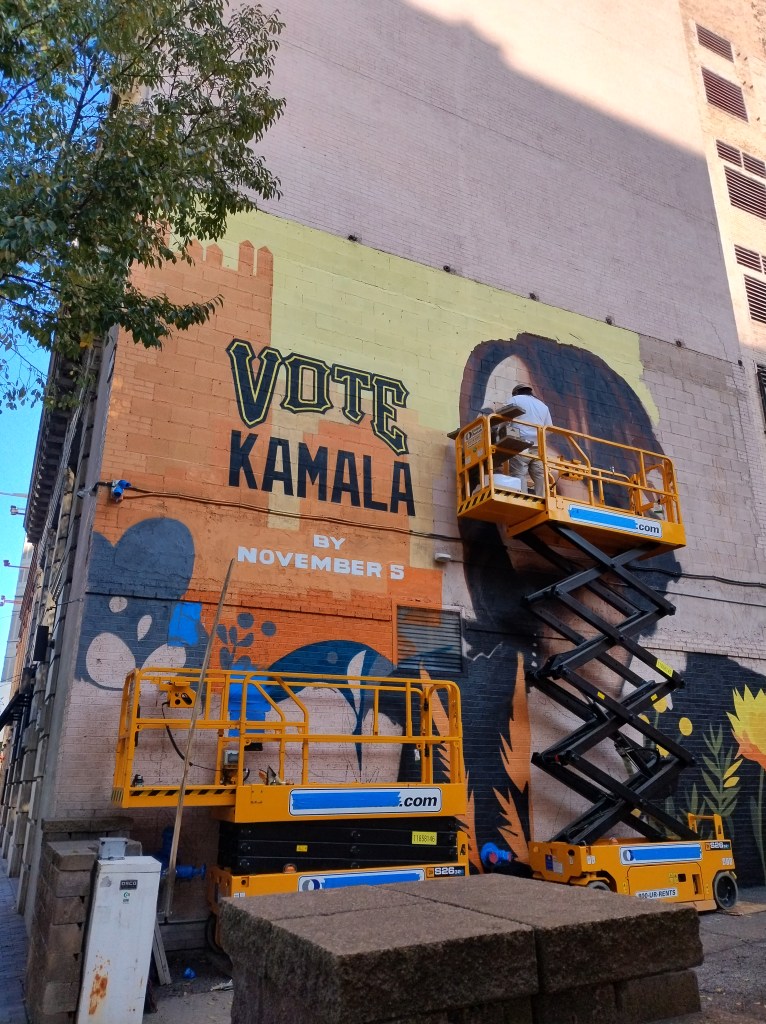
Presidential candidate Kamala Harris said this about housing in her speech at the Democratic National Convention this past week:

Photo by Palo Cech on Pexels.com

That’s why we will create what I call an opportunity economy. An opportunity economy where everyone has a chance to compete and a chance to succeed. Whether you live in a rural area, small town, or big city. As President, I will bring together: Labor and workers, Small business owners and entrepreneurs, And American companies. To create jobs. Grow our economy. And lower the cost of everyday needs. Like
health care. Housing. And groceries. We will: Provide access to capital for small business owners, entrepreneurs, and founders. We will end America’s housing shortage. And protect Social Security
and Medicare.

I am interested in hearing more about this plan for housing for two reasons:

  1. I think many Americans perceive this as a need. People need more housing, particularly cheaper good housing. They want the opportunity to invest in a residence and a community. They want the opportunity for that ownership to be an asset down the road. They do not want housing to take up too much of their budget.
  2. I have tried to keep track of this issue during recent presidential elections and it does not appear to an issue that candidates lead with. There could be multiple reasons for this: it is difficult to addressing housing at a national level when it is often a local issue and it may not be a “winning” issue with voters compared to other topics. However, I have often thought that a candidate that could promote a reasonable and doable strategy that could help people would do well to do so.

Could the two candidates offer more about housing in the coming weeks?

Weird repeat occurrences in the Chicago suburbs: guns in cars at Naperville Topgolf, trucks hitting Long Grove covered bridge

Follow the news in the Chicago suburbs and it seems two stories come up pretty reliably.

Photo by Ann H on Pexels.com

First, the Topgolf facility in Naperville now has had 22 gun arrests in the last two years:

For the third time in less than two weeks, police have made a firearm-related arrest in the Naperville Topgolf parking lot…

Coffey’s arrest brings the number of firearm-related arrests made outside the Naperville Topgolf since August 2023 to 22…

Officers were in the business’ parking lot in squad cars when one of them observed Coffey exiting a white Mercedes SUV while smoking what they believed to be cannabis, Krakow said. Officers exited their squads and approached on foot. Their investigation into the cannabis led to a search of Coffey’s vehicle.

Police’s search yielded a 9mm handgun that was recovered from a backpack, Krakow said.

How many more times will this happen? Naperville is a wealthy and high status suburb.

Second, a covered bridge in Long Grove keeps getting hit by trucks. It just happened again earlier this week:

Once again, a box truck became stuck under Long Grove’s iconic covered bridge early Monday morning, with the vehicle taking the brunt of the damage.

“The vast majority of the times this happens, it damages the vehicle,” Long Grove Assistant Village Manager Dana McCarthy said. “The bridge is made of heavy duty steel.”…

Though the bridge has certainly been hit well over 50 times since it reopened in 2020 after an extensive renovation, the village itself doesn’t keep count of the instances.

If this happened a few times, it could be a pattern in suburbs where these things tend not to happen. “Strange but true” stories from the suburbs that happen a few times.

But now people are paying attention – both of these occurrences are now “common” – and they keep happening. The media widely reports on the police work at Topgolf yet more arrests are made? There are plenty of warnings around the bridge about the height but trucks keep trying to drive through?

I assume the phenomena will end at some point but it is hard to know when.

    Big political changes in the suburbs, DuPage County edition

    The suburbs are the place where elections are won and lost these days yet voting patterns in the suburbs are dynamic. For example, here is an overview of what has happened in DuPage County, Illinois, in recent decades:

    Photo by Edmond Dantu00e8s on Pexels.com

    “It is easy to forget this county, DuPage, was once one of the reddest counties in America not long ago,” Conroy said during Tuesday morning’s Illinois delegate breakfast.

    She noted that DuPage was where “Republican presidents raised millions of dollars, produced a U.S. speaker of the House” and led both chambers in Springfield. “But 12 years ago, that tide began to turn,” said Conroy, who in 2012 became the first Democrat to win an Illinois House seat in a district entirely in DuPage.

    In 2022, Conroy again made history as the first female elected to head the DuPage County Board and the first Democrat to hold that title in several decades. That same year, Democrats solidified a 12-6 majority on the county board. In 2018, Republicans held all but one seat on the county board.

    Conroy said Democratic women also now make up an overwhelming majority of state representatives and senators representing DuPage in Springfield.

    This is a change echoed in the other collar counties of the Chicago area: a shift from Republican bases to Democratic majorities. This is all part of the emerging complex suburbia.

    At the same time, this is not the first time there was a major political shift in DuPage County. Local historical Leone Schmidt detailed political life in early decades in the county in the 1989 book When the Democrats Ruled DuPage. She describes the book this way:

    It covers the impassioned and sophisticated political activities, the interplay of parties and personalities, and the heyday and fall of the Democrats as a force in Du Page County.

    Democrats kicked off local political life and helped the county become its own entity. But, within a few decades, Republicans came to dominate local offices. Historian Stephen J. Buck says in the 2019 article “Free Soil, Free Labor, Free Men: The origins of the Republican Party in DuPage County, Illinois”:

    By 1860, the Democrats were the minority party in the county, and the Republicans successfully imposed the importance of party loyalty, regardless of local issues, on county politics.

    The county has experienced at least two major shifts in political leadership and voting patterns. As politicians and parties fight for votes in DuPage County and other suburbs, there could be future shifts. What can look like solid majorities through multiple decades can change – they have before.

    Americans on what they think the cutoffs are to be considered “financially comfortable” and “wealthy”

    A recent survey asked Americans how much wealth someone would need to fit into different categories. Here are some of the results:

    Photo by Pixabay on Pexels.com

    Charles Schwab today released additional findings from its 2024 Modern Wealth Survey. Since 2017, Schwab has collected data annually on Americans’ perspectives on saving, spending, investing, and wealth. This year’s study reveals that Americans now think it takes an average of $2.5 million to be considered wealthy – which is up slightly from 2023 and 2022 ($2.2 million).

    By generation, Boomers have the highest threshold of what it takes to be considered wealthy, at $2.8 million, while the younger generations, Millennials and Gen Z, have lower thresholds of what is considered wealthy. At the same time, Americans say that the average net worth required to be financially comfortable is $778,000. The average net worth required for financial comfort reached a peak last year at $1 million, but this year, Americans’ estimations are more in line with 2022 ($775,000) and show an upward trend when compared with 2021 ($624,000).

    Income is one measure of considering status and social class and wealth – adding up assets and subtracting debts – is another way. It may have benchmark figures like income does; perhaps making six figures is similar to being a millionaire or the median income might be akin to median wealth.

    The survey referenced above has less intuitive figures after considering all the responses. To be wealthy, $2.5 million is up from previous years. It is certainly above $1 million and $2 million. It feels oddly specific, as if having $2.3 million would not quite qualify but $2.8 million certainly does (even for Boomers!).

    The figure for being financially comfortable is also interesting: $778,000. Less than $1 million, more than $500,000. The figure has gone up and done in recent years. Having less than $778k feels uncomfortable and insufficient?

    This would be fascinating to track over time with multiple kinds of data. If asked to add up different costs or expenses people might face, would the responses from the survey be revised upward or downward? Does this depend highly on the respondent’s current income level or cost of living or other traits? How much do broader economic factors affect the responses people give?

    Given the importance of jobs reports for policy and the economy, why are there so many later revisions to the data?

    The number of jobs gained in the United States is expected to be revised:

    Photo by Vojtech Okenka on Pexels.com

    Goldman Sachs Group Inc. and Wells Fargo & Co. economists expect the government’s preliminary benchmark revisions on Wednesday to show payrolls growth in the year through March was at least 600,000 weaker than currently estimated — about 50,000 a month.

    While JPMorgan Chase & Co. forecasters see a decline of about 360,000, Goldman Sachs indicates it could be as large as a million.

    These are not just numbers; this data has implications for policies and economic conditions. Why are they being revised?

    Once a year, the BLS benchmarks the March payrolls level to a more accurate but less timely data source called the Quarterly Census of Employment and Wages, which is based on state unemployment insurance tax records and covers nearly all US jobs. The release of the latest QCEW report in June already hinted at weaker payroll gains last year…

    For most of the recent years, monthly payroll data have been stronger than the QCEW figures. Some economists attribute that in part to the so-called birth-death model — an adjustment the BLS makes to the data to account for the net number of businesses opening and closing, but that might be off in the post-pandemic world…

    Ronnie Walker at Goldman Sachs says the QCEW figures are likely to overstate the moderation in employment growth because they will strip out up to half a million unauthorized immigrants that were included in the initial estimates.

    In other words, this is a measurement issue. The first measure comes from a particular set of data and the revision utilizes a different set of data that takes more time to put together. There might also be discrepancies on what is included in each set of data, not just differences in the sources of data. This mismatch leads to later revisions.

    Given our data and analysis abilities today, isn’t there some way to improve the system? Could we get (a) more complete data quicker or (b) better estimates in the first place or (c) even new data sources that could provide better information? To have an initial set of figures that people respond to and then a later set of figures that people respond to seems counterproductive given the stakes involved. .

    Superfans and experiencing “collective effervescence”

    What superfans experience in a community of like-minded people could be described this way:

    Photo by anna-m. w. on Pexels.com

    Picture a crowd swaying in unison to a beloved song. Everyone assembled feels the same emotion simultaneously, says Paul Booth, a professor of media and pop culture at DePaul University. The euphoria catches and builds.

    The experience, known as “collective effervescence,” can feel transcendent, he says, almost telepathic.

    “I think it has to do with wanting something in our lives that we can lose ourselves in,” he says. At a time of increasing polarization and cynicism—not to mention that coming election—it’s an especially wondrous connection, he adds…

    Fandom asks us to latch ourselves to something outside of us, to allow a person or object we don’t have control over to become part of our identities. How much easier to stay cool and removed, rather than risk having our enthusiasm batted down or betrayed.

    Concerts, conventions, sporting events, etc…gather with thousands of like-minded people and the activity and emotions can move people in unique ways. At one point in The Elementary Forms of Religious Life, sociologist Émile Durkheim asked:

    What other name can we give to that state when, after a collective effervescence, men believe themselves transported into an entirely different world from the one they have before their eyes?

    It is not just a place where music is playing or a game or a bunch of activities in a convention hall; it is a particular experience that individuals alone have difficulty producing. It is the product of communal energy.

    As the article notes, what happens if people experience fewer collective effervescence moments? Do humans need a certain amount to thrive – or do they suffer ill effects with fewer moments of collective effervescence?

    Eight American metro areas have homes worth over $1 trillion – and one involves a large suburb

    What do all the housing values in a city add up to? For eight American metro areas, the housing values are over $1 trillion:

    Photo by Tara Winstead on Pexels.com

    According to residential real estate website Redfin, less than 10 metro areas in America are now worth $1 trillion in collective real estate home values. Most of those areas make sense for the list, like New York, Boston and Atlanta (the latter of which has a metro population of more than 6 million people). Anaheim, on the other hand, has a population of about 350,000 people, and for years fought to disengage itself from the ignominious nickname “Anacrime,” despite being home to the so-called happiest place on Earth…

    The Orange County city reached its recently minted status due to an explosion in the real estate market in that area, with home prices up more than 12% over the past year, Redfin says. To source its findings, the Seattle-based company relied on aggregate home sale data for almost 100 million homes across the U.S.

    San Francisco, meanwhile, has not reached trillion-dollar status yet, but that’s only because the city itself is so small. When combined with other large area real estate markets in San Jose and Oakland, the number jumps to a staggering $2.5 trillion. The other cities that did cross the $1 trillion threshold are Chicago, Washington, D.C., and Phoenix.

    Nationally, the biggest overall rise in home values comes from more rural and suburban areas, Redfin says. The high cost of homeownership in Anaheim specifically points to ongoing issues in California around housing supply and affordability. Orange County has long been a wealthy area in aggregate, with pockets of affordability. Now, many prospective homeowners may be feeling the squeeze to leave, departing for less expensive homes in places like the Inland Empire and Bakersfield.

    To some degree, this measure may not have much value. The biggest metro areas are on this list. (Missing are Dallas and Houston.) Have a lot of people and have relatively high prices and a place ll make this list.

    On the other hand, Anaheim does seem like a bit of a surprise. It is a suburb of Los Angeles. In 1950, it had just over 14,500 residents. It grew tremendously in the postwar era. According to the Census Bureau, it has a median housing value of over $713,000.

    What other suburbs could be close to joining this list? They would need to be large and expensive. This would rule out many communities in the Northeast and Midwest where suburbs tend to be smaller. Are there some Sunbelt or West Coast suburbs that could join the list soon?