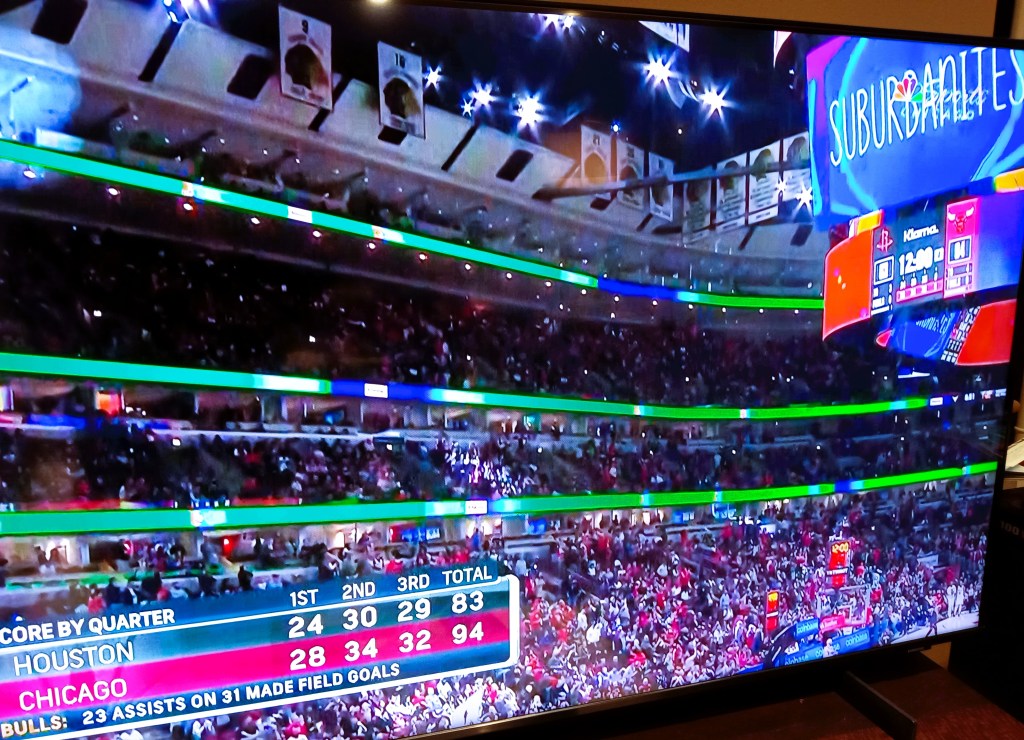
I could not tell exactly what was happening because I caught this recently on TV but I was still interested to see what was on the scoreboard at the United Center during a Bulls game:
Was this a cheering contest between Chicago residents and suburbanites? Some camera shots on the big screen? A trivia contest?
Given the population of the Chicago region, there were probably a lot of suburbanites at the game. In 2020, Chicago had 2.74 million residents and the region had 9.61 million residents. This puts the suburban population at 6.87 million. This means over 71% of people in the region live in the suburbs.
The Chicago Bulls tend to have good attendance, even if the team is not doing great. This year, the team is under .500 and the team is second in the league in home attendance. (They also have one of the largest arenas.)
Suburbanites have ideas about Chicago and its residents and vice versa. Does identifying the two groups at a Bulls game exacerbate these differences or help bring them together around their common Bulls fandom? (I am guessing it is the second as Bulls games usually are good experiences, even if the home team is not great.)
West Dundee and Bloomingdale officials have similar visions for the mall properties in their towns.
West Dundee sees a mixed-use development with residential, office, retail and entertainment. Bloomingdale’s consultants have drawn up conceptual plans showing residential, commercial and recreational development in place of the mall’s former retail buildings and parking lots.
Typically, villages stay out of the real estate business and leave redevelopment of retail centers to developers. But for West Dundee and Bloomingdale, taking ownership of their malls and clearing some obstacles, such as multiple property owners or restrictive covenants, were deemed essential for future redevelopment.
“Almost uniformly, every developer with whom we spoke stated that the site has too many complications — too many owners, too many covenants, too many uncertainties,” Nelson said last year. “The village’s aim is to bring simplicity to the process so reliable developers with established track records will be interested in partnering to reformat the area. Without municipal intervention, that simply won’t happen.”
I wonder if this is an instance where a large property owner – the owners of these malls – can afford to sit on these properties for a while to see if there will be a bigger financial return later. I remember reading in the past about parking lots in downtown areas; they are not flashing and they are not the preferred land use but the company who owns that lot can wait until there is significant demand for the property and then make a lot of money on selling the parking lot. Compared to these suburbs, the property owners may be less interested in moving quickly on a redevelopment plan. (This could also apply to recent conversations about suburban office parks and downtown office buildings: even vacant buildings might not need to be sold or redeveloped if an owner can afford to hang on to them.)
Imagine the best weather for infrastructure. It is probably not the four seasons of weather in the Chicago region:
From the State Climatologist Office in Illinois:
Chicago lies midway between the Continental Divide and the Atlantic Ocean, and is 900 miles north of the Gulf of Mexico. Chicago’s climate is typically continental with cold winters, warm summers, and frequent short fluctuations in temperature, humidity, cloudiness, and wind direction. Many consider the more moderate temperatures of spring and fall to be the most pleasant. Lake Michigan provides a moderating influence on temperature while boosting the amount of snowfall received in the city.
Such fluctuations in the Chicago region lead to potholes, closures of airports and roads plus delays, flooding, and pressure on systems at both the hot and cold ends of the temperature spectrum. Coming out of a major snow storm and heading into several days of subzero temperatures, some of everyday activity is disrupted but mostly life goes on. Humans have developed systems and practices that make it possible to live in many different conditions.
What might be ideal? How about a place with more consistent temperatures, few storms, and no flooding? I am sure there are locations in the United States that meet this more than others. Everywhere else, people and systems adapt.
Modern infrastructure that makes everyday life possible is remarkable enough in addition to adaptability to different climates and making repairs when local conditions make it difficult.
Many features of atheist churches in the U.S. are directly borrowed from religious organizations. At Sunday Assembly, where I spent three years doing research, services include collective singing, reading inspirational texts, silent reflection and collecting donations. They center around a central lecture given by a member of the congregation or a member of the larger local community. I attended one service where an astronomer gave a talk about the New Horizons spacecraft’s mission to Pluto. At another service, a member of a local community garden organization talked about building community through her community garden program.
Atheist church organizers I met told me that they intentionally borrow the structure of a church because they see it as a good model for building effective rituals and communities. More generally, the structure of a “congregation” is popular and familiar to most attendees.
However, there are key differences. Sunday Assembly has no hierarchical structure, and there is no pastor or minister, meaning that decisions are made by the community. Attendees share duties for running the services and finding speakers and readings.
The other key difference is the complete lack of reference to the supernatural. Lectures and rituals I have encountered at atheist church services are centered around affirming atheistic beliefs, celebrating science, cultivating experiences of awe and wonder for nature, and creating communities of support.
Communities and rituals are pretty important to human beings. So are religious beliefs and practices.
I wonder how much the decline of civic organizations and engagement also contributes to these kinds of congregations. Yes, there is a decline in religiosity – but there is also less engagement with civic groups and community life.
Additionally, will the same sorts of issues that religious congregations face – disagreements and fracturing, abuses of power, difficulties acquiring resources – be ones that secular congregations encounter?
Above all, though, the problem seems to be us — the American public, the American driver. “It’s not an exaggeration to say behavior on the road today is the worst I’ve ever seen,” Capt. Michael Brown, a state police district commander in Michigan, told me. “It’s not just the volume. It’s the variety. There’s impaired driving, which constituted 40 percent of our fatalities last year. There are people going twice the legal limit on surface streets. There’s road rage,” Brown went on. “There’s impatience — right before we started talking, I got an email from a woman who was driving along in traffic and saw some guy fly by her off the roadway, on the shoulder, at 80, 90 miles an hour.” Brown stressed it was rare to receive such a message: “It’s got so bad, so extremely typical,” he said, “that people aren’t going to alert us unless it’s super egregious.”
In 2020 and 2021, the National Highway Traffic Safety Administration has calculated, approximately a quarter of all fatal wrecks in the United States involved vehicles traveling above the posted speed limit; a significant percentage of the dead, whether passenger or driver, were not wearing seatbelts. In line with the trends documented by Kuhls in Nevada — and observed firsthand by Brown in Michigan — national intoxicated-driving rates have surged to the extent that one in every 10 arrests is now linked to a suspected D.U.I. And aggressive driving, defined by AAA as “tailgating, erratic lane changing or illegal passing,” factors into 56 percent of crashes resulting in a fatality. (Distressingly, this statistic does not cover the tens of thousands of people injured, often critically, by aggressive drivers, or the 550 people shot annually after or during road-rage incidents — or the growing number of pedestrians and cyclists deliberately targeted by incensed motorists.)
Take the bad behavior and add the perils of distraction by smartphone — responsible, by one conservative estimate, for about 3,500 deaths annually — and you’re left with what Emily Schweninger, a senior policy adviser at the U.S. Department of Transportation, described to me as a “genuine public-health crisis” on the level of cancer, suicide and heart disease.
Much could change in the coming years to address this issue. Safety features in vehicles. Changed designs of roadways and spaces for pedestrians and bicyclists. Other efforts need more time and capabilities: self-driving vehicles, a changed culture around roads, driving, and community life.
But, part of the issue is whether these accidents and deaths are a problem or not. Americans like to complain about other drivers and tend to see their own driving as okay. Driving is required in many places. Some drivers might even enjoy driving. The delivery of many of our goods requires driving. Are deaths via vehicle just the price Americans are willing to pay for driving?
Addressing this issue is a long-term project. All of daily life contains some risks but Americans tend to not think much about the risks of driving even as it impacts many lives on a daily basis. Does this mean a national safety campaign is needed? A serious conversation about how necessary driving should be? A need to invest in new technologies and options? On one hand, plenty of people would have experience with this issue. On the other hand, it will take a lot of work to convince people to support significant changes to American driving and all that goes with it.
America’s offices are emptier than at any point in at least four decades, reflecting years of overbuilding and shifting work habits that were accelerated by the pandemic.
A staggering 19.6% of office space in major U.S. cities wasn’t leased as of the fourth quarter, according to Moody’s Analytics, up from 18.8% a year earlier. That is slightly above the previous records of 19.3% set in 1986 and 1991 and the highest number since at least 1979, which is as far back as Moody’s data go…
That glut weighs on the office market to this day and helps explain why vacancies are far higher in the U.S. than in Europe or Asia. Many office parks built in the 1980s and earlier struggle to find tenants as companies cut back on space or leave for more modern buildings.
“The bulk of the vacant space are buildings that were built in the 1950s, ’60s, ’70s and ’80s,” said Mary Ann Tighe, chief executive of the New York tri-state region at real-estate brokerage CBRE.
And just as in the early ’90s, it is the overbuilt South that is hit hardest. Today, the three major U.S. cities with the country’s highest office-vacancy rates are Houston, Dallas and Austin, Texas, according to Moody’s. In 1991, Palm Beach and Fort Lauderdale in Florida and San Antonio held those positions.
This sounds like a cyclical market: during financial downturns, fewer companies want office space and vacancies rise. During economic success, more companies expand and make use of the space. When more space is built during the good times, that same space is not necessarily needed later.
Does that mean that COVID-19 was only a partial contributor to office vacancies? Was a reckoning going to come for urban office space even without a global pandemic? Or might office space be back in demand again soon as economic conditions change?
I can see why new office space is desirable to fund and build. Whether it should be built, given the cycles discussed above, is another story. And if office space cannot be easily converted to other uses, how much more is really needed in major cities?
To Lee and his colleagues’ surprise, millennials aren’t moving to nearby dense, walkable exurbs. They’re getting way out to peripheral suburbs.
“It turned out that millennials are moving to the most boring places in the world,” says Lee, who’s now a professor at Seoul National University. “They’re moving to really single-family-dominated areas with very few urban amenities.”
What might make these places less boring?
It’s expensive to live in the places millennials prefer: walkable communities with lots of shops, restaurants, and public space. An analysis published last year found that homebuyers in the 35 biggest American metropolitan areas paid 34% more to live in walkable neighborhoods, while renters paid 41% more. Paul Stout, a millennial landscape-architecture student with a popular urbanist TikTok account called Talking Cities, says he constantly hears from followers who wish they could afford a home within walking distance of places like coffee shops…
But while millennials wallow over the choice between a tiny apartment in a dense city and a lonely, sidewalk-less subdivision, urbanists insist any place can be dense and walkable as long as land-use laws allow it and people want to live there.
“There’s a lot of places in the suburbs that could be really lovely to live if you could only put a grocery store or a coffee shop on the corner,” Stout says. “I’m optimistic that you could actually make living walkable almost anywhere in the US, given the right package of zoning reform.”
Does this mean suburbs further out from the city are really “the most boring places in the world”? Or are millennials and many others pushed into binary choices where they prioritize cheaper and larger housing and thus give up other community features? In many American communities, they cannot have both cosmopolitan street life and ample affordable housing they can own.
And I would venture to guess that at least a few of American suburbanites do not find them to be boring places. (One could argue they were pushed into this option rather than chose it but that is a different argument.) Millennials and Gen Z may find them more boring than older adults and this would be interesting data to compare.
My guess at how Peoria or a similar city could truly boom is that a major, well-known company moves its operations to the city. While the opposite might seem to be happening in cities like Peoria – such as Caterpillar moving out – imagine a Silicon Valley company making Peoria home. Such a move could be good for its employees and help improve the fortunes of a different area.
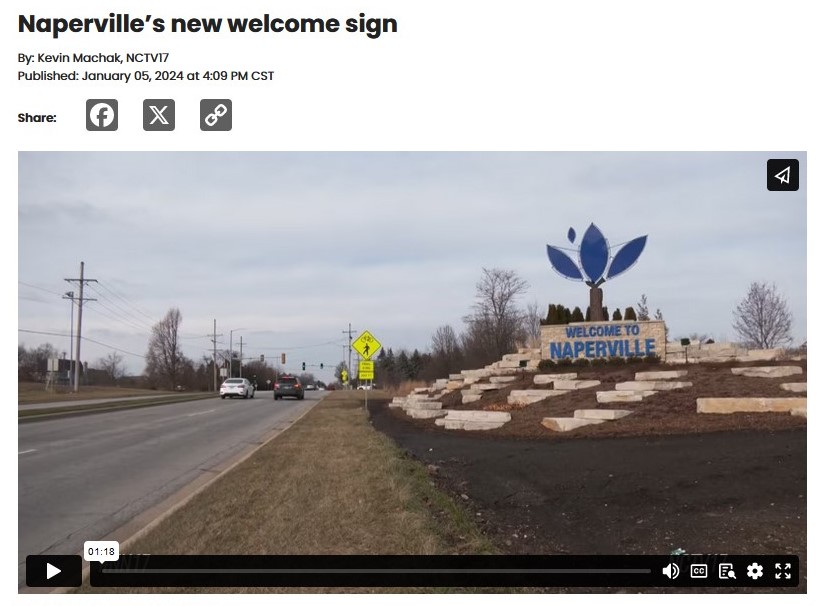
Naperville spent $100,000 for a unique sign welcoming people to the community along its border with Bolingbrook. Amid some concerns from residents about the price, here is information about the sign and the overall budget of the city for 2023. First, the sign:
A freshly-completed “Welcome to Naperville” sign sits along the entry route, just next to the trails among DuPage River Park and just across from DuPage River Sports Complex.
The design stems from the city of Naperville’s official logo of 50 years, which depicts a tree with water running underneath. Surrounding the sign are limestone slabs. The city plans to add fresh vegetation to the area in the spring.
The new greeting, which costs $100,000, is just one of a number of beautification projects that have been planned for since 2021 and officially budget-approved for since the fall of 2022. At that time, the city council approved of $250,000 for the Department of Public Works to make multiple improvements throughout the city…
Keeping the current economic climate, our mission, and strategic priorities in mind, the 2023 City of Naperville budget is recommended at $603.46 million, an overall increase of 11.6% from the $540.58 million 2022 budget. Additional capital expenses are the primary driver behind this increased investment in our organization and community. It is worth noting that the 2023 budget leverages existing revenue streams and fiscal policies. No new taxes, fees, or other revenues are recommended to support the 2023 budget proposal.
From my math, this means the sign cost less than one-tenth of one percent of the city’s budget. Even building one of these on each other side of the city – north, east, west – would not take much money.
Is this an unnecessary expenditure? That is a different question. Signs are not necessarily cheap and they can be bland or strange. For example, see this recent one in Naperville for a new subdivision. This new one welcoming people to the suburb is unique with its 3D form and landscaping. Naperville has a history of spending money for parks and beautification: just look at the Riverwalk over time (and I would guess many would say this was a good investment). Additionally, Naperville is a unique suburb that sees itself as having a particular status.
If the goal is to continue to brand the community in a particular way, this sign stands out and is a small fraction of the budget.
Buffalo, New York is projected to be the hottest housing market of 2024, according to an analysis from real estate company Zillow.
Zillow called affordability the “most powerful force driving real estate,” bringing lower-cost markets in the Great Lakes, Midwest and South regions to the top of the company’s 2024 rankings.
“Housing markets are healthiest where affordable home prices and strong employment are giving young hopefuls a real shot at buying and starting to build equity,” said Anushna Prakash, data scientist for Zillow Economic Research…
According to Zillow’s analysis, Buffalo has the highest number of new jobs per home permitted – a measure of expected demand, as new jobs often mean new residents.
The key seems to be the expected job growth in Buffalo. Yes, there is cheaper housing in the region but a growth in jobs means more people which means more demand for housing. How many people would choose a job in Buffalo because of the cheaper housing instead of going elsewhere where housing would be more expensive?
On the list of the predicted top ten housing markets are 6 regions in the Midwest or Northeast – the Rust Belt. This includes Buffalo, Cincinnati, Columbus, Indianapolis, Providence, and Cleveland. If this prediction comes true, would this help create more momentum in these places for a brighter future?
For example, Buffalo’s population peaked in 1950 with over 580,000 residents. In the 2020 Census, Buffalo had over 278,000 residents. The metropolitan region peaked in population in 1970. Similarly, Cincinnati (#2 on the predicted list) peaked in population in 1950 and has lost nearly 200,000 residents since (even as the metro area has grown slowly since then).






 Legally Sociable