When a billboard with a basketball player slowed down Chicago traffic

Along one of the most congested stretches of highway in the United States, a mural of NBA player Dennis Rodman led to even more traffic in early 1996:

In March 1996, men’s clothier Bigsby & Kruthers painted an image of Rodman on the side of a building just off the Kennedy Expressway. The 32-foot-high mural stared eastbound traffic in the eye, causing gapers delays in both directions that snarled traffic as badly as road construction.

An operations manager for a traffic-data company said the larger-than-life image added 20 to 30 minutes to morning commutes on the Kennedy and the Edens Expressway. And that was before Rodman’s hair was even on it.

“The 75-foot-wide advertisement included a color image of Michael Jordan looking down on traffic,” a March 26, 1996, Tribune story read. “But it’s the oversize Rodman who has taken the rush out of rush hour. His power glower is punctuated with three earrings and a nose ring; his arms are crossed, and his natty suit has the sleeves ripped out to reveal his collection of tattoos. He is even leaning forward, as if he just might want to butt heads.”

Standing just before the North Avenue exit, the painting was wider and taller than billboard laws normally would have allowed. But because the building was being used as a Bigsby & Kruthers warehouse, the advertising was not limited in size.

While most of the mural was black and white, the hair was in color — and changed as Rodman’s dye did, only adding to the traffic headaches.

Alas, the mural didn’t last. Bigsby & Kruthers covered it up a little more than two weeks after it first appeared in response to the concern of traffic officials.

A few quick thoughts:

  1. Cities have regular spots that come up on traffic reports and the Kennedy is typically on the list in Chicago (“from O’Hare to downtown”). These spots can be on the list for a variety of reasons: a chokepoint for traffic, an odd curve or different road design (such as narrowing of lanes), and/or regular accidents. Billboards probably are not common contributors to this.
  2. At the same time, certain billboards or advertisements can be become part of the urban highway experience. As commuters travel regular routes, they get used to seeing particular signs. New signs can also garner attention if they are a significant change or unusual. The other sports one that comes to mind from the Chicago region involved a series of Brian Urlacher balding treatment billboards along I-294 that popped up several years ago. I’m not sure if it caused any delays but it certainly caught people’s eyes as one of the city’s most recognizable recent sports stars suddenly had hair.
  3. The particular Rodman billboard came as part of a perfect storm. Take a regularly congested stretch of highway plus an incredible basketball team that set the record that year for most wins in a season plus a truly unique player on the billboard (and not one who fit the typical Chicago image). The billboard did not last long but it left a mark.
The relatively narrow sidewalks in both cities and suburbs

With fewer cars on the roads, Tom Vanderbilt considers the possible size and role of sidewalks:

Even in a place such as New York City, sidewalks, as the architect John Massengale documented, have been shrunk over the years to make more space for cars. In my own neighborhood, many stretches of sidewalk are the bare minimum of five feet wide. This, per long-standing research, accommodates two pedestrians at once, but begins to fall apart at anything beyond that: two pedestrians encountering one walking in the opposite direction; a kid on a scooter; people stopping to chat. Making matters worse are sidewalk-shrinking obstructions such as trees, light poles, or, most egregious, traffic signs. That same street meanwhile, will dedicate more than 10 feet to an active vehicle-travel lane, as well as two additional lanes of parked vehicles—each larger than the sidewalk itself.

The larger question that Vanderbilt and others address is this: are cities made for cars or people? Is the goal of urban planning to move as many cars as efficiently as possible or to encourage a vibrant streetlife and pedestrian activity?

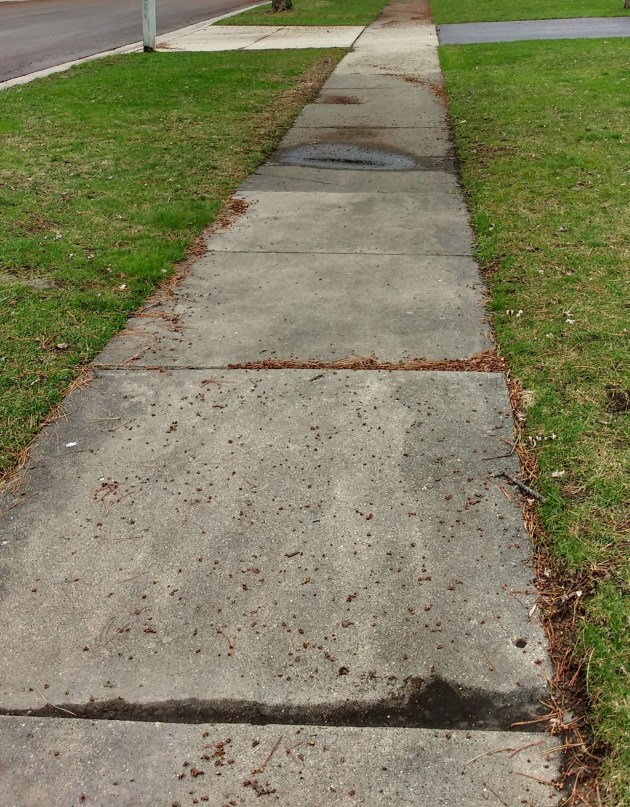
This also applies to the many residential and suburban areas of the United States. In recent weeks, I have thought about this in my residential neighborhood. There is little room for multiple people. The difference is starker when comparing the sidewalk to the nearby roadway, which easily accommodates two cars passing at 30 mph. And with the size of the residential sidewalk, this forces walkers, runners, and bicyclists either into the grass or, more recently with COVID-19, into the street so that everyone has enough space.

SidewalkResidential

I am guessing various actors would throw up some roadblocks regarding wider sidewalks in residential neighborhoods: they would be more costly to put down, they would take away land from yards, a wider sidewalk is less necessary in normal times (and the rate of sidewalk use does seem up in my locale). But, the way to counter this might be to suggest the sidewalk could expand while the street could shrink. Do we really need such wide residential streets? Would we rather make our neighborhoods more pleasant for cars or people? The American suburbs are tied up with cars and driving but this does not have to always require sacrifice from those who want to walk, run, and bike.

Marketing 101 example: equating pickup trucks to the American way of life

A look at declines in pickup sales for American automakers includes this description of what pickups represent:

“Pickups represent a rugged sense of individualism for many Americans. They are the very definition of America in that they are larger than life like America and can both work and play hard,” said Erich Merkle, U.S. Ford sales analyst.

This is both a concise and bold marketing statement: pickups are the American way of life! The statement ties to multiple big themes that run through American culture: individualism, larger than life, hard work and lots of play. And it is a vehicle that allows the owner to participate in the pervasive driving culture in the United States. And all this just for $35,000 to $50,000 for a new truck!

A truck, like many consumer goods, is not just about functionality but is also a statement about the owners and what they want to be. Buying smartphones, single-family homes, clothing, and more fall into the same process: marketing appeals to our want for what we own to match our personality and/or aspirations. A truck is not just a truck; it is a statement about the driver. It says, “I eat a Prius for lunch” or “I need to do important projects” or “I have the resources to buy a new truck” (among other possible messages).

Then I am reminded that it is just a pickup truck. Vehicles are necessary in many American communities in order to get from Point A to Point B. But, many vehicles may work in order to accomplish regular tasks. If the primary vehicle use is for commuting to work or regular errands such as buying groceries or dropping off and picking up kids, a truck is probably not needed. Some people need trucks for regularly hauling items or for work.

For now, this match between pickups and the American Dream “works.” There are numerous other products that would wish to tie themselves as closely as pickup trucks to the base values of the American Dream. It may not be this way in several decades; perhaps the rugged individualism and freedom will be attached to fleets of electric vehicles that are at everyone’s beck and call. Until something changes, expect to continue to see the marketing pitch that pickups equal the American way of life.

A brief history of the Sunday drive

With Illinois residents asked to shelter in place, architecture critic Blair Kamin suggests the Sunday drive could be revived – and provides a brief history of the practice:

Building on the precedent of the high society horse-drawn carriages that rolled down elegant boulevards in the late 19th century, the Sunday Drive is thought to have originated in the 1920s — just a few years after the great influenza epidemic of 1918 that killed at least 50 million people worldwide…

Henry Ford, whose mass production methods made cars available to millions, is said to have supported the Sunday Drive because it helped to sell cars…

The popularity of the Sunday Drive reached its apex in the 1950s and 1960s, when cars were still associated with personal freedom, not air pollution or suburban sprawl.

But something changed in the 1970s. Perhaps it was rising gas prices or a heightened environmental consciousness. Or maybe, some urban planners think, suburban sprawl was blurring the once-clear boundary between town and country. Where once there were farm fields and expanses of nature, now there were strip malls and traffic-jammed arterial roads. That made the Sunday Drive a lot less alluring.

This impulse is not foreign to Americans today. Driving is romanticized in many ways, from the celebration of road trips to marketing for cars which shows happy drivers moving through alluring landscapes to ordering social life in the suburbs around the need to drive. At the same time, as Kamin notes, driving is a humdrum activity much of the time. The car commercials that show people cruising down empty roads in the middle of the day do not match everyday experiences.

I also wonder about the connections between Sunday drives and other activities. For example, take organized religion. The classic sociological study Middletown describes the changes in a small city with the introduction of cars, including some residents who shifted from going to church on Sundays to taking recreational drives with family. The car offered an escape from the typical way of life. As a more recent example, data suggests younger people are less interested in getting their driver’s licenses. Why would you want to go for a leisurely drive when a smartphone or tablet or laptop offers access to what information and destinations you want?

Less traffic, faster driving

Reports suggest more drivers are going fast on emptier roads:

Despite there being far fewer vehicles on the road due to COVID-19 stay-at-home orders, state highway safety officials across the country are seeing a severe spike in speeding. Many states have reported alarming speed increases, with some noting a significant surge in vehicles clocked at 100 mph or more.

Being a safe driver should always be a priority, but during the coronavirus pandemic, traffic safety experts at the Governors Highway Safety Association (GHSA) say it is more important than ever. “While COVID-19 is clearly our national priority, our traffic safety laws cannot be ignored,” said GHSA Executive Director Jonathan Adkins. “Law enforcement officials have the same mission as health care providers — to save lives. If you must drive, buckle up, follow the posted speed limit and look out for pedestrians and bicyclists. Emergency rooms in many areas of the country are at capacity, and the last thing they need is additional strain from traffic crash victims.”

During the past month, pedestrian and bicycle traffic are reported to have increased exponentially, while motor vehicle traffic is down. Adkins noted that GHSA is encouraged to see so many communities across the country making roadways more accessible to pedestrians and bicyclists. To keep roads safe for everyone, traffic safety officials nationwide are pleading with motorists to slow down and respect traffic safety laws…

A 2019 report on speeding by GHSA, “Speeding Away from Zero: Rethinking a Forgotten Traffic Safety Challenge,” highlights excessive vehicle speed as a persistent factor in nearly one-third of all motor vehicle-related fatalities, while a 2020 GHSA report on pedestrian fatalities, published in February, finds that pedestrians now account for 17% of all traffic-related fatalities.

In many metropolitan regions, traffic is pretty constant throughout the day. COVID-19 has reduced the number of daily work trips plus some of the other reasons for cars and trucks on the road.

With more open road, perhaps it is “natural” for drivers to feel they can go faster. I am reminded of the argument by New Urbanists that narrower roads lined with parked cars and trees close to the street push drivers to slow down. The illusion is that with fewer potential obstacles on the road, a driver can be safe even while going faster. Of course, going faster reduces the time drivers have to correct and avoid things in their path.

It would be interesting to note how much local police forces are responding to speeders now. Is it worth stopping them if there is a risk of transmitting COVID-19? Are police resources needed more elsewhere? At this point, what other options do officials have in reducing speeds on less crowded roads?

The scale of warehouse and intermodal facilities in Will County, Illinois

As residents and local officials in Joliet and Will County debated a proposal for a new 1,300 acre office park, WBEZ put the size of the issue at hand in perspective:

The county is home to the largest inland port in North America and 3.5% of the nation’s GDP passes through here…

And $65 billion worth of products moves through Will County annually, according to the Will County Center for Economic Development.

In other words, this an important area for the current economy and the land use case has local, regional, and global implications. A few thoughts:

  1. Joliet and neighboring communities might not want the additional facilities and trucks but having these facilities in this part of the metropolitan region might be good for 9+ million residents. Balancing local interests and metropolitan interests is not easy. And the Chicago region has a lot of railroad and shipping bottlenecks.
  2. This is a symptom of larger economic changes as the economy became globalized, shipping goods across the country and on-time delivery became common, and Internet sales picked up. The effects may be local but Will County is part of a larger system.
  3. The changes in Joliet over time are striking, The news story hinted at how the community, what social worker Graham Romeyn Taylor in Satellite Cities: A Study of Industrial Suburbs in 1915 would have called an “industrial suburb,” has changed:

“Three steel mills closed. Caterpillar went from 8,000 people to a little over a thousand. We had numerous manufacturing plants shuttered,” said John Grueling, president and CEO of the Will County Center for Economic Development.

No other county in Illinois has seen job growth like Will County. It’s the epicenter of transportation for goods that move across the region and country with North America’s largest inland port. Now another real estate company wants to expand in the area by developing a logistics business park, and its raising concerns about the future of the county.

In summary: local land use decisions can have big impacts.

(See an earlier post about how the Will County community of Elwood responded to a large intermodal facility.)

A way to fight app directed through traffic: cul-de-sacs

The suburbs are full of of cul-de-sacs. Homeowners might prefer them because of the quiet and the space that they allow for kids and vehicles. They can help developers and builders fit more houses into spaces.

At the same time, cul-de-sacs may be the bane of New Urbanism as neighborhoods with many of them do not have a consistent street grid and they are primarily lined by private single-family homes. One video promoting New Urbanism put it this way: The greatest threat to our planet is…

CuldeSacsfromBuilttoLast

Yet, cul-de-sacs do provide one additional advantage in today’s world. They can limit the effectiveness of Waze and other traffic or mapping apps: cars and traffic cannot cut through cul-de-sacs. I saw this argument recently in a 2001 newspaper article where a suburban leader said they had restricted commercial development to main roads and highways and the high percentage cul-de-sacs and loops among the residential roads kept neighborhoods quiet. With more cul-de-sacs, more traffic is routed to arterial roads, streets that can usually accommodate more volume. Cul-de-sacs help make residential neighborhoods harder to navigate; I can think of several residential neighborhoods in my area that make it very difficult to find your way through if you are not familiar with it because of the winding roads and dead ends.

New Urbanists would argue that this is not ideal: more cars on arterial roads is going to lead to more congestion (as opposed to a grid system that provides drivers lots of options), arterial roads may be less friendly to pedestrians and bicyclists, and we should be working to reduce driving anyhow rather than planning communities around cul-de-sacs that depend on cars.

Speed bumps, roadside speed monitors, and other devices might not be enough to stop through traffic in residential neighborhoods. Permanent cul-de-sacs could do the trick – but at a cost to the overall fabric of the neighborhood and community.

Imagining tipping points for when Americans will not be hesitant about getting into a self-driving vehicle

A recent survey from AAA suggests Americans are not ready for self-driving vehicles:

The survey shows only 1 in 10 drivers say they would trust riding in a self-driving car, and 28% say they don’t know how they feel about the technology.

According to AAA, trust in automated vehicles can improve with more tangible information on key issues, as well as quality education and experience.

For instance, six in 10 Americans say they would like to have a clear understanding of who is legally responsible in a crash with a self-driving vehicle.

Seven in 10 Americans said they would feel safer riding in a self-driving vehicle if they had the ability to take over control is something goes wrong.

There are a few different issues to address here. Addressing just one, such as who is legally responsible, might not be enough to get people into a vehicle.

I wonder what the tipping point will be on this. Several scenarios could present themselves:

1. A government ruling or edict that makes self-driving cars more attractive. Imagine a guideline that 20% of vehicles must be self-driving in five years.

2. A company that does not make these vehicles invests heavily in them. Think a ride sharing or rental car company goes all in with a fleet of vehicles.

3. Trucking companies switch over to self-driving trucks to cut costs. Would Americans be okay with a self-driving cars if trucks are already doing this (and the alternative might be higher prices for delivered goods)?

4. There is a cool self-driving vehicle that just catches everyone’s attention. Tesla seems to capture attention but does not have a fully-functional self-driving feature yet.

5. There is a significant safety issue that arises with regular vehicles or driving is soon seen as a significant health issue. Perhaps at some point Americans will get fed up with the 30,000+ deaths a year in car accidents. (Could be connected to #1.)

Given the concerns people have, it is hard to know when self-driving vehicles will become a significant presence on the road. 2030? A number of things will need to come together for fears to subside.

Calculating the costs of commuting versus benefits of living further from work

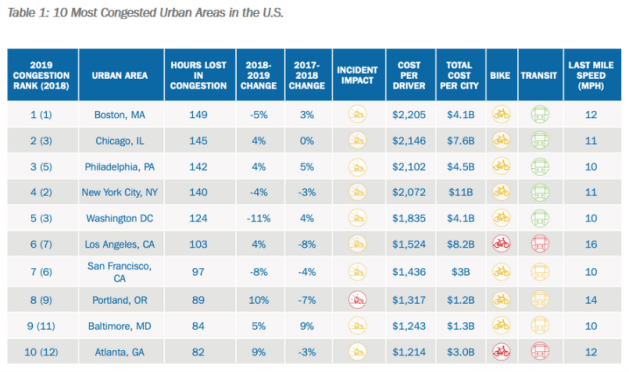
INRIX recently published data on traffic and congestion in major American cities with Boston leading the way. Here is one of the data tables:

INRIXcongestion2020

When put in these terms, it looks like commuters lose a lot of hours and money by sitting in traffic. In addition to the time it should take to commute by car, drivers in Boston lose over 6 days to congestion and over $2,000 dollars. The cost for the city/region is huge when all the drivers are added together. In New York City, $11 billion lost!

On the other hand, people keep commuting. Why would they do this in light of these costs? The pull of the suburbs and locations away from their work is strong. Perhaps workers should be able to live near their work but a good number choose or are pushed to locations far from their jobs. And they might be willing to put up with these costs because the places where they live offer other good things (and measurable benefits). In American life, suburbs offer single-family homes, places for family life, and more. Losing 100+ hours in traffic each year in the biggest cities could be tolerable if it comes with a bigger, cheaper home in a well-regarded community.

In an ideal world, workplaces and communities that people want to live in and would thrive in would be located near each other. Sometimes they are but often they are not. In a country where Americans and their government have prioritized certain things – driving over mass transit throughout metropolitan regions, for example – even the hassles of commuting make some sense.

Need bigger garages and parking spaces for bigger vehicles

Americans’ interest in bigger vehicles means more space needs to be devoted to their storage:

Across America, the drive for bigger vehicles is bumping into physical limitations. SUVs and pickups are getting so large that they’re struggling to fit into some home and parking garages and public parking spaces.

Homeowners may need to think twice about purchasing larger vehicles, while parking lot operators are starting to charge oversize fees to accommodate behemoth SUVs and trucks…

“Nowadays, there’s people buying Dodge Rams, Ford pickups that don’t fit, and they’ll park them outside,” he said. “The difference here is this is an electric vehicle and … you need to plug it in. I’m not gonna spend $50,000, $60,000, $70,000, $80,000 on a vehicle and then have to run an extension cord outside the garage or an outside outlet.”…

While larger vehicles may pose some inconveniences, Americans don’t seem too bothered by it overall, at least if the vehicles being introduced by automakers are any indication.

This goes along with the idea that Americans should buy bigger houses to help store their stuff!

I first noticed this last year on a trip to New York City. In looking ahead of time for a parking garage, I saw that garages charged more for oversized vehicles. The article notes that this is largely confined to New York City but from other recent experiences seeing large vehicles in parking garages in the Chicago area, I would not be surprised if this idea spreads.

Another casualty to these large vehicles: lanes on roads and highways. A bigger vehicle means it takes up more of a lane, particularly on roadways with narrower lanes and tighter conditions. There is also less room for drifting from going straight ahead.

There is a focus in some places of reducing the number of parking spots as communities have long had generous numbers of spots compared to the average number of parkers. It would be interesting to see how a reduction in the number of parking spots might clash with a need to create bigger spots (which would take up more space per spot).