Tearing down what used to be starter homes and replacing them with McMansions

This sounds like what I found among teardowns in Naperville, Illinois: some desirable lots that used to contain starter homes now are home to McMansions.

Photo by Pixabay on Pexels.com

In each of these places (that last one is Austin), modest entry-level housing has been replaced over time by far larger and more expensive homes out of reach of most first-time home buyers. Neighbors sometimes sneer at such new additions as “McMansions” (but note the regional variation in McMansion architecture). I often hear from readers and residents during my reporting that it’s a shame the developers who built them tore down “perfectly good houses.”

This has consequences:

There is nothing inherently bad about small 100-year-old houses getting replaced by larger, modern ones (indeed, many planners, historians and economists would say there is something bad about insisting that communities must remain exactly the same forever). Tastes change. Consumer demands and demographics shift. Americans, on average, have become wealthier over time, capable of affording more housing than the typical family could three generations ago.

But the reality is that most communities effectively ensure that the only viable replacement for a starter home on expensive land is a new home that’s much larger and more expensive. That stance contributes to the affordable housing crisis. If communities struggling with it want to rebuild the entry-level end of the housing market over time, that will almost certainly require allowing a new generation of starter homes that look more like duplexes or condos, or small homes on subdivided lots.

Over time, the number of smaller homes in desirable communities or neighborhoods dwindle as property owners and new buyers want homes that reflect more current trends. Another way to think about this: the supply of starter homes or smaller homes is reduced in particular places (if it is already not that affordable because of the demand in desirable places) and it is not necessarily being replaced nearby, if at all within a region.

It may be worth noting that this teardown pattern does not happen everywhere in cities and suburbs or even in most places. While I have not looked at the issue systematically in the Chicago region, the evidence I have seen is that teardowns are taking place in larger numbers only in certain locations.

Removing a mound and landmark to supply 1800s development

The landscape of the Chicago region has a limited range of elevation. One of the natural mounds and an early landmark disappeared at the hand of a local company for local building:

Photo by Photo Collections on Pexels.com

Long ago, a mound jutted up from the flood plain flatlands surrounding the Des Plaines River in what is now a mostly industrial area on the southwest side of Joliet.

It was a significant feature and guidepost for travelers plying the Illinois waterway in the earliest days of recorded history, and a mainstay on maps for decades. Some speculated it was a creation of the mound building civilization that had populated these lands for centuries, best known for its world class city at Cahokia.

Subsequent digging didn’t turn up valuable artifacts, but instead revealed valuable gravel and sand deposited during the ice age, and a short-lived company made quick work of Mount Joliet, dispersing its innards for use in roadways and other projects as the modern development of the region began in earnest in the second half of the 1800s…

Another feature used by centuries of travelers in the area has survived to the present day. In fact, besides giving river navigators a guide point, Mount Joliet may have been one of the landmarks as well along the Great Sauk Trail, an ancient roadway connecting the Mississippi River to what is now the Detroit area.

According to another source:

The mound was destroyed when it’s clay contents were mined to make sewer tiles by the Drain Tile Manufactory of the Joliet Mound Company in the 19th century.

White European settlers to northeast Illinois altered the landscape when they moved into the region in the 1830s. They altered waterways, cleared trees and forests, drained swamps, dug up prairie, made plowable farmland, laid railroad lines, and created plats for sale and development. It does not sound like this mound was in the way of anything; rather, it offered raw material for objects helpful to new development.

I am grateful for maps and other efforts that show what metropolitan regions looked like before white European settlers and then prior to all of the urbanization and suburbanization of the 1800s onward. For example, I have seen multiple versions of this for Manhattan and New York City, discussing and showing streams, hills, and habitats that are hard to imagine in such a large city. Likewise, maps and narratives of the Chicago region highlight a verdant area at the southwest edge of Lake Michigan – that just happened to be an easy portage point to connect the Great Lakes and the Mississippi. Today, it is hard to imagine significant hills or mounds in a region where the flat grid predominates.

Suburban fiction and the unhappy white suburban families of Jonathan Franzen

There exists a common fictional narrative involving the American suburbs: the white nuclear family that looks successful from the outside – home, children who achieve, high-status communities, good jobs, well-educated, etc. – is internally falling apart. The suburban veneer is thin; when it is scratched away or falls off, the white suburban family is hurting. Such a story has been told in various forms for decades.

Photo by Kindel Media on Pexels.com

I have recently read several of the big novels of Jonathan Franzen. In both The Corrections and Freedom, the various members of white suburban families are not doing well and neither is the family as a whole. He switches perspectives from different family members (and some connected characters) who are experiencing both their own personal struggles and ones connected to their upbringing and those ongoing ties. The suburban homes are not happy ones; they are settings for unresolved conflicts, anger, and a sense that life should have turned out better.

Is this the same kind of suburban fiction that has been tread many times before? The settings have changed a bit – the suburbs of the 2000s are not exactly the same as the new mass produced suburbs of the 1950s, there is new technology available, etc. – and Franzen has a particular style. However, the stories felt similar to others in key ways.

(Disclaimer: I have not read all of Franzen’s work or his most recent novel set in the Chicago suburbs.)

Déjà vu and spatial resemblance

A recent study look at the connections between places and a sense of déjà vu:

Photo by cottonbro on Pexels.com

To investigate this idea in the laboratory, my team used virtual reality to place people within scenes. That way we could manipulate the environments people found themselves in – some scenes shared the same spatial layout while otherwise being distinct. As predicted, déjà vu was more likely to happen when people were in a scene that contained the same spatial arrangement of elements as an earlier scene they viewed but didn’t recall.

This research suggests that one contributing factor to déjà vu can be spatial resemblance of a new scene to one in memory that fails to be consciously called to mind at the moment. However, it does not mean that spatial resemblance is the only cause of déjà vu. Very likely, many factors can contribute to what makes a scene or a situation feel familiar. More research is underway to investigate additional possible factors at play in this mysterious phenomenon.

One thought in response as someone who studies places. We may as individuals not be always consciously aware of spatial arrangements or places. Particularly in today’s world, we may zoom by particular settings in cars or be in a lot of different spatial arrangements in a short amount of time. Yet, in each of these places we are taking in the setting and it is making an impression on us. It may not register at the time or we may not know what it means for us. But, it can influence our later experiences and interpretations of the world around us.

When a McMansion feels more like an estate

Defining a McMansion is doable. But, at what point does a McMansion become an estate?

Photo by Mike B on Pexels.com

He liked how certain details — the neighborhood of manses behind gates and shrouded with trees; the house’s circular drive and imposing view — gave the ordinary McMansion an estate feel. He eventually dotted the lawn with gargoyles and Renaissance-style statues.

In this example, a McMansion feels more like an estate when it has added levels of privacy (gates, lots of trees blocking views of houses), a particular kind of driveway, and a particular view. Presumably, normal McMansions do not have these features or have imitations of these features. The suburban subdivision of McMansions offers limited privacy. The straight driveway leads to a big garage. The view is not imposing.

Is there a market for upselling McMansions? Take your typical newer McMansion, whether in a new development or in a teardown setting. What small features would differentiate it from similar homes and translate to a higher value? At the same time, adding special touches to McMansions goes against the mass-produced image of such homes.

Are the boundaries between McMansion and estate different than those between McMansions and mansions? In this second comparison, the size of the home itself seems to matter. The McMansion is roughly 3,000 to 10,000 square feet while the McMansion is larger.

“Driving in ‘American Dream mode'”

Driving during a stretch of pleasant fall weather, I thought of a phrase I heard a few months back in a radio conversation: “driving in ‘American Dream mode’.” The idea was this: putting the windows down, turning up the radio or music, and enjoying the drive is an ideal expression of the American Dream. Freedom. Cars. Moving quickly through the landscape.

Photo by cottonbro on Pexels.com

Many car commercials play off this idea. These commercials rarely feature traffic and stopping for traffic lights or stop signs. The driving is often through pleasant landscapes. The drivers and the passengers are enjoying the experience. The cars are new and loaded with features.

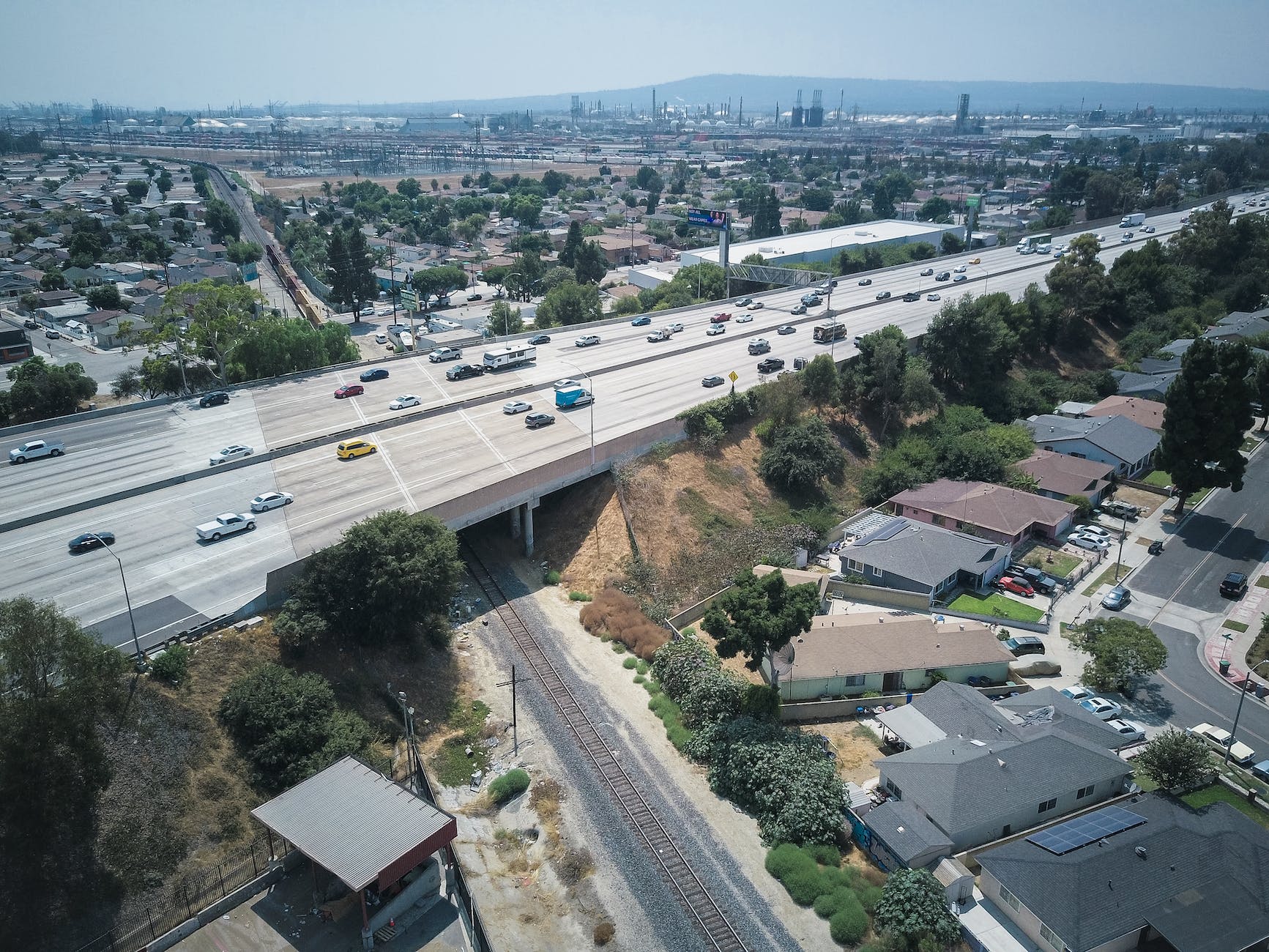
Numerous social forces converged to this point where a particular driving experience embodies the American Dream. The construction of roads and highways. Sprawling suburbs. The rise of fast food, big box stores, and road trips. Driving is an essential part of the American way of life.

Even if relatively few people get to regularly drive in “American Dream mode,” it is a powerful symbol.

All the construction at the same time + the other factors that increase traffic

A “perfect storm” of traffic has hit Chicagoland:

Photo by Kanjo Melo on Pexels.com

The recent traffic backups aren’t a mirage, say transportation officials. It’s really a perfect storm of ongoing construction projects occurring at nearly all points of the expressway system. This includes the Jane Byrne Interchange project, the behind schedule and over budget construction job that offers one of the worst choke points for congestion in the heart of downtown Chicago…

The last week in September saw some of the worst traffic in recent memory, thanks not only to the ongoing construction — including the start of three-weekend lane reductions on Interstate 57 to accommodate ramp patching and resurfacing — but also an emergency closure of the outbound Dan Ryan Expressway ramp to the outbound Stevenson Expressway that isn’t expected to completed until Sunday, according to IDOT…

Transit experts say that Chicago, which has some of the worst congestion of any American city, is also grappling with its return to normalcy following closures brought on by the pandemic. The added congestion comes at a time when many workers such as Cavanagh are returning to the office after two years of work-from-home protocols. Rider usage of transit systems such as the Chicago Transit Authority, Metra and Pace also haven’t yet returned to normal…

“In other words, drivers are making more trips, but they’re shorter trips on average,” Dan Ginsburg, TTWN’s director of operations said in an email.

So the old joke in Chicago, “there are two seasons: construction and winter,” rings true again?

But, this is a bigger issue than just construction. The infrastructure needs help. More people are driving. People live and work in different locations. Mass transit is not being used much. Mass transit does not necessarily reach where it needs to reach. People want to drive faster. There is a lot of freight and cargo moving through the region and so on.

This “perfect storm” could be an opportunity to ask how to address traffic and congestion throughout the city and region for the next few decades? How will this get any better?

Another suburban Chicago mall goes in on denser housing to revive its fortunes

Yorktown Mall in Lombard is planning to replace a vacant anchor store with hundreds of apartments:

Photo by Pixabay on Pexels.com

The department store closings have turned other enclosed malls into retail ghost towns. But Yorktown has sought to reinvent itself by thinking outside the big box…

Pacific is now teaming up with Chicago-based Synergy Construction on a major overhaul of the west side of the 54-year-old mall. Plans call for replacing the cavernous, three-level Carson’s store and its vast parking lot with an apartment complex and a public park. The residential portion of the development will cost an estimated $201 million over two phases, Lombard officials say…

Pacific and Synergy have not finalized a unit count, but village memos indicate the latest project could bring approximately 700 apartments to Yorktown.

“You start having a critical mass of maybe 1,500 or 2,000 new residents,” Niehaus said. “And when you look at the rent rates that the apartments are generating, it typically lends itself to people that have disposable income that will want to shop or eat or participate in activities.”

Not all malls will survive the coming years. The idea behind replacing stores with apartments or housing is that it is a better use of the space rather than trying to chase a dwindling number of successful retail options and adding residents next to stores, restaurants, and entertainment options means they will spend some of their money in the remaining mall spaces.

Will this ultimately be the successful tactic that either saves some portion of the mall or revitalizes/transitions the space from retail to other uses? Housing is needed in many communities with shopping malls. Will communities recoup the revenue that used to come in through sales taxes? Will the footprint of the mall eventually disappear into the sprawling suburban landscape? As noted in the article, this is not the only Chicago mall pursuing this. See the example of the Fox Valley Mall in Aurora. Wait another thirty years or so and the legacy of the suburban shopping mall – roughly a century old at that point – might be very different.

Too many taxing bodies in Illinois to easily count them

How many taxing bodies are in Illinois?

Photo by Karolina Grabowska on Pexels.com

Anyone who gazes at a property tax bill realizes Illinois is awash in local government: townships, school and park districts, road and bridge agencies, community colleges, police and fire departments, and a collection of water, housing, cultural, cemetery, and even mosquito abatement districts. The Cook County treasurer’s website lists eight taxing districts for Chicago, 11 for Winnetka, and 10 each for Norridge and Hodgkins.

There are so many entities that even the experts differ on their number. The Civic Federation, which charts government spending and claims to have done the most exhaustive search, says Illinois has 8,923. That’s higher than the 6,032 tally from the Illinois Policy Institute and the 6,918 listed in a 2017 U.S. Census Bureau report — 2,000 more than second-place Pennsylvania.

Americans like local government. Do they like local government this much? Perhaps the presence of this many taxing bodies in Illinois, Pennsylvania, and other states is the answer: “yes they do.”

However, it seems like it should be easier to count the number in Illinois. The state government itself does not keep track? How could the Civic Federation and the Census Bureau differ by roughly 2,000 taxing bodies? While the rest of the article goes on to detail how difficult it is to consolidate these governmental bodies or to eliminate them, having an accurate count might be an important start.

The ongoing social construction of what food is labeled healthy

New proposed guidelines from the FDA would change what constitutes health food and what can be marked healthy:

Photo by Ella Olsson on Pexels.com

Under the proposal, manufacturers can label their products “healthy” if they contain a meaningful amount of food from at least one of the food groups or subgroups (such as fruit, vegetable or dairy) recommended by the dietary guidelines. They must also adhere to specific limits for certain nutrients, such as saturated fat, sodium and added sugars. For example, a cereal would need to contain three-quarters of an ounce of whole grains and no more than 1 gram of saturated fat, 230 milligrams of sodium and 2.5 grams of added sugars per serving for a food manufacturer to use the word “healthy” on the label.

The labels are aimed at helping consumers more easily navigate nutrition labels and make better choices at the grocery store. The proposed rule would align the definition of the “healthy” claim with current nutrition science, the updated Nutrition Facts label and the current Dietary Guidelines for Americans, the FDA said…

New labeling language is sure to be controversial among food manufacturers that have sought to capitalize on Americans’ interest in more-healthful food…

But what constitutes “healthy” food is a thorny topic among nutrition experts. Would foods high in what many nutrition scientists call “good fats,” such as those that contain almonds or avocados, be deemed “unhealthy,” whereas artificially sweetened fruit snacks or reduced-fat sugary yogurts might be considered “healthy”?

Put together science, business interests, politics, other interested social actors, and the everyday food practices of people in the United States and you have a public conversation slash negotiation over what it means for food to be healthy. This is not a new process – it has been going on for decades – but it has significant ongoing implications.

When talking about graphs and charts, I use the example my Statistics class of the evolution of the image of a healthy diet. Today, this is My Plate which was developed a little more than a decade ago. Prior to that was the food pyramid and there were several other government sponsored graphics before that. Each of them theoretically represent a healthy diet or approach to eating but they emphasize different foods and quantities. They reflect this ongoing social construction of healthy food.

This suggests that what is considered healthy might change within a decade or two after this current round of conversation and guidelines comes to a conclusion. These changes will embody new understandings and social/power dynamics.