Researchers adjust as Americans say they are more religious when asked via phone versus responding online

Research findings suggest Americans answer questions about religiosity differently depending on the mode of the survey:

Photo by mentatdgt on Pexels.com

Researchers found the cause of the “noise” when they compared the cellphone results with the results of their online survey: social desirability bias. According to studies of polling methods, people answer questions differently when they’re speaking to another human. It turns out that sometimes people overstate their Bible reading if they suspect the people on the other end of the call will think more highly of them if they engaged the Scriptures more. Sometimes, they overstate it a lot…

Smith said that when Pew first launched the trend panel in 2014, there was no major difference between answers about religion online and over the telephone. But over time, he saw a growing split. Even when questions were worded exactly the same online and on the phone, Americans answered differently on the phone. When speaking to a human being, for example, they were much more likely to say they were religious. Online, more people were more comfortable saying they didn’t go to any kind of religious service or listing their religious affiliation as “none.”…

After re-weighting the online data set with better information about the American population from its National Public Opinion Reference Survey, Pew has decided to stop phone polling and rely completely on the online panels…

Pew’s analysis finds that, today, about 10 percent of Americans will say they go to church regularly if asked by a human but will say that they don’t if asked online. Social scientists and pollsters cannot say for sure whether that social desirability bias has increased, decreased, or stayed the same since Gallup first started asking religious questions 86 years ago.

This shift regarding studying religion highlights broader considerations about methodology that are always helpful to keep in mind:

  1. Both methods and people/social conditions change. More and more surveying (and other data collection) is done via the Internet and other technologies. This might change who responds, how people respond, and more. At the same time, actual religiosity changes and social scientists try to keep up. This is a dynamic process that should be expected to change over time to help researchers get better and better data.
  2. Social desirability bias is not the same as people lying to researchers or being dishonest with researchers. That implies an intentional false answer. This is more about context: the mode of the survey – phone or online – influences who the respondent is responding to. And with a human interaction, we might respond differently. In an interaction, we with impression management in mind where we want to be viewed in particular ways by the person with whom we are interacting.
  3. Studying any aspect of religiosity benefits from multiple methods and multiple approaches to the same phenomena under study. A single measure of church attendance can tell us something but getting multiple data points with multiple methods can help provide a more complete picture. Surveys have particular strengths but they are not great in other areas. Results from surveys should be put alongside other data drawn from interviews, ethnographies, focus groups, historical analysis, and more to see what consensus can be reached. All of this might be out of the reach of individual researchers or single research projects but the field as a whole can help find the broader patterns.
Reconsidering the need for faculty offices after COVID-19

With more faculty and college instructors working from off-campus during COVID-19, does this mean faculty offices can be done away with in the future?

Many campus planners have long advocated for fewer traditional, individual, closed-door offices, and more shared workspaces for faculty and staff members, like what many private companies have. The idea is that open, common work rooms will foster collaboration and make instructors more visible and less intimidating to students. A few phone rooms, meeting rooms, and lockers could serve for whenever somebody needed quiet, privacy, and somewhere to store belongings.

Having fewer private offices could also save on heating and electricity costs. On average, 19 percent of campuses’ indoor square footage is dedicated to offices, according to a 2007 survey (the latest available) of 276 institutions that are members of the Society for College and University Planning. (Only housing, at 20 percent, commands a larger area.) Using that much space more efficiently could make a big difference to a college’s bottom line.

Especially if faculty and staff members will continue to work from home more often, leaving their desks unoccupied some days of the week, colleges could save by having people who come in on different days share the same private office. As Paul Dale, president of Paradise Valley Community College, in Phoenix, Ariz. put it, it’s a way of fitting “30 pounds of potatoes in a 20-pound bag.”

Faculty members accustomed to their own offices can be loath to give them up, however. Private faculty-office space is a marker of accomplishment and prestige, said Luanne Greene, president of Ayers Saint Gross. Sometimes it’s even written into tenure contracts. But with the pandemic-driven increase in working from home, Greene and her team have seen a shift.

These arguments mirror those from corporate world where the open office emerged in recent decades: efficiencies in how space is used plus possibilities for collaboration and quick interactions. Yet, open offices are not embraced by all workers.

From my own studies of spaces plus my experiences as a faculty member, here are at least a few reasons why offices are valuable:

  1. A sense of space that is yours. College classrooms are often impersonal, spaces meant to be used by instructors from a variety of disciplines. They contain the tools necessary for teaching and learning – projectors, computers, whiteboards, desks or tables plus seating, etc. – but they often have little character. In contrast, offices are spaces where instructors can customize their surroundings to fit their personality and their needs for work (conversations, study, writing, etc.).
  2. A permanent place to store books and other materials. An open work space has little room for this and the assumption may be that we are living in a paperless world. This is not true for many scholars.
  3. A place of solitude that is conducive to the kind of creativity and study that scholars need to do. Putting on headphones in a busy area or working from home may not be able to approximate the way that an office can provide the solitary setting that is often needed.

Of course, not all college instructors might see this the same way. But, as the article notes, faculty would have concerns. And the solution presented at the end of this section – smaller individual offices with more space that could shared by all – is an intriguing compromise for settings and instructors where that collaborative space would be valued.

Naperville at #1 on several Niche.com Best Cities lists

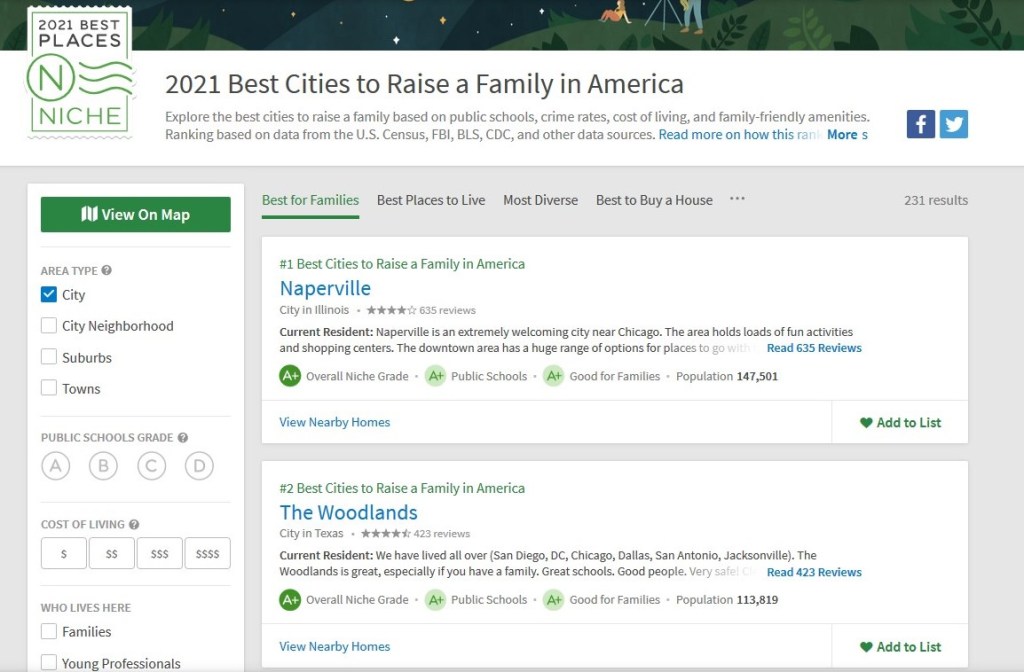
Naperville adds to its rankings accolades with the new 2021 Niche.com lists:

Naperville was also ranked #1 for Cities with the Best Public Schools and #3 for Best Cities to Live in America. See previous posts about Naperville’s rankings: “wealthiest city in the Midwest” and “safest city over 100,000 residents.”

This ongoing praise for Naperville makes sense both for knowing the suburb as well as what sorts of communities make it to the top of these kinds of lists. Naperville grew tremendously in the final decades of the twentieth century but it also developed a high quality of life: vibrant downtown, highly-rated schools, local recreation opportunities, wealthy, and safe. The accolades have changed to some degree because the size of the community changed; for example, Naperville is the list of “cities” for Niche.com while the Best Places to Live in America tend to be smaller communities.

If you browse the Niche.com rankings just a little bit, you see wealthy suburbs from certain metro areas in the United States. That the same communities keep popping up on these lists year after year suggests they have an ongoing high quality of life but also it hints at what Americans – and people who make these rankings – think are desirable communities. Is the goal of American life to ascend to one of these well-off communities, most of them relatively white and wealthy suburbs?

Planning for more Sun Belt passenger train routes

Even though the United States has struggled to build and use passenger rail between major cities, the CEO of Amtrak suggests that shift in where Americans live means there are new opportunities:

Photo by Pixabay on Pexels.com

There’s 100 million more people in the United States today than there were when Amtrak was created in 1971. And if you look about the shift of where people moved to and where they have moved from, there are 20, 25 dense corridors across our nation where Amtrak has little to no service. And that’s where people have moved to. Think about the corridors in Arizona, between Phoenix and Tucson and Flagstaff, and the route between Las Vegas and Southern California. Look at the growth that we’ve experienced in the Carolinas, for example, from Raleigh to Charlotte and Greensboro and Winston-Salem—we started the service there a couple of years ago with two trains a day, and we’re looking to grow that to six trains a day along that route.

A lot of the growth I’m talking about here would occur on corridors we already serve, but we’re only serving them once a day. Another that comes to mind is Nashville to Atlanta, with stops in Chattanooga. Try to fly that. There’s no service there. It’s a major corridor. It’s an integrated economy. I could go on and on, but I believe these areas of opportunity allow us, over the next 20-year period of time, to double our ridership.

The logic sounds similar to what has been proposed for the Midwest and other corridors in the United States: look to provide good quality passenger train service between cities where the distance means that flying is not that convenient. But, the geography in the example above has shifted from the Midwest, Northeast, or California corridors to the growing Sun Belt where there are plenty of highways but not as many other transit options.

Thinking more about these Sun Belt corridors, it seems like the Amtrak service is waiting for a critical mass of potential riders as opposed to thinking ahead of the population growth. Take the Nashville to Atlanta corridor. These areas have been growing for several decades: the city of Nashville boomed first in the 1960s and then has expanded from nearly 450,000 residents in 1970 to over 670,000 residents in 2019 while the Atlanta metropolitan region grew from just under a million residents in 1950 to over 6 million in 2019. Is it too late for Amtrak to get started with a thriving service or do they demand from potential riders to even consider boosting the amount of service? Imagine if Amtrak had planned for all of this five decades ago and connected the Sun Belt with numerous routes; how might this have affected population growth and transportation patterns? Could the United States have had a sprawling postwar era full of railroad passenger lines?

Abolish townships or worry about turning them blue (or keeping them red)?

Illinois has many taxing bodies and government units. Illinois moved to stop creating new government bodies and DuPage County resolved several years ago to work to reduce the number of government bodies. Townships are a common target; they exist above municipal governments and below counties so are they necessary?

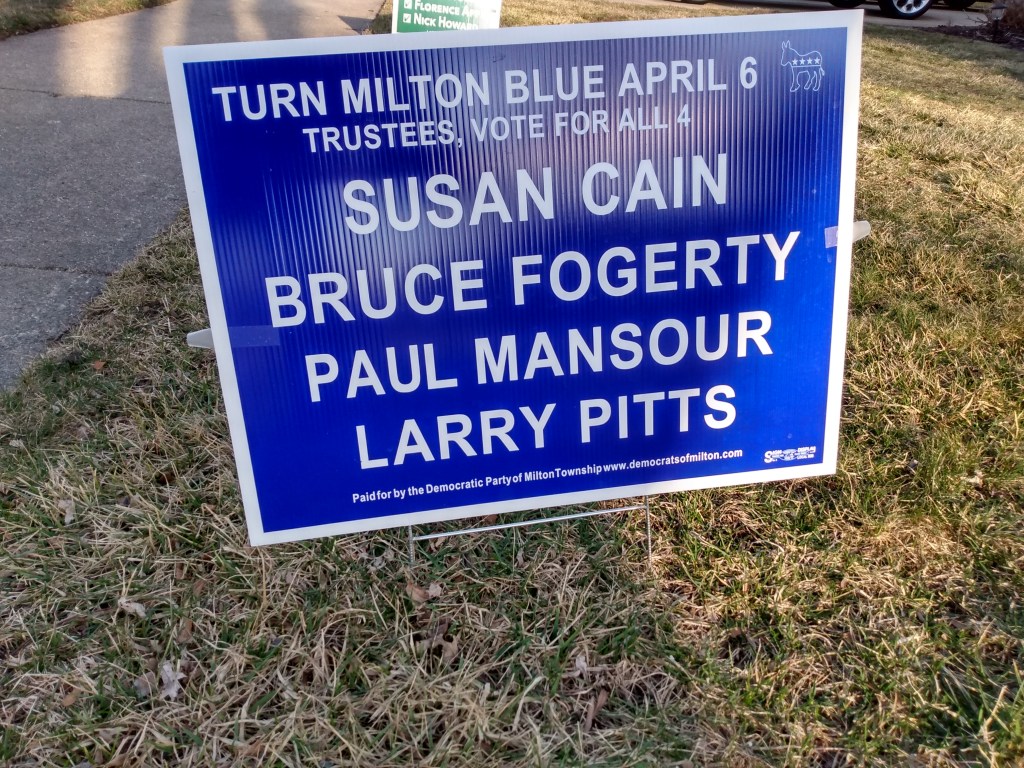
I thought of this recently with the lead-up to the upcoming local elections. On one side, I have seen signs urging voters to “Turn Milton Blue.”

This might be a strategy to boost local turnout and connect to broader political patterns. But, I do not know what these candidates want to do at the township level. What significant changes are needed?

On the other hand, I have seen campaign material for Republican candidates for Milton Township. This material listed all the things that the township does, presumably because of the Republicans there. For a party that at least talks sometimes about limited government, should they argue townships are unnecessary rather than fighting for political seats?

More broadly, how much do these township races benefit the people and communities of Illinois? In a time of budget deficits before COVID-19 plus further issues because of COVID-19, is it more important that one party or another holds the majority of seats in townships?

Target on The Magnificent Mile is preferable to empty retail space

With reports of Target’s interest in moving to Macy’s former space in Water Tower Place along Michigan Avenue in Chicago, I heard some concern about such a normal big box retailer moving into a prestigious retail space. Here is the problem for Chicago and many other communities facing retail vacancies: filling space can be really hard.

Google Street View image August 2019

Brick-and-mortar retailers are not doing well overall. This extends from suburban shopping malls to high-status locations like Manhattan or downtown Chicago.

And this issue is not just about shopping and what people can purchase. Busy retail anchors a number of important activities: sales tax and property tax revenue for municipalities; tourism or visitors from other communities who want to come spend money because of the scene; restaurants and other land uses that cater to those out for a shopping trip. Vacant structures do not just lack these features; their emptiness is also a blight, a suggestion that corporate and visitor interest is low, a reminder that the property is not generating the kind of revenue it could.

Filling large retail spaces is no easy task. Many communities are struggling with this and seeking other land uses (recent examples here and here). A building with some sort of activity, even if it is a downgrade in terms of status, is preferable to no activity. The Magnificent Mile might not seem so magnificent with Target – people can find this shopping all over the place – but it beats becoming The Vacant Mile.

Reminder: only about one-third of American adults have a college degree

Coverage of a recent study about life expectancy and education provided this reminder about education levels in the United States:

Photo by Ekrulila on Pexels.com

About one-third of Americans have a four-year college degree, and they are living longer and more prosperous lives while the rest face rising death rates and declining prospects, said researcher Angus Deaton, a professor at the University of Southern California’s Center for Health Policy and Economics.

According to QuickFacts from the Census with July 1, 2019 estimates, 32.1% of American adults have a bachelor’s degree or higher.

For a good segment of Americans, college is the expected path that follows after high school and also leads to future opportunities, particularly regarding jobs. But, many American adults did not or do not follow that path and this has all kinds of consequences. At the least, it can provide a reminder to current college students and instructors that college is an opportunity and/or blessing, not just something to be endured for later outcomes. More broadly, that degree can separate workers in the job market, lead to subsequent educational opportunities, and, as this study suggests, interact with health.

Does social media make your life better?

It is a simple question. It may not have an easy answer.

Photo by Anete Lusina on Pexels.com

As I teach undergraduate students ages 18-22, the topic of social media comes up. It may be during a class break when many go to their smartphones. It may be during conversations about social interaction or the media or technology. It may be in discussing my research in this area. According to psychologist Jean Twenge, these students would be right in the iGeneration that grew up with iPhones and smartphones. They are often immersed in social media.

In two research studies (one from 2015 looking at 18-23 year olds and one from 2020 looking at 23-28 year olds), Peter Mundey and I examined how emerging adults interacted with social media. The vast majority participated. But, they also expressed reservations ranging from privacy issues to negative interactions to new demands on their. On one hand, they enjoyed maintaining connections to people and described participation as necessary to keeping up with people. On the other hand, it would be hard to not participate at all as it is connected to multiple life domains.

My sense from this data is there is not a total endorsement of social media from emerging adults. Their responses are differentt from singing the praises of the positive benefits of social media. And when I ask my students the question in the title – “does social media make your life better?” – it can provoke some thinking.

Perhaps this is a good question for many people to ask. It could be a more domain-specific question: is social media good for our national political life? Does social media encourage spiritual growth? Does social media promote learning? Or, it might be better as a larger question: does social media improve the lives of its users? This is at least a question worth pondering and then acting in response to the answer.

Functional religion in the form of American politics

I have seen some version of this argument several times recently. Here it is in The Atlantic: Americans have replaced religion and its associated features with politics.

Photo by Luis Quintero on Pexels.com

But if secularists hoped that declining religiosity would make for more rational politics, drained of faith’s inflaming passions, they are likely disappointed. As Christianity’s hold, in particular, has weakened, ideological intensity and fragmentation have risen. American faith, it turns out, is as fervent as ever; it’s just that what was once religious belief has now been channeled into political belief. Political debates over what America is supposed to mean have taken on the character of theological disputations. This is what religion without religion looks like.

Not so long ago, I could comfort American audiences with a contrast: Whereas in the Middle East, politics is war by other means—and sometimes is literal war—politics in America was less existentially fraught. During the Arab Spring, in countries like Egypt and Tunisia, debates weren’t about health care or taxes—they were, with sometimes frightening intensity, about foundational questions: What does it mean to be a nation? What is the purpose of the state? What is the role of religion in public life? American politics in the Obama years had its moments of ferment—the Tea Party and tan suits—but was still relatively boring.

We didn’t realize how lucky we were. Since the end of the Obama era, debates over what it means to be American have become suffused with a fervor that would be unimaginable in debates over, say, Belgian-ness or the “meaning” of Sweden. It’s rare to hear someone accused of being un-Swedish or un-British—but un-American is a common slur, slung by both left and right against the other. Being called un-American is like being called “un-Christian” or “un-Islamic,” a charge akin to heresy.

This is because America itself is “almost a religion,” as the Catholic philosopher Michael Novak once put it, particularly for immigrants who come to their new identity with the zeal of the converted. The American civic religion has its own founding myth, its prophets and processions, as well as its scripture—the Declaration of Independence, the Constitution, and The Federalist Papers. In his famous “I Have a Dream” speech, Martin Luther King Jr. wished that “one day this nation will rise up and live out the true meaning of its creed.” The very idea that a nation might have a creed—a word associated primarily with religion—illustrates the uniqueness of American identity as well as its predicament.

The particular form of religious activity and civil religion in the United States is unique. But, more broadly, this discussion gets at what religion is. Is it about belief in a transcendent being or a supernatural realm? Or, is it more about what religion does in terms of particular practices?

Such discussions remind me of the work of sociologist Emile Durkheim. In his work, religion serves a cohesive function in society. Here is an earlier post about how functional religion could explain devotion to Apple:

The argument is one that can be applied to many things that take on the functions of religion such as providing meaning (Apple vs. other corporations, beauty vs. functionality), participating in common rituals (buying new products), and uniting people around common symbols (talking with other Mac users).

Politics can do some of these same things. Politics provides meaning in particular beliefs, policy positions, activities, and group identities. Politics has its own set of common rituals and ceremonies, which could even extend to today’s patterns of reacting to political news via Twitter and other forms of social media. There are common symbols ranging from particular visual images to personas to slogans. Political camps can have their own sacred narratives about how the world works.

Durkheim also had ideas about religion giving way to other forms of cohesion. For example, an expanding division of labor would increase interdependence on each other. Science could help address particular issues that used to be addressed by religion. Is politics – particularly in the form right now in the United States that is marked by polarization – an advancement and a move away from religion?

In a land of driving, both a bifurcated housing market and car buying market

Americans like to drive and have structured much of daily life around driving. This means many people need a reliable car to get to a decent job, which then enables them to buy a decent home in a place they want to live. But, what if both the house and car buying markets do not provide a lot of good options at lower prices? From the auto industry:

Photo by Pixabay on Pexels.com

Yet that increase was nothing next to what happened in the used market. The average price of a used vehicle surged nearly 14% — roughly 10 times the rate of inflation — to over $23,000. It was among the fastest such increases in decades, said Ivan Drury, a senior manager of insights for Edmunds.com.

The main reason for the exploding prices is a simple one of economics: Too few vehicles available for sale during the pandemic and too many buyers. The price hikes come at a terrible time for buyers, many of whom are struggling financially or looking for vehicles to avoid public transit or ride hailing because the virus. And dealers and analysts say the elevated prices could endure or rise even further for months or years, with new vehicle inventories tight and fewer trade-ins coming onto dealers’ lots…

Charlie Chesbrough, senior economist for Cox Automotive, predicted a tight used-vehicle market with high prices for several more years…

In recent years, automakers had set the stage for higher prices by scrubbing many lower-priced new vehicles that had only thin profit margins. Starting five years ago, Ford, GM and Fiat Chrysler (now Stellantis) stopped selling many sedans and hatchbacks in the United States. Likewise, Honda and Toyota have canceled U.S. sales of lower-priced subcompacts. Their SUV replacements have higher sticker prices.

On the housing side, builders and developers have devoted less attention to starter homes. It can be difficult for some workers to find housing near where they work. The ideal of the suburban single-family home is not attainable for all.

On the driving side, cars are not cheap to operate and maintain. Moving to the suburbs and many American communities requires a commitment to driving to work. A reliable car at a reasonable price could go a long ways to keeping transportation costs down and freeing up household money for other items.

These issues require longer-term planning and attention: how can people with fewer resources still obtain decent housing and decent transportation options? COVID-19 may have exacerbated these issues but the article about the auto industry suggests these trends were already underway; car prices were on the upswing. Trying to tackle density issues or providing more mass transit are difficult to address in many communities and regions. A conversion to electric cars in the next decade or two sounds good but imposes new costs on drivers.

In the meantime, those with resources can likely pick up better options for both cars and homes. These choices can then have positive cascading effects on future spending and outcomes.