Former Lt. Governor of Illinois now devoted to fighting for fair housing in Chicago suburbs

As Evelyn Sanguinetti transitions to addressing fair housing after previously serving for four years as lieutenant governor of Illinois, she describes the kinds of housing discrimination that occur:

brick building facade on cold clear day

Photo by Nick Bondarev on Pexels.com

Discrimination takes so many different forms. It’s not as apparent as it once was decades ago. The wrongdoers have become better at this sort of illegal activity. You will see it taking the form of lying about the availability of housing or home loans or home insurance, or applying a no-pets policy on service animals. You will see discrimination in the way of illegal steering. So when a prospective tenant wants to look at one apartment, the company showing the apartments says, “No, no, you really want to look a few blocks over; that’s where you really want to go.” A lot of people do not know their rights and they do not realize that this is what’s occurring. Another form it takes is offering different terms or conditions to members of a protected class, such as requiring sex in exchange for rent.

You see discrimination in the form of constructing inaccessible buildings — that’s a big one, too. A lot of the cases that we have pending and a lot of the work we do from a previous settlement, is we make improvements to make housing accessible to people with disabilities.

Another form of discrimination is saying, “No children allowed,”bwhich to me is like a stake straight at my heart. I grew up with my abuelita, my great-grandparents. I mean, there were a lot of us in one household and a lot of children. But the wrongdoers also find a way of making sure children are not allowed. Well, children need to live somewhere.

This sort of discrimination is often quietly done and scattered across locations. It rarely comes up in the news. It may be hard for people to guess how often it happens. The people affected by it may not know how to fight back or bring the issue to light.

Some of the issue might be defining fair housing. Sanguinetti explains the concept:

There’s always this conclusion that goes on with a lot of people like, “Fair housing? Free housing! That’s cool.” And I’m thinking, “No, no.” The Fair Housing Act provides that if you have the resources to live where you want, but you’re being prevented from doing so because you’re a member of a protected class, that’s illegal.

I imagine some might confuse fair housing with affordable housing which is often about providing housing for those who do not have the resources to live in a place. If we do not have a foundation of fair housing, it would be even harder to make the case for affordable housing – which is hard enough in many suburbs.

At the same time, efforts which help ensure fair housing do not necessarily help with getting residents resources (jobs, income, wealth, connections, etc.) that would help them access housing). Fair housing addresses the housing side once people try to acquire housing. Work is also needed on the other end in helping people get to a point where they can have housing choices that help them meet their goals.

The current social contract: we get along by leaving each other alone

A Washington D.C. resident says he is leaving the city because social order has broken down. Here is how he describes what made city life work:

time lapse photography of people walking on pedestrian lane

Photo by Mike Chai on Pexels.com

All I asked in return was relative safety and to be left alone to enjoy the city. City-living in America, for decades, meant tolerating mild inconveniences so that you could be left alone, alongside millions of others. That was the tacit pact…

Gay? Black? Trans? No offense, but, so what? We are city people: we have seen it all—literally, all—our entire lives. You are our neighbors, our friends, the president of our HOAs, our coworkers. The great beauty of the city is that we come from all walks of life and we get along. We accomplish this by leaving each other alone.

This sounds similar to how sociologist M. P. Baumgartner described the “moral minimalism” pervasive in suburban social life:

A kind of moral minimalism pervades the suburbs, in which people prefer the least extreme reactions to offenses and are reluctant to exercise any social control against one another at all. (3)

suburbia is a model of social order. The order is not born, however, of conditions widely perceived to generate social harmony. It does not arise from intimacy and connectedness, but rather from some of the very things more often presumed to bring about conflict and violence – transiency, fragmentation, isolation, atomization, and indifference among people. The suburbs lack social cohesion but they are free of strife. They are, so to speak, disorganized and orderly at the same time. (134)

In both descriptions, residents want to be left alone. They want to live life as they see fit without interference or social control exerted by others. This does not necessarily mean there is no social interaction or residents dislike the local environment; the Washington, D.C. resident describes partaking in and enjoying urban culture and interacting with neighbors. In Baumgartner’s study, suburbanites might know each other or interact; they just do not get too deeply involved or try to pressure others.

At the root of this seems to be a deep seated individualism that provides space for people to make their own choices. Every space or community provides some constraints on what people can do (or can imagine doing) yet Americans often imagine themselves as solitary units. The strains of this are everywhere: as long as it does not hurt other people, people should be free to do it; what people do on their own time or in their own dwelling is none of my business; a man’s home is his castle; you do you and I’ll do me; and so on.

Even though this idea is widespread, it also has limits. If individuals are masters of their own fate and this should not be interfered with, it can be tough to rally people around particular causes that require collective effort. Indeed, I think a good argument could be made that some of our current political conflict is due to the fact that different groups would like to introduce ideas/values/legislation for others to consider and/or follow while wanting to claim that they also support individualism.

More broadly, this is an odd social contract to have considering the sweep of human history and societies. Much of what humans experienced took place in relatively small groups with strong bonds. Today, more of our world is organized around people with whom we have chosen to interact with more tenuous ties to traditional bonding agents like extended family, religious groups, and specific geographic locations and the communities there.

I do not know if this social contract will last. The individualism of the last few centuries has changed much. Yet, it is helpful to keep in mind as we consider how to do anything together.

What could lead to Americans considering what they want the suburbs to be

Yesterday, I wrote about competing visions of American suburbs. Under what circumstances might a national conversation, debate, and/or reckoning take place regarding what suburbs should be in the future? Here are a few possibilities:

photo of houses under starry skies

Photo by Dominika Roseclay on Pexels.com

  1. An election. As noted yesterday, elections can help to bring issues to the forefront. The suburbs are not a key issue in the 2020 presidential election but this does not mean they could not be down the road.
  2. Building concern about housing. The need for cheaper housing in certain metropolitan areas has led to local and state-level debate but this has rarely reached national levels. I am pessimistic about national level discussions about and solutions for housing – but it could happen.
  3. Some sort of crisis or unusual occurrence in suburbia that pushes people to rethink what suburbs are about. Perhaps it is ongoing police violence – like in Ferguson, Missouri – or an usual place like Columbia, Maryland that people want to emulate.
  4. Declining interest in living in suburbs among future generations. Whether millennials and their successors want to or can live in suburbs is up for debate.
  5. A redefinition of the American Dream away from single-family homes, driving, and private spaces to other factors ranging from different kinds of spaces (perhaps more cosmopolitan canopies?) to an inability or declining interest in homeownership compared to securing health care and basic income or a rise in AI, robots, and technology that renders spaces less important than ever.
  6. Black swan events or large changes beyond the control of the average suburbanite. Imagine no more gasoline or a disease that strikes suburbanites at higher rates or a collapse of the global economy rendering the suburban lifestyle difficult. (Because these are black swan events, they are hard or impossible to predict.)

For roughly seventy years, the United States has promoted suburbs on a massive scale (with evidence that a suburban vision has existed for roughly 170 years). With a majority of Americans living in suburbs, it would take work or certain events for a robust conversation to be had and then a wind-down of the suburbs and shift toward other spaces would likely take decades. At the same time, future researchers and pundits might look back to important conversations, events, decisions, or changes that started the United States down a path away from suburbs. Those precipitating factors could occur today, in the near future, somewhere down the road, or never. While the suburbs in the United States have tremendous inertia pushing them into the future, they do not necessarily have to continue.

What vision of the suburbs do President Trump and other Americans have?

With recent words, President Trump has suggested Joe Biden and Democrats want to destroy suburbs. To Trump, what are the suburbs? One columnist puts it this way:

frontyard at the village

Photo by Lisa Fotios on Pexels.com

Trump seems to have a suburb in his imagination, one that’s a remnant of the 1950s and 1960s. It’s populated entirely by white people, who came there to escape diversifying neighborhoods and are terrified that people of color might move in next door. These suburbanites can be pulled to the Republican Party with a proper dose of racialized fear.

Yet, the suburbs as a whole today do not look like this:

Trump seems to think it’s still 1973. But here’s his problem: The suburbs of today are very different than they were then. The suburbs are still majority white, but they’re more diverse than they were when Trump was refusing to rent to people of color. They have more immigrants, more people of color, more people with higher education — and critically, the white people who live there are rejecting Trump.

Suburbs have indeed changed – see this earlier post on complex suburbia. In multiple ways, suburban areas are now different. They have more nonwhite residents and more residents who are lower-class and working-class (as well as more who live under the poverty line). Some suburbs are classic bedroom suburbs populated by whiter and wealthier residents but there are also numerous suburbs that are more diverse and less well-off. Suburbs are now full of jobs, from manual labor and production jobs to elite white-collar positions.

While this story casts the issue in terms of voters and winning the 2020 election – and suburban voters are indeed crucial – there is a bigger issue at stake: what vision of American suburbs will win out? Here are three competing options:

1. The suburbs are the American Dream where anyone who works hard can purchase a single-family home, live with their family, and expect to live a relatively comfortable life and expect good things for their children. This is often tied to the mass suburbanization of the 1950s and 1960s – and this vision may have fully flowered at this point – but this ideology stretches back at least a few decades earlier.

2. The suburbs are the American Dream as they offer opportunities to all Americans who want to find the good life as defined by a decent job, a place to live, and peace and quiet. This would be a more multicultural vision of suburbs where the movement of minorities and those with fewer resources to suburbs in the last few decades represents progress and success as they too can enjoy a suburban lifestyle (and the dream of #1 was restricted largely to whites).

3. The suburbs are a dead-end for all Americans. According to critics of the suburbs, the emphasis on sprawling land use and driving, individual lives and private homes, and exclusion are not sustainable or desirable for future generations. While some people may want to live this lifestyle, we should encourage more Americans to live in denser communities.

No presidential election is a referendum on just one issue. At this point, the issue of suburbs is still not a front-burner issue: housing received limited attention at the Democratic debates and arguably Trump is more interested in discussing race and cities in ways to attract voters than he is in considering suburban life and its ongoing role in American life. Yet, this is an opportunity for Americans to think about what kind of spaces they want to encourage and inhabit in the future.

Disproportionately more Illinois COVID-19 cases and deaths in the Chicago suburbs

The Daily Herald reports on COVID-19 cases in the Chicago suburbs as a whole:

IDPHdashboardJul2320

Since the outbreak began, there have been 83,563 cases in the suburbs as of Thursday, 50% of the state’s total, according to the Illinois Department of Public Health. There have been 3,750 deaths in the suburbs, representing almost 50.9% of all deaths in Illinois.

The data presented suggest the Chicago suburbs account for roughly half of cases and deaths in Illinois. But, how does this compare to the percent of Illinois residents living in the Chicago suburbs?

The subsequent numbers of COVID-19 cases by community suggest these are the counties in the Daily Herald analysis: suburban Cook County, DuPage County, Kane County, Will County, McHenry County, and Lake County. If you add up these populations (using the U.S. Census QuickFacts 2019 population estimates), the suburban population is roughly 5,610,000. With the total population of Illinois at 12,671,821, the residents of the Chicago suburbs account for a little over 44% of the state’s population.

Thus, the Chicago suburbs have slightly more of their share of COVID-19 cases and deaths within the state of Illinois. Is this expected or unexpected? If we hold to images of wealthier, whiter suburbs, perhaps this is surprising: can’t many suburbanites work from home and/or shelter in place in large homes? Or, is suburbia more complex?

The disparities across suburban communities are not just limited to DuPage County. Take two large municipalities in suburban Cook County: even though Schaumburg has 13,000 more residents than Des Plaines, it has 1,200 cases than Des Plaines. Or, in Kane County, St. Charles has 4,500 fewer residents than Carpentersville (population of just over 37,000) but has just a little more than half of the cases.

While much attention regarding COVID-19 has focused on cities – and for some good reasons – this data from the Chicago suburbs suggests it is a issue for many suburbs as well.

(It is unclear how this data might change if the analysis extended to more counties in the Chicago metropolitan region, which include additional counties in Illinois, northwest Indiana, and southeastern Wisconsin.)

When a pie chart works for analyzing the lyrics of a song, Hey Jude edition

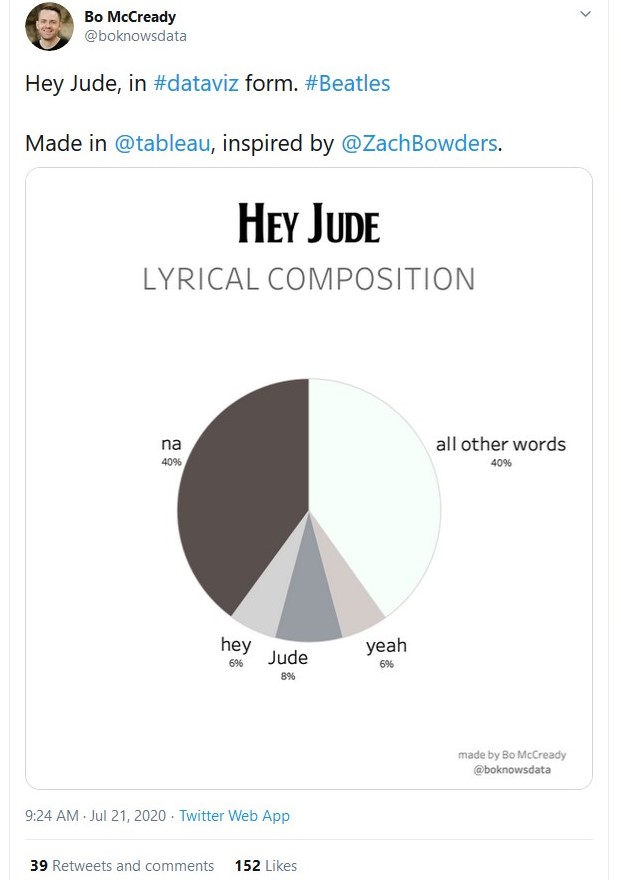
Earlier this week, a data visualization expert presented a pie chart for the lyrics of The Beatles’ hit “Hey Jude”:

HeyJudeLyricsPieChart

Pie charts are very effective when you want to show the readers that a large percentage of what you are examining is made of one or two categories. In contrast, too many categories or not a clear larger category can render a pie chart less useful. In this case, the word/lyrics “na” makes up 40% of the song “Hey Jude.” In contrast, the words in the song’s title – “hey” and “Jude” – comprise 14% of the song and “all other words” – the song has three verses (the fourth one repeats the first verse) and two bridges – account for 40%.

This should lead to questions about what made this song such a hit. Singing “na” over and over again leads to a number one hit and a song played countless time on radio? The lyrics Paul McCartney wrote out in the studio sold for over $900,000 though there are no written “na”s on that piece of paper. Of course, the song was written and performed by the Beatles, a musical and sociological phenomena if there ever was one, and the song is a hopeful as Paul aimed to reassure John Lennon’s son Julian. Could the song stand on its own as a 3 minute single (and these first minutes contain few “na”s)? These words are still hopeful and the way the Beatles stack instruments and harmonies from a relatively quiet first verse through the second bridge is interesting. Yet, the “na”s at the end make the song unique, not just for the number of them (roughly minutes before fading out) but the spirit in which they are offered (big sound plus Paul improvising over the top).

Thus, the pie graph above does a good job. It points out the lyrical peculiarities of this hit song and hints at deeper questions about the Beatles, music, and what makes songs and cultural products popular.

Wealthier Americans have a larger carbon footprint in part due to larger homes

Large homes and McMansions do not just take up land and resources at construction; according to a new study, they have larger carbon footprints. Here is the abstract:

aerial photography of gray houses

Photo by David McBee on Pexels.com

Residential energy use accounts for roughly 20% of greenhouse gas (GHG) emissions in the United States. Using data on 93 million individual households, we estimate these GHGs across the contiguous United States and clarify the respective influence of climate, affluence, energy infrastructure, urban form, and building attributes (age, housing type, heating fuel) in driving these emissions. A ranking by state reveals that GHGs (per unit floor space) are lowest in Western US states and highest in Central states. Wealthier Americans have per capita footprints ∼25% higher than those of lower-income residents, primarily due to larger homes. In especially affluent suburbs, these emissions can be 15 times higher than nearby neighborhoods. If the electrical grid is decarbonized, then the residential housing sector can meet the 28% emission reduction target for 2025 under the Paris Agreement. However, grid decarbonization will be insufficient to meet the 80% emissions reduction target for 2050 due to a growing housing stock and continued use of fossil fuels (natural gas, propane, and fuel oil) in homes. Meeting this target will also require deep energy retrofits and transitioning to distributed low-carbon energy sources, as well as reducing per capita floor space and zoning denser settlement patterns.

More from the study linking energy use, wealth, and housing size:

We find that both household energy use and emissions per square meter vary widely across the country, driven primarily by thermal energy demand and the fuel used in electricity production (“grid mix”). ZIP-code level analysis shows income is positively correlated with both per capita energy use and emissions, along with the tendency for wealth and living area to increase together. City and neighborhood analyses underscore the environmental benefits of denser settlement patterns and the degree to which carbon-intensive electrical grids counteract these benefits.

Bigger homes require more energy to heat, cool, and light. Wealthier people can afford these expenses. Indeed, being able to shoulder all of these costs with a larger home may be a form of conspicuous consumption: “I have enough resources to live in a larger home and maintain it.” Critics of McMansions argue that such homes are meant to impress those who see them, not necessarily great spaces for residents to inhabit.

The study also connects the findings to possibilities for making single-family homes more green. The models work with two options: (1) retrofitting homes to make them more energy efficient and (2) reducing power generated with fossil fuels (“grid decarbonization”). Yet, there are other options to pursue that could help with the situation:

1. Promoting the construction of or the inhabiting of smaller homes. This could range from tiny houses to the “not-so-big home” to smart-sizing or down-sizing. This may require more significant lifestyle changes – cutting on consumption would be difficult – that are too hard for many people.

2. Promoting fewer single-family homes. While they are the basis of suburban life and popular in many other American communities, multi-family housing is more energy efficient. Given the rhetoric surrounding suburbs (such as President Trump claiming Democrats want to abolish suburb), this may not be easy.

3. Promoting less energy use within homes. What if residents used less heat, air conditioning, and lighting? What if they watched less TV and used their phones and computers less? Again, this might require large lifestyle changes that many would find difficult.

4. Constructing newer homes with much stricter energy guidelines, perhaps even net-zero-energy homes or passive houses. Even if these are restricted to wealthier homeowners who can afford the changes, this could help limit the energy use of larger homes. Also, if such homes are viewed by the public as cool or desirable, perhaps these features trickle down.

5. Could wealthier homeowners purchase carbon offsets for their homes? This would allow them to keep their bigger structures while providing funds that could be put to good use elsewhere.

The scenarios in the paper as well as the ones I proposed all require working multiple sectors of society to get to a place where homes, particularly large ones, use less energy.

Fewer plane flights, worse weather forecasts, collecting data

The consequences of COVID-19 continue: with fewer commercial airline flights, weather models have less data.

white clouds and blue sky

Photo by Ithalu Dominguez on Pexels.com

During their time in the skies, commercial airplanes regularly log a variety of meteorological data, including air temperature, relative humidity, air pressure and wind direction — data that is used to populate weather prediction models…

With less spring meteorological data to work with, forecasting models have produced less accurate predictions, researchers said. Long-term term forecasts suffered the most from a lack of meteorological data, according to the latest analysis…

Forecast accuracy suffered the most across the United States, southeast China and Australia, as well as more remote regions like the Sahara Desert, Greenland and Antarctica.

Though Western Europe experienced an 80 to 90 percent drop in flight traffic during the height of the pandemic, weather forecasts in the region remained relatively accurate. Chen suspects the region’s densely-packed network of ground-based weather stations helped forecasters continue to populate models with sufficient amounts of meteorological data.

Models, whether for pandemics or weather, need good input. Better data up front helps researchers adjust models to fit past patterns and predict future outcomes. Absent of data, it can be hard to fit models, especially in complex systems like weather.

As noted above, there are other ways to obtain weather data. Airplanes offered a convenient way to collect data: thousands of regular flights could lead to a lot of data. In contrast, constructing ground stations would require more resources in the short-term.

Yet, any data collector needs to remain flexible. One source of data can disappear, leading to a new approach. Or, a new opportunity might arise and switching methods makes sense. Or, those studying and predicting weather could develop multiple good sources of data that could options or redundancy amid black swan events.

Few may recognize all of this is happening. Weather forecasts will continue. Behind the scenes, we might even get better weather models in the long run as researchers and meteorologists adjust.

McMansions, SUVs, and megachurches

I recently reviewed the book The Glass Church: Robert H. Schuller, the Crystal Cathedral, and the Strain of Megachurch Ministry by sociologists Mark Mulder and Gerardo Martí. As the authors describe Schuller’s emphasis on growth, they include this line on page four:

TheGlassChurchP4

As I studied the use of the term McMansion in the first decade of the twenty-first century, I found people regularly linked McMansions to SUVs. As the cited passage above suggests, McMansions and SUVs came about at the same time. Perhaps some would go even further and say McMansion owners are likely to be SUV owners or the two consumer goods are likely to be found in the same communities or kinds of places. And, like the passage above, the comparisons could go further than SUVs to include large food items.

Rarely have I seen the growth of McMansions and the growth of single-family homes in the United States connected to megachurches. A similar argument could be made: in a period of growth as Americans liked to consume bigger items in bigger settings with providers happy to produce larger goods, McMansions and megachurches came about or became widely recognized at roughly the same time (McMansions built in the closing decades of the 1900s and as a term widely used by the early 2000s; megachurch as a phenomenon known by the 1980s). As everything grew and appetites expanded, so did churches. And maybe megachurches were likely to spring up in or near McMansion filled suburban communities flush with money, family life, and access to highways.

At least in this study, Robert Schuller was enamored with growth decades before McMansions became a thing. Mulder and Martí suggest Schuller pushed for growth in order to encourage more growth; previous accomplishments became evidence for pursuing and fulfilling future accomplishments (until it could no longer hold together). Yet, Schuller was well-positioned in a booming suburban area: he arrived in Orange County in the 1950s and capitalized on the growing population and appetite for large churches in a way that few other religious leaders could match.

Now, linking these multiple phenomena together would take some more work. Were Orange County McMansion owners more likely to attend a megachurch? Is this a pattern throughout the United States? Did an ideology of growth pervade many sectors at the same time and mutually reinforce each other or explicitly intersect at points?

Considering what we know about the broad sweep of suburban TV shows

An Atlas Obscura piece on Levittown begins with a summary of suburbs on television:

gray scale photo analogue of television

Photo by Andre Moura on Pexels.com

From the air, the homes fan out like intricate beadwork. For decades, America’s suburbs have been a popular setting for television shows, from Leave It To Beaver* to Desperate Housewives, chronicling entertaining trivialities against the backdrop of meticulously shorn lawns, the drifting smoke of barbecues, the infrastructure of cars and roads: a pleasantly domestic—but fraught—version of the American dream.

There is no doubt about the claim in the second sentence: “America’s suburbs have been a popular setting for television shows.” Today, television viewers can still find new suburban sitcoms that play with the 1950s formula (actually begun in radio) of a happy nuclear family with plenty of resources working through entertaining yet relatively low-level issues. And as noted at the end (and developed by numerous scholars – I would recommend starting with the work of Lynn Spigel), the television image of suburbs was too pleasant and reinforced a well-off white image of the suburbs.

At the same time, I have published two articles on television in the suburbs and they contribute to a more complicated story of suburbs on television. In my article “From I Love Lucy in Connecticut to Desperate Housewives’ Wisteria Lane: Suburban TV Shows, 1950-2007,” I find that suburban-set shows never dominated the most popular American TV shows. Although such shows might be familiar, common, and live on in memories connected to a different era, they are not the only places Americans see on television. Take as one example the Brady Bunch: it may have been watched for millions in syndication, it may have particularly influenced younger viewers, and it had an iconic house but it never was a Top 30 television show. The suburban TV show is well-known but how influential they are is debatable.

Similarly, more recent suburban TV shows have truly tweaked the format. Lynn Spigel points out that twists to the typical format started early on while more recent shows feature suburban lifestyles from a different point of view (thinking of Black-ish, Fresh Off the Boat, and American Housewife off the top of my head). I wrote “A McMansion for the Suburban Mob Family: The Unfulfilling Single-Family Home of The Sopranos” and considered this critically-acclaimed and popular show set in suburban New Jersey. It has a similar set-up to 1950s suburban shows – the successful white nuclear family living in a big suburban house – but ultimately suggests all of this is an illusion as Tony Soprano’s mob dealings undergird and undercut the family’s attempts to live a normal suburban life. The Sopranos is not the only show to do this; others feature other family structures, deviant behavior, and alternative routes into and out of the suburban dream.

At this point, have television shows covered all of the stories of American suburbs? No. Is there still a typical format? Yes. Have creators played around with the typical format to present other stories? Yes.. Do Americans want to watch suburban TV shows? Yes and no.