The bigger and feature-filled “New American Home”

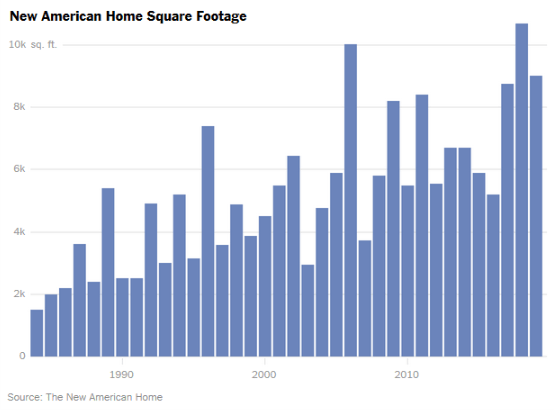
What the National Association of Home Builders displays as the “New American Home” just keeps getting bigger and bigger:

The first New American Home that N.A.H.B. built, in Houston in 1984, was 1,500 square feet and cost $80,000. By 2006, at the peak of the housing bubble, the N.A.H.B. home – a lakeside McMansion in Florida with a tri-level kitchen island and a waterfall off the master suite – was over 10,000 square feet and listed for $5.3 million in what is today one of the nation’s foreclosure capitals, Orlando.

That 1984 project was the smallest; square footage hasn’t dipped below 2,200 since 1985. The 2018 version, also in Florida, is “Tuscan”-inspired and is close to 11,000 square feet, with eight bathrooms and both an elevator and a car elevator in the garage. The 2019 version, to be unveiled soon, is 8,000 square feet and has an “inner sanctum lounge” and a view of the Vegas strip.

NewAmericanHomeSquareFootage

The N.A.H.B. house may be meant to highlight trends, but they’re not necessarily the trends homeowners want (and certainly not what most people need). Instead, they’re what builders, kitchen and bath manufacturers and real estate agents would like to sell them: Think cathedral ceilings, granite countertops, gift-wrapping rooms and, more recently, “smart” appliances like a refrigerator that can text you when you’re low on milk and eggs.

Many builders will tell you that though these houses are large, they are more efficient – even that they have a small carbon footprint. But this is like bragging about the good gas mileage of an S.U.V. While a 10,000-square-foot house built today uses less energy than a 10,000-square-foot house built a decade ago, a home of this size requires a phenomenal amount of energy to run. (And most likely has an S.U.V. or two in the garage.)
I see enough from the NAHB to guess that they have some influence in the housing industry, particularly among national or larger builders. That their show home put together each year keeps getting bigger on average and with more and more features suggests the emphasis is on new and profits. At the same time, it might be hard to show a direct causal link between these annual productions and what homes are actually built. Builders in the United States have constructed many large homes in recent decades but the median square footage has dropped slightly in the last few years.

I suspect it would also be interesting to analyze the architectural and design choices for the New American Homes. Americans may like big homes but not necessarily modern ones. How many of these homes are modernist, Craftsman, or Mediterranean (and which styles are studiously avoided)? Are they all open concept in the main living areas? Is storage a priority and/or large garages? This sort of project could then be expanded to model homes in different areas or among different builders to think about how what builders present influence buying patterns.

Census 2020 looking to go online

Reaching younger Americans is part of the reason plans are underway to move parts of the decennial 2020 census online:

Millennials (born from 1981 to 1996) and Generation Z (born after 1996) account for about 35 percent of the approximate 325 million people in the U.S., according to estimates, and census officials say their traditional means of outreach — mail-in questionnaires, landline phone calls and door-to-door surveys — are failing to connect with this significant segment of the population.

The Census Bureau plans to conduct its first-ever online headcount, which it predicts will generate 60 percent of the total responses for 2020…

However, social scientists suggest that millennials and Generation Z could have a hard time appreciating the importance of the census, having grown up amid a distorted media landscape of instant online gratification, “fake news” and a culture of likes on social networks…

Last month, census communications chief Burton Reist was quoted as saying endorsements from celebrities such as LeBron James are being considered. He described a hypothetical situation in which the NBA superstar urges young people during halftime to pull out their cellphones and “answer the census.”

Moving data collection online would seem to offer a lot in terms of lower costs and easier data tabulation. But, as the article suggests, it brings along its own issues such as cutting through the online clutter and working with celebrities to pitch the online data collection.

On one hand, this might lead to the conclusion that it is still difficult to use web surveys to collect information on a broad scale. Unless a research company has a panel of possible participants in a recruited and relatively representative panel, reaching the broader public on a voluntary basis is hard.

On the other hand, perhaps this should be taken as a good sign: the Census Bureau clearly indicates their data collection has to match what people actually use. Going door to door may not be feasible going forward. If people are online or using devices for hours a day, online surveys might be more attractive.

Almost regardless of how this turns out in the 2020 count, it will be an interesting experiment to watch. What will the online response rate be? How will the Census Bureau have to go about advertising online data entry?

I lived in a suburban house with radioactive thorium in the front yard

The first home my parents purchased was on the southwest side of West Chicago, a small suburb in the western part of DuPage County. While the community was the known for the railroad, industry, and a sizable population of Mexican residents, what we did not know was in the ground in our front yard also came to define the suburb.

The 1954 ranch house on a quiet street with no sidewalks was relatively unassuming: the home was just over 1,200 square feet, had a one car garage, three bedrooms, and a decent-sized yard. The self-contained subdivision was near a grocery store and some strip malls and was a ten minute car ride from the suburb’s downtown.

WestChicagoHouse.png

When my parents went to sell the home in 1988, a discovery was made: the front yard had radioactive material from a local plant. A Chicago company produced lanterns and opened a facility in West Chicago in 1932. The radioactive waste material from the plant, thorium, was then offered to the community as fill. The city and residents took the fill and used it all over the suburb. The plant was later acquired by Kerr-McGee and when the radioactive thorium was discovered throughout the community (after years of struggle), a good portion of the community became the Kerr-McGee Superfund site and the last of the contaminated soil was removed in 2015.

This front yard revelation had implications for selling the home: no one would want it. Supposedly, the radioactivity in the front yard was enough to equal that of an x-ray if someone sat between the two trees in the front for 24 hours. Eventually, Kerr-McGee purchased the home and years later, many yards on that street were torn up to remove the radioactive material.

It is hard to know if the radioactivity had any effects on those of us who lived in the house. Nothing obvious has emerged yet. We may have emerged unscathed. It was not Love Canal. Perhaps this could be considered an odd footnote in a suburban upbringing. Yet, at the same time, few suburbanites would expect to find they had purchased radioactive land. Furthermore, few Americans have a personal connection to a decades-long and costly fight to clean up and remove (this cost an estimated $1.2 billion alone) radioactive thorium.

The dystopian sociological origins of the concept of meritocracy

What exactly meritocracy means requires going back to the origins of the term in the 1950s:

As the tech writer Antonio García Martínez pointed out, “It’s worth recalling that the word ‘meritocracy’ was coined as a satirical slur in a dystopic novel by a sociologist.” Martínez is referring to The Rise of the Meritocracy, 1870–2033, published in 1958 by the British sociologist and politician Michael Young. Young’s work was indeed intended as a social satire, positing a future in which trends in the British educational system were carried out to their absurd conclusions.

Written in the style of a doctoral dissertation by a scholar in the year 2034, The Rise of the Meritocracy imagines a world in which social class has been replaced by a hierarchy that places at the top those who could advance educationally through rigid testing standards. But those standards simply end up reinscribing the old class system, leading to a popular revolt.

Writing in The Guardian in 2001, a year before his death, Young looked back ruefully on how the irony of his coinage had been lost on the likes of Tony Blair, who was then making “meritocracy” the keystone of the Labour Party’s educational policy. “I have been sadly disappointed by my 1958 book, The Rise of the Meritocracy,” he wrote. “I coined a word which has gone into general circulation, especially in the United States, and most recently found a prominent place in the speeches of Mr Blair.” His book, he added, was “a satire meant to be a warning (which needless to say has not been heeded).”…

But our friend Throgmorton didn’t simply see meritocracy as some sort of Platonic ideal—he jingoistically claimed that the United States was already a meritocracy, and the world’s only example of it. Not only did he overlook the peculiarly British irony in which Young couched the term, he also missed out on an irony much closer to home: In 1959, five years after the Supreme Court outlawed segregation in public schools, African Americans were still being systematically denied equal access to education across the South.

It sounds like people wanted the idea of meritocracy to be true or they could justify their existing ideologies with such a term. And then the concept simply takes on a life of its own separate from its origins. It is hard to imagine a ruling class – whether there by wealth or educational achievement or battle – that does not have an ideology that justifies their presence there and rise to that position. At what point will meritocracy fail to provide enough justification? And, if meritocracy is at some point no longer defensible, what ideology comes next to explain those in power?

This origin story also may serve as a reminder that satire is difficult to present to the public. It is a relatively lesser-known genre and can easily be misunderstood. Plenty of recent examples suggest satire is often taken as truth (think incidents with The Onion or the Babylon Bee) until a respected source goes out of their way to point out the original point.


Promote smaller, cheaper housing by calling it “missing middle housing”

Even if the median size of new American homes is smaller in recent years, this does not mean it is easy to construct smaller new homes in communities:

To propel the movement, he recommends using the term “missing middle housing,” rather than terms such as “upzoning,” “density” and “multifamily,” which he says have a negative connotation.

“I can’t imagine a single neighborhood in the country where people will get excited about the term ‘density,’ ” Parolek said. “Even things like ‘multifamily’ can be a scary term that’s past its life span.”

His larger recommendation is for cities to change their zoning ordinances. Parolek advocates for form-based zoning, which allows more flexibility for what can be built on a property…

“Zoning in and of itself is a system that encourages single-family home construction in cities,” Parolek said. “Most cities don’t have effective zoning for missing middle housing, so the easy thing to do is to build a single-family house. There’s no neighborhood pushback and less risk. There’s a reason it’s being done, but it’s not responding to what the market wants.”

Very few neighbors or communities would be excited to live next to or approve cheaper housing. The assumption is that more expensive housing is good: it will bring in more tax dollars, typically has fewer residents (so lower local costs), and connotes a higher status. In contrast, it is thought cheaper housing brings down surrounding property values and the kind of people who live in cheaper housing are not as desirable as higher income residents.

Would communities react better to “missing middle housing”? Perhaps. Many places talk about the need to have housing where hard working professionals with a stake in the community, like teachers and firefighters, can reside in the place where they work. Or, it is desirable to provide denser housing for young professionals and retirees to keep them in the community. Yet, as Parolek notes, the goal is still to move people toward a single-family home (with some flexibility for townhouses and condos) in the long run. Changing zoning is not easy because many people purchase a home and then work hard for years to protect the value of that home. Cheaper housing may be more acceptable if located away from existing larger and more expensive housing, if it is allowed in the community at all.

Missing from even this suggestion about “missing middle housing” is an acknowledgement of the necessity of housing for lower-class and poorer residents. True affordable housing needs to go beyond the middle-class and provide housing for those working in the retail and service industries. But, I don’t think most communities and America as a whole wants to talk about this kind of housing.

New Bel Air homes of over 17,500 square feet cannot be called McMansions

In recent years, a number of extra large houses have been constructed in Bel Air. But, these are not just regular McMansions:

Rosen rallied his neighbors in a mini-revolt against City Hall. The result was 2017’s Bel Air mansion ordinance, a more rigid version of the ordinance imposed on the rest of Los Angeles. While many of the hauling trucks are now gone, the wealthy enclave is still grappling with the legacy of its McMansion years. Between 2014 and early 2017, the city issued 28 permits for mansions in Bel Air of 17,500 square feet or larger, most of which are still under construction, according to an analysis by The Real Deal. The projects are exacerbating a spec-home building spree that rattled longtime Bel Air residents and is dramatically altering the landscape of the area, not to mention its real-estate market.

As of Wednesday there were 12 homes in Bel Air of 15,000 square feet or larger currently sitting empty and unsold in, according to MLS data cited by Steve Lewis, President of CORE Real Estate Group in Beverly Hills.

These are not regular McMansions in suburban neighborhoods: these are megahomes going for megaprices and constructed by and for the ultra-wealthy.

Meanwhile, on Chalon Road, Thomas Barrack Jr., the Colony Capital CEO and pal of President Donald Trump, is nearly done building out an eight-acre compound with a 77,000-square-foot mansion being designed by Peter Marino. Barrack is building it on behalf of the royal family of Qatar. Other competing giant offerings, including the Mountain, a 157-acre plot in Beverly Hills Post Office now listed for $650 million, and a 120-acre site owned by an entity linked to the late Paul Allen asking $150 million, don’t have plans or permits in place for mega-mansions, Blankenship said.

Massive spec mansions on the market right now include Bruce Makowsky’s 38,000-square-foot estate at 924 Bel Air Road, asking a much-reduced $150 million, and the Mohamed Hadid-developed mansion at 901 Strada Vecchia, which is the subject of an FBI probe and a lawsuit from neighbors who want to see it torn down.

Granted, it sounds like some of the activity in Bel Air may be consistent with several features of McMansions: big homes, teardowns, and status symbols for the wealthy. For those who live in Bel Air, it could be disconcerting to see the scale of new construction. But, this article focuses primarily on the really big homes, the ones that are not just someone upgrading from a 2,000 square foot ranch to a 5,000 square foot home with a mishmash of architectural features. The last example in the piece illustrates this difference between a McMansion and mansion: a billionaire/actress couple want to tear down a home under 8,000 and more than double the square footage in a new home. Again, that is a scale far beyond the average upper middle-class American (and that does not even include the price it takes to buy into this particular neighborhood). Perhaps the real goal of using the term McMansion here is to denigrate the new homes and not grant them the status of mansion.

I would argue McMansions are roughly 3,000 square feet to 10,000 square feet. The bottom end may seem rather small but this size home could be quite large if constructed in a home of small homes. The upper end is a rough cutoff when a home goes from regular big home to extra large/wealthy big home. Size is a critical factor in defining a McMansion and these Bel Air homes are way beyond McMansion limits.

New American homes continue to get smaller

Data from 2018 shows new homes in the United States are getting smaller:

NAHB data shows the average size of new houses fell for the third straight year in 2018. Median square footage of single-family houses decreased to 2,320 last year after peaking at more than 2,500 square feet in 2015.

Although still above the sub-2,200-square-foot medians hit during the Great Recession, the numbers suggest that entry-level buyers and those looking for starter homes might finally have more options in the coming years. It’s also good news for those who have had problems getting a mortgage because of credit issues.

Robert Dietz, NAHB’s chief economist, said the data probably indicates that home builders are turning toward middle-class housing after spending much of the current economic growth period focused on the high-end development.

In the aftermath of the housing bubble and the economic crisis, builders focused on higher-end buyers. With money to be made there and the limited ability of those with fewer resources to purchase new homes, bigger homes were the primary focus.

So what has changed? Lower class and middle class buyers may now again have the resources to purchase new homes. With a steady economic recovery (stock market up, unemployment down, wages relatively flat), homeownership may be attainable again for more people. The homeownership rate has been down during the last decade though up a little recently.

Just one reminder: the decreased median may not mean that fewer large homes are under construction – Americans do seem to want big homes – but rather that more smaller new homes were built.

“In the suburbs, trees take on a outsize role”

With local plans to remove the trees along her suburban street in New Jersey, one writer considers their role in suburban communities:

Despite these losses, I had not expected to lose so many at once. And yet, West Orange is grappling with a problem faced by communities around the country. Street trees planted decades — and in some cases, a century — ago were not ideal species for a paved environment and are now large, mature and in need of maintenance. With little soil available beneath the sidewalk, roots interfere with drainage systems, and buckle concrete. Utility companies aggressively prune tree limbs away from power lines, leaving awkward, and potentially unstable, V-shaped trees…

And so, the iconic Norman Rockwell-style streetscape is fading away. As West Orange replaces sidewalks and curbs, it often removes old town-owned trees and plants new species that are more compatible for the location, if homeowners request them. “Over the next 20 or 30 years, there won’t be any tall trees where there are overhead wires,” Mr. Linson said.

Conservationists espouse maintenance methods that could protect more trees, like permeable sidewalks and more careful pruning. While these efforts are often costly for cash-strapped towns, they could preserve a resource that cleans particulate matter from the air, absorbs runoff and reduces the heat index. “The benefits to society far outweigh the costs” of higher maintenance, said Robert McDonald, the lead scientist for the Global Cities program at the Nature Conservancy…

But for all the hope for the future a sapling may represent, I wonder if I will be here long enough to see these new young ones fill out and replenish my block. Instead, I may only get to experience them as sparse reminders of the giants that have been lost.

I’m reminded of a short section of James Howard Kunstler’s TED talk about suburbs where he talks about the role of trees along streets: to provide shade, to frame the street, and to protect pedestrians from vehicles on the road. When the trees must be removed or they are not there in the first place, it is noticeable.

Our suburban street has a nice collection of sidewalk trees that do just the things Kunstler suggests they can, including curving nicely over the curving road. Yet, right before we bought the property, our big tree in the front had been removed – I can see it an older Google Street View image – and several months after moving in the city put in a new sapling. This left the front of our home exposed to the summer sun. While we are fortunate to still have several big trees in the front and back, it will be nice to have that one tree back in 10-20 years.

As the writer suggests about the outsize role of suburban trees, I am still surprised to see so many new subdivisions that still show little regard for keeping trees. A new home may be great but an empty yard is so much less enjoyable than one with even just a few interesting and/or stately trees.

1960s white religious leaders: God told us to love our neighbors but did not mean to pick our neighbors for us

My history colleague Karen Johnson recently delivered the first Faith and Learning lecture on the Wheaton College campus titled “Place Matters:  The vocation of where we live and how we live there.” See the talk here.

One quote from her talk (roughly 35:50 into the talk) stuck with me. In opposing open housing efforts in the 1960s through the Illinois Association of Real Estate Boards, white religious leaders said:

“We don’t doubt the words of Him who said, ‘Thou shalt love thy neighbor as thyself,’ but we do doubt, gentlemen, that He meant to disturb our American heritage and freedoms by picking these neighbors for us.”
Three features of this stand out:
1. I suspect this logic is still in use in many American communities today. Individual liberty about where to live is more prized than government intervention to help those who cannot move to certain places unless they have help (usually for reasons connected to social class and race and ethnicity). While it is couched in religious terms in this quote, I don’t think it needs religious backing to be widely supported by many suburbanites or wealthier residents.
2. Connected to the first point, few white and wealthier residents would today explicitly say that their opposition to affordable housing or government intervention to bring new people to communities is because of race and ethnicity (some government intervention in housing is more than acceptable as long as it helps the right people). They might talk in terms of social class or the character of the community. But, it still often comes down to race and who are desirable neighbors.
3. The mixing of American and religious values is strong. For American Christians, where do individual liberties end and Christian responsibilities begin? Which takes precedence? All religious groups have to think about which ideas and values to take on within particular contexts (whether nations, communities, or subgroups). A good portion of the critique of conservative Protestants often seems to involve the blurring of these lines: can these Christians see when their own stated religious commitments do not align with particular American commitments?

Playing SimCity, becoming an urban planner

Building a city on a computer screen led to a future career for some SimCity players:

Thirty years ago, Maxis released “SimCity” for Mac and Amiga. It was succeeded by “SimCity 2000” in 1993, “SimCity 3000” in 1999, “SimCity 4” in 2003, a version for the Nintendo DS in 2007, “SimCity: BuildIt” in 2013 and an app launched in 2014…

Along the way, the games have introduced millions of players to the joys and frustrations of zoning, street grids and infrastructure funding — and influenced a generation of people who plan cities for a living. For many urban and transit planners, architects, government officials and activists, “SimCity” was their first taste of running a city. It was the first time they realized that neighborhoods, towns and cities were things that were planned, and that it was someone’s job to decide where streets, schools, bus stops and stores were supposed to go.

“I used to draw maps of cities for fun. I had no idea it was an actual career,” said Nicole Payne, now a program official for the National Assn. of City Transportation Officials in New York City. When she was 10, a librarian saw her drawings and told her there was a video game she should try…

In more than a dozen interviews for this article, people who went from “SimCity” enthusiasts to professional planners talked about what they liked about the game: The way you can visualize how a single change affects a whole city. The ability to see how transit, livability and the economy are all connected. The fact that no one likes to live near a landfill.

This could be my story too: I enjoyed drawing cities as a kid, reading about cities, and visiting Chicago. I discovered SimCity during elementary school, playing for the first time on a green monochrome monitor. It opened up new possibilities, particularly as the game evolved. I spent endless hours creating cities and, like some of the people interviewed in this story, trying to make them pristine as well as based around different principles. We played Simcity as enrichment time in middle school and I probably trailed off in playing by early high school when I was more taken by Civilization II and franchise mode of sports games. All of that SimCity playing did push me to think about urban planning and serving in local government.

At the same time, as this article notes, SimCity likely shaped how I thought cities worked. SimCity is not neutral in its planning philosophy. At the least, it presented the idea that a planner from above could shape everything, even down to the terrain. The speed at which it could happen was also impressive: a mouse click could add residences or take them away while the game speed could be paused or sped to impressive speeds (usually to add money to the coffers if one was not playing with the cheat codes). Cities and communities do not work this way; even powerful leaders usually need at least a team of elites to get things done and significant urban projects often take a long time.