Homeownership rate up, driven by millennials

Millennials buying homes helped push the national homeownership rate higher:

The homeownership rate for Americans under 35 jumped to 36.8 percent in the third quarter, highest in five years, the Census Bureau said Tuesday. The share of millennial homeowners was up sharply, from 36.5 percent in the second quarter and 35.6 percent a year earlier. That’s still below the historically normal 40 percent-plus share for Americans that age.

But the young adults, largely first-time homebuyers, drove the national homeownership rate to 64.4 percent – highest since 2014 – from 64.3 percent the prior quarter…

Skylar Olsen, director of economic research for real estate site Zillow, says the slowing housing market actually has aided millennials who are facing somewhat less competition as they hunt for their first home…

The surge in millennial homeownership is a sign the recent housing slowdown is likely temporary, McLaughlin says. “Because that group is so big, it can help support the U.S. housing market indefinitely,” he says.

Millennials are good for something! Someone has to want to buy all those homes that Baby Boomers will soon make available.

Seriously though, two thoughts based on this data:

  1. Even with this news, expect the increasing ability of millennials to buy homes to lead to steady progress, not huge changes in homeownership (which had reached record low rates).
  2. Even with their economic troubles, millennials would prefer not to rent in the long run and would like to own homes, preferably in the suburbs.

For the housing market to really take off, both millennials and Baby Boomers need to want to and be able to move into homes they want.
 

Turning “Property Brothers” into a sitcom

The rise of Jonathan and Drew Scott may be both improbable and humorous enough for a sitcom:

The series is titled “It Takes Two,” based on the Scott brothers’ memoir of the same name. The show follows two entrepreneurial twin brothers who decide to join forces in the real estate business when they realize they are stronger together than apart. Fox has given the project a script commitment with a penalty attached.

The Scotts rose to fame with their hit TV series “Property Brothers,” which is broadcast on HGTV in the U.S. The show proved so successful that it inspired multiple spinoffs, including “Brother vs. Brother” and “Property Brothers: At Home.”

Brothers Jon and Josh Silberman will write and executive produce the series. The duo’s previous TV credits include “Living Biblically” and “It’s Always Sunny in Philadelphia.” They are also writing the screenplay for the upcoming Wile E. Coyote movie.

Given the popularity of the HGTV show with its combination of real estate and renovation plus friendly zaniness, this could easily lead to the land of TV sitcoms.

At the same time, it would be very interesting to see how different the sitcom is from the scripted reality presented on Property Brothers. What details about the Scott’s will be shared on the sitcom? Will the sitcom maintain the general positivity and wholesomeness that marks HGTV shows? Will the sitcom parody what happens on HGTV or will those be the serious moments on the show?

I suspect the sitcom will tread lightly on what actually happens on HGTV or in revealing the “dark sides” of the brothers. This may not be the case if the brothers are hoping to go a new direction or if their HGTV contracts are coming due soon. But, could the Scott’s reinvent themselves with this sitcom or is it another avenue for burnishing their brand and bringing in revenue?

(Final note: if this is successful, how far away is HGTV from running its own sitcoms or dramas? Given the heavy editing and scripting already, perhaps the network is not that far off.)

Who owns large apartment complexes in downtown Wheaton?

The national and international flow of capital in real estate is a well-established phenomena in the biggest cities but it is recognized less in suburbs. Here is an example of this in Wheaton, Illinois:

In the bigger deal, San Francisco-based FPA Multifamily acquired Wheaton Center, a 758-unit property in downtown Wheaton, from Edge Principal Advisors of New York, according to a statement from HFF, the brokerage that arranged the sale.

It’s unclear how much FPA paid—the statement did not include a price and FPA and Edge representatives did not return calls—but the property was expected to fetch about $135 million, according to Real Estate Alert, a trade publication. At that price, the sale would generate a big profit for Edge, which paid $44 million for Wheaton Center in 2014 and invested about $40 million in a major renovation.

The seller of the other property might want to forget about Wheaton altogether. Invesco, an Atlanta-based pension fund adviser, sold Wheaton 121, a 306-unit apartment complex that opened in 2014, for $72 million, according to Connor Group, the Ohio investment firm that bought the property. That’s nearly 25 percent less than the $95.8 million Invesco paid in 2015 for the complex, 121 N. Cross St.

The main culprit: property taxes. Wheaton 121’s taxes rose so much after Invesco bought it that the added expense significantly depressed the property’s value, according to people familiar with the complex. A jump in the property’s assessed value pushed Invesco’s 2018 tax bill up to $2.0 million, a whopping 47 percent increase from 2016, according to DuPage County records.

I suspect most suburbanites know little about who owns major pieces of land in their community, let alone who owns large apartment buildings (which may be more or less common depending on the suburb). Unless the owner makes a big deal of their ownership with signs or presence in the community, daily life just moves on.

But, this infusion of money from far away could have a significant influence on a suburb. Local developers may not be interested in sizable projects or may not be able to access the same amounts of capital. At the same time, a local developer may be more attuned to local conditions. Presumably, all the owners of nicer properties want to be seen as good actors in the suburb but they may have varying levels of involvement and commitment to the exact community.

Naperville train parking permits require 7 year wait yet parking lots are 88-90% full

Long waits – seven years or so – for a parking permit at the busy downtown Naperville train station are not new but recent data hints that those parking lots are not full every day:

Of the 1,681 spaces at the Naperville station, 918 are dedicated to quarterly permit holders but those spaces generally don’t fill up. Because about 10 percent to 20 percent of permit spaces are left empty on average, Naperville oversells the number of permits for each of the three dedicated lots.

“Our spaces that are dedicated for quarterly permit holders, the utilization there is significantly lower than what we see for our daily fee spaces. Our daily fee spaces are generally fully occupied by about 6:30 (a.m.),” Louden said…

Naperville issues 850 quarterly permits for the 526 spots in the Burlington lot, which sees an average utilization rate of 89 percent, according to a presentation from city staff. The city issues 185 permits for the Parkview lot’s 110 spaces and sees an 88 percent utilization rate. And 474 permits are issued for the 282 quarterly spaces in the Kroehler lot, which sees a 90 percent utilization rate…

“For a lot of communities, what we would recommend at CMAP is to better manage the parking supply by using pricing as you would with any other economic good,” Bayley said. “It’s about incentives as well as disincentives, and really the disincentive is going to be the cost and the wait list.”

Parking can be a difficult commodity to manage. In suburban areas, it is often expected to be plentiful and free. Americans love to drive. Yet, keeping parking prices low and having a good amount of availability can influence behavior. If parking is easy, there is little incentive to do something else instead. Plus, there is a bigger picture to keep in mind. As the article asks, it is good in the long run to provide spaces that enable driving or is it better to develop and promote alternative forms of transportation?

There are numerous ways Naperville could get creative in promoting higher utilization rates. The article mentions raising prices but they could also notify certain permit holders about their spots being empty and talk about the possibility of reducing permit spots and replacing them with daily fees.

I wonder if there is are two other groups the Naperville needs to hear from:

(1) those who do not buy quarterly permits yet are unsuccessful when they try to find a daily spot. What do they do – then drive into the city? Take another form of transportation? What about the people who are not daily commuters but who might occasionally want to ride the train into the city – can they access a spot?

(2) people who do not purchase a quarterly permit but instead rely on day-to-day parking. Why are they willing to do this and can they always get daily spots


Contested House races in educated suburban districts

The road to political success for the national parties continues to run through middle suburbs:

On one side of that divide is growing Democratic strength in white-collar suburbs recoiling from Trump; on the other is continued Republican dominance in rural places and blue-collar communities that flocked to Trump in 2016 and haven’t wavered much since. These divergent forces explain why Democratic opportunities are expanding in well-educated suburban districts around major metropolitan areas all over the country while the party is still facing an uphill climb in almost all the House seats outside metropolitan areas that it hoped to contest this year.

The Washington race between first-time Democratic candidate Kim Schrier, a pediatrician, and Republican Dino Rossi, a three-time GOP nominee for statewide office, is one of several contests that capture both of those dynamics inside the same district. Democrats this year are mounting serious challenges for Republican-held seats that sprawl from suburban into rural areas around Richmond, Virginia; Lexington, Kentucky; Charlotte and Raleigh, North Carolina; Cedar Rapids and Des Moines, Iowa; Topeka, Kansas; Columbus, Ohio; Springfield, Illinois; and parts of upstate New York, among other places.

Republicans have controlled each of these districts for years, typically posting comfortable margins in both their rural and suburban areas. But the results in them this fall will pressure-test the electoral trade that Trump is imposing on his party: growing strength in small-town and rural communities offset by growing skepticism and resistance in many white-collar suburbs, particularly among women. The intensely divisive confirmation battle over Supreme Court Justice Brett Kavanaugh appears poised to magnify the trends on both sides of that line.

The main contours of the political battle continues to hold: Democrats get votes from big cities and close suburbs, Republicans get votes from rural areas and exurbs, and the two parties fight over the middle suburbs characterized by relatively educated and wealthy residents with some pockets of poorer residents as well as various levels of racial and ethnic diversity. This was the pattern in 2016 (see earlier posts about Clinton winning in the Chicago suburbs, Trump losing ground in suburbs, and changes in suburban voting patterns) and it appears to be true in the 2018 elections (see recent posts here and here).

Teaching kids about Chicago’s Deep Tunnel project

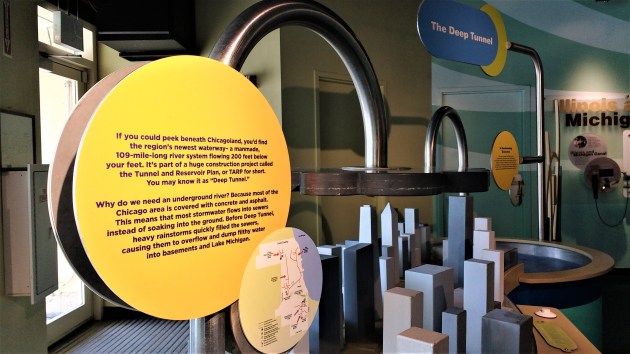
Kids should know about one of the largest civil engineering projects in the world: the Deep Tunnel project in and around Chicago.

DeepTunnelNotebaertNatureMuseum

This is from the Riverworks exhibit at the Peggy Notebaert Nature Museum in Chicago. While some of the pieces of the exhibit failed to work the day we visited, I think I could see the purpose of the The Deep Tunnel exhibit: the floodwaters would be diverted away from the city.

The concept may appear simple and explainable to kids but the execution in real life is not. The exhibit suggests the flooding the past is now alleviated by Deep Tunnel. Yet, the problems are likely to go on in a region that continues to expand and change. Remediating water and flooding issues is a very difficult task compared to altering development at the beginning.

It is interesting to think how else this engineering feat could be presented to children. I could imagine a scaled model that kids could walk through to help give them a sense of the size of the sewers needed as well as the size of some of the water reservoirs. Deep Tunnel is not intended for minor amounts of water; this is supposed to help protect millions of people on a fairly regular basis. Communicating the sheer size could fascinate kids. Or, perhaps some sort of computer game where kids play the role of an engineer or expert as they make choices about where to divert water. Come to think of it, where is this version of Simcity or Roller Coaster Tycoon – “Infrastructure Builder” or “Sewer Wars” or something catchier.

If “Ninety percent or so of renters still want to become homeowners,” what could this lead to?

Financial pressures might have pushed more Americans toward renting and lower rates of homeownership but that does not mean attitudes have shifted away from homeownership. From an overview of housing ten years after the burst housing bubble:

“There’s a remarkably high preference for homeownership that shows up in every survey of renters,” says Chris Herbert, managing director of the Joint Center for Housing Studies of Harvard University. “Ninety percent or so of renters still want to become homeowners. Certainly, young people are moving into homeownership more slowly, but that’s because of a host of reasons such as marrying and having children later, a reduced ability to save since the recession and that it’s harder to get a loan. It’s not because of a fundamental change in attitude.”

Let’s assume this desire for owning a home continues for at least a few years – and this is a consistent desire across multiple decades already. What might this lead to? Two different paths:

  1. The economy improves to the point where those who want to buy a home are able to. This may be difficult to imagine given the availability of high-paying jobs plus the return of housing prices to 2000s levels. Yet, homeownership has been higher in the past and might be again in the future as this is what Americans want. Historically, the federal government has helped Americans reach this goal.
  2. A changing economy plus high housing prices mean relatively few of those who want to own a home will be able to. Younger adults become frustrated by their inability to purchase a home, particularly compared to previous generations. They take out that frustration in various ways, perhaps including higher levels of stress or taking it to the polls (though I argue it will be difficult to have a national conversation about housing and proposals to address housing are often unpopular).

The homeownership rate will be very interesting to watch in the next ten to twenty years. While Americans promoted homeownership for over a century now, there is no guarantee it has to continue into the future if conditions make it very difficult for average residents to buy a house.

Fox Valley Mall “near Naperville” Part 2 – development requirements

A store at Fox Valley Mall prefers to say they are “near Naperville” rather than the actual location in Aurora. How did this shopping center end up across the street from Naperville?

The Urban Investment and Development Corporation (UIDC) started purchasing property for a shopping center in 1966. At this point, Naperville was expanding to the south and southwest at a rapid rate but was nowhere near the size it is today. Similarly, Aurora had an established downtown but there was not a whole lot of development in this area. To help guide its growth, Naperville had developed regulations, particularly in residential subdivisions, to help ensure quality development.

In 1972, UIDC annexed the land they had purchased to Naperville. According to local officials in both communities, the developer chose Aurora in part because of fewer development regulations. Fallout from this choice ensued. Aurora and Naperville signed a boundary agreement to help limit such situations where a developer could play the two communities off of each other. The 1975 Naperville mayoral race included discussion of the loss of the mall. Additionally, the construction of the mall and the loss of status and sales tax money to Aurora helped spur Naperville leaders toward improving the community’s downtown. After the mall opened, Naperville was able to capture some status and money through the opening of stores on the east side of Route 59.

In sum, the developer of the Fox Valley Mall chose to locate in Aurora for some advantages in the early 1970s. Given the path of the two communities since then, I wonder if that developer would choose differently today. On one hand, a Naperville address would convey a certain status. On the other hand, locating just across the street might be the perfect solution: the developers could get benefits from Aurora while always claiming to be “near Naperville.”

Fox Valley Mall “near Naperville” Part 1 – status

I recently heard a radio ad for a store located at Fox Valley Mall which was said to be “near Naperville.” The mall is officially located in Aurora so why would a store there claim to be in the next suburb over? One word: status.

In this particular location, Aurora and Naperville are separated by Illinois Route 59. On the east side, containing a number of stores just across the street from the mall, is Naperville. On the west side, including the mall plus additional stores, is Aurora. Aurora is the bigger community – roughly 200,000 people – but Naperville is the wealthier, higher status community. Some of the figures: Naperville has a median household income of over $110,000 and 4.9% of residents are in poverty. In contrast, Aurora has a median household income of almost $64,000 and 14.0% of residents are in poverty. The communities also differ in race and ethnicity: Aurora is significantly less white (over 30%) and more Latino (35% more) and Black (5% more).

So, when a store says they are “near Naperville,” what are they trying to hint at? They want to associate their store and the shopping experience with a wealthier community rather than Aurora. They want people to think of an upscale and safe place, rather than the diversity of incomes and races/ethnicities of Aurora. Ultimately, they want shoppers to come and spend money like they have Naperville resources.

If it is the case that the store wants to associate with Naperville, why is it located in Aurora? The bigger question: why is the mall in Aurora? To be answered tomorrow.

Do political signs in yards lower property values?

Homeowner’s associations often have restrictions about signs and displays owners can have on their property. The supposed goal of all of this is to protect property values. Without such community organizations, someone might do something odd to their property (ranging from painting their door an unusual color to having stuff in the yard to hanging) that would affect selling prices nearby.

Two questions:

  1. Do political signs and displays actually lower property values?
  2. Even if they do drive down property values, isn’t political expression worth it?

Regarding the first question, outside of legal opinions, I cannot quickly find scholarship with empirical evidence about this. I could see how such an argument could be made: certain political opinions or just the clutter of political signs or displays could detract from the particular aesthetic of a block or neighborhood. As realtors often suggest that the interiors of homes should be relatively depersonalized and uncluttered so that any prospective buyer could imagine themselves there, perhaps the same applies for the exterior. If political signs do indeed have a negative effect, I imagine it would be quite small. (Could signs have a positive effect? Perhaps it could indicate the political leanings of a neighborhood that some would find worth knowing. Or, it might suggest a level of political engagement that some could find attractive.)

But, even if political signs have a negative effect, how much are they worth regulating given that Americans typically like to have the right to political expression? Should HOAs have special regulations about signs or displays that go beyond what a municipality might have about size or noise or crowding? (See a recent example involving a large “Impeach Trump” sign in Elgin, Illinois that the owner reduced in size after the city said it violated their codes.) HOAs often go beyond municipal regulations to make sure that property owners are protected against possible threats to their property values.  Why not allow a little more politics in HOA developments rather than clamp down on matters that could be handled by someone else? (There is already a sorting process that goes on for homeowners at the municipal level before they even consider entering an HOA.)

Another argument to make in favor of more freedom for political signage in HOAs is thinking about the common good – theoretically what politics is about – rather than individual property owners. If more speech is better so that all sides have a chance to participate, why would we then allow HOAs to limit some political expressions just so owners can benefit?

Ultimately, homeowners voluntarily enter such communities; they do not have to purchase one of the millions of housing units governed by an HOA. At the same time, many Americans seem willing to enter HOAs to protect their property until they run into regulations they do not like. If higher property values are the ultimate goal of suburban life, perhaps these HOA dispute stories will simply continue because people cannot afford to not utilize them. On the other hand, if HOAs do not serve the common political good, perhaps they should be avoided.