Quick Review: The End of the Suburbs

I recently read The End of the Suburbs, written by Fortune journalist Leigh Gallagher. On one hand, the book does a nice job describing some recent trends involving, but, on the other hand, the book is mistitled and I think she misses some key points about suburbs.

1. If I could title the book, I would name it something like “The End of the Sprawling Suburbs” or perhaps “The End of Sprawl.” Neither title is as sexy but she is not arguing that the American suburbs will disappear, rather that demographics and other factors are shifting toward cities. There is a big difference between ending suburbs and seeing them “grow up,” as one cited expert puts it.

2. Some of the key trends she highlights: the costs of driving (the whole oil industry, maintenance/gas/insurance/stress for owners, paying for roads/infrastructure), a changing family structure with more single-person and no-children households, changes among millennials and baby boomers who may be looking to get out of the suburbs in large numbers, a push toward New Urbanism in new suburban developments to increase density and strengthen community, and builders and developers, like Toll Brothers, are looking to build denser and more urban developments with more mixed-uses and smaller houses.

3. But, here are some big areas that I think Gallagher misses:

a. While she highlights the benefits of New Urbanism, does this lead to more affordable housing? In fact, the need for more affordable housing is rarely mentioned. As certain areas become more popular, such as urban neighborhoods that attract the creative class, this raises prices and pushes certain people out.

b. The main focus in the book is on big cities in the Northeast and Midwest. While she mentions some Sunbelt cities, like Las Vegas and Los Angeles, there is a lot more to explore here. There are particular patterns in Northern cities compared to newer, more sprawling Sunbelt cities. And in a book talking about the end of sprawl, how could she not mention Portland’s fight against urban sprawl in the last few decades?

c. It is an intriguing idea that cities and suburbs are starting to blend together. But, some of the examples are strange. For example, she talk about how there is increased poverty in the suburbs, which then could make cities more attractive again. There are still some major differences between the two sets of places, particularly the cultural mindsets as well as the settlement patterns.

d. She highlights thriving urban cores – but what about the rest of big cities? While Manhattan and Chicago’s Loop might be doing all right, what about the poorer parts of those cities? The recent mayoral race in NYC involved this issue and many have complained in Chicago that most of the neighborhoods experience little government help. In other words, these thriving urban and suburban developments often benefit the wealthier in society who can take advantage of them.

e. It isn’t until the last chapter that she highlights some defenders of sprawl – people like Joel Kotkin or Robert Bruegmann – but doesn’t spend much time with their ideas. Indeed, the book reads as if these trends are all inevitably moving toward cities and defenders of suburbs would argue critics of suburbs have been making these arguments for decades.

4. Two questions inspired by the book:

a. Just how much should the American economy rely on the housing industry? Gallagher suggests housing is a sign of a good economy based in other areas rather than one of the leading industries. Sprawl can lead to boom times for the construction and housing industries but it can also face tough times. Perhaps our efforts would be better spent trying to build up other industries.

b. Is the century of sprawl in America (roughly 1910 to today – there were suburbs before this but their mass development based around cars and mass housing really began in the 1920s) an aberration in our history or is it a deeper mentality and period? Gallagher suggests we are at the end of an era but others could argue the suburbs are deeply culturally engrained in American life and have a longer past and future.

Overall, this is an interesting read summarizing some important trends but I also think Gallagher misses some major suburban trends.
“4 Hard Truths About [mass] Transit”

A new report from a Toronto-area panel argues there are key points that need to be understood about mass transit:

1. “Subways are not the only good form of transit.” There’s a tendency to see subways as the optimal form of urban transportation. For sure, an efficient subway system, with the power of moving thousands of people quickly through crowded corridors, can make a great city even greater. At the same time, heavy rail is extremely expensive and only appropriate when levels of existing density demand it…

2. “Transit does not automatically drive development.” Hard truth number two picks up where hard truth number one left off. It’s become increasingly fashionable to suggest that transit alone can boost the local economy by attracting businesses and retail development. Again, to be sure, public transportation that increases access to a dense area can produce so-called “agglomeration economies” — in other words, they can be worth way more than their cost to a city…

3. The cost of transit is more than construction. Canadian governments, like those in the United States, separate capital costs of constructing public transportation from the operational costs of running it. The Ontario panel argues that this practice can obscure the total investment needed to pay for a new line or system throughout its functional life. As this chart shows, capital costs are in many cases just a fraction (though a sizeable one) of 50-year costs for a mode..

4. Transit users aren’t the only ones who benefit from transit. This point is perhaps the panel’s most important. The discussion about public transportation often dissolves into an emotional debate about whether or not all city residents should pay for a system used by only some. It’s an odd contention, really, since few people also argue that paying for police, hospitals, schools are worthwhile — although not everyone uses these public services, either.

It is good to take a sober look at large-scale infrastructure projects. But, I wonder if a mass transit proponent wouldn’t look at this list and think that the first three are fairly negative: a good mass transit system offers multiple options, transit doesn’t guarantee development, and the costs are long-term.

If these are good principles, perhaps the next question to ask is then how to build a good system in a city. If there is not much there to start, which might be the case in denser or larger suburbs or newer big cities, how does one overcome the high initial start-up costs? Additionally, how do you move more Americans out of cars as it seems that when they have the choice to drive or not, they will choose driving?

ESPN pushing unscientific “NFL Hazing Survey”

On Sportscenter last night as well as on their website, ESPN last night was pushing a survey of 72 NFL players regarding the recent locker room troubles involving the Miami Dolphins. The problem: the survey is unscientific, something they mentioned at the beginning of the TV reports. The online story includes a similar disclaimer at the beginning of the third paragraph:

But in an unscientific survey conducted by team reporters for ESPN.com’s NFL Nation over two days this week, Incognito does not have the same level of support from some of his peers. Three players participated from each team surveyed, with 72 players in all asked three questions. The players taking part were granted anonymity.

If the survey is unscientific, why do they then spend time discussing the results? If they admit upfront that it is unscientific, what exactly could the viewer/reader learn from the data? It is good that they mentioned the unscientific sample but their own statement suggests we shouldn’t put much stock in what they say next.

New SimCity expansion pack moves toward dystopian cities

I still haven’t played the latest version of SimCity but there is now an expansion pack that portrays a bleaker urban future:

If this sounds like the setup for a disturbing science fiction novel, you’re not far off: This is actually the premise for SimCity: Cities of Tomorrow, a deeply cynical expansion pack for the SimCity game, set to be released November 12. The original SimCity game, of course (along with its most recent fifth edition), allowed players to act as mayors and design the ideal modern city. But the evil genius behind the game play was always that sustainability was illusory: even the most well-designed cities eventually imploded. Players thought they were all-powerful mayors, but they were merely delayers of the inevitable. The best they could do was stave off their city’s collapse…

It’s impossible to miss the socioeconomic and political commentary embedded within Cities of Tomorrow. That the affluent live in the epicenter and the poor are relegated to the suburban fringes feels like a direct commentary on the demographic inversion cities like Chicago, New York and San Francisco are currently experiencing. The concentration of wealth calls to mind what’s left of the Occupy movement. The Sims’ addiction to Omega despite its negative effects on the environment mirrors the developed world’s dependence on oil. Even the MagLev is nearly identical to Elon Musk’s proposed Hyperloop (especially since it only seems plausible within the construct of a video game)…

Whether inspired by real or fictional events, the expansion pack has an inescapable, soul-crushing pessimism. Any idealists who try to a construct a pollution or poverty free utopia are engaging in a Sisyphean task. And this is out of necessity, Librande explains.

“Utopia, in general, is boring for game play. So if we set up a utopian city there’d be nothing for the player to do,” he says…

Librande doesn’t worry about the game’s bleak view of the future turning off any prospective gamers. If anything, they’ll be attracted to the challenge. SimCity has a notoriously die-hard fan base, and what he thinks will make the expansion pack so alluring is not what the game play says about society, but what it says about each player. Players must divide their faith and resources between two purposefully ambiguous entities: OmegaCo and The Academy. OmegaCo’s goal is profit, and The Academy’s motive is to make its technology ubiquitous. What players choose will reveal their attitudes toward capitalism, class, and the balance between privacy and utility.

Utopia is boring! Well-being is overrated! Bring on the morally impossible choices and decaying cities! SimCity has always had a little of this built-in into its gameplay. I clearly remember the scenarios in the original that asked the player to rebuild a city after some sort of disaster, whether an earthquake or Godzilla. I didn’t take much joy in this but other players did; it can be fun to destroy a city with no real consequences.

Perhaps this says more about our current mindset: we’d prefer to deal with decay than positive construction. Cities aren’t “real” until they are clearly gritty and suffering is around the corner. (I’ve heard presentations from urban sociologists on this: there are some gentrifiers who want to “live on the edge” and have to keep moving to find that line between nice neighborhoods and neighborhoods with problems.) Again, there are no consequences for the player for having a dark city where either capitalism or the NSA has run amok. Compare this to the real problems faced in poor neighborhoods in the United States or in the slums in Third World cities where real lives are affected and life chances are severely diminished.

To the Miami Herald: a 23,576 square foot home is not a McMansion

The Miami Herald features a 23,576 square foot home for auction. However, they err by calling it a McMansion:

If you need a house that stretches across east and west wings, a massive McMansion — said to be the largest home for sale in Broward — will be auctioned off on Dec. 8.

The 23,576-square-foot, custom-built home on 10 acres features seven bedrooms, eight full baths and two half baths. It boasts inlaid Italian marble and cathedral-style ceilings, and comes with a guest house, four-car garage, and statues and objects of art from all over the world.

“The finish work on the inside is the most amazing, with 30-foot high ceilings, chandeliers. It’s just magnificent,” said Jim Gall, president of Auction Company of America, hired to auction off the home, which was listed a year ago for $10 million…

Gall said he plans to start the bidding on the house at $5 million.

Homeowner Ray Moses said he and his wife, Pam, spent five years building the mansion after buying the property, which was formerly used as a horse boarding facility. Broward County property records show they paid $2,225,000 for the acreage in 2003.

Here are four reasons it is not a McMansion (with the most important reason at the top):

1. This home is far beyond the size of a McMansion. This kind of square footage is way beyond a McMansion.

2. Because of its size, luxury, and land, it is also out of the price range of a typical, particularly in Florida. The price might make sense if it was a big house in New York City.

3. This is not a big house on a postage-stamp lot; there are ten acres of land.

4. The home is custom-built, not part of a suburban neighborhood where the houses all look at the same.

By size alone, this home is not a McMansion but the other factors matter as well.

Interestingly, the report on the auction starts with the term McMansion and later uses mansion. Does this suggest the terms are interchangeable? Again, I would argue they are distinct categories.

Toronto mayor Rob Ford’s problems include living in a “American-style suburban McMansion”?

The mayor of Toronto is getting all kinds of attention – and at least one person thinks one of his problems is “American-style suburban McMansion”:

Also from the Gawkerverse: this Ken Layne piece about Rob Ford’s essential un-Canadianness, which wrongly asserts that “when he sits around his American-style suburban McMansion, he literally sits around his American-style suburban McMansion.” Rob Ford’s house is suburban, but it’s actually a pretty modest place.

Americans are known for their big houses. It shouldn’t be a surprise that this is something Canadians pick up on since most Canadians live quite close to the U.S.-Canada border. Indeed, there are plenty of stories regarding McMansions in the Chicago metropolitan region and Chicago and Toronto are often compared to each other. But, which part of the insinuation is worse:

1. That a Canadian acts like an American?

2. That owning a McMansion is a bad thing anyway (whether one lives in Canada, the United States, Australia, and other places with McMansions)?

3. That sprawl/suburbs are bad?

This also reminds me of the documentary Radiant City that involves Canadian suburbanites outside of Calgary but utilizes a number of American opponents to McMansions and seems to be most interested in tackling American-style sprawl. A side note: it is a film that includes a mock musical about mowing lawns.

Studying religiosity by text messages and three minute surveys

A new study of religiosity utilizes text messages and short surveys:

After signing up on soulpulse.org, users receive text messages twice a day for 14 days that direct them to a 15 to 20-question survey. These questions gather data on daily spiritual attitudes and physical influences at points during the day, such as quality of sleep, amount of exercise and alcohol consumption. The average length of time required to complete the survey is around three minutes and is designed with the ideas of simplicity and ease of use.

At the end of the two-week testing period, the reward for participants is a comprehensive review of their data that allows them to see and learn more about their spiritual mindsets. In return, the research team is given the opportunity to analyze the information that they have collected. Wright said they have already found that people report the greatest feelings of spirituality on Sundays and the least amount on Wednesdays.

A collection of three-minute surveys however, took months of collaboration across the country to complete. 18 months of planning and 10 trips to Silicon Valley were necessary, as well as a team of people who each contributed a unique skillset to the group. The Soulpulse team consists of four computer programmers, three public engagers and six academic advisors – including UConn professors Crystal Park and Jeremy Pais.

Measuring religiosity is well established in sociology but it often relies on people reporting on their past behavior. For example, some sociologists suggest church attendance figures are regularly inflated. Using text messages would allow more up-to-date data as the goal is to quickly interrupt people’s activity and get their more accurate take on their religious behavior.

Generally, I would guess sociology and other social science fields are headed in this direction for data collection: less formal and more minute to minute. In the past, some of this was done with time diaries or logs. But, even these posed problems as at the end of the day a person might misremember or reinterpret their earlier actions. Utilizing text messages or pop-up Internet surveys or other means could yield more better data, utilize newer technologies respondents are regularly engaging, and perhaps even take less time in the long run.

Quick Review: League of Denial

I had a chance this past week to read the book League of Denial and see the PBS documentary by the same name. Some thoughts about the story of the NFL and concussion research (focusing mostly on the book which provides a more detailed narrative):

1. I know some fans are already complaining of “concussion fatigue” but it is hard to think of football the same way after hearing this story. For decades, we have held up players for their toughness and yet it may be ruining their brains.

2. The human story in all of this is quite interesting. This includes some of the former football players who have been driven to the edge by their football-related brain injuries. At the same time, the story amongst the doctors is also pretty fascinating, the chase for fame, publishing articles, and acquiring brains. Running through the whole book is this question of “who is really doing this research for the right reasons?” Even if the NFL research appears to be irrevocably tainted, are the researchers on the other side completely neutral or pure of heart?

3. The whole scientific process is laid out in the book (glossed over more in the documentary)…and I’m not sure how it fares. You have scientists fighting each other to acquire brains. You have peer-reviewed research – supposed to help prevent erroneous findings – that is viewed by many as erroneous from the start. You have scientists fighting for funding, an ongoing battle for all researchers as they must support their work and have their own livelihoods. In the end, consensus seems to be emerging but the book and documentary highlight the messy process it takes to get there.

4. The comparisons of the NFL to Big Tobacco seem compelling: the NFL tried to bury concussions research for a few decades and still doesn’t admit to a long-term impact of concussions on its players. One place where the comparison might break down for the general public (and scientific research could change this in the near future): the worst problems seem to be in long-time NFL players. When exactly does CTE start in the brains of football players? There is some evidence younger players, college or high school, might already have CTE but we need more evidence of this to be sure. If that is established, that perhaps kids as young as junior high already have CTE and that CTE is derived from regular hits at a young age (not the big knock-out blows), the link to Big Tobacco might be complete.

5. It is not really part of this story but I was struck again by how relatively little we know about the brain. Concussion research didn’t really take off until the 1990s, even as this had happened with football players for decades. (One sports area where it had been studied: boxing.) Much of this research is quite new and is a reminder that we humans don’t know as much as we might think.

6. This also provides a big reminder that the NFL is big business. Players seem the most aware of this: they can be cut at any time and an injury outside of their control could end their careers. The league and owners do not come off well here as they try to protect their holdings. The employees – the players – are generally treated badly: paid well if they perform but thrown aside otherwise. This may lead to a “better product” on the field but the human toll is staggering.

7. How exactly you change people’s opinions, both fans and players, regarding concussions will be fascinating to watch. It will take quite a shift among players from the tough-guy image to being willing to consider their futures more carefully. For fans, they may become more understanding as their favorite players consider what concussions might do to their lives. Will the NFL remain as popular? Hard to say though I imagine most fans this past weekend of football had little problem watching lots of gridiron action Saturday and Sunday.

Changing the official poverty measure leads to 49.7 million Americans in poverty

If recommendations from social scientists are followed, the official US government measure of poverty will change and nearly 50 million Americans will be categorized as in poverty:

The number of poor people in America is 3 million higher than the official count, encompassing 1 in 6 residents due to out-of-pocket medical costs and work-related expenses, according to a revised census measure released Wednesday.

The new measure is aimed at providing a fuller picture of poverty, but does not replace the official government numbers. Put in place two years ago by the Obama administration, it generally is considered more reliable by social scientists because it factors in living expenses as well as the effects of government aid, such as food stamps and tax credits.

Administration officials have declined to say whether the new measure eventually could replace the official poverty formula, which is used to allocate federal dollars to states and localities and to determine eligibility for safety-net programs such as Medicaid.

Congress would have to agree to adopt the new measure, which generally would result in a higher poverty rate from year to year and thus higher government payouts for aid programs.

Some other interesting data in the story as well: Social Security reduces poverty for those over 65 years old quite a bit and food stamps reduce the number of Americans in poverty by over 5 million.

On one hand, it is hard to argue with calls for a more accurate measure of poverty. This would better reflect actual living situations and give the government a better tool for addressing the issue. On the other hand, this is quite the political football. Don’t poor Americans have plenty of electronics (a bad argument)? But, as Joseph Stiglitz notes in the article, how can one of the wealthiest countries in the world have 1 out of every 6 residents living below the poverty line?

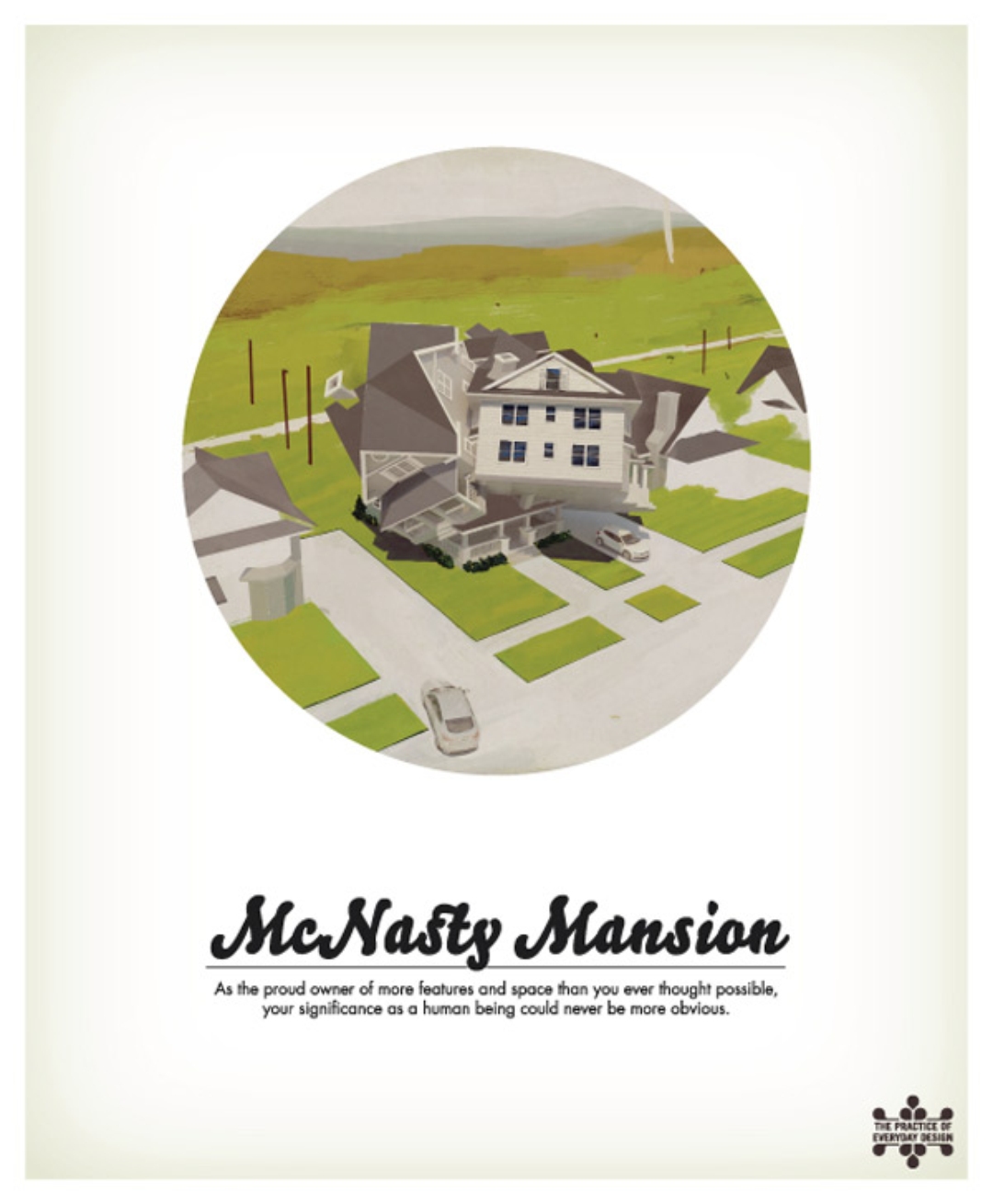
The crazy house you get when put together the McMansions of Google 3D warehouse

One group combined the various McMansion designs they found on Google 3D warehouse – and the result is not pretty:

Two-year-old Canadian design office The Practice of Everyday Design searched Google 3D Warehouse (an open-source library of model files) for the most popular suburban home typologies. After culling the top examples, they fused them all together and 3D-printed the mess. They call it “Nasty McMansion,” and you can buy one! We suggest hanging it on a string and dangling it from the ceiling in your office, as a warning.

Think of it as a kind of Ringstrasse for suburban mansions. Write TOPED:

“The McNasty Mansion offers a new and more exciting typology of homes, formed off the same principals of the McMansion: more rooms than one can fill, enough mixed styles to ensure complete architectural confusion, and enough faux finishes and cheap materials to keep cost down but dimensions huge.

I’m not sure how exactly they put this image together but it looks like it was done in such a way to maximize the bizarreness. For example, that front door on the left that tilts down toward the ground would be quite difficult for the average McMansion owner to access. Wouldn’t you get a similar result even if you combined more pleasing designs? And how exactly does their 3D design incorporate “faux finishes and cheap materials” versus the real things? But, if the goal was to create a “McNasty” design that creates a startling visual, the goal was met.

Just curious: what is the general level of architectural design on Google 3D warehouse?