Cities and metro areas like growth – but do not necessarily like the changes it brings

Growth is good in the United States for cities and metropolitan regions. But, the changes that come with growth is not always viewed fondly by the people already there. The most recent example: Nashville.

Photo by Isaac Loredo Vargas on Pexels.com

Remacia Smith watches her children play in a grassy park by the Cumberland River, not far from where software giant Oracle said last week it would base its new headquarters. It is bittersweet—her hometown is thriving, but it has reached a point where it no longer works for her…

“There are pain points of this growth,” said Kate Webster, a 35-year-old real-estate agent who has lived in Nashville for 14 years. “But at the end of the day, I’d rather live in a city that is growing than one that is declining.”…

The region needs to focus on improving transit options and traffic flow, and on more housing options, Gaughan said. Many neighborhoods need to rezone for construction that allows more people to live there, he said.

John Michael Morgan, a lifelong resident of the area, said he remembers when Nashville’s prospects weren’t so hot. The growth is exciting, he said, but he worries about Nashville losing some of its personality.

“Nashville’s always been a big town that felt like a small town,” said Morgan, who is 44 years old. “Now we’re a big town that feels like a big town.”.

Change can be hard for residents of a community. They are used to the way things were. They may have moved there for particular features of the community.

Increased population growth tends to lead to more construction, higher housing prices, more traffic, and different streetscapes.

However, the United States tends to treat growth as a good thing. What community wants to stagnate or decrease in terms of population and business activity? How many people want to be in an undesirable community?

At some point, the growth in Nashville will level out and that will offer an opportunity to assess what has changed. Is the city and metropolitan region now a different place? What has fundamentally (and perhaps unalterably) changed?

Setting The Matrix in Chicago – sort of

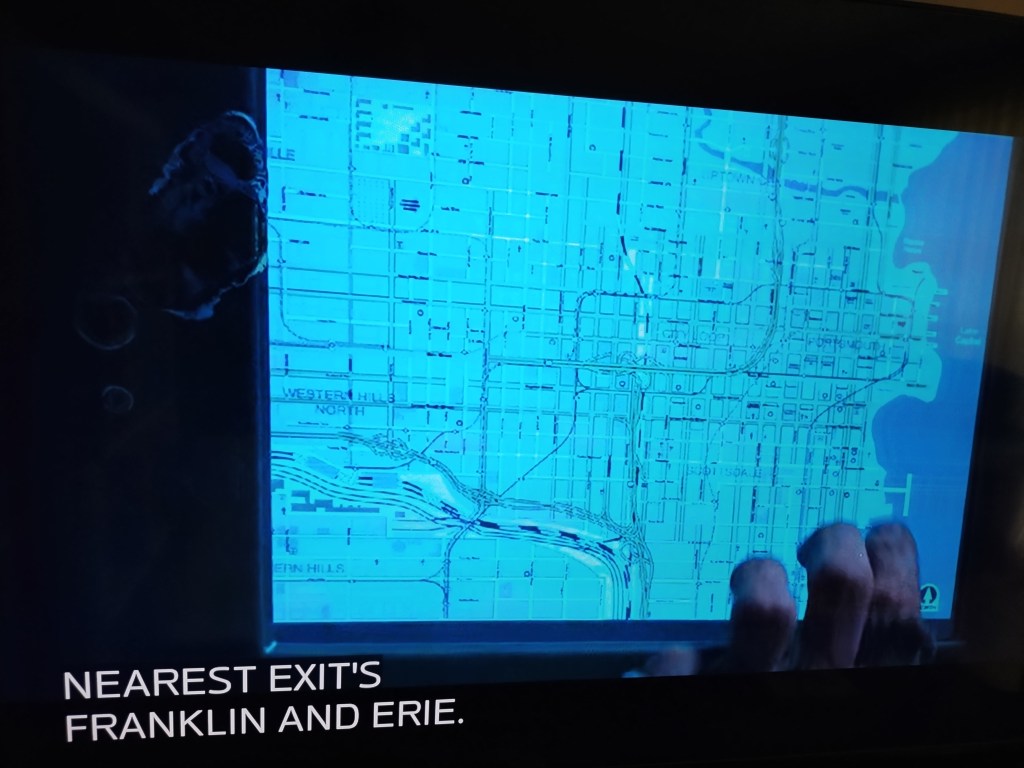
While recently rewatching The Matrix, I noticed multiple references to Chicago streets. And then there is a map in the second half of the film:

Looking closely, this is not exactly Chicago. But, the waterfront kind of looks like Chicago, there is a neighborhood on the map marked “City Loop,” the city has a river, and things do appear to converge in the district next to the waterfront.

Why the resemblance? One source suggests this is deliberate in the depiction of Mega City:

Early drafts of the screenplay identified the city as Chicago, and most of the street and landmark names referenced in the films are from Chicago,[4] such as Wabash and Lake, Franklin and Erie, State Street, Balbo Drive, Cumberland Ave, the Adams Street Bridge and the Loop Train.[5] Some street names, such as Paterson Pass and Wu Ping Ave., are derived from names of production staff.

In a brief screenshot of the first movie, wherein Tank zooms in a map on the screen to give Cypher directions to the telephone, the map of the city shows a coastline similar to that of Chicago’s Lake Michigan Coastline.

The creators have connections to Chicago:

Sure, most of the trilogy’s urban scenes were shot in Sydney, and close watchers of the first movie can spot several Sydney landmark buildings. But creators Larry and Andy Wachowski were raised in Chicago and drop at least five references in the first script…

The Wachowskis attended Whitney Young High School and spent two years in small liberal arts colleges before they each dropped out and started a construction business. Then the quirky film resume began to take shape.

This is not unusual in today’s filming of movies and shows: creators are from certain places, scenes may be shot in a variety of places, and the name of the place in the film or show may or may not align with the places that are depicted on screen. In The Matrix, a combination of modern cities produce a soulless but recognizable setting.

The American middle class and a high salary to “live comfortably” in a city with a 50/30/20 budget

SmartAsset recently looked at the salary needed to “live comfortably” in American metro areas. The numbers are pretty high:

Photo by Vecislavas Popa on Pexels.com

Key Findings

  • On average, an individual needs $96,500 for sustainable comfort in a major U.S. city. This includes being able to pay off debt and invest for the future. It’s even more expensive for families, who need to make an average combined income of about $235,000 to support two adults and two children without the pressure of living paycheck to paycheck.
  • A family must make over $300k to raise two kids comfortably in six cities. Two working adults need to make a particularly high combined income in San Francisco ($339,123); San Jose ($334,547); Boston ($319,738); Arlington, VA ($318,573); New York City ($318,406); and Oakland, CA ($316,243) to raise two children with enough money for needs, wants and savings.
  • It takes the most money to live comfortably as a single person in New York City. This breaks down to $66.62 in hourly wages, or an annual salary of $138,570. To cover necessities as a single person in New York City, you’ll need an estimated $70,000 in wages. 

Here are the budget calculations:

SmartAsset used MIT Living Wage Calculator data to gather the basic cost of living for an individual with no children and for two working adults with two children. Data includes cost of necessities including housing, food, transportation and income taxes. It was last updated to reflect the most recent data available on Feb. 14, 2024.

Applying these costs to the 50/30/20 budget for 99 of the largest U.S. cities, MIT’s living wage is assumed to cover needs (i.e. 50% of one’s budget). From there the total wage was extrapolated for individuals and families to spend 30% of the total on wants and 20% on savings or debt payments.

I would be interested to see how this compares with how different people or groups over time have defined the American middle class. Is it a particular income band or an ability to have certain kinds of experiences? Do Americans in the middle class interpret their own lives as living comfortable?

Since most residents in cities do not have the salaries listed above, one conclusion is that many people are not able to live comfortably. Do these numbers mean that people below these salary points are living paycheck to paycheck (or think they are)?

This could lead to helpful discussions of social class, pay, and conditions in American cities. If Americans should be able to live on a 50/30/20 budget, what could be changed to help people achieve this?

Chicago as a laboratory – for residential segregation?

A quote discussing a new documentary about residential segregation in Chicago reminded me of imagery used by sociologist Robert Park about seeing a city as a laboratory for study:

Photo by Karl Solano on Pexels.com

“This documentary really shows that Chicago is not just a place where segregation happened, but in some ways the intellectual and bureaucratic headquarters for thinking about how to carry it out,” Brown said. “It was a real brain trust in Chicago starting at the very turn of the 20th century, thinking about the problems that Blacks posed for real estate values and coming up with different ways of thinking about that as salesmen from the realtor point of view, as an intellectual problem being studied at UChicago, and the way the different neighborhood associations were also trying out different ways of keeping Blacks out of their neighborhoods.”

In other words, at official, neighborhood, and organizational levels, Chicago worked out how to practice residential segregation. Over the years, Chicago has ranked high on measures of residential segregation. A quick visual of the situation – such as a dot map showing race and ethnicity of residents – shows the differences in residences in Chicago today. And did other places follow the lead of Chicago?

I look forward to seeing this documentary.

A Japanese experimental city to test self-driving vehicles and other new tech

A new community being built by Toyota offers opportunities to test self-driving cars:

Photo by Shane Aldendorff on Pexels.com

First announced in 2021, Toyota has been hard at work constructing their Woven City just miles away from Mount Fuji on the island of Honshū, with the first of 2,000 anticipated residents now expected to move in before the end of the year. 

News of the project’s imminent completion comes not long after photos were shared of progress being made on Saudi Arabia’s behemoth ‘mirror city’ project The Line, though they’re hardly the only megacities currently under construction around the world. 

Marketed as a ‘mass human experiment’, Woven City will provide a ‘living laboratory’ for Toyota to test prototypes of their renewable and energy-efficient self-driving vehicles, dubbed ‘E-palettes’.

The car manufacturer expects to gather data from the use of these driverless cars, guided by sensors in lights, buildings and roads across the city…

Woven City is also expected to feature ‘smart homes’ running almost entirely on hydrogen, reducing emissions so that the futuristic habitation, with its whopping price tag of £7.8 billion, will be as sustainable and eco-friendly as possible.

Imagine a future email that reads like this: “You are invited to live in a new brand-new community built and owned by [megacorporation name]. You have an exciting opportunity to be part of a new community featuring all sorts of innovative technologies. In exchange for a reduced rent, you will participate in testing numerous new technologies that have the potential to improve the world and our profits (wait they would not say this second part). All your experiences outside of your residence are subject to use by the company.”

How many people would take this opportunity? Given that people so freely give up their information for social media, wouldn’t an enticement of cheaper housing prove attractive? And you get to try out new technology? It may be a company town – but it is one with benefits (at least, according to the company).

It would also be interesting to see what would need to change in terms of local governments and zoning to make such a community possible.

25% of Parisian residents live in public housing; hard to imagine this in the United States

A sizable portion of Paris residents live in public housing:

Photo by Chris Molloy on Pexels.com

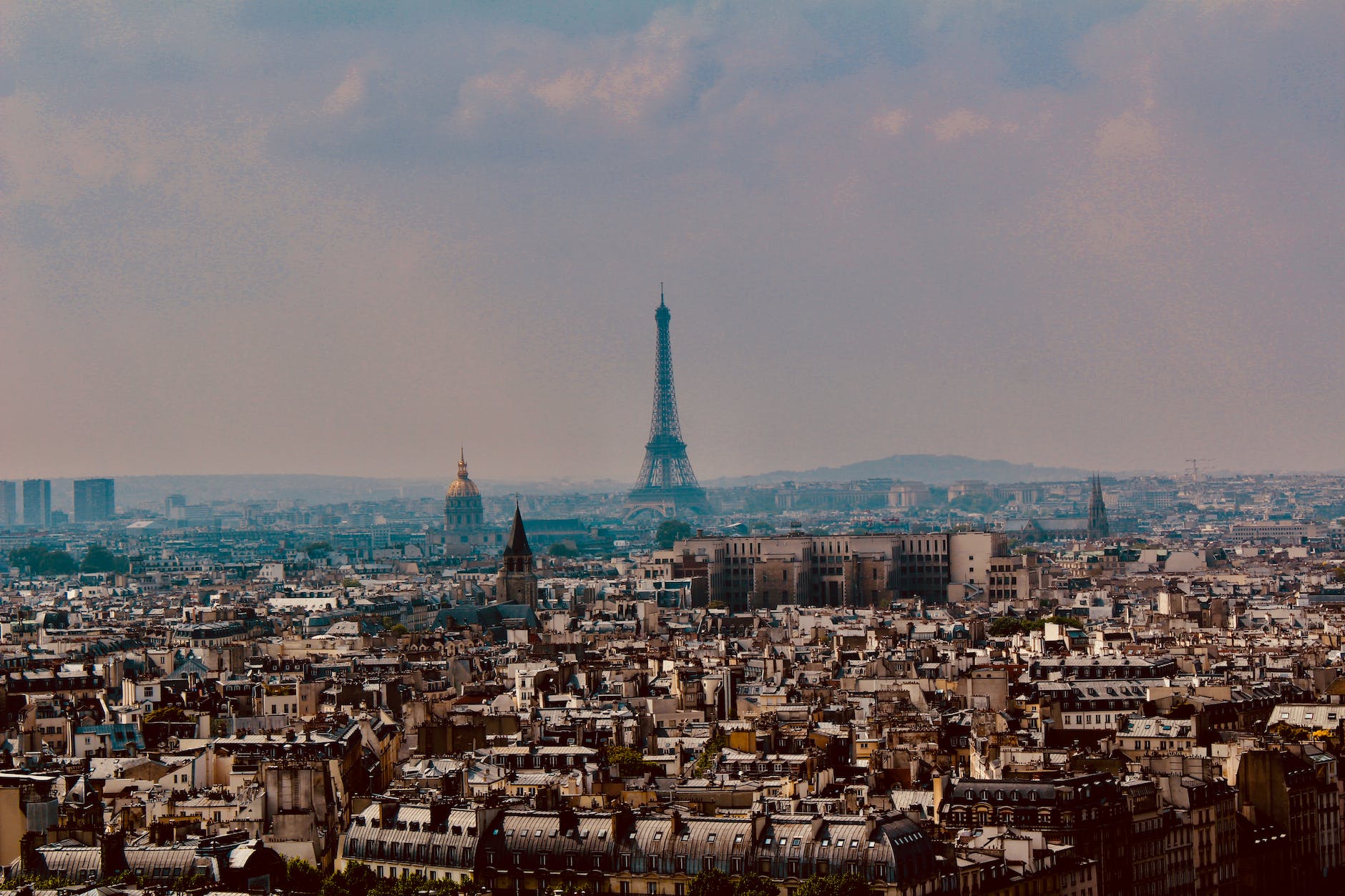
This summer, when the French capital welcomes upward of 15 million visitors for the Olympic Games, it will showcase a city engineered by government policies to achieve mixité sociale — residents from a broad cross-section of society. One quarter of all Paris residents now live in public housing, up from 13 percent in the late 1990s. The mixité sociale policy, promoted most forcefully by left-wing political parties, notably the French Communist Party, targets the economic segregation seen in many world cities.

“Our guiding philosophy is that those who produce the riches of the city must have the right to live in it,” said Ian Brossat, a communist senator who served for a decade as City Hall’s head of housing. Teachers, sanitation workers, nurses, college students, bakers and butchers are among those who benefit from the program.

Making the philosophy a reality is increasingly hard — the wait list for public housing in Paris is more than six years long. “I won’t say this is easy and that we have solved the problem,” Mr. Brossat said…

City Hall has a direct hand in the types of businesses that take root and survive in Paris because it is the landlord, through its real estate subsidiaries, of 19 percent of the city’s shops. Nicolas Bonnet-Oulaldj, the city counselor who oversees the city’s commercial landholdings, said his office is constantly studying neighborhoods to maintain a balance of essential shops and limit the number of chains, which can usually pay higher rent.

Three related reasons come to mind for why this would not happen in an American city, even with significant needs for housing:

  1. A supposed free market approach to housing. Americans prioritize policies and programs for single-family homes, not denser urban housing with subsidized rents. Why should public housing take up valuable real estate that would go for much higher prices on the open market?
  2. Many Americans think public housing has already failed in the United States. The story might go like this: the limited project that began in the first few decades of the twentieth century led to disastrous high-rise public housing projects in big cities and a subsequent retreat from public housing (shifting to providing housing vouchers).
  3. Less interest in centralized planning and government control. Would Americans want the government choosing housing and business opportunities in major cities? You mean Paris is not organically developed?

Overall, American cities pursue market approaches to social issues.

Crows take to American cities

The humble – mighty? – crow is congregating in some American cities:

Photo by Mike Bird on Pexels.com

Across North America, crow populations have been declining for decades. But crows appear to be flocking to cities more than ever before. Cities from Sunnyvale, California, to Danville, Illinois, to Poughkeepsie, New York, host thousands of crows each winter. Some popular urban roosts host more than 100,000 crows each night.

Crows are territorial during the spring and summer breeding season, but during the rest of the year, they sleep in large groups known as roosts. Sometimes a roost occupies a single tree; sometimes it’s spread over multiple perching sites—usually flat roofs or treetops—in a consistent area. Roosting has clear advantages for crows, especially during winter. “They’re better off being in a big group, where they get the benefit of all those eyes looking out for danger. It’s also warmer,” John Marzluff, the author of Gifts of the Crow, told me.

City roosts offer even more advantages. The very features of urban life that harm other species—fragmented landscapes, bright lights at night, and open stretches of grass in parks—benefit crows. Lights make it easier to spot predators, such as owls. Grass doesn’t offer much in the way of food or shelter for many animals, but crows will happily dig through it for beetle larvae and other snacks. Also, Marzluff told me, crows like that we humans often plant grass close to clusters of trees, where they can sleep or nest, and other food sources, such as our trash. Fragmented habitats, such as a group of trees in a park surrounded by asphalt, harm other species because they aren’t big enough to foster genetic diversity. But they are ideal for crows, who can fly between pockets of greenery and like to have a variety of options for their nesting areas and foraging sites.

Crows, in other words, move to urban areas for the same reason humans do: Cities offer just about everything they need within flapping distance. During the breeding season, Marzluff said, crows even decamp to the suburbs to raise their families, just like humans. And once even small roosts are established, many of them grow year after year, from perhaps a few hundred birds to a few hundred thousand. News spreads fast through the crow community, Marzluff said: Crows share information with one another and develop traditions and culture within populations, including roosting habits, though scientists still don’t know exactly how they do it.

These birds are real!

This reminds me of the book Subirdia which suggested some bird species can thrive with human development and others do not. Crows are likely not the only birds or animal species that finds cities to be a good habitat.

The article ends with suggestions from some that humans should embrace crows in cities. However, if the headline is prescient, would crows go the way of pigeons? Or might some another birds take over from the crows?

“Communities,”cities and towns,” and “urban, suburban, and rural” in SOTU speech

How did President Joe Biden describe where Americans live? Here are some patterns from his State of the Union speech last night:

Photo by freestocks.org on Pexels.com
  1. Communities was used five times. This phrase covers a lot of potential places. Here are two uses: “Thanks to our Bipartisan Infrastructure Law, 46,000 new projects have been announced across your communities—modernizing our roads and bridges, ports and airports, and public transit systems.”; “Taking historic action on environmental justice for fence-line communities smothered by the legacy of pollution.”
  2. Cities and towns was used twice. This presumably refers to both places with more residents and those with fewer. Here are several uses: “It doesn’t make the news but in thousands of cities and towns the American people are writing the greatest comeback story never told.”; “Help cities and towns invest in more community police officers, more mental health workers, and more community violence intervention.”
  3. Urban, suburban, rural was used once (and mentioned communities): “Providing affordable high speed internet for every American no matter where you live. Urban, suburban, and rural communities—in red states and blue.”

These uses are likely trying to cover as many different places in the United States at once. I imagine few Americans would not fit into one of these places described. A community could refer to municipalities, geographies, and other social groups that would use this term to describe themselves. Cities and towns covers bigger and smaller places. Urban, suburban, rural is a common set of categories that refers to different places and ways of life.

Are these the most effective terms to use when talking to a broad audience of people in the United States? When people hear these terms, do they recognize their own communities?

Ongoing movement of religious people from American cities to suburbs

More religious people in cities are moving to suburbs:

Photo by Jonathan Meyer on Pexels.com

Researchers interviewed by The Times said rising costs, rampant crime and changing racial demographics have made it harder to sustain worship spaces in large cities…

As more urban neighborhoods become secularized, demographers say religious families increasingly prefer to settle in suburban enclaves up to 20 miles outside of city centers…

“Over the last 10 years, the 100 fastest-growing churches in America are primarily in the growing inner and outer ring suburbs of major cities,” said Ryan Burge, an Eastern Illinois University political scientist and religious demographer. “They’re almost always non-denominational Christian churches near cities like Charlotte, Charleston and Atlanta. They are the fastest because that’s where people are moving.”…

In New Orleans and several Midwest and Northeast cities, gentrification has pushed more Black Christians into the suburbs than other groups…

Rather than start in the city and expand to the suburbs, most new churches now move in the opposite direction. For example, Elevation Church in Matthews, North Carolina, started 12 miles southeast of downtown Charlotte. It later planted a satellite church in the city center.

In some ways, these are continuations of existing trends. The United States is a majority suburban country and more people have lived in suburbs than cities since the 1960s. White flight from cities included congregations. Increasing racial and ethnic diversity in suburbs has occurred alongside increasing religious diversity in suburbs.

On the other hand, these could include new and different patterns:

-Which churches are closing and which religious groups are moving to the suburbs. If it was largely white congregations in the postwar era, it now includes more groups.

-The number of congregations closing. Are there now more closing than decades before?

-The relative power and influence of suburban megachurches compared to the past. If congregational influence decades ago tended to reside in older, urban congregations, this may have shifted today.

-Are cities more secular than they were in the past? Significant percentages of urban residents are religious and cities contain numerous religious congregations and organizations. Or, has the perception of cities and religion changed?

I suspect there is more to say on the connection between religion and suburbs.

Baseball stadiums in relation to downtowns

The Chicago White Sox have had recent talks about the possibility of a new stadium closer to Chicago’s downtown. This would move them closer to the Loop and downtown activity. How does this compare to other baseball teams?

According to this map, most stadiums are pretty close to downtown. Some are further away – Texas, Kansas City – while others are close to ten miles away but still in the city (both New York teams).

My suspicion – without looking hard at the data – it that this may not be true of all of the major sports leagues in the United States. Baseball stadiums are often close to downtown but this may not hold across other sports. At least a few NFL stadiums are in the suburbs.

Do cities believe baseball stadiums are economic engines? Do teams closer to downtowns draw more fans? Do team owners see locations closer to downtown as more desirable, particularly with the trend to make money on developing land around the stadium?