The use of former Catholic properties includes homes for other congregations and giving the land back to a Tribal Nation

When churches and properties of the Catholic Church are sold, what happens to them? In the last few days, I saw two articles that highlight several of the possible outcomes. First, they can become homes for other congregations:
Photo by RDNE Stock project on Pexels.com

Local Catholic leaders tend to be grateful that others can use the space for worship and service. But it’s not always a smooth transition. Evangelical churches without experience with bigger facilities may not be ready for the upkeep. And local Catholic parishioners may feel the emotional sting of seeing their former sacred spaces dismantled and reused by other traditions…

Real estate broker Matt Messier, whose company Foundry Commercial has sold around 3,000 churches over the last 50 years, estimates that more than half of church properties—whether Catholic or mainline Protestant—get bought by a fellow faith group…

An ongoing study on Chicago churches by the University of Notre Dame researchers found the same. “The most common reuse of dedicated church buildings—not only Catholic church buildings—is reuse for another church,” said program director Maddy Johnson.

Second, a community of Sisters in Wisconsin sold their property to a neighboring Native tribe:

A Wisconsin religious community says it has completed the first known instance of a Catholic group returning land to a Native American tribe, hailing it as a move made in the “spirit of relationship and healing.”

The Franciscan Sisters of Perpetual Adoration announced the transfer in an Oct. 31 news release on its website. The community is located in La Crosse, Wisconsin, near the state’s border with Minnesota.

The sisters had purchased the land from the Lac du Flambeau Band of the Lake Superior Chippewa tribe in 1966 and used the property for its Marywood Franciscan Spirituality Center.

The sisters said they sold the property to the tribe for $30,000, the exact amount for which they paid for the land six decades ago. The modern sale price represented “just over 1% of [the land’s] current market value,” the sisters said.

The first set of outcomes is more common than the second. There are plenty of religious congregations who need buildings as constructing a new building is expensive – buying the property, erecting a building, etc. – and time consuming – it could take years to raise funds, obtain approval, complete the construction, etc. Given more recent discussion of colonialism and history, perhaps there will be more instances of religious groups giving land to Native tribes.

There are some guidelines in place regarding who the Church might sell to:

“Catholic bishops are required to protect former Catholic worship sites from what canon law calls ‘sordid use,’” said Notre Dame’s Johnson. “In addition, recent Vatican guidance has encouraged, where possible, proactively finding mission-aligned reuses. What this means for non-Catholic religious reuse of former Catholic sites is a point of debate.”

With the number of church closures in recent years and expected in the coming years, keep an eye out for research regarding what happens to properties, buildings, and congregations. My recently published look at how many congregations researchers can find online has implications for studying closed congregations and the fate of their properties.
New publication – Finding Congregations through Online Searches: Possibilities and Perils

Review of Religious Research just published online a research note I wrote titled “Finding Congregations through Online Searches: Possibilities and Perils.” This comes out of research I have been conducting the last few years looking for religious congregations in the suburbs. With all the congregations with online presences, whether on social media or on websites or in online directories, what can researchers learn? Here is the abstract for the article:

Photo by Afif Ramdhasuma on Pexels.com

Many religious congregations are active online and people seek out congregations online but existing research is less clear about whether all congregations within a geographic area are discoverable through online searches and what information about congregations is available online. Searching for congregations in a large suburban county on five online platforms – three directories (YellowPages.comYelp.comChurchFinder.com) and two social media platforms (Facebook, Instagram) – revealed over 700 congregations. The counts showed similarities and differences for certain religious groups compared to the 2020 U.S. Religion Census. It is difficult to have certainty regarding obtaining a complete population of congregations in this county given the ambiguity of some online information and the possible number of congregations not online. Of congregations found online, the different platforms enable researchers to examine locations, buildings, images, posts, links, activities, and interactions with online actors. These findings point to a need for more online searching for congregations in order to study hundreds of congregations at a time, compare online search results to other methods for finding congregations, and contribute to research on congregational activity, online interactions, and closures.

I have analyzed the online presence of congregations in several works as it enables researchers to look across a large number of cases. And it provides needed insights into what congregations are doing online and offline as the worlds are more overlapping than some might imagine. Can looking at congregations online find all the congregations or tell a researcher everything about congregational activity? No, but it offers opportunities that might be hard to match with other methods and insights into the influential online realm.

Using community wayfinding signs for religious congregations

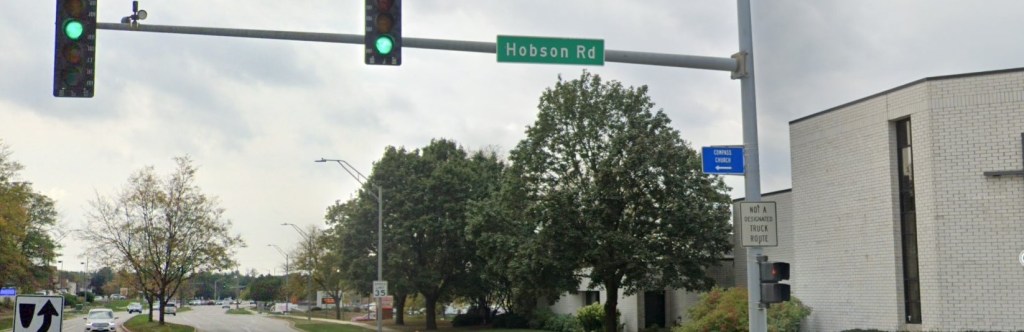
Drive through a community in the Chicago area and you see a lot of signs. One small set of these direct travelers toward religious congregations. Here is one example from Google Street View:

Image from Google Street View

See the small blue sign on the traffic light pole? It directs people to a church a half a mile down the road.

A few observations in seeing such signs:

  1. Not all congregations have a sign. Could all congregations request one and then have at least one pointing toward them?
  2. The signs are pretty small. How many drivers see them.
  3. The signs tend to be posted at busier intersections. Some drives from those intersections are shorter and easier to navigate than others. For example, a driver might see a sign pointing in a direction but it may take a little while before finding the congregation roughly in that direction.

Given that these signs are likely provided as a community good, can their use be improved in significant ways?

Ongoing movement of religious people from American cities to suburbs

More religious people in cities are moving to suburbs:

Photo by Jonathan Meyer on Pexels.com

Researchers interviewed by The Times said rising costs, rampant crime and changing racial demographics have made it harder to sustain worship spaces in large cities…

As more urban neighborhoods become secularized, demographers say religious families increasingly prefer to settle in suburban enclaves up to 20 miles outside of city centers…

“Over the last 10 years, the 100 fastest-growing churches in America are primarily in the growing inner and outer ring suburbs of major cities,” said Ryan Burge, an Eastern Illinois University political scientist and religious demographer. “They’re almost always non-denominational Christian churches near cities like Charlotte, Charleston and Atlanta. They are the fastest because that’s where people are moving.”…

In New Orleans and several Midwest and Northeast cities, gentrification has pushed more Black Christians into the suburbs than other groups…

Rather than start in the city and expand to the suburbs, most new churches now move in the opposite direction. For example, Elevation Church in Matthews, North Carolina, started 12 miles southeast of downtown Charlotte. It later planted a satellite church in the city center.

In some ways, these are continuations of existing trends. The United States is a majority suburban country and more people have lived in suburbs than cities since the 1960s. White flight from cities included congregations. Increasing racial and ethnic diversity in suburbs has occurred alongside increasing religious diversity in suburbs.

On the other hand, these could include new and different patterns:

-Which churches are closing and which religious groups are moving to the suburbs. If it was largely white congregations in the postwar era, it now includes more groups.

-The number of congregations closing. Are there now more closing than decades before?

-The relative power and influence of suburban megachurches compared to the past. If congregational influence decades ago tended to reside in older, urban congregations, this may have shifted today.

-Are cities more secular than they were in the past? Significant percentages of urban residents are religious and cities contain numerous religious congregations and organizations. Or, has the perception of cities and religion changed?

I suspect there is more to say on the connection between religion and suburbs.

Famous NYC church sells air rights to help keep building going

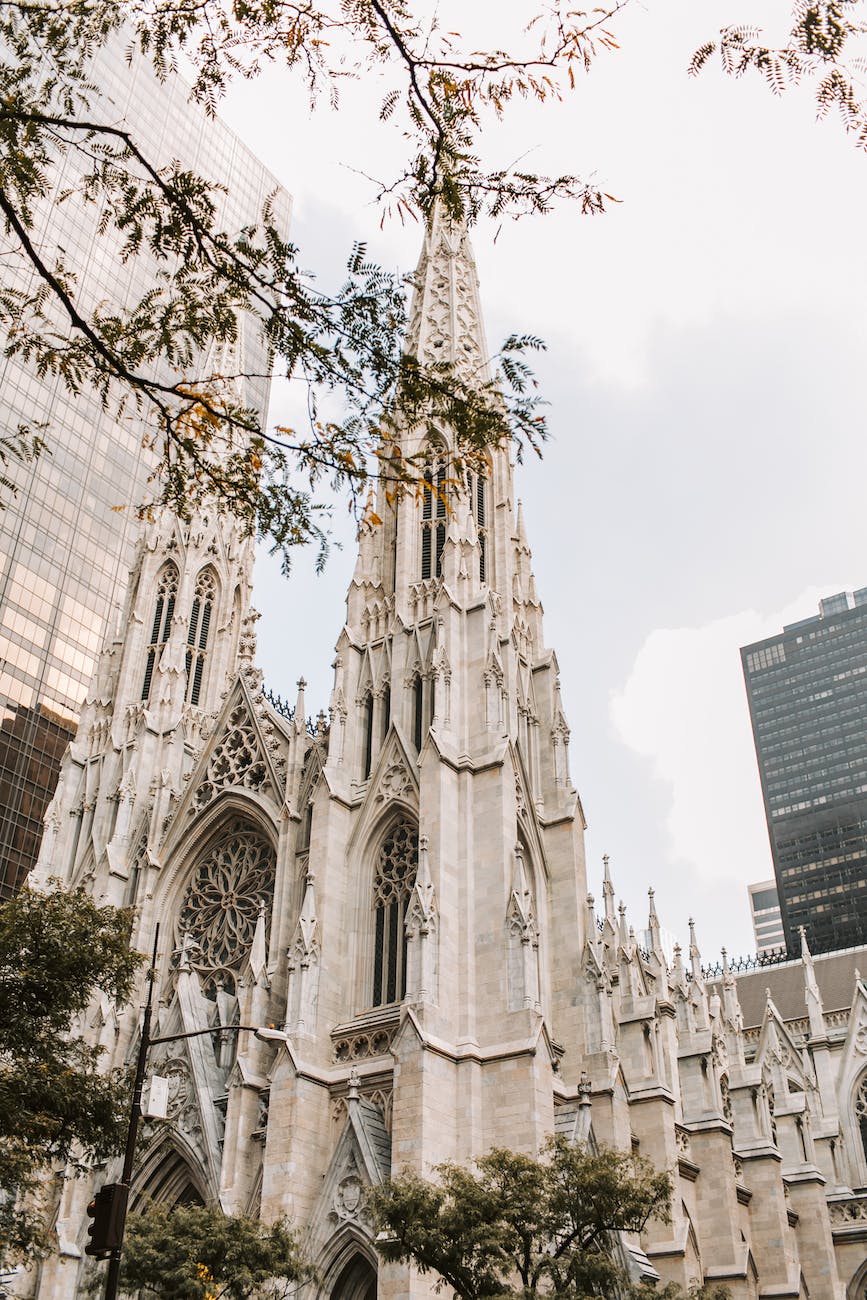
This is not an unknown story in New York City: a congregation sells part of its property or air rights to help fund its operations. This time it is St. Patrick’s Cathedral:

Photo by Vlada Karpovich on Pexels.com

Citadel’s Ken Griffin and Steve Roth’s Vornado Realty Trust agreed to buy up to 525,000 square feet of air rights from the Roman Catholic Archdiocese of New York to facilitate the development of 350 Park Avenue, PincusCo reported

The per square foot basis of the deal is arguably more important than the total purchase price, because that hasn’t been determined. Under the agreement, the developers can buy up to 525,000 square feet of air rights, but could also buy as little as 315,000 square feet. That means the purchase price ranges from $98.4 million all the way up to $164 million…

Representatives of Griffin, Vornado and Rudin did not respond to a request for comment from The Real Deal. A spokesperson for the Archdiocese of New York said that it is the church’s “hope that the money will go to the continued upkeep of the Cathedral.”…

Griffin’s Citadel is working to develop a 51-story tower at 350 Park Avenue, designed by Norman Foster. Griffin’s firm is redeveloping properties master leased from Vornado and Rudin. Citadel would occupy roughly 54 percent of the 1.7-million-square-foot property, which would stand 1,350 feet tall.

I remember at least a few of these stories while examining zoning conflict in the New York City. For a congregation with an older building and perhaps an aging congregation, allowing others to make use of their property in different ways could help pay the bills. Here, one of the wealthiest people in the United States wants to build a skyscraper, the church has the air rights, and the money paid to the church can help the Cathedral into the future.

This reminds me of some of the reasons many churches left Chicago’s Loop by the early twentieth century. Land prices were high, people had moved out of the central business district, and they could relocate to quieter, more residential streets. That left very few congregations in the downtown.

And even though this point was passed long ago, the contrast of a 51-story skyscraper near a landmark church is interesting to consider. No longer is religious activity at the center of big cities. Is this a physical manifestation that shows America’s leading religion is business?

More Protestant churches closing than opening – and understanding the bigger patterns

One source suggests more Protestant churches are closing than are opening:

Photo by Luis Quintero on Pexels.com

About 4,500 Protestant churches closed in 2019, the last year data is available, with about 3,000 new churches opening, according to Lifeway Research. It was the first time the number of churches in the US hadn’t grown since the evangelical firm started studying the topic. With the pandemic speeding up a broader trend of Americans turning away from Christianity, researchers say the closures will only have accelerated…

“In the last three years, all signs are pointing to a continued pace of closures probably similar to 2019 or possibly higher, as there’s been a really rapid rise in American individuals who say they’re not religious.”

The rest of the article deals with why this is happening and what happens to these buildings.

For this post, I am more interested in putting the cited numbers in context. Here are different aspects of this:

  1. As cross-sectional numbers (first sentence above), it is hard to know what do with these figures. In 2019, more Protestant churches closed than opened. This is a one year figure.
  2. Looking at trends over time is useful. The next sentence above says this is the first time that more congregations have closed than opened since Lifeway started tracking this. So this is a reversal or change to a larger trend? How long has anyone tracked this? Is it assumed that it is good or normal that more churches open than close each year?
  3. As noted above, there are fewer people claiming religious affiliation. Are there additional factors involved, such as a shift of attendees toward larger congregations?
  4. Are there other data sources for the number of churches and what does their data show?

With the attention that is paid to the declining number of religious Americans, it would be helpful to continue to look at the corresponding organizational changes including changes in the number of congregations.

A Brooklyn church pursuing a Jane Jacobs-inspired development

A plan is underway for a New York City church to work with a developer to construct a sizable development:

Photo by Pixabay on Pexels.com

A. R. Bernard, pastor of the largest evangelical church in New York City, has been working on a plan for more than 10 years. Now the proposal to build a $1.2 billion urban village and revitalize the struggling neighborhood around his church is progressing through the city’s approval process and closer to reality. The Christian Cultural Center (CCC) hopes developers could break ground in Brooklyn next year…

On 10.5 acres of church land, the proposed village would include thousands of units of affordable housing, a trade school, a supermarket, a performing arts center, 24/7 childcare for night-shift workers, senior living facilities, and other amenities designed to revitalize the East New York neighborhood…

“I’m a big Jane Jacobs fan, when it comes to understanding the urban landscape. And community means amenities are within a 1,000-foot walking distance,” Bernard said, referring to the urban planner who is famous for saving lower Manhattan from a highway and for her ideas on smaller-scale urban development focused on street life. “She was a genius. Absolute genius.” He sees this plan as a counter to the influence of the infamous urban planner and Jacobs nemesis Robert Moses, who had a history of dividing communities economically, including in this part of Brooklyn…

The church hopes this village can be a model for other cities and it could be scaled up or down, Bernard thinks. But he added that a church must be large enough, like CCC, to pull such a plan off.

As my research on religious congregations and zoning issues in the New York City region found, it is not necessarily easy for congregations to make significant changes to property. Lots of actors can express concerns.

But, some congregations have the resources and community presence to pursue projects like this and it might be difficult for others to propose and pull off the same plan. Affordable housing is needed all over and it sounds like the other parts of the project would also provide helpful facilities and services.

It would also be interesting to see how the congregation might serve as a physical and social anchor of a sizable new development as it matures.

The fate of church buildings when thousands of churches cease operating

A new book addresses the fate of church buildings when congregations end:

Photo by Pixabay on Pexels.com

Dominic Dutra, author of “Closing Costs,” a new book about how church property can be repurposed, says there are thousands of churches around the country that have closed or will likely close in the years to come. And too often, he said, leaders of those churches put off any discussion about what to do with their building until it’s too late.

“I’ve had situations where buildings are empty and they have no plan at all,” he said.

A 2021 study from Lifeway Research, based on data from three-dozen denominations, found that 4,500 churches closed in 2019, while only 3,000 were started. The 2021 Faith Communities Today study found that the median worship attendance for churches in the U.S. dropped from 137 people to 65 people over the past two decades.

Dutra argues that billions of dollars in church property could be put to work for ministry ­— if church leaders become proactive about the future. He has worked with a number of religious groups to do just that.

The numbers cited above are interesting: prior to COVID-19, more churches closed than opened. Additionally, the data from the survey is consistent with the National Congregations Study run over the last two decades regarding the median size of churches.

This is one area that my co-author Robert Brenneman and I did not address as much as we could have in our 2020 book Building Faith: A Sociology of Religious Structures. One of the later chapters looks at the fate of church buildings in the Chicago area. We found big differences across four denominations and a number of church buildings put to other uses. Church building are used in a variety of ways, including used by new congregations, converted into housing or commercial space, razed, and preserved.

Based on the description of the book in the article above, my guess is the recommendation is that church buildings no longer housing congregations can be put to other faith uses. There is certainly opportunity, ranging from serving new congregations to housing non-profits or parachurch organizations to being home to community centers.

Only megachurches and “minichurches” in the United States?

Recent data suggests there may be two very different sizes of churches in the United States:

Photo by Emily Hopper on Pexels.com

According to the recently released Faith Communities Today study, half of the congregations in the United States have 65 people or fewer, while two-thirds of congregations have fewer than 100…

“Shrinking attendance figures coupled with an increase in the number and percent of small congregations obviously indicates that a good many congregations are not growing,” the study’s authors found. “Indeed, the median rate of change between 2015 and 2020 was a negative 7%,” meaning half of all congregations declined in attendance by at least 7%.

While most congregations are small, however, most worshippers attend a larger congregation. Another prominent report, the National Congregations Study, found that while the average congregation is small — about 70 people — the majority of churchgoers are worshipping in a congregation of about 400 people.

The report reflects the reality that religious Americans are being sorted into two kinds of churches — megachurches, and minichurches like Cornerstone.

Are they being sorted or has this been going on for a while? On the larger end are megachurches, congregations with more 2,000 members. Megachurches have been a phenomena for at least a few decades. Megachurches get a lot of attention due to their size, their programs, and leaders. Since each one attracts many attendees, they could equal dozens of smaller churches in terms of people there for services. Megachurches have been a phenomena for at least a few decades.

If the primary marker of a religious congregation is size and growth, then megachurches are more successful. The article goes on to talk about different reasons why people and leaders might choose smaller congregations. The megachurch experience is not for everyone. Whether there is much left for small congregations if much of the resources and attention is going to larger congregations is another story.

And the answer regarding this competition between megachurches and minichurches might be in between. The big megachurches are known, small congregations are everywhere, and a sizable set of Americans worship in congregations of several hundred. These medium sized congregations can offer some of the amenities of the biggest churches while staying at an approachable size.