Can a movie that says something about suburbia be set in a place that is only sort of a suburb?

The name of the new movie Holland refers to the community in west Michigan. Numerous reviews note that the film says something about the suburbs. A few examples: first, from Variety:

Through it all, Macfadyen seems suspiciously good-natured, which merely encourages us to guess what he might be hiding. The “Succession” star brings a disconcerting Kevin Spacey-like energy to his performance, which reinforces the connection some might detect between “Holland” and 1999’s “American Beauty” — another movie about the toxic black mold that thrives just beneath the veneer of suburban perfection.

Second, from Roger-Ebert.com.

Kidman does her best to be the MVP of “Holland,” imbuing Nancy with just enough Midwestern nicety to make her memorable. Nancy is the kind of woman who wants to be a perfect wife and mother but also wants some mystery in her life and responds to the attraction of the handsome new teacher at her school. She’s a suburban shark, always swimming to a nearly impossible objective of keeping her pristine reputation in the community, holding her family together, and having a fling with Dave. While she doesn’t make any bad choices, there’s a version of “Holland” that lets Kidman loose, turning the temperature up on this character’s emotions in a manner that Cave feels tentative to do.

Third, from Mashable.com:

Watching Kidman play a happy homemaker in a pretty suburban town might swiftly recall Frank Oz’s underrated 2004 comedy remake of The Stepford Wives, which Kidman starred in.

You get the idea: the setting and the plot add up o a film that seems to say something about the American suburbs. This is familiar ground in American movies (as well as novels, TV shows, songs, and other cultural works)

But is Holland, Michigan a suburb? Here is what Wikipedia says:

The city spans the Ottawa/Allegan county line, with 9.08 sq mi (23.52 km2) in Ottawa and the remaining 8.13 sq mi (21.06 km2) in Allegan. Holland is the largest city in both Ottawa and Allegan counties. The Ottawa County portion is part of the Grand Rapids metropolitan area, while the Allegan County portion anchors the Holland micropolitan statistical area, which is coextensive with Allegan County. The city is part of the larger Grand Rapids–Wyoming combined statistical area.

Since metropolitan areas have boundaries based on counties, it seems that part of the city is part of the suburbs of Grand Rapids, a city of nearly 200,000 people and a metropolitan area of over 1 million people. But a good portion of the city, home to over 37,000 residents, is also its own smaller urban area.

Do the people of Holland see themselves as suburbanites? How many commute to Grand Rapids and other parts of the region? Are there cultural and historical ties to Grand Rapids?

None of this may matter for putting together a film. Filming scenes in downtown Holland or within neighborhoods in the community may look suburban. How many people watching really want to have authentic places that match what is being described? (For example, once I have seen a few studio backlots, it is hard to unsee them.) If the movie is about the suburbs, who is to say it isn’t?
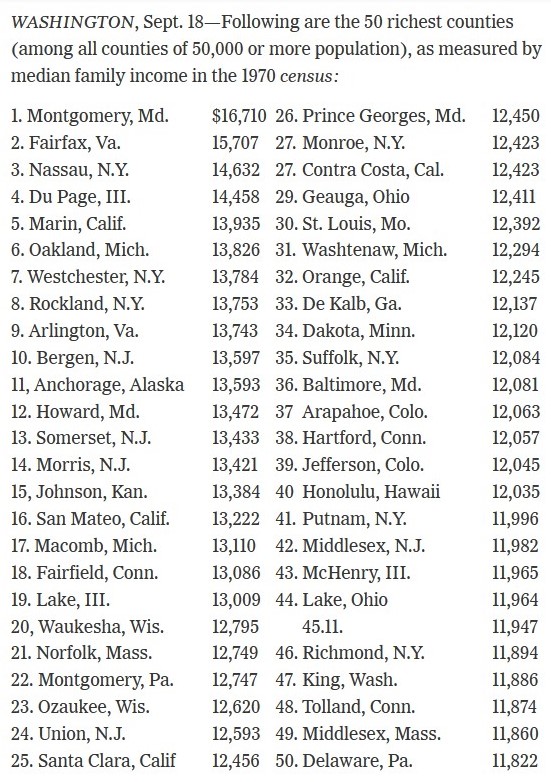
The wealthiest US counties in 1972 versus today

Considering median household income at the county level, I did a little research regarding past patterns compared to today. In 1972, the New York Times reported on the wealthiest counties in the United States:

As the article notes, all these counties are suburban counties.

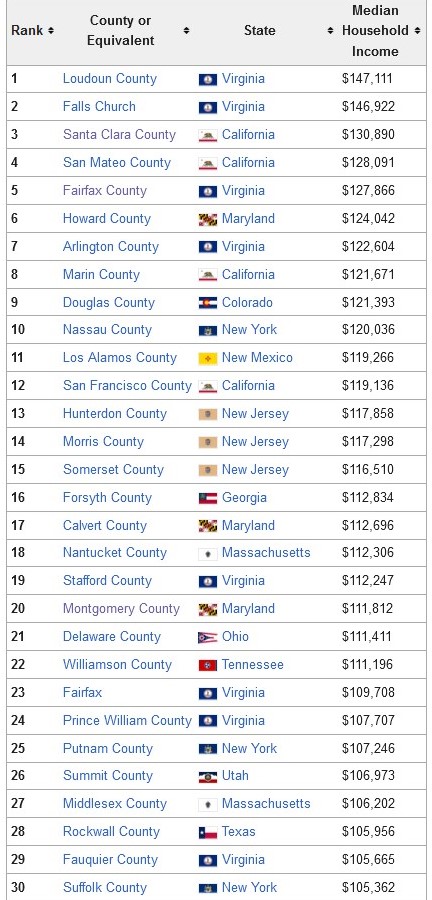
According to Wikipedia, here are the wealthiest counties today:

Almost all of these top 30 are suburban. But the wealthiest counties have shifted toward more counties in the South and West. Some of the same counties are at the top of the list but there are also new counties there as well. What might have happened in 50+ years? Some guesses:

  1. Some of the wealthier counties in the 1970 Census matured, now have slower growth, and have more diverse populations. In contrast, the rapidly growing counties today are more in the South and West.
  2. Shifts in industry. Manufacturing jobs declined in many places and growing sectors, such as tech and the federal government, generated wealth elsewhere.
  3. Measuring at the county level might obscure patterns at the municipality level and at the regional level. For example, this may be less about individual counties and more about a region – say like the Washington, D.C region – growing.

I would be interested to hear how many companies and residents think at the county level these days. If someone were going to move, would they think in terms of Westchester or Nassau Counties outside of New York City like they might have in 1970 or would they think instead of specific communities and suburbs they have heard about?

Median age of housing by state and county

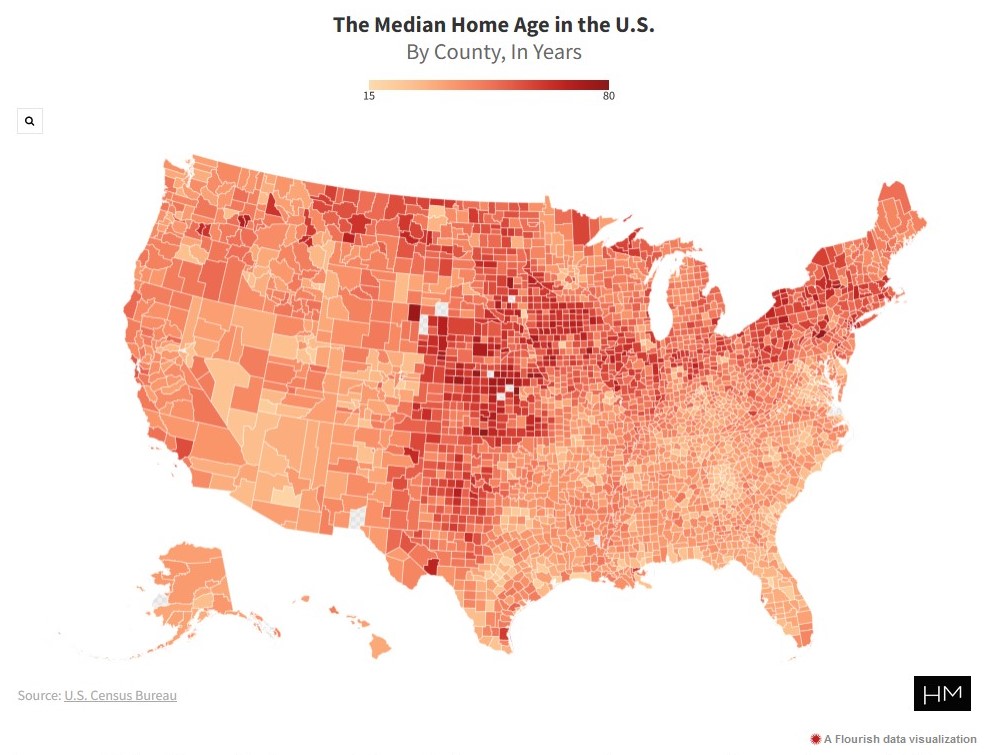
Using Census data, HouseMethod looked at the median age of homes across different geographies in the United States:

Age may just be a number, but when it comes to the age of a home, it can be an indicator of its style, features, or condition. It can even help tell a story about where it’s located. Home construction, especially in modern building, comes in waves in areas with new developments springing up as a city grows…

New York came in as the state with the oldest median home age in the U.S. at 63 years. Rhode Island was a few years younger at 60, followed closely by Massachusetts (59), Pennsylvania (57), and Connecticut (55). No surprise that the five states with the oldest median home age are all located in the northeast as they had some of the largest growth in early America. 

At the other end of the spectrum, the five states with the youngest median home age are Nevada (26), Arizona (30), Utah (31), Georgia (31), and North Carolina and South Carolina tied at 32 years old. Nevada has been the fastest-growing state for roughly five decades so it follows that the homes would be the newest. Likewise, the other ‘youngest’ states have seen large population increases and the housing being built to satisfy the demand…

The county with the oldest median home age in the U.S. is Clay County, Kansas. The county’s median year of structure build is 1941, bringing the county’s median home age to 79 years. The Sunshine State of Florida holds the ‘youngest’ county in the country, with Sumter County, Florida having a median home age of 17 years.

The median is helpful here: half of the homes were constructed before, half after. I do not know if the Census reports this data but it would also be interesting to know the 25th and 75th percentiles or other points along the data distribution. Are there also places that have more compressed or longer ranges of development?

Is it surprising that there a good number of older county medians in the center of country, roughly running from Texas to the Dakotas?

This reminds me of Dolores Hayden’s book Building Suburbia: Green Fields and Urban Growth, 1820-2000. She details waves of suburban development, dependent on factors like transportation technologies and ideas about what suburbs should be and include.

What happens to the housing in the locations with older housing overall? What percent ends up fixed up and restored or designated as part of a historic district? In contrast, what percent is undesirable and not brought into a more modern era?

The US county with the longest life expectancy – and a big error margin

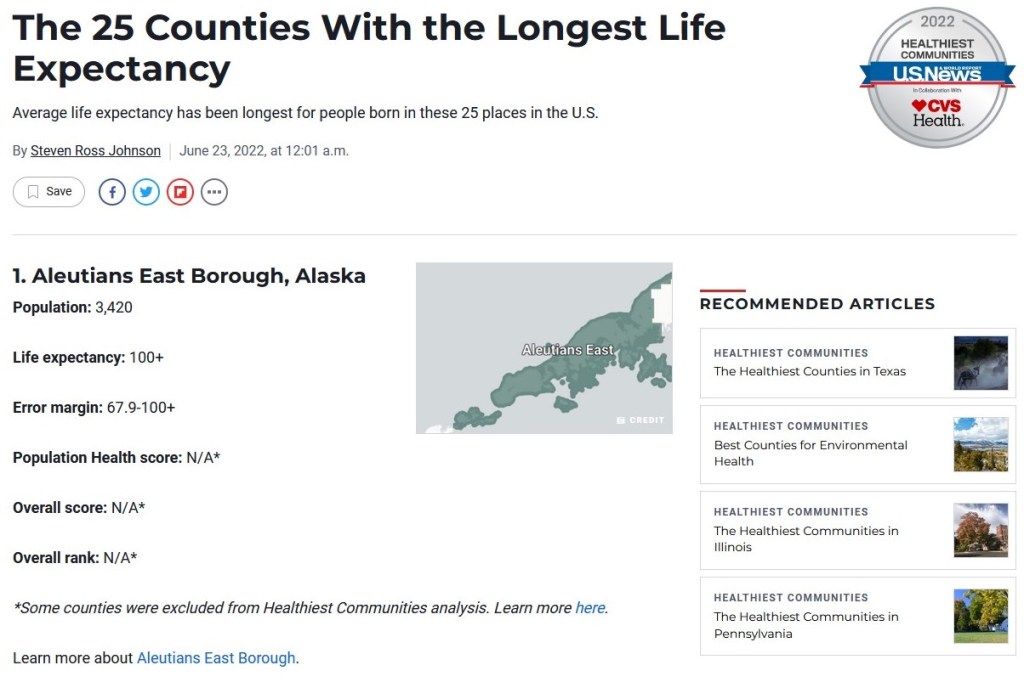
A recent ranking of US counties by life expectancy at birth now found Aleutians East Borough at the top of the list:

This is one of three counties with a life expectancy of “100+.” Out of these three, it is also the one with the largest error margin. If I am interpreting this correctly, the list compilers are 95% confident that the life expectancy of this county is between 67.9 and 100+.

This is most likely due to the relatively small number of people in the county. This is not uncommon in these rankings: of the top 16 counties in life expectancy, the highest population is over 55,000 and several counties have fewer people than the one ranking #1. When there are fewer cases (residents, for this analysis) to consider, it is harder to be confident in the calculated life expectancy. My guess is that this county had the highest expected life expectancy in the statistical model so even with the large confidence interval it ended up at the top of the list.

With fewer people in a number of these counties, the year-to-year predictions could shift more given conditions. Does this mean the rankings should be disregarded? Not necessarily but the confidence interval does provide insight into how the life spans of a small number of residents can change these rankings.

Asset income across American counties, from Teton County to South Dakota

A new report finds gaps in asset income across locations in the United States:

Photo by Andrew Jensen on Pexels.com

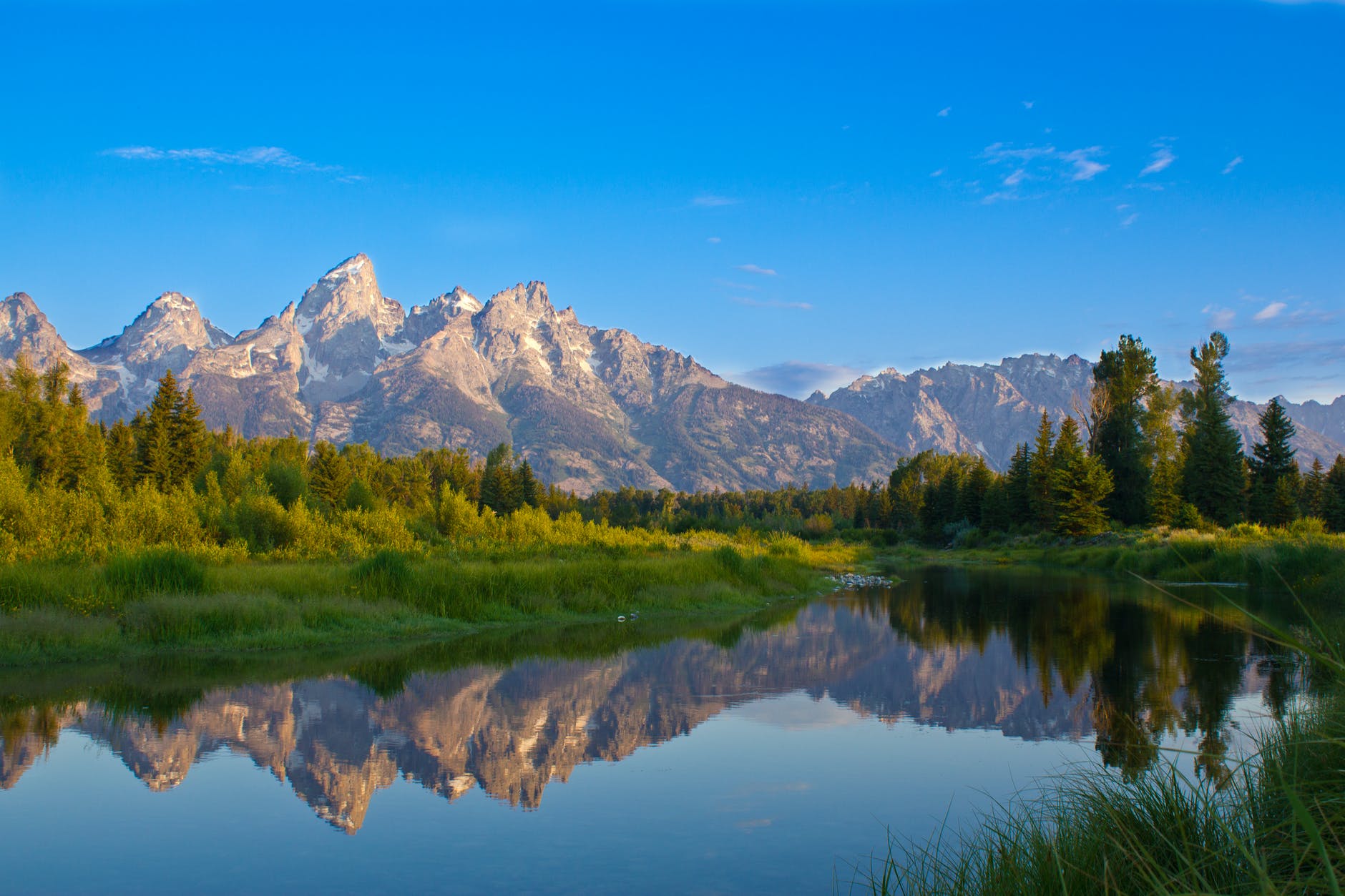
Wyoming’s Teton County, home to Jackson Hole, has the nation’s highest per-capita income from assets, according to a study by the Economic Innovation Group. The analysis found a sharp increase in geographic concentration of asset ownership over the past decades…

It’s soared in places like New York City and the San Francisco Bay Area. Meanwhile, across Appalachia, the Deep South and much of the Midwest, it stagnated, representing a negligible source of income…

Nationwide, the county with the lowest asset income per capita is in South Dakota, home to the Pine Ridge Indian Reservation. At $2,800 per person, it’s one-third of the national average. Among the largest U.S. counties, the ones with the five lowest incomes from assets per capita are all mostly Hispanic or Black.

Only a minority of Americans holds assets beyond homes, cars and retirement savings. About 15% of households own stocks and 13% hold business equity or other residential property, according to Fed data.

First, the emphasis here on asset income is helpful compared to the more common analysis of incomes. While income may be related to assets, assets gets more at wealth or how income is converted into more long-lasting economic resources.

Second, that assets are concentrated in particular locations is not surprising but with the relatively limited number of Americans who have certain assets, this concentration is even more notable. The truly wealthy Americans have assets and utilize them in certain places, like New York City, San Francisco/Silicon Valley, and Jackson Hole, Wyoming.

With this said, how much does increasing incomes reduce the gap in wealth and assets? Or, how might efforts at local and national levels affect this gap both locally and nationally? The most exclusive locations are going to be difficult for many Americans to afford at any point, regardless of their income. While much sociological research has studied the concentration of poverty, wealth also concentrates with positive feedback loops for those who can participate.

The power of local politics to shape national outcomes

A deep look at the changing political tides in suburban Oakland County, Michigan ends with this:

Photo by cottonbro on Pexels.com

Such a post-mortem would likely reveal that the party’s disinterest in holding onto the suburbs prevents the rise of new Pattersonian Republicans with their own identities separate from Trumpism and that this will have long-term historical consequences.

“There are dozens, if not hundreds of these local or regional-level political power brokers who shape the outcomes of how our cities and regions function in ways that just aren’t visible to most people,” says Delmont, the Dartmouth historian. “We spend so much time talking about who’s in the White House or even who’s in Congress. But it might be the L. Brooks Pattersons of the world who actually determine, like: Do we have affordable housing? Do we have segregated cities? Do we have police forces that are militarized? The people who actually operate the levers of power are probably much more positioned like a Brooks Patterson than a President Trump or President Biden.”

National politics are indeed often built on smaller units of government. While a lot of attention goes to presidential elections (and this article also focuses on Donald Trump and how this connects to local politics), there is a lot of work that happens at the Congressional, state, and other levels that undergird the larger outcomes. A candidate or political party is going to struggle without grassroots, lower-level support.

This reminds me of my blog post Thursday about addressing housing issues municipality by municipality. We often look at particular issues at a national level. How to provide affordable housing? How to explain the rise and fall of Donald Trump? There are multiple levels of analysis possible and needed. In this post and on Thursday, the reminder is that the local level matters. Does Oakland County and all the local machinations about county seats and redestricting determine who will be president or which political party will control Congress? No, but add up a lot of counties in important areas – particularly with suburban voters who can be swayed election to election – and this can start to matter.

Another side to this is how American residents approach local government. Particularly in suburban areas, they like the idea of local control. Yet, local voting can be very low with turnout around 15-20%. If elections for county boards in places like suburban Detroit matter for national outcomes, shouldn’t suburbanites pay more attention local elections?

What looking at COVID-19 risk by county across the United States can tell us

A new analysis by the Census Bureau looks at the risk for COVID-19 by county:

CountyLevelCOVID19RiskLevels

See how the Census Bureau calculated the risk here.

Several thoughts on the map:

1. There are some patterns. Many counties in the Northeast, Midwest, and Mountain West having lower levels of risk (outside of urban counties). In contrast, the Sun Belt and the West Coast are at higher risk.

2. Doing this at the county level makes some sense: people might travel within a county for work, errands, and other activity. At the same time, there could be significant disparities across communities within counties that a map like this covers up. For example, it looks like DuPage County is somewhere in the middle and some suburbs there have higher rates of cases than others.

3. The differences across geographies also speak to the difficulties of enacting policies across different areas. On the risk map, some states have more consistent patterns while others have a mix (ranging from more equal numbers of counties at different levels or a few heavily populated counties versus everyone else). National policies have to address places with different experiences and different futures.

4. This data cannot tell us how many people cross county lines within a region or state. There are clusters of counties with similar risk levels but this may not speak much to travel as to similar populations.

More on COVID-19 in suburbs

While much of the COVID-19 attention has been on cities, it is also present in suburban locations. Yesterday, I looked at cases in DuPage County west of Chicago. Today, a little digging around for other suburban locations:

Westchester County, New York

The New York region leads the United States in number of cases and deaths. Westchester County is a wealthy county just north of the city. Early on, an outbreak in New Rochelle received attention. According to figures for the county as of a few days ago, it looks like COVID-19 is in a number of community in sizable numbers.

Nassau and Suffolk Counties, New York

These Long Island suburban counties have thousands of cases and as of April 9 are being watched by officials:

New York Gov. Andrew Cuomo said health officials “watching” Nassau and Suffolk counties as the number of deaths related to novel coronavirus (COVID-19) is on the rise.

There have now been 18,548 confirmed COVID-19 cases in Nassau County – up 1,938 from the day before, while Suffolk County has reached 15,844 cases, an increase of 291…

“We’ve been watching Rockland County, Nassau County, Suffolk County closely,” he said. “We’re looking at the concentric circles around New York City, and the natural spread circles are toward the suburbs. Westchester has already had trouble, now we’re seeing new hotspots on Long Island and the other suburbs.

Seattle area, Washington

King County, Washington is home both to Seattle and over a million suburban residents and two surrounding counties, Snohomish and Pierce, have more suburban residents. An update on the cases and deaths as of last night:

King County has been struck the hardest with Covid-19 with 3,688 cases and 244 deaths. Snohomish County reports 1,695 cases and 63 deaths. Pierce County reports 795 cases and 16 deaths.

From mid-March, a story of how the Seattle suburb of Kirkland responded in early March:

Within hours, Kirkland, an affluent mid-sized suburb that until two weeks ago was best known outside of Washington as the namesake for Costco’s Kirkland Signature brand, became the epicenter of the U.S. coronavirus outbreak.

More than 60 Kirkland residents, including people staying there temporarily, have died from or been hospitalized with the virus. Nearly all of them were associated with Life Care Center. Many patients with symptoms are at EvergreenHealth, a Kirkland hospital, which has seen nearly 100 confirmed cases and 24 deaths.

Kirkland’s response to the crisis is being watched around the country, and other cities are looking to them for guidance as infections spread.

New Orleans area

An update from yesterday shows numerous cases in and around New Orleans:

Orleans and Jefferson parishes continue to lead all other parishes with their coronavirus cases. According to Thursday’s update, New Orleans has 5,242 cases while Jefferson Parish is reporting 4,480 cases…

Other parishes seeing high case numbers include East Baton Rouge, Caddo and St. Tammany. Health officials continue to monitor St. John the Baptist, Ascension and Lafourche parishes where cases are in the 300-400 range.

In sum, numerous suburban counties and communities outside of major cities hit by COVID-19 are also facing significant numbers of cases. Various factors could be at play including race/ethnicity, the locations of jobs and workplaces, and the ability of suburban governments and organizations to respond to the threat.

(And a bonus story from ABC in Australia: how residents of Australian suburbs are coping with isolation.)

Implicating suburban sprawl in the spread of ticks and pathogens

As new tick-borne illnesses spread, sprawl is part of the problem:

But as climate change, suburban sprawl, and increased international travel are putting more ticks and the pathogens they carry in the paths of humans, what’s becoming more urgently apparent is how the US’s tick monitoring systems are not keeping pace.

“It’s really a patchwork in terms of the effort that different areas are putting into surveillance,” says Becky Eisen, a tick biologist with CDC’s Division of Vector-Borne diseases. The federal public health agency maintains national maps of the ranges of different tick species, but they’re extrapolated from scattered data collected in large part by academic researchers. Only a few states, mostly in the Northeast, have dedicated tick surveillance and control programs. That leaves large parts of the country in a data blackout.

To help address that problem the CDC is funding an effort to identify the most urgent gaps in surveillance. It has also begun publishing guidance documents for public health departments on how to collect ticks and test them for diseases, to encourage more consistent data collection across different states and counties.

In an ideal world, says Eisen, every county in the US would send a few well-protected people out into fields and forests every spring and summer, setting traps or dragging a white flannel sheet between them to collect all the ticks making their homes in the grasses and underbrush. Their precise numbers, locations, and species would be recorded so that later on when they get ground up and tested, that DNA would paint a national picture of risk for exposure to every tick-borne pathogen in America. But she recognizes that would be incredibly labor-intensive, and with only so many public funding dollars to go around each year, there are always competing priorities.“But from a research perspective, that’s the kind of repeatable, consistent data we’d really want,” says Eisen. “That would be the dream.”

While there is little direct discussion of sprawl, I wonder if there are two problems at play.

First, sprawl puts more people in interaction with more natural settings. As metropolitan areas expand, more residents end up in higher densities in areas that previously had experienced limited human residence. More people at the wildland urban interface could potentially lead to more problems in both directions: humans can pick up diseases while nature can be negatively impacted by more people.

Second, increasing sprawl means more data needs to be collected as more people are at possible threat. Metropolitan areas (metropolitan statistical areas according to the Census Bureau) typically expand county by county as outer counties increase in population and have more ties to the rest of the region. Since many metropolitan regions expand in circles, adding more counties at the edges could significantly increase the number of counties that need monitoring. And as the article ends with, finding money to do all that data collection and analysis is difficult.

Making a horror film about illnesses carried by ticks would take some work to make interesting but these sorts of hidden and minimally problematic in terms of number of suburbanites at this point issues could cause a lot of anxiety.

Mapping county votes in the 2018 House elections

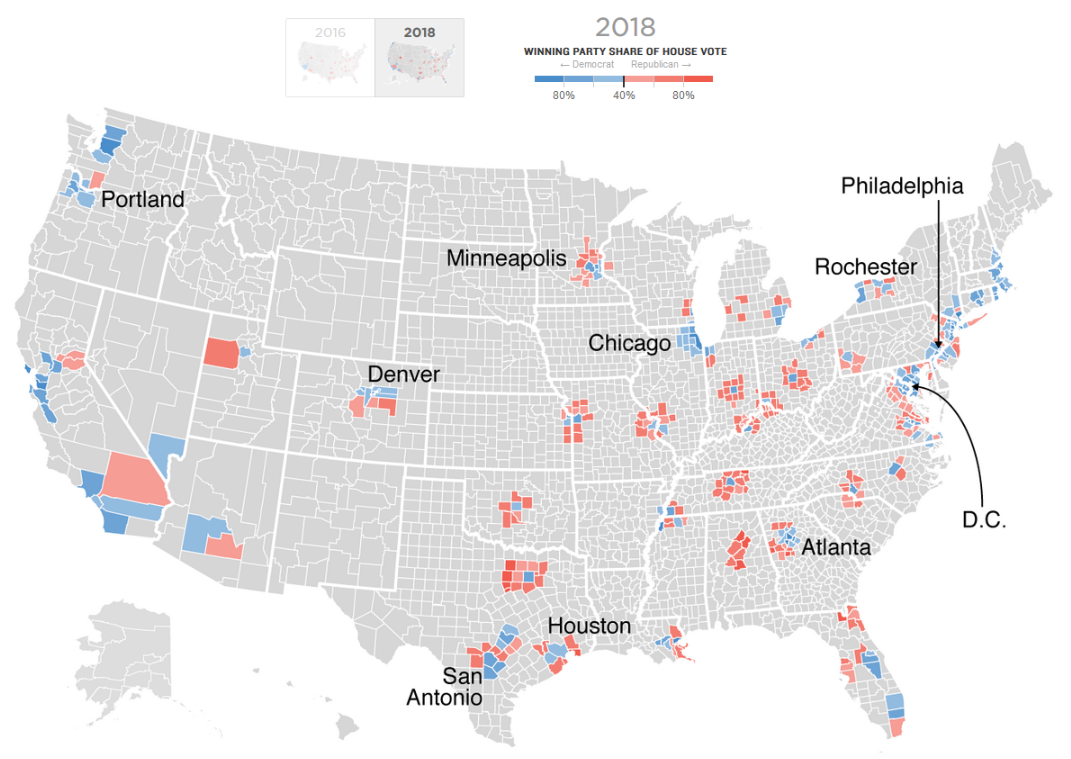
More media outlets are using maps to illustrate the results of the 2018 election. See this story from NPR that uses country level voting to show where the two parties picked up or lost House seats:

NPRcountyelectionresults2018.png

Of the 41 congressional districts that Democrats turned from red to blue this election, 38 were suburban, according to an analysis by The New York Times. (Democrats may pick up one to two more seats, once all votes are counted and elections are certified.)

But more granular than congressional districts overall are the counties that compose them. We mapped the percentage of House ballots cast for the party that received the most votes in each suburban county, and we looked at how that compared with 2016.

This map hints at metropolitan regions swinging toward one party or another while still generally adhering to the patterns of big cities and close suburbs vote Democratic and further-flung suburbs vote Republican. Regions like Seattle, San Francisco, Chicago, and Boston swung entirely Democratic. Some were more split: Denver, San Antonio, Miami, Orlando, and Washington, D.C.