Survey data on wealthy New York City residents thinking about leaving the city

New survey data looks at what New York City residents making more than $100,000 think about leaving the city:

We found that 44% of high-income New Yorkers say that they have considered relocating outside the city in the past four months, with cost of living cited as the biggest reason. More than half of high-income New Yorkers are working entirely from home, and nearly two-thirds believe that this will be the new normal for the city…

Of those considering leaving New York City, 30% say that the possibility of working remotely makes it more likely that they will move. Of New York City residents who earn $100,000 or more annually, 44% have considered moving out of the city in the past four months (see Figure 4). Looking ahead, 37% say that it is at least somewhat likely that they will not be living in the city within the next two years…

The cost of living, more than any other factor, contributes to the likelihood of leaving New York City (see Figure 5). A total of 69% of respondents cite cost of living as a reason to leave the city; that figure is even higher among black (77%) and Hispanic (79%) respondents. Other reasons cited by respondents considering leaving New York City include crime (47%), desire for a nonurban lifestyle (46%), and the ability to work from home (30%)…

Only 38% of New Yorkers surveyed said that the quality of life now was excellent or good, a drop by half, from 79% before the pandemic (see Figure 2). Most believe that the city has a long road to recovery: 69% say that it “will take longer than a year” for quality of life to return to normal.

Finally some data on New Yorkers leaving the city! (Of course, this is more about attitudes than actual behavior.)

If I am interpreting the data above correctly, it sounds like COVID-19 has brought some other issues to light. This includes:

(1) If I can work remotely, do I value city life enough to stay there even though I do not need to be close to work?

(2) If the city is not what it was – and it is not clear when it might return to normal – because of decreased social activity due to COVID, the cost of living may not be justifiable.

Ultimately, is it worth living in a global city – with all that comes with it for high earners including jobs, cultural amenities, and a high cost of living – when the positive features of this city are muted during a pandemic?

Patterns in suburban Chicago rallies for in-person schooling, sports

The suburbs are not typically considered hot spots for protest activity. Yet, in the Chicago region, in the past few weeks several suburban rallies have taken place in support of a return to school. The latest one on Monday in Barrington:

Holding signs like “Schools not screens” and “Stop playing politics, start playing ball,” more than 200 parents and students in Barrington Area Unit District 220 took part in a rally Monday evening asking the district to allow in-person schooling and sports…

A survey conducted by the district earlier this summer showed 70% of parents wanted their children in school, he pointed out. “So why are they not in school?” he said, getting applause and cheering from the crowd.

This comes less than a week after a protest with a similar theme in Wheaton:

As students across the Western suburbs begin the school year with remote learning, hundreds of parents and students rallied in a downtown Wheaton park Tuesday night to demand a total return to classrooms and sports…

The gathering in Wheaton’s Memorial Park drew participants from as far away as Mokena and Orland Park, Western Springs and Huntley.

Along with students, some teachers and coaches, parents at the rally made the case for reopening classrooms, arguing that the loss of social interaction in schools hurts their children’s emotional, mental and social well-being.

A few thoughts on these protests:

  1. Given how COVID-19 has been politicized, would it be fair to characterize as these rallies as a conservative response to current conditions? If so, this could join a pro-police rally in Oak Brook a few years ago. This is in contrast to “liberal” suburban rallies in Naperville (example here) and in other suburbs. (NIMBY protests in the Chicago suburbs may be bipartisan.)
  2. Do suburban protests tend to take place in wealthier suburbs? I have made the case that Naperville draws particular attention for protests because it is large and has a lively downtown. Would suburban protests in more working class communities draw the same attention?
  3. Do we know if there is a recent (last five years or so) increase in suburban rallies and protests? We would need to have a baseline of collective activity over time and then compare. If there is an increase, it might be due to multiple factors: increasing diversity in suburbs and changing communities as well as ongoing battles for suburban voters.

“Zoom towns” better have good Internet capabilities

“Zoom towns” are areas of the United States that are gaining residents due to people trying to move away from COVID-19 cases:

Photo by Brett Sayles on Pexels.com

Like a lot of other vacation destinations — the Hamptons, Cape Cod, Aspen and so on — the Truckee housing market is booming during the coronavirus pandemic. It’s up over 23% since last year, according to data from Redfin, a real estate brokerage. Truckee is part of a trend that realtors and journalists are calling “Zoom towns,” places that are booming as remote work takes off.

There are numerous ways that these new full-time residents might transform their new communities, particularly if they are people with more resources.

But one issue for these growing communities involves infrastructure: how prepared are they to host more Internet traffic? Since March, much activity has moved online: work, school, social gatherings, public meetings, etc. Are there some places better equipped to handle all of this increased streaming? Are “zoom towns” the kinds of places that have robust Internet capacity? This might not be a big problem in suburbs of major cities (such as New Yorkers headed out to New Jersey) or for people who move from major city to major city (from San Francisco to Austin) but it could be for others who head to smaller communities or vacation towns.

What the COVID-19 pandemic could do is help remind Americans of the need to improve networks that enable computer, smartphone, and tablet activity. We do not just need to maintain what already exists; this pandemic has highlighted what was already going to happen: an increased need for streaming and conducting activity online. Without good infrastructure development in this area, future opportunities may not exist. Or, particular locations or kinds of places can be harmed or left behind, leading to or growing digital divides. From rural communities to poorer communities in and around cities, residents need decent Internet speeds to live during COVID and flourish afterward.

The start of municipal budget issues due to COVID-19? The case of Chicago

COVID-19 has disrupted a lot of life in the United States and it will have consequences for municipal budgets. Here is how Chicago mayor Lori Lightfoot describes the fiscal impact:

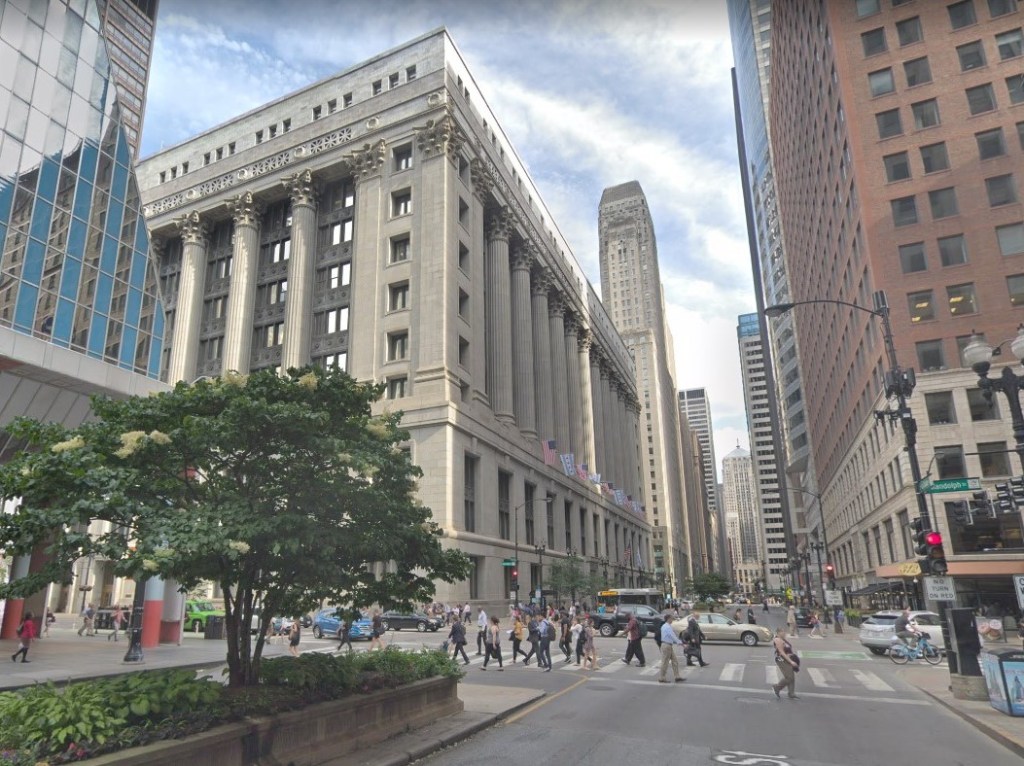
Google Street View of Chicago City Hall, June 2018

Citing the “catastrophic collapse of our local and national economy” because of COVID-19 and damage to local businesses from civil unrest, Mayor Lori Lightfoot on Monday laid out a $1.2 billion shortfall for what she called Chicago’s “pandemic budget” in 2021…

The ongoing coronavirus crisis has also spiked the 2020 budget shortfall to nearly $800 million, Lightfoot said. She said that deficit would be filled using relief funds and other unspecified aid from the federal government, in addition to debt refinancing, and borrowing…

In laying out the 2021 shortfall, Lightfoot cited dire numbers — more than 900,000 Chicago-area residents filed for unemployment since the start of the pandemic, while personal services, hospitality and tourism industries “are still seeing a fraction of their typical revenues and some businesses have sadly closed with no hope of coming back.”…

The bad news has seemed inevitable for months, as tax receipts plummeted with large parts of the economy shut down and spending in Chicago by tourists and conventioneers cratered throughout the summer because of the pandemic.

Chicago has its own particular challenges but the COVID-19 shortfall is one that many communities in the United States, big and small, will experience. Local governments tend to want to diversify their tax base so that they are drawing tax revenues from multiple sources. COVID-19 interrupts or limits a number of these streams: money from visitors (who stay in hotels, visit sites, eat), sales tax revenues (derived from businesses from residents and visitors, who are affected by employment and travel opportunities), and property tax revenue (could be affected if people are moving in or out affecting demand plus whether residents and landlords are able to pay their bills). Furthermore, right now this is posed as an issue for the current budget; what is the effect for months or years down the road as cities and communities try to rebound and/or continue to battle COVID-19?

Closing these COVID-19 shortfalls will provide unique opportunities for politicians. This article suggests all options are on the table; yet, I am sure most, if not all of the politicians involved, have particular budget options they would not consider. Many municipal governments will hope there are extra resources available from above, perhaps from the county, state, and federal governments. Yet, all levels of government are likely to feel the impact of COVID-19. And with the current discord between the White House and big city leaders, it is hard to imagine what a palatable plan for the federal government and municipal governments to work together would look like. Could this/should this be a major issue on the November 2020 campaign trail as multiple levels of government look to address COVID effects?

Addressing COVID-19 and public noise issues at the same time with “library rules for America”

While Derek Thompson suggests less or no talking in public would help limit the spread of COVID-19, his solution would also address concerns people have about noise in public:

Photo by Inga Seliverstova on Pexels.com

Here’s one solution: Library rules for America. Every time you walked into a school, a medical clinic, a drug store, a barbershop, an office, an airplane, a train, or a government building, you should see a sign that read: Hush for Your Health; or Make Good Choices, Lower Your Voices!; or Keep Quiet and Carry On. “In terms of the science, I am convinced that something like this library rule would reduce all modes of viral transmission,” Jimenez told me.

Thompson also hints at a persistent noise issue:

If Americans imported Japan’s subway rules to our public life, we might be able to accelerate our return to a more muted form of normalcy. Several times in the past few weeks, I’ve heard people talking loudly on their cellphones in grocery stores and pharmacies, sometimes with their masks pushed aside from their mouths to improve the clarity of their diction. Such behavior displays a total failure to understand how the disease spreads.

These loud conversations in public, whether the user is on speakerphone or talking loudly to someone nearby, are an annoyance to many. Some noise in public is to be expected: vehicles go by, people are around, airplanes fly overhead, etc. But, having people around you who are carrying on loud, conversations can be frustrating.

On the user end, it can be easy to end up yelling into your phone without being aware of it. You get caught up in talking, there is noise around, the phone call audio quality may not be great, and you sound like a lunatic to passerby even though you think you are just having a normal conversation. Or, a regular social interaction could be fun or maddening, leading to increased volume.

I wonder if this solitude attributed to libraries would match what they aspire to be these days. When people need public spaces and resources, libraries can be gathering places. The days of hushed shelves of books may be gone and replaced by tool and gadget rentals, computer labs, meeting rooms, and interactive areas.

More broadly, Americans are known for their loud conversations and convivial spirit. The friendliness or public conversation plus the volume can rankle some. Asking Americans to act like they are in a library might be a lot to ask. Imagine: “If I want to talk loud in public, that is my right!” A quiet American soundscape, particularly in certain settings, might be jarring.

Perhaps the bigger question is how far Americans would go to slow or eliminate COVID-19. Is not having loud conversations in public too much to ask? Now, if COVID-19 and noise guidelines could speak to the loud playing of music…

Collect better data on whether Chicagoans are leaving the city

Even as there are claims 500,000 New Yorkers have left the city, a new article suggests “some” Chicago residents are leaving. The evidence:

Incidents of widespread looting and soaring homicide figures in Chicago have made national news during an already tumultuous year. As a result, some say residents in affluent neighborhoods downtown, and on the North Side, no longer feel safe in the city’s epicenter and are looking to move away. Aldermen say they see their constituents leaving the city, and it’s a concern echoed by some real estate agents and the head of a sizable property management firm.

It’s still too soon to get an accurate measure of an actual shift in population, and such a change could be driven by a number of factors — from restless residents looking for more spacious homes in the suburbs due to COVID-19, to remote work allowing more employees to live anywhere they please…

The day after looting broke out two weeks ago, a Tribune columnist strolled through Gold Coast and Streeterville. Residents of the swanky Near North Side told him they’d be moving “as soon as we can get out.” Others expressed fear of returning downtown in the future.

Rafael Murillo, a licensed real estate broker at Compass whose primary market is downtown high-rises, said he has seen a trend of city dwellers looking to move to the suburbs sooner than initially planned, due in part to the recent unrest in the city.

Three pieces of data I see i this story: aldermen reporting on actions in their districts; journalists talking to some people; and comments from people in the real estate industry. This is not that different than what is being said in New York City (plus information from moving companies).

The caveat that leads the second paragraph above – we do not have an accurate measure yet – may be correct but then it is difficult to square with the rest of the story that suggests “some” people are leaving. What we want to know is the size of this trend. Is this a trickle of people in a city that has been losing people or a recent flood? And if the numbers are larger, what exactly are the motivations of people for leaving (being pushed over the edge, fear, housing values, etc.)?

Someone could find some more certain data. Work with the local utilities to look at usage (or nonusage in units)? Traffic counts? Post office address changes? Triangulate with more data sources? If this is indeed a trend, it is an important one to highlight, explain, and discuss. But, without better data, it is hard to know what to make of it.

Why I am excited to teach in Fall 2020

Starting up college classes in Fall 2020 is a difficult and uncertain task. Many decisions and much planning has gone into schools starting up or getting close to starting again. Here is why I am excited to be back in the classroom to start classes this next week:

Image capture from “Why Study Sociology and Anthropology at Wheaton?
  1. I am always excited for learning to begin. There is much for all of us to learn; the well-worn phrase “the more you learn, the less you know” (or some variation) is true. The start of a new class marks the beginning of a process by which an instructor and students learn together. There are a lot of other things that colleges and universities are now about but learning is at the heart of the mission. Teaching many classes at the undergraduate level means that the courses are just the start of what could become life-long conversations or projects yet there is potential to spark new interests or paths or epiphanies. Even though I have taught each of my two classes this fall semester more than ten times each, I am excited to share the material, ways of thinking, and skills with new sets of students. We have minds and bodies and we are called to put them to use in learning and then applying or living out that knowledge.
  2. Learning together. Learning is not only a solitary task; it comes to full fruition when done in community. Over sixteen weeks of classes, we will get to know each other a little better, hear alternative perspectives, and consider what it all means. Since my institution is smaller, I can know every student’s name, run into people on campus, and find opportunities to link broader or structural concepts to individual experiences. Even with masks this semester or going virtual for the second half of the Spring 2020 semester, we can build relationships during class discussions, through assignments, and outside of class. By the end of the semester, it is hard to let go of a class as an instructor prepares to start the process all over again the next term.
  3. This is a critical time to address issues in society and in our world. One of the reasons I enjoy sociology is that is always applies to current circumstances and now is no different with COVID-19, a presidential election cycle, conversation and action about race, changing economies and cultures, and more. Classrooms provide spaces to explore what is happening from a particular disciplinary lens and since sociology examines all aspects of human behavior, there is much to consider (much more than we can do in any 16 week semester!). There is much for us to apply the sociological imagination to. And with a shared faith commitment on our campus, we can connect sociology’s (or other disciplines) approach to the world to our religious beliefs, belonging, and behavior.
  4. Getting back to some sort of routine. COVID-19 has disrupted a lot of daily patterns. As my campus gets back to on-campus classes, we hopefully we be able to settle into a rhythm and structure that helps us nudge us in positive directions. Living in chaotic or uncertain times is difficult for humans; we need routines and patterns. The academic calendar is one such pattern that does much to structure my own life through my own educational experiences plus now teaching. By the time August starts, I am ready for the school year to start up even as I am grateful for the change that summer brings with a more flexible schedule and time for research.

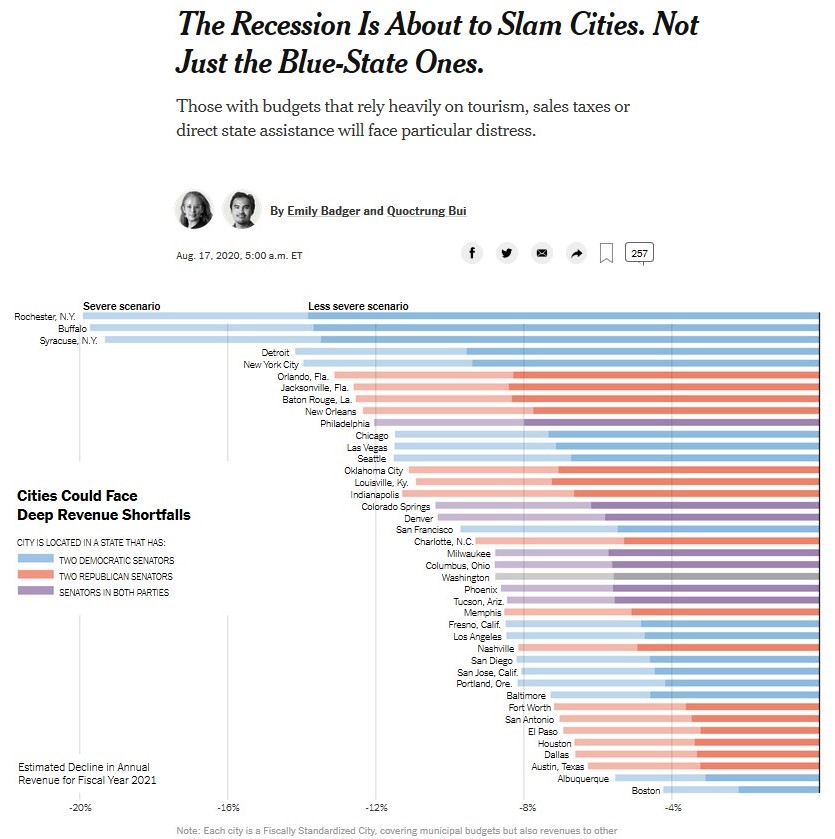
The coming budget reckoning for big cities

A new analysis suggests particular big cities will suffer losses in tax revenues due to COVID-19:

Describing the study results more:

What matters more in this pandemic moment is how a city generates money: Those highly dependent on tourism, on direct state aid or on volatile sales taxes will hurt the most. Cities like Boston, which rely heavily on the most stable revenue, property taxes, are in the strongest position — for now.

The estimates, to be published in the National Tax Journal by Mr. Chernick, David Copeland at Georgia State University and Andrew Reschovsky at the University of Wisconsin, are based on the mix of local revenue sources, the importance of state aid and the composition of jobs and wages in each city. The researchers predict average revenue shortfalls in the 2021 fiscal year of about 5.5 percent in a less severe scenario, or 9 percent in a more severe one.

Tax revenues can come from a variety of sources. Like recommendations for individual investors to diversify their portfolio, municipalities can benefit from a broad tax base that is not too reliant on any one sector. As the analysis suggests, relying on one single source can cause problems when that area experiences a downturn. (At the same time, creating such a robust and resilient local economy might be very difficult to do given historical patterns, current conditions, and competition in the future.)

The color coding of the graph above is interesting in that it implies that there are a number of cities that Republicans should care about helping. I wonder how this will play out: even as Republican senators would want more municipal tax revenues, it does not necessarily mean that they are pro-city or would want to go out of their way to provide funding. Are Republicans more in favor of seeing the fate of cities and suburbs as tied together when their cities are at risk?

Carmageddon in Los Angeles vs. Carmageddon in New York City

Remember Carmageddon and Carmageddon II in Los Angeles? Now, Carmageddon has come to New York City:

In Chicago and in other cities with robust transit systems, people who have never owned cars before are suddenly buying them. In New York City, some are calling it “carmaggedon,” as residents there registered 40,000 new cars in July, the highest monthly total in years. Meanwhile, NYC subway ridership is still down more than 75% from last year.

pexels-photo-1116244.jpeg

Photo by Jack Gittoes on Pexels.com

The difference in what leads to carmageddon in each city is striking. In Los Angeles, closing a section of a major highway is a problem for the entire system. Because of the emphasis on driving and the various chokepoints in the road system, a single closure has ripple effects. In New York City, the opposite is the case: high mass transit use, particularly in Manhattan and denser parts of the city, is necessary. If something threatens the mass transit lines – here, it is an unwillingness to use mass transit when there is a pandemic – then too many cars may be on roads that cannot handle the increased volume.

Fortunately for Los Angeles and unfortunately for New York, the length of Carmageddon matters. Closing a major highway for just a few days is survivable. Indeed, Los Angeles got out ahead of the problem and enough drivers were able to make alternate plans. Decreased mass transit use due to COVID-19 is another story. How long will the virus be around? Will there be a point where residents return to mass transit even with the threat of the virus present? Carmageddon in New York might prove more lengthy and much more difficult to remedy.

During COVID-19, wealthier people now less mobile than poorer people

Researchers found changes in mobility patterns among Americans of different income levels during COVID-19:

woman in yellow tshirt and beige jacket holding a fruit stand

Photo by Anna Shvets on Pexels.com

Writing in the journal PNAS, researchers from several California universities describe how they used anonymized cell phone location data and census info to show a dramatic reversal in how mobile Americans have been this year. Before Covid-19 struck, rich Americans moved about more than poor Americans—they can always afford to travel. But between January and April, that flipped. Rich folk are now far more likely to stay completely at home than poor folk: The study found that 25 percent more high earners stayed completely at home during the pandemic, compared to the number of them who had stayed home before. That increase was only 10 percent among low earners. And that has major implications for how we as a nation can fight the pandemic.

“In the early stages of the Covid-19 pandemic, there was a clear mobility response across the board,” says University of California, Davis environmental economist Joakim Weill, lead author on the paper. “In the US, everyone started to stay at home more. But we also found that there is a clear differential between wealthier communities and poor communities, where individuals in wealthier neighborhoods tended to stay at home much more than people in poorer neighborhoods.”…

Close to half of the wealthiest Americans stayed completely at home on weekdays in April, compared to less than 40 percent of low-earners. The poor traveled farther distances on average: In the same month, people who live in lower-income areas traveled between 5 and 6 kilometers, while the rich traveled closer to 4. The rich nearly halved their visits to recreational and retail areas in April, while the poor cut their visits by only a quarter—perhaps because their jobs required them to return to work there.

To be clear, the researchers can’t definitively say why the data shows this dramatic discrepancy, but they can begin to speculate. For one, essential workers often earn lower incomes, like clerks at grocery stores and pharmacies. Indeed, the US Bureau of Labor Statistics has found that among Americans 25 and older with less than a high school diploma, just 5 percent teleworked in June. On the other hand, 54 percent of Americans with a bachelor’s or more advanced degree were able to work remotely.

Social class is connected to mobility, health, and a whole lot of factors in social life. The anonymized cell phone data also seems to align with other patterns: those who can leaving certain big cities as well as differences in COVID-19 cases across communities and racial and ethnic groups.

As the article goes on to note, the fact that anyone can contract COVID-19 is not the same as saying everyone has the same likelihood of contracting COVID-19. Those with resources have more options in how to respond to crises plus more options when it comes to treatment. These differences are generally present regarding health but a large pandemic reveals some of the underlying patterns that deserve attention.