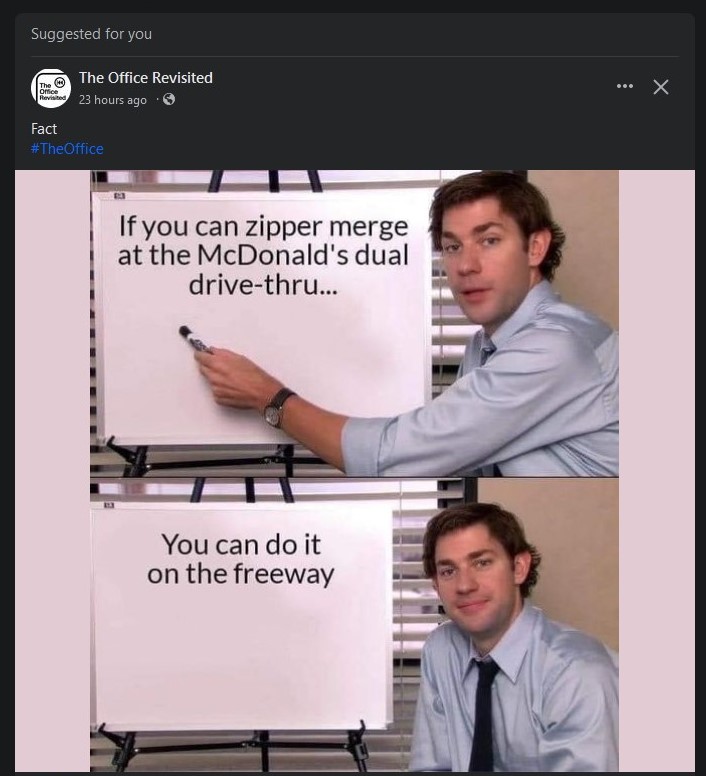
McDonald’s has several advantages in encouraging a smooth zipper merge process:
A shorter runway to merging. You often go around a turn, order, and immediately merge. In contrast, highway merges can sometimes be seen from a mile or more away and some want to block all that space.
A physical separation of the lanes before merging. The vehicles are ordering before merging and the need to have a display board and speaker means the lanes cannot be crossed into. Even if a driver wanted to block the other lane, the physical barriers make that difficult.
People want to get their food. While driving on the highway, the goal is to get somewhere quickly. Different motivations.
Might it matter that McDonald’s is private property while highways/roadways are more of open or public space?
Some of these principles could be applied to highways. Imagine temporary physical barriers between the lanes to force a merge closer to the end of the lanes. Or, reminders that blocking lanes has (legal?) consequences even though it is more public space.
The situation poses a commuting challenge that L.A. has not seen in years, with hundreds of thousands of commuters facing detours and heavier-than-normal traffic. Starting Monday, some worked from home and others took mass transit, but many simply endured the delays.
The closure caused gridlock in some areas, but there was general sentiment that L.A. survived the first morning and evening commute without too much chaos thanks in part to warnings sent to residents’ cellphones…
Federal, state and local agencies are scrambling to determine what happens next after the sudden closure of the mile-long section of the heavily trafficked freeway between Alameda Street and the East L.A interchange, a key east-west route through downtown. Mayor Karen Bass said that U.S. Secretary of Transportation Pete Buttigieg called and reassured her that federal officials were aware of the impact from closing one of the busiest freeway corridors in the country.
“Losing the stretch of the 10 Freeway will take time and money from people’s lives and businesses,” Bass said. “It’s disrupting in every way. Whether you were talking about traveling to and from work, or your child care plans, and the flow of goods and commerce, this will disrupt the lives of Angelenos.”
Los Angeles and the region depend heavily on highways. This is true of all metropolitan areas in the United States but Los Angeles is famous for its driving and its lack of mass transit within a sprawling region.
While I am sure the focus here will be on getting this highway going again as soon as possible, why not think as well as future transportation options? The initial Carmageddons in Los Angeles went rather smoothly but this is another chance to think about additional travel options and building an adaptable and redundant system. If for a variety of reasons residents of the region cannot drive to work or where they need to go, do they have viable alternatives? Fires like this are rare but individuals face all sorts of challenges in getting where they need to go.
More broadly, can more people in the region regularly shift their transportation away from driving alone to other options? As the population of the region grows, the traffic is not going away. Roads do need to be maintained. Accidents will happen on the roadways. When I rode the LA subway on a recent visit, it worked okay one-way (the return trip was derailed by a long delay that pushed me to walking several miles) but it had limited options of where I could go. Are many people willing to ride buses and other forms of mass transit when they might drive?
The highway detours will end at some point but will driving return to normal immediately? Probably yes…but there will likely be more opportunities to consider other transportation options in the years to come.
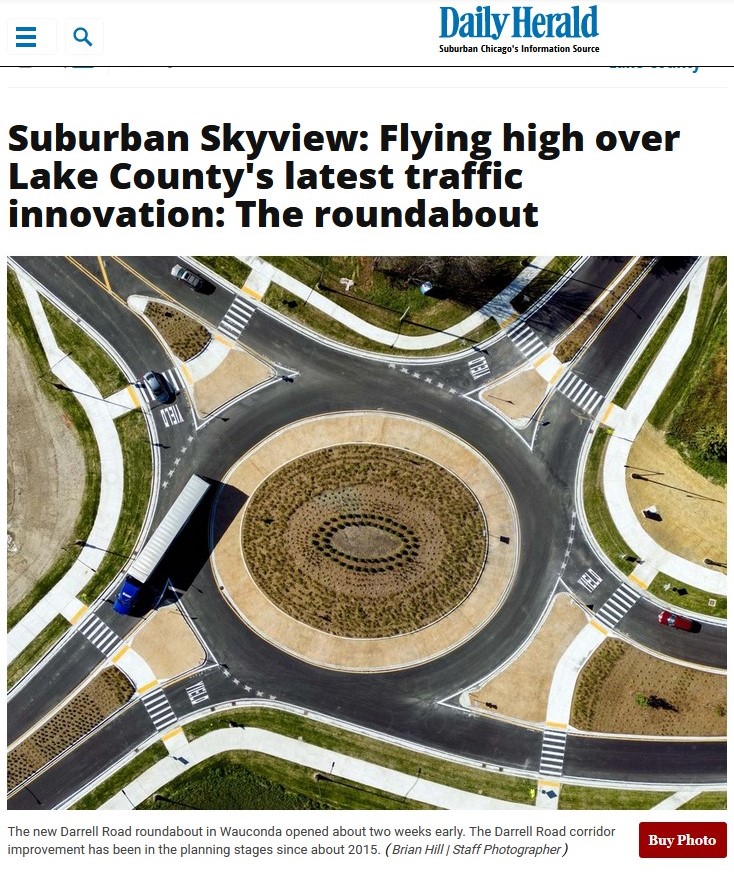
The Lake County Division of Transportation (LCDOT) closed Darrell, Neville and Case roads in Wauconda to through traffic for 110 days to construct a roundabout and realign the intersections…
This is the ninth roundabout in the Lake County Division of Transportation system. The $8.1 million project is the first of three roundabouts to be built as part of the Darrell Road corridor improvement.
Suburbanites are used to traffic lights and stop signs. Adding roundabouts or diamond interchanges presents a new dimension to driving. The roundabout offers the possibility of a smoother journey – if there is not too much traffic – but requires a different level of attention as there are multiple yield points.
Suburbanites can come to like roundabouts with experience. But, local drivers will likely need some time to get used to them. I am curious to see how many roundabouts will eventually populate the suburbs. They are likely not possible in many places due to existing land uses. However, if they help move traffic, are safe, and people can drive through them, we will probably see more of them in the Chicago region.
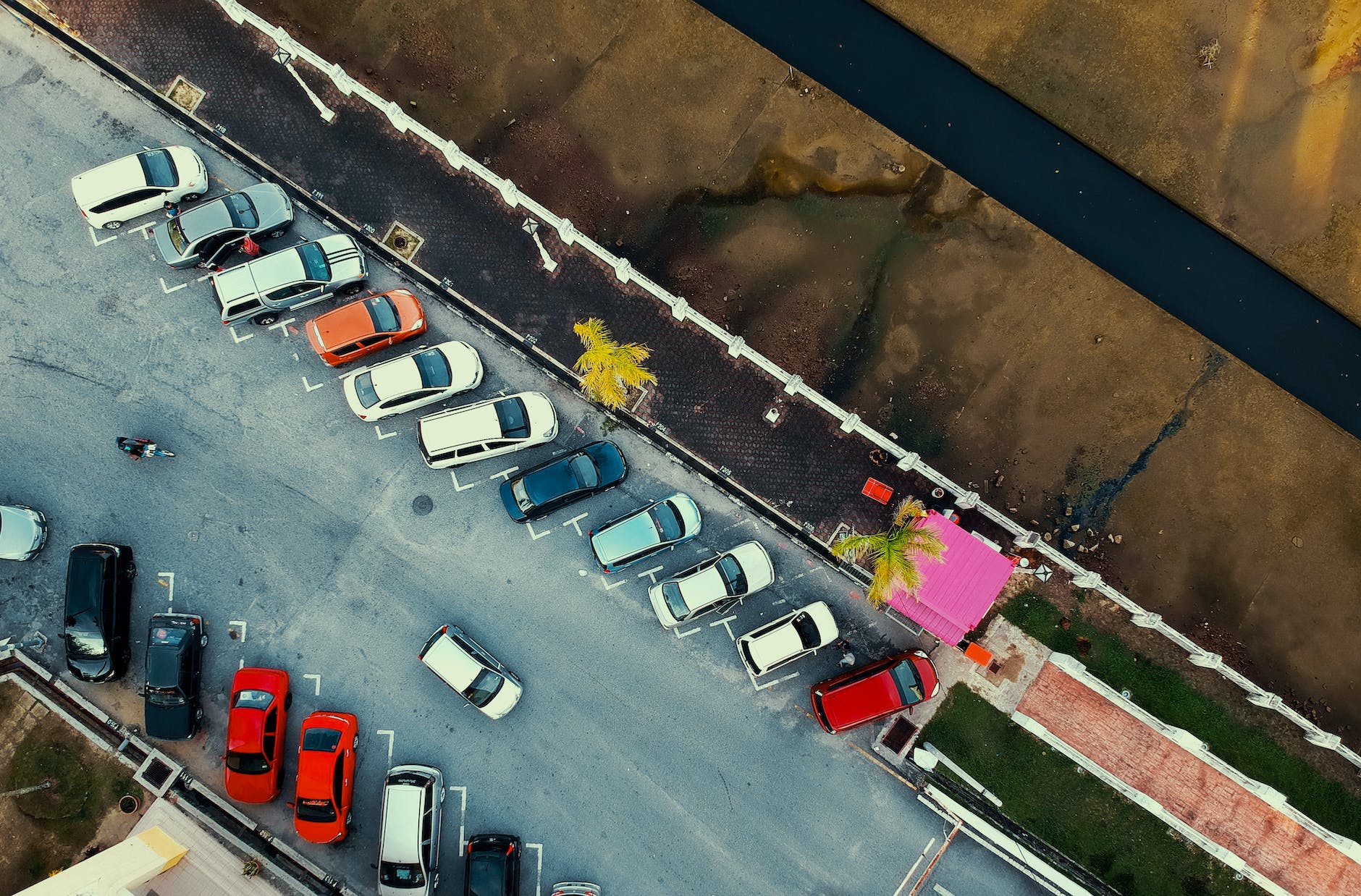
According to Donald Shoup, an urban planner and parking research pioneer at the University of California, Los Angeles, the government doesn’t track the number of parking spaces. But speaking with WSJ, he estimates that on the low end, the U.S. has at least 700 million parking spaces, and on the high end, the estimate is more like 2 billion. That works out to somewhere between 2.5 and 7.0 parking spaces per registered vehicle in America.
As this article goes on to note, some believe that is way too many parking spots. (Hence, the /s tag on the post title.) All of that parking takes up a lot of space, continues to further the commitment in communities to driving, and has negative environmental consequences.
At the same time, I could imagine many drivers in the United States like having all of this available parking and might even want more spots. In a car-dependent society, people need a place to park. People expect to be able to find parking quickly and close to their destination. If parking is limited and/or costly, drivers will express frustrations. Some might note that even if they wanted to use other forms of transportation (and avoid parking issues), these are not always available or convenient.
Commitments to reduce the number of parking spots in the United States long-term probably requires a lot of small changes to different parts of planning and communities. Just as a quick example, increased mass transit use and service would help reduce the number of drivers and reduce the need for parking spots. But, that chain does not happen quickly and there are multiple levers to move. I wonder if one of the important moves would be for some key communities to change their parking guidelines, find that it works or is successful (and also enables other good opportunities for land use), and this becomes a model for others to follow.
When school started in our area in mid-August, I noticed more signs on streets near schools asking drivers to slow down and pay attention because children are present. But, we are now weeks past this and I wonder at what speeds drivers are going.
I am guessing the signs had limited effect, if any at all. School zones may be important to a few drivers, particularly with increased vehicular and pedestrian traffic at certain times in the morning and afternoon..
Many communities struggle with people driving fast through residential streets with speed limits of 20-30 mph. These suburban roads can often be wide, fairly straight, and have limited obstacles on the sides. Even the possibilities of children being present may not be enough to
Communities have multiple techniques to try to address this. There are warning signs, signs that flash the speed of oncoming drivers, and traffic control devices like speed bumps. The presence of crossing guards on foot and/or police vehicles can help reinforce the need to slow down.
As long as driving is the dominant mode of transportation and communities prioritize the fast flow of cars, it will be hard to slow down drivers around schools. Fewer students walk or bike to school than in the past but those who do and those who might if it could be safer would benefit from safer pathways.
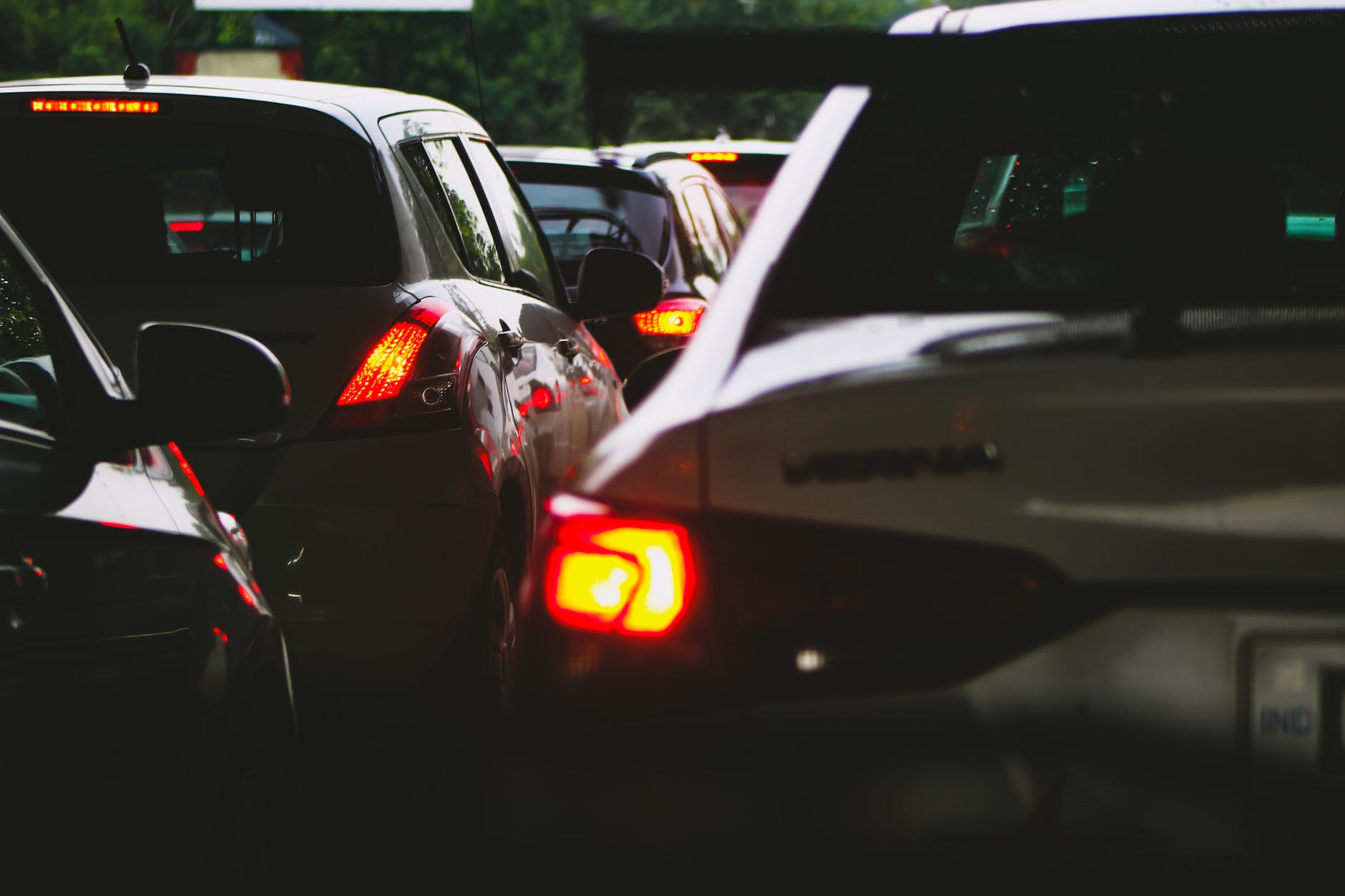
-The delayed start from a traffic light. Vehicles at the start of the line may not move for a few seconds after the light turns green, even when the path is clear. This slows down the rest of traffic, particularly when there are a lot of traffic lights in a row.
-The increased distance between vehicles. If drivers think they need more margin because they are not fully paying attention to the road, vehicles will be further spaced out.
-Not paying attention to directions or turns might mean people have to cut across lanes or make alternative paths.
Since traffic can act like waves, then even a slight disruption can have a ripple effect.
If all drivers took the “most efficient” or “fastest” routes according to their apps, would these hits to traffic be cancelled out?
It might also be worth remembering that one of the appeals of self-driving vehicles is that they could better address these issues. They could better safe themselves and adjust to changes in conditions around them.
But roadkill is also a culprit in our planet’s current mass die-off. Every year American cars hit more than 1 million large animals, such as deer, elk, and moose, and as many as 340 million birds; across the continent, roadkill may claim the lives of billions of pollinating insects. The ranks of the victims include many endangered species: One 2008 congressional report found that traffic existentially threatens at least 21 critters in the U.S., including the Houston toad and the Hawaiian goose. If the last-ever California tiger salamander shuffles off this mortal coil, the odds are decent that it will happen on rain-slick blacktop one damp spring night.
But, it has costs. It is expensive. Driving pollutes. It is part of sprawl. And it is dangerous to life, whether other drivers or pedestrians or animals.
There may innovative solutions. See the construction of bridges or overpasses over roads and highways that enable wildlife to cross roads without danger.
Yet, the danger to animals appears to be a cost Americans are willing to bear for what driving brings. Whether it continues this way remains to be seen.
According to the Department of Energy, even though medium- and heavy-duty trucks account for only 4% of the vehicles in the United States, they consume 25% of total highway fuel and create nearly 30% of highway carbon emissions. Stricter standards on smog-forming emissions on trucks will take effect in 2027, which could force companies to turn to electric versions such as this Tesla fleet.
Since trucking is essential, even small improvements to gas mileage and emissions could go a long ways. I am not sure that having full fleets of electric trucks or even autonomous electric trucks in a few decades time would look that futuristic but it sounds like they could help.
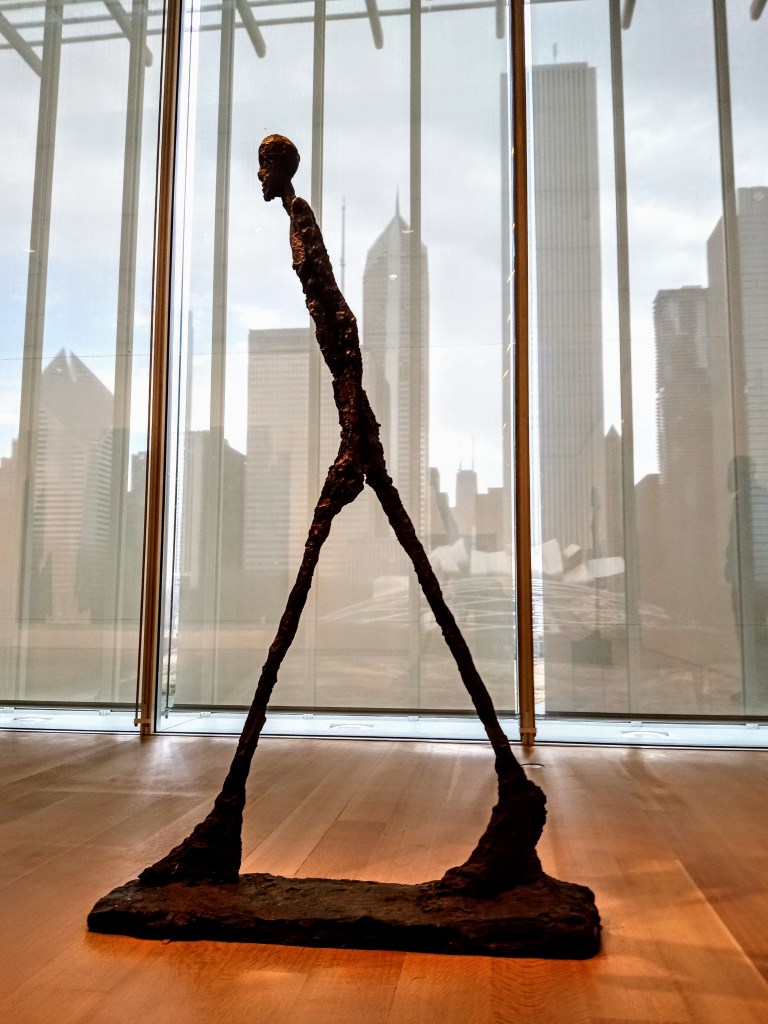
“Walking Man II” by Alberto Giacometti at the Art Institute of Chicago
Many spaces in the United States privilege driving rather than walking. Driving is often faster. In the same amount of time, a driver can likely go farther than a pedestrian.
But, driving is not what humans have done throughout most of history. Driving is much faster. It requires technology to make and maintain vehicles. There needs to a lot of infrastructure to support driving. The scale changes as a vehicle is moving much faster and needs more room.
Even to see the statue above, many visitors will take a vehicle on a roadway. This enables millions to visit the museum and take in this image. Yet, they will contemplate a depiction of a human walking while primarily traveling via other modes.
Asking Americans to not drive as much or at all is a tall order. Cars are an integral part of the American way of life. Maybe reflecting on “Walking Man II” can help people remember a past and envision a different future.
Could more unusual speed limits help improve safety on the roads? Here is one speed limit I saw recently along a road coming out of a shopping plaza:
Most speed limits are in increments of 5. I assume this is, in part, due to standardization of roadways throughout the United States. But, why not throw in some more unusual numbers to catch the attention of drivers? Would I be able to stick to the occasional 13 or 31 or 67 more easily than the standard 15, 30, or 65? If every speed limit was a number off of the 5/10s pattern, they might make the problem worse. The key could be to have some numbers off from typical numbers.
The switch to more digital speedometers in cars could help with this. A good number of speedometers are also in increments of 5 and 10 so matching 13 mph could be hard. If more drivers have digital displays where a 5/10 increment does not exist, then escaping the rigidity of 5/10s could be easier.





 Legally Sociable