I recently received the breakdowns of where tax dollars for the State of Illinois and DuPage County went in 2024:
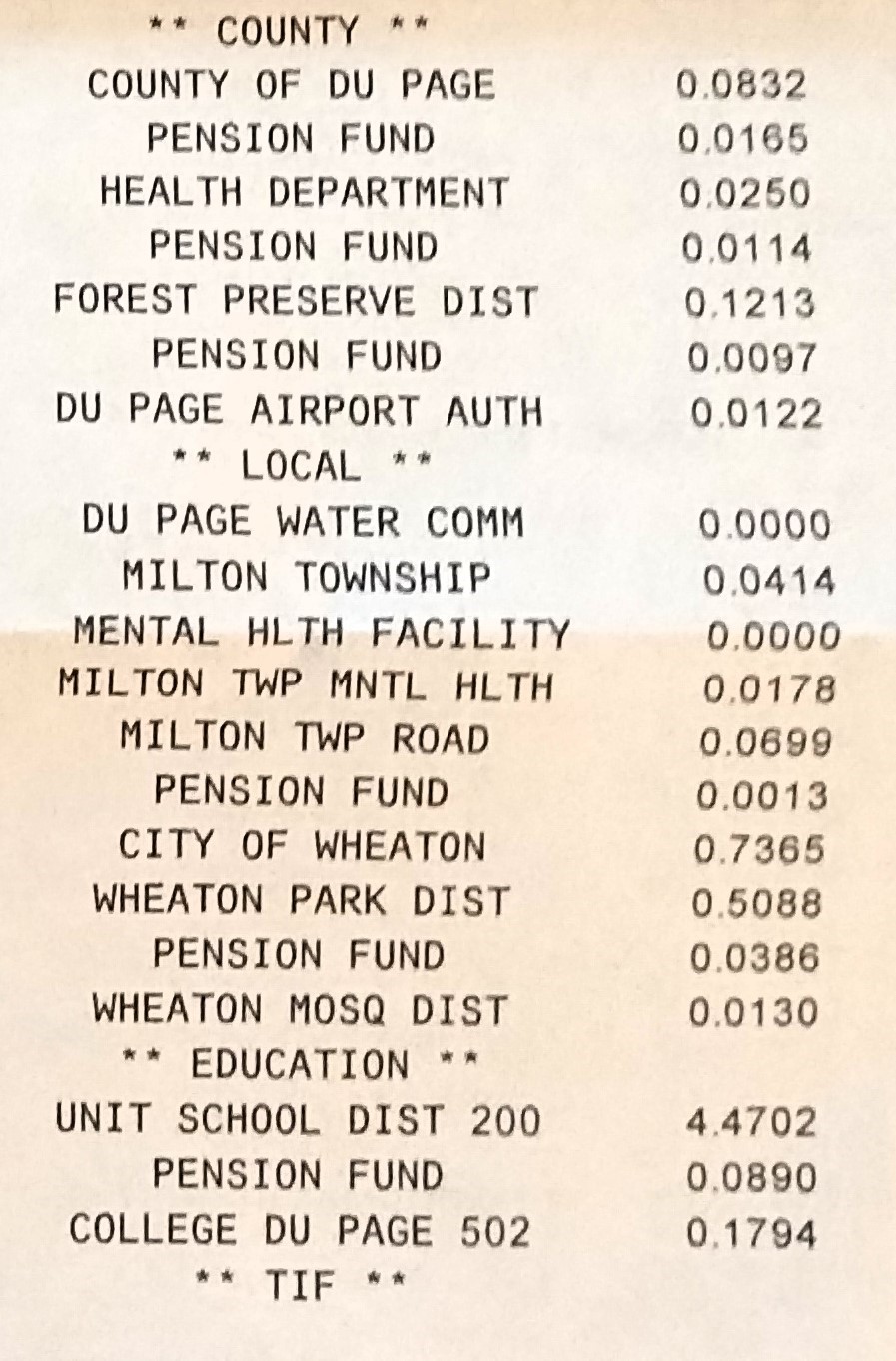
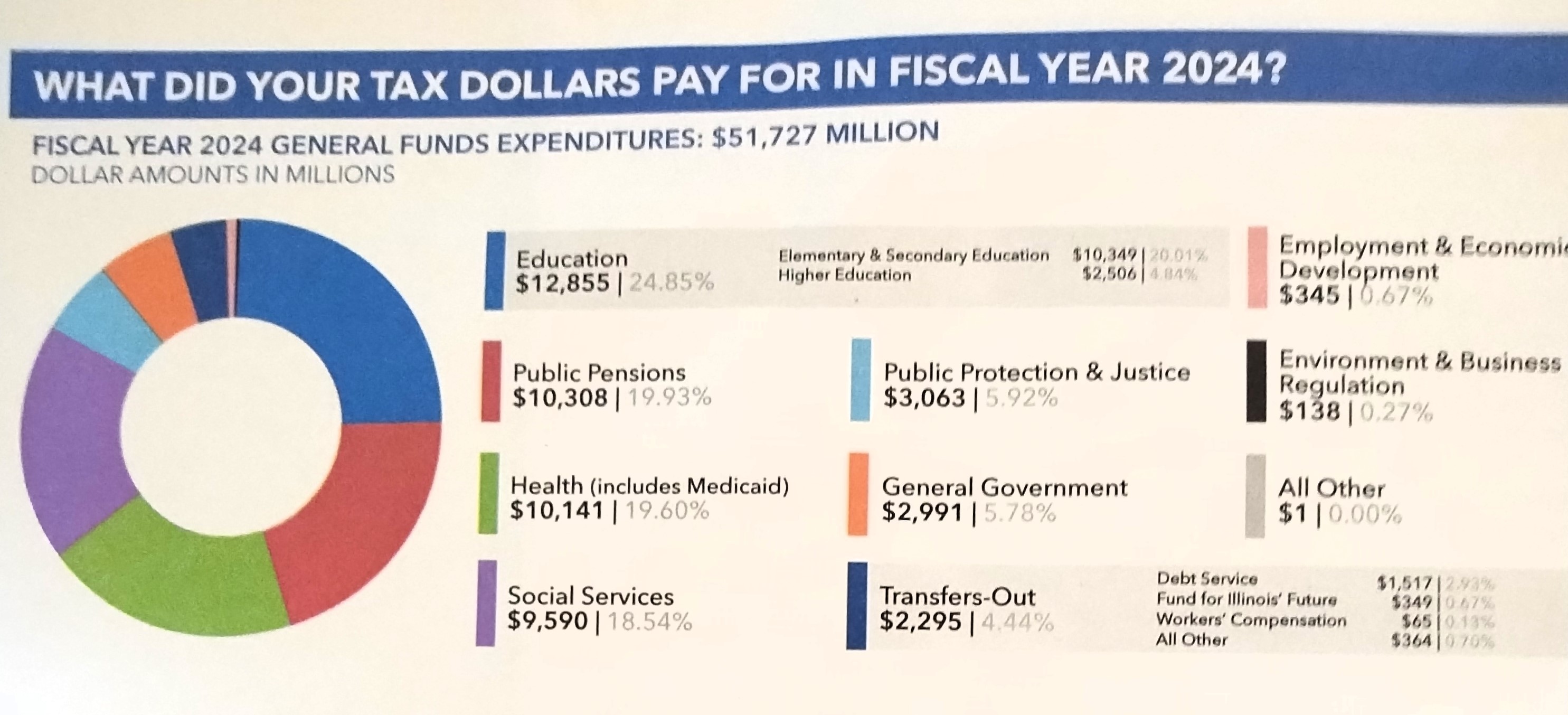
In both cases, education leads the way. For state expenditures, education accounts for 24.8% of spending. At the local level, education accounts for 69.4% of the total rate.
The large portions going to education are supported by multiple interests of residents:
Education is often pitched as for children, the next generation, and the future. If we do not spend on education today, how will the children succeed and/or do better than the previous generation?
The quality of local schools is often tied to housing prices and the status of communities. To not spend locally on schools might provide short-term savings but reduce the desirability of properties and communities in the long-term.
The bulk of education costs is in salaries for teachers and staff. Without quality educators, how can schools be successful?
Some might complain about the tax burden – and Illinois does have high property taxes – but it is hard to argue against spending on education. It could be more effective to reign in spending by targeting other areas where there is duplication of local services (such as townships).
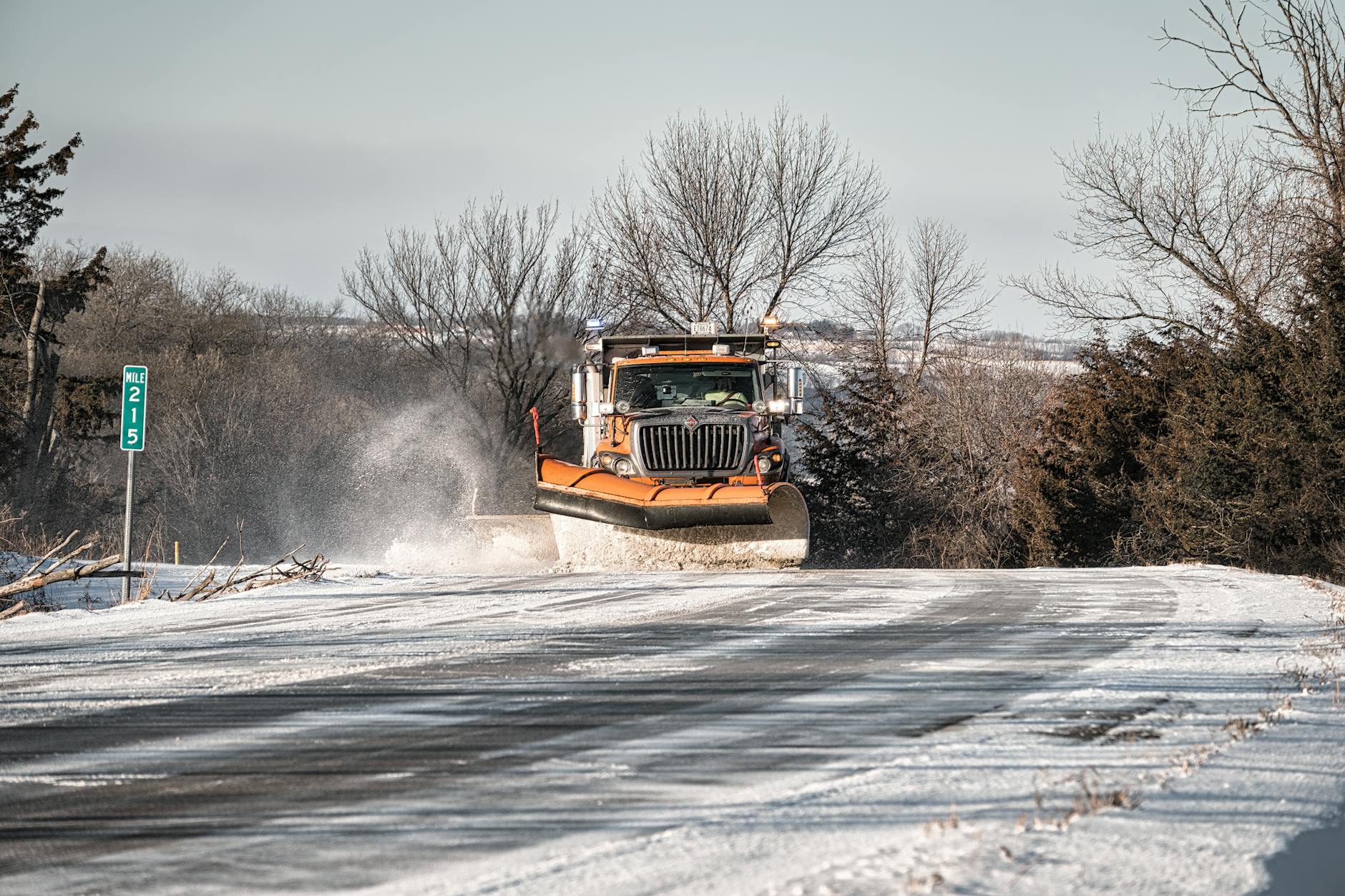
She noted the county’s division of transportation takes care of 220 miles of county highways and 92 miles of multiuse trails. It also maintains 650 vehicles in the countywide fleet and is responsible for snow removal on county roads.
This sounds like a lot of vehicles and I do not know if it is a lot or a little compared to similar-sized counties. At least in this story, the county is looking for a bigger transportation facility to meet all its need for space.
So in one suburban county, there are multiple actors responsible for the roads: the state for interstates and other highways, townships for some roads, municipalities for some roads, and the county for some roads. Is this the best way to approach things? Does each government body have similar vehicles? How close are each other’s roads to each other? If starting suburbia from scratch from this point on, would it be better to have one body address all the roads?
Roads are near sacred in the United States so I understand the attention paid to them. Yet the resources and energy required to maintain them, let alone expand them, is large.
“It is easy to forget this county, DuPage, was once one of the reddest counties in America not long ago,” Conroy said during Tuesday morning’s Illinois delegate breakfast.
She noted that DuPage was where “Republican presidents raised millions of dollars, produced a U.S. speaker of the House” and led both chambers in Springfield. “But 12 years ago, that tide began to turn,” said Conroy, who in 2012 became the first Democrat to win an Illinois House seat in a district entirely in DuPage.
In 2022, Conroy again made history as the first female elected to head the DuPage County Board and the first Democrat to hold that title in several decades. That same year, Democrats solidified a 12-6 majority on the county board. In 2018, Republicans held all but one seat on the county board.
Conroy said Democratic women also now make up an overwhelming majority of state representatives and senators representing DuPage in Springfield.
This is a change echoed in the other collar counties of the Chicago area: a shift from Republican bases to Democratic majorities. This is all part of the emerging complex suburbia.
At the same time, this is not the first time there was a major political shift in DuPage County. Local historical Leone Schmidt detailed political life in early decades in the county in the 1989 book When the Democrats Ruled DuPage. She describes the book this way:
It covers the impassioned and sophisticated political activities, the interplay of parties and personalities, and the heyday and fall of the Democrats as a force in Du Page County.
By 1860, the Democrats were the minority party in the county, and the Republicans successfully imposed the importance of party loyalty, regardless of local issues, on county politics.
The county has experienced at least two major shifts in political leadership and voting patterns. As politicians and parties fight for votes in DuPage County and other suburbs, there could be future shifts. What can look like solid majorities through multiple decades can change – they have before.
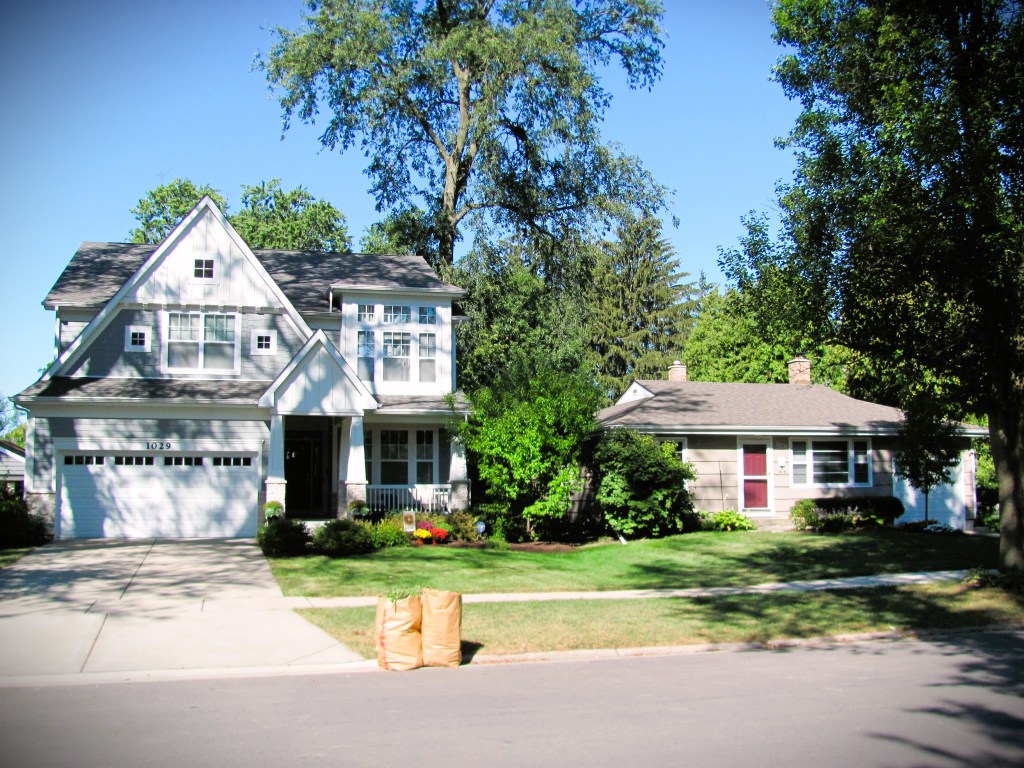
While working on a project, I noticed something while driving through a number of DuPage County communities: there are teardown homes everywhere. They are not just limited to desirable downtowns; they are spread throughout numerous residential neighborhoods. They are often easy to spot: much larger than adjacent homes and with a particular architectural style with stone or fake stone bases, lots of roof peaks, and plentiful garage space. Some could be categorized as teardown McMansions. (Some of these homes might be infill homes where homes were constructed on empty land.)
These teardowns follow some of the patterns I found in over 300 teardowns in Naperville. The architecture and design is similar. The homes are often located next to older homes, often from the postwar era, from the twentieth century.
One difference is that these teardowns are spread throughout communities. In Naperville, teardowns tended to cluster near the desirable downtown area. In some of the communities I drove through, teardowns and/or infill homes are all over the place. Some of these communities do not have downtowns like Naperville and have housing stocks of different ages. It was not unusual to see a teardown suddenly in a neighborhood on the edge of a community when in Naperville the teardowns tend to cluster in particular neighborhoods.
In a county that is largely built out and with suburbs now 50-170+ years old, there will be more opportunities for property owners, builders, and developers to tear down old homes and construct new ones. My sense is that while communities may have regulations about what can be rebuilt, the general atmosphere is in favor of these new homes as long as there is interest and resources to make it happen.
Four months later, Carroll and others say the response to the mass shooting has only reinforced long-simmering feelings of neglect among the 3,000-plus residents clustered in apartment and condominium complexes in an unincorporated area on DuPage County’s southeastern edge…
In recent weeks, DuPage County Board members have pledged more than $1.5 million for infrastructure improvements and to bolster the efforts of nonprofit organizations already working in the community…
Williams eventually moved from the complex. But she started a nonprofit organization, Youth 4 Excellence Inc., that works with families in the community. Hers is one of a handful of nonprofits that have tried to fill in the service gaps in a neighborhood that Williams called “a desert,” its residents — many living at or below poverty — isolated by a lack of public transportation and afforded limited access to amenities enjoyed by their affluent neighbors…
At least part of that isolation is due to the area being unincorporated. Though Willowbrook and Hinsdale are found in the names of the neighborhood and some of its residential complexes, it has no affiliation with either town. Instead, it’s part of the county’s 3rd District, which covers portions of at least 10 communities and is represented by three county board members.
A few thoughts and questions about this given my knowledge and study of communities and DuPage County:
Unincorporated areas can be under the oversight of DuPage County – it sounds like this is the case here. That means the County is responsible for local services, not a municipality.
Why has this area remained unincorporated rather than being annexed into a nearby suburb? Suburban communities are often eager to expand their boundaries; why did this part of the county not end up as part of another community?
Does it matter that this area primarily consists of apartments and condos rather than single-family homes? How different are day-to-day life and local services compared to other unincorporated areas in DuPage County that consist of more single-family homes?
DuPage County Board members represent both actors in municipalities and in unincorporated areas. To which do they pay more attention?
In a suburban county with relatively little open land left to develop, unincorporated areas likely face unique challenges compared to the hundreds of thousands of residents located within communities.
When well-taken-care-of, closed landfills can have multiple uses. They can generate renewable natural gas, host solar panels and even provide valuable natural habitat.
Atop the district’s Greene Valley landfill, for instance, a thriving prairie is home to seven state endangered birds, one state threatened bird and even a gas-to-electric power plant.
“The landfills are here forever, and they’re always going to need special care,” said Jessica Ortega, the district manager of strategic plans and initiatives. “It’s unavoidable that landfills are going to continue to emit greenhouse gasses, therefore it’s important to explore opportunities to implement strategies to minimize and reduce greenhouse gas emissions from landfills and to care for the sites as naturalized areas.”
What were once landfills at the edges of the metropolitan region are now firmly integrated into a Forest Preserve system. Bonus: they are some of the highest hills around.
I bet there are some interesting stories that could be told here. Who lived next to these landfills decades ago? What were the obstacles to converting these to other uses? What are these sites expected to look like in 50 or 100 years?
DuPage County, Illinois is a vibrant suburban county with over 930,000 residents, lots of jobs, and numerous communities. Like many suburbs, it has become more complex in recent years due to demographic, cultural, economic, and social changes. It is also home to hundreds of religious congregations.
Brian Miller (Professor of Sociology, Wheaton College, and co-author of Building Faith: A Sociology of Religious Structures) is using a quantitative approach focusing on DuPage County in Illinois, which is home to hundreds of religious organizations. He is documenting the number and types of transitioned congregations in the suburban context, looking for patterns of building usage and community impact.
I have started looking at sources that will help with the project. Here are two that are proving very helpful:
This builds on earlier work I have done regarding religious buildings. Based on existing research, I would expect a variety of outcomes for former religious buildings from no building present on the site to empty structures to buildings converted for other uses.
I was reading through some newspaper articles from the 1990s about development in my suburban county. In an article on a $75 million bond proposal for county voters to preserve 2,300 acres of open space (which voters did approve), here is one explanation why county voters should increase their property taxes for this purpose:
Bond issue proponents have stressed that preserving open land will help everyone by making DuPage County an even more desirable place to live. Saving open space will improve wildlife habitats, help control flooding, improve stream water quality, avoid added congestion and protect property values, Oldfield said. (Lynn Van Matre, “DuPage voters to decide on open space,” Chicago Tribune, November 2, 1997)
The reasons listed for voting in favor of spending this money appear to split into two areas: (1) environmental concerns (wildlife, flooding, water) and (2) a particular quality of life marked by property values and limited traffic.
But, I wonder if the first category is a subset of the second set of concerns. Suburbanites in Chicagoland care about property values and have concerns about drug treatment centers, waste transfer facilities, religious buildings, apartments, and anything else they think threatens their financial investment.
Do suburban residents care more about environmental concerns or about what development might go into these open spaces? From the perspective of some (and this was also expressed in the article above), such land could be used for affordable housing or for community amenities. To keep it as open space means it could not be other uses that people could benefit from.
If preserving property values is the top concern regarding land development, this is the sort of decision that might be made. Such a decision does not come cheaply; local property owners pay more but they do so in order to hopefully boost their investment even more.
If you’re not doing anything Thursday evening, swing by the park for a bit of Shakespeare, a signature cocktail and an interesting bite or two from a selection of food trucks. What park? Why, Cantigny Park, in DuPage County, of course. Where else would anyone go for a hip summer evening out in the Chicago area?
Long overshadowed by Cook County when it comes to cool stuff to see and do, DuPage County is starting to change its image as a boring suburban haven for people intimidated by life in the big city.
The editorial also notes the “good government” and diversity of the county:
The occasional scandal aside, we think of DuPage as being a haven for good government compared with the rest of the state, owing in no small part to the 12-year tenure of Dan Cronin as chair of the DuPage County Board. Cronin, a native of Elmhurst, set a singular example for reducing the size and cost of county government and we were sorry to see him step down.
Democrats have turned the tables in this longtime GOP bastion, holding a majority on the board for the first time in decades. In November, voters elected the county’s first woman as board chair to replace Cronin. After her election, longtime Illinois state Rep. Deb Conroy noted that her predecessors on the board had been white men. “And today that is not the face of DuPage County,” she said. “DuPage County today is richly diverse.”
As chair, Conroy should aim to extend Cronin’s proud legacy of efficient government, while ensuring this important part of the state is inclusive and equitable.
The contrast in this editorial is the city of Chicago and Cook County. The city is supposed to be the place of cool scenes, art exhibits, and exciting entertainment options. These are now available in the suburbs?!
I would put this recognition as part of a longer process of suburban development. At this point, DuPage County has had over seven decades of suburban postwar growth. It is a wealthy suburban county with plenty of jobs and economic opportunities. Before the postwar era, the county had roughly one hundred years of history involving the arrival of white settlers and the removal of Native residents, the coming of the railroad that connected the county to Chicago and other parts of the Midwest, the founding of small towns throughout the county, and the start of suburbanization on the eastern edges of the county.
This means the county has had plenty of time to mature and develop. Suburban greenfield growth is pretty much done and the population has grown less than 2% each decade since 2000. More communities have focused on infill development, redevelopment, and enhancing their downtowns (or trying to create community nodes if they did not have a downtown). There are plenty of institutional and community resources to draw on and wealthier residents to spend money. The demographics and social priorities of county have changed.
Additionally, people can live, work, go to school, find interesting restaurants and shopping spots, and more all within the suburbs. Chicago does offer unique opportunities and places but many suburbanites spend a majority of their time closer to home.
Is DuPage County cool? Or, are the suburbs more complex than an image of quiet and staid communities that provide bedrooms for urban jobs and exciting city opportunities?
(One note: the coolness the Editorial Board cites does not likely extend to all suburbs. The piece notes particular communities and opportunities. How many entertainment centers can the suburbs have? Suburbia is full of uneven development and inequalities.)
The creation of an ad hoc affordable housing committee was announced during Tuesday’s county board meeting and comes two weeks after the county board set aside $2.5 million to start an affordable housing solutions program.
“If you work in DuPage County, you should be able to live in DuPage County,” said Deborah Conroy, county board chairwoman, after announcing the committee…
The cost of land, officials said, often hinders affordable housing developments…
From 2018 to 2022, some 862 affordable rental units were built in DuPage County, Illinois Housing Development Authority Executive Director Kristin Faust told board members Tuesday. During that same time, 996 homebuyers purchased a home with a mortgage assisted by the housing authority, Faust said.
DuPage County is a relatively wealthy county. According to the Census Bureau, the median household income is $100,292, the poverty rate is 6.9%, and the median value of owner-occupied housing is $324,900.
Additionally, the County and the municipalities within it do not have a great history of pursuing affordable housing. In the postwar era, DuPage County did not build much public housing when it had funds to do so. Municipalities largely pursued housing aimed at white, middle-class and above residents. Affordable housing has been raised as an issue in the county since at least the 1970s. Newer efforts still aim their efforts at relatively well-off residents.
By not having sufficient affordable housing in DuPage County (or in the Chicago region as a whole), the County may struggle to grow, attract workers, and continue the quality of life that residents expect.