Marijuana dispensaries and the ongoing reputation of suburban communities

Over a decade ago, numerous Chicago suburbs debated regulations regarding marijuana dispensaries. One line of argument went that such establishments diminished the reputation of communities. Here is an update for one Chicago suburb:

Photo by Nataliya Vaitkevich on Pexels.com

A second marijuana dispensary quietly has opened in Arlington Heights, years after controversy and debate about whether to allow the first one to do business in town.

Longtime Mayor Tom Hayes was outright opposed to the vice, arguing it would diminish the village’s reputation as a family-oriented community.

But supporters say times have changed, and there was the new mayor, Jim Tinaglia, holding giant scissors at a recent ribbon cutting welcoming the new business and its green — leaves and tax dollars — to town…

But others on the elected panel soon decided revenue estimates from local taxes on pot sales — as much as $500,000 per dispensary, per year — were too good to pass up.

This potential link between the status of the community and the presence of marijuana dispensaries sound like it could involve testable hypotheses.

First, we would need to get at the status of a community. The suburbs overall are considered by Americans as “family-friendly” but the suggestion here is that some suburbs are more about families than others. Could Census data reveal that a suburb is “family-oriented” or would this depend on survey or interview data of local leaders and residents? Or is this more about social class – income, wealth, housing values and types, etc. – and the status that comes with it?

Second, perhaps this is not about status but rather the need for local revenues. How do budgets look before and after considering a marijuana dispensary? Can suburbs afford to keep certain businesses out? Dispensaries may not be the only businesses suburbs do not want; this could range from tattoo shops to warehouses to other land uses considered not in character with the community.

At least from this one story above, it sounds like a change in leadership plus a need for revenue led to different local approaches. And does this come with increased local revenues and any difference in status?


Brian Wilson and suburban music

The recently deceased Brian Wilson was from the suburbs of Los Angeles and wrote music about suburban lifestyles:

Photo by Alex Hussein on Pexels.com

Wilson’s legacy includes dozens of hit singles with the Beach Boys, including three Number One singles (“I Get Around,” “Help Me, Rhonda,” and “Good Vibrations”). In the 1960s, the Beach Boys were not only the most successful American band, but they also jockeyed for global preeminence with the Beatles. And on albums such as Pet Sounds, Wilson’s lavish, orchestral production techniques dramatically expanded the sonic palette of rock & roll and showed how the recording studio could be an instrument by itself.

Born June 20, 1942, Brian Wilson grew up in Hawthorne, California, a modest town next to the Los Angeles Airport. Brian was the eldest of three brothers; his younger brothers were Dennis and Carl. Their father, Murry, was an aspiring songwriter and a tyrant. “Although he saw himself as a loving father who guided his brood with a firm hand, he abused us psychologically and physically, creating wounds that never healed,” Wilson wrote in his 1991 autobiography, Wouldn’t It Be Nice: My Own Story.

Wilson grew up playing sports and obsessing over music, teaching his brothers to harmonize with him. Music was his sustenance and his solace, he said: “Early on, I learned that when I tuned the world out, I was able to tune in a mysterious, God-given music. It was my gift, and it allowed me to interpret and understand emotions I couldn’t articulate.”

In 1961, Brian, Dennis, and Carl formed a band with their cousin Mike Love and their friend Al Jardine, managed by Murry Wilson; Brian played bass, took many of the lead vocals, and wrote the songs. Signed to Capitol Records and named the Beach Boys, they started to roll out hits like convertible Thunderbirds coming off an assembly line: “Surfin’ U.S.A.” (with music borrowed from Chuck Berry’s “Sweet Little Sixteen”), “Surfer Girl,” “Be True to Your School,” “Fun, Fun, Fun.” Those Brian Wilson compositions all sounded like insanely catchy jingles for the California teenage lifestyle — surfboards, hamburger stands, pep rallies — but on the flip side of the good times was a real sense of melancholy. Sometimes that was apparent in the lyrics — the lonesome “In My Room,” for example — and sometimes it was expressed nonverbally, with the Beach Boys’ heartbreaking multipart harmonies.

Two connections to the suburbs to note:

  1. Hawthorne, California was a small community in the early 1940s – over 8,000 residents – southwest of downtown Los Angeles and a few miles from the beach. Today, the community houses nearly 90,000 people. The suburb was home to a number of aerospace companies over the years and Mattel was started there in 1945. It grew as the sprawling Los Angeles area grew in the postwar era.
  2. Many of the songs of the The Beach Boys reflect features of suburban life, particularly for teenagers. Numerous early songs discuss driving. Los Angeles became a driving capital in the postwar era and Hawthorne is bordered by multiple interstates. A teenager driving in the early 1960s could easily access the beach, fast roads, fast food, shopping malls, and new subdivisions and communities. Do this all in the sunshine and you might be regularly going in “American Dream mode.” There is also the theme of family. The group includes Wilson’s two brothers and his cousin. Wilson writes and sings about relationships. In the suburbia of the 1950s and 1960s, nuclear families were emphasized. The Brady Bunch, set not that far from Hawthorne, purported to show wholesome family life. That the group and songs involved family life, even amid clear themes of teenager individualism, is not surprising given the suburban context.

Bonus note about the Chicago area: Wilson lived in suburban St. Charles for a few years and recorded an album in his home basement:

Thomas and Wilson met four years ago in Nashville when the producer was recording Stars and Stripes, a country tribute to the Beach Boys. They are an unlikely pair — Wilson the fragile artist and Thomas the beefy Midwesterner who wears cowboy boots and a mullet haircut. But in 1996, their wives bought sprawling homes next to each other in the rolling countryside of St. Charles, Illinois, and a studio was installed in Wilson’s basement to record Imagination.

The Wilsons chose St. Charles almost by chance. “Joe and Brian were in the studio in Chicago one day, so Chris [Thomas’ wife] and I went shopping, because they were looking for a house,” explains Melinda, 51, sitting with Brian in a small, comfortable room off the studio in St. Charles. “We saw this place with a basement that was unfinished, and we thought, ‘Why not?’

“It’s good to get out somewhere, away from everything, where you can work,” she says. “It doesn’t matter about the weather, doesn’t matter about traffic. If Brian doesn’t want to work, he just goes upstairs, and when he feels like it, he comes down. Most artists are not people who can do a nine-to-five trip.”…

Later, over dinner, Wilson feels differently, and he admits that he misses L.A.: “It’s home, where I’ve always recorded, and there’s just something about the vibe there. I like the L.A. vibe.”

After living in St. Charles, Wilson moved back to Los Angeles.

American minivan sales peaked in 2000

As the era of the McMansion and SUV emerged in the early 2000s, the minivan went into decline:

Photo by jacky xing on Pexels.com

Even so, minivan sales have been falling steadily since their peak in 2000, when about 1.3 million were sold in the United States. As of last year, that figure is down by about 80 percent.

What caused this decline? The same article suggests this:

However it evolves, the minivan will still be trammeled by its fundamental purpose. It is useful because it offers benefits for families, and it is uncool because family life is thought to be imprisoning. That logic cannot be overcome by mere design. In the end, the minivan dilemma has more to do with how Americans think than what we drive. Families, or at least vehicles expressly designed for them, turned out to be lamentable. We’d prefer to daydream about fording Yukon streams instead.

I am interested in some of the bigger connections that might be made around this same time (early 2000s). So family life in the suburbs – embodied by the minivan – became uncool? The 2000 Census was the first time 50% of Americans lived in suburbia. By this point, several generations of Americans had experienced or grew up in suburban settings. Is a choice of vehicles really pushing back against family life in the suburbs (even as plenty of Americans continue in these settings)?

Or another way to take the argument above is that individualism wins out over any symbols of family life. The iPhone and SUV somehow broadcast a consistent message of a cool or unique individual – regardless of how many people own the same model – while the minivan is saddled with family life. Did the long-term American yearning to be an individual doom the minivan (despite its peak in 2000)?

A third consideration: is this just a branding question? If so, other products have been revived so why not the minivan? Imagine a famous celebrity endorses the minivan and drives one around. Or a new brand emerges. Or problems arise with SUVs and the minivan is dependable. Or families become cool again. There may be limited interest in trying to revive the minivan but this could provide someone a marketing challenge.

Seeing the nuclear family in a suburban single-family home as a historical blip

David Brooks argues the idealized American family in the suburbs is a historical anomaly:

For a time, it all seemed to work. From 1950 to 1965, divorce rates dropped, fertility rates rose, and the American nuclear family seemed to be in wonderful shape. And most people seemed prosperous and happy. In these years, a kind of cult formed around this type of family—what McCall’s, the leading women’s magazine of the day, called “togetherness.” Healthy people lived in two-parent families. In a 1957 survey, more than half of the respondents said that unmarried people were “sick,” “immoral,” or “neurotic.”

During this period, a certain family ideal became engraved in our minds: a married couple with 2.5 kids. When we think of the American family, many of us still revert to this ideal. When we have debates about how to strengthen the family, we are thinking of the two-parent nuclear family, with one or two kids, probably living in some detached family home on some suburban street. We take it as the norm, even though this wasn’t the way most humans lived during the tens of thousands of years before 1950, and it isn’t the way most humans have lived during the 55 years since 1965.

Today, only a minority of American households are traditional two-parent nuclear families and only one-third of American individuals live in this kind of family. That 1950–65 window was not normal. It was a freakish historical moment when all of society conspired, wittingly and not, to obscure the essential fragility of the nuclear family.

In a sweeping historical perspective, Brooks is right (nor is he the first to make this argument): the American arrangement of small nuclear families in large private homes is unusual. It is even relatively unusual among contemporary living arrangements throughout the world. Fifty years from now, will this period look even more like a historical blip?
And yet, the idea has a strong hold on American life. This particular lifestyle became a significant part of the American Dream, supported by the federal government, promoted by films and television, and defining much of popular twentieth century sprawling suburbs. To move away from this ideal will take some work, even if there are reasons pushing Americans away from this life. Brooks proposes some different alternatives, from multigenerational dwellings to cohousing, but each will take time to develop. It is hard enough to get politicians to talk about housing, let alone discuss all the social arrangements and family life attached to it.
At the least, this is a reminder of how social arrangements can come together through a  confluence of forces and come to seem like normal – until things have changed.

Gendered McMansions, Part 3: suburban sprawl and raising children

Many, though not all, McMansions are located in suburban communities. From the beginning of suburbs in United States, one emphasis has been on the raising of successful children. This could include wanting to stay away from the big city and its problems (historian Robert Fishman argues this was behind the efforts of Englishman William Wilberforce in moving his family out of London) as well as developing a pervasive ideology that suburban life with its single-family homes, safety, schools, and proximity to nature as the best place to raise children (attested to in numerous studies including The Levittowners).

As part of the suburban landscape, the McMansion is then part of the goal of raising children. Young children may be less interested in the home’s status and ability to broadcast a message to neighbors but the homeowners hope they use and benefit from the safe, private space that can both host time with others (family, friends) and provide space to be alone. In addition to the benefits of the school districts and communities in which the suburban McMansions are located, those with the means to purchase and maintain a McMansion also likely have the resources to put their children in extra activities or visit places or provide lots of stuff at home.

In this suburban world, women have traditionally been responsible for child care and ensuring the success of children. Think of the typical image of the 1950s suburban family: father goes off in the morning to a corporate job and returns in the evening to be served or doted on by his family. The wife takes care of the children and all the household duties with little help from the father. And even in today’s world with more attention from fathers to caring for children and household duties, children are often still the responsibility of mothers.

So if McMansions, single-family homes devoted to nuclear family life, are often nested within suburbs, also devoted to nuclear families and children, and caring for children and family often falls to women, then one of the primary social roles of the McMansion is gendered. The large home might be a status symbol as well as an attempt to get the most house for the money but it is certainly a space intended to grow successful children.


Graphing changing household arrangements from 1960 to 2017

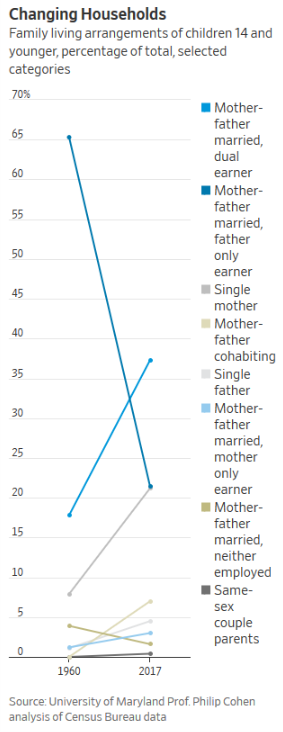
An article discussing changes in American household arrangements includes this graph:

HouseholdArrangements1960to2017

A summary of the data:

It all represents an increasing distance from the nuclear-family structure considered traditional for decades. The changes solidify shifts that have been mounting since then, erasing the notion of one dominant family type. In the early 1960s, two-thirds of children were raised in male-breadwinner, married-couple families. By contrast, today there is no one family-and-work arrangement that encompasses the majority of children, demographers say.

“That dominant model declined, but it’s not like it was replaced by one thing,” says Philip Cohen, professor of sociology at the University of Maryland. “It was replaced by a peacock’s tail, a plethora of different arrangements.”

The graph is most effective at showing the biggest change: the decline of the “mother-father married, father only earner” group over nearly six decades. Two other categories have significant increases – married and dual earners, single mother – while the five categories at the bottom involve relatively fewer households.

The graph is unusually skinny from left to right and this helps emphasize the straight lines up or down over time. Would a wider x-axis show some more variation over time or are the trends always pretty consistent?

The colors are a little hard to distinguish. I am not usually in favor of dotted lines and so on but this might be an opportunity to differentiate between trend lines.

Just thinking about other graph options, a pie chart for each time period might also communicate the big change well (though the smaller categories might not show up as well) or a clustered bar graph with the two years side to side could show the relative changes for each group.

In sum, graphing significant social change is not necessarily easy and this format clearly communicates a big change.


A declining American belief in God, country, and family

Pollsters and sociologists find a shift away from three American values:

The nuclear family, religious fealty, and national pride—family, God, and country—are a holy trinity of American traditionalism. The fact that allegiance to all three is in precipitous decline tells us something important about the evolution of the American identity…

But it looks like something bigger is going on. Millennials and Gen Z are not only unlikely to call themselves Protestants and patriots, but also less likely to call themselves Democrats or Republicans. They seem most comfortable with unaffiliation, even anti-affiliation. They are less likely than preceding generations to identify as “environmentalists,” less likely to be loyal to specific brands, and less likely to trust authorities, or companies, or institutions. Less than one-third of them say they have “a lot of confidence” in unions, or Silicon Valley, or the federal government, or the news, or the justice system. And don’t even get them started on the banks...

The older working-class men in the Edin, Nelson, et al paper desperately want meaning in their lives, but they lack the social structures that have historically been the surest vehicles for meaning-making. They want to be fathers without nuclear families. They want spirituality without organized religion. They want psychic empowerment from work in an economy that has reduced their economic power. They want freedom from pain and misery at a time when the pharmaceutical solutions to those maladies are addictive and deadly. They want the same pride and esteem and belonging that people have always wanted.

The ends of Millennials and Gen-Z are similarly traditional. The NBC/WSJ poll found that, for all their institutional skepticism, this group was more likely than Gen-Xers to value “community involvement” and more likely than all older groups to prize “tolerance for others.” This is not the picture of a generation that has fallen into hopelessness, but rather a group that is focused on building solidarity with other victims of economic and social injustice. Younger generations have been the force behind equality movements like #BlackLivesMatter, #MeToo, #AbolishICE, and Medicare for All, not only because they’re liberal, and not only because they have the technological savvy to organize across the Internet, but also because their experience in this economy makes them exquisitely sensitive to institutional abuses of power, and doubly eager to correct it. What Americans young and old are abandoning is not so much the promise of family, faith, and national pride, but the trust that America’s existing institutions can be relied on to provide for them.

My first thought: I wonder if these three values have been consistent throughout American history or are more particular to the postwar era. It was in the prosperity of roughly 15-20 years after World War II that Americans became the most religious, the nuclear family became the ideal, and America saw itself as opposed to communism and the Soviet Union. Additionally, a number of societal institutions were relatively strong and well-regarded. Prior to this era, would the same values have held and/or would others have been in the top three? For example, I could imagine making a case for individualism as a core American value from the beginning. This would, to some degree, be in opposition to all three of God, country, and family which require loyalty to larger groups or beings.

My second thought: what comes next in a trinity of American values? Would something like self, community, and success work?

Utilizing productivity software to schedule family life

Organize your family with Slack, Google Calendar, and Trello (among other options):

Asana said it doesn’t collect data on the various “personal-use cases” its software is put toward. But Joshua Zerkel, the company’s head of global community, says that in talking with people about how they use the product, he hears many say it comes in handy for nonbusiness purposes, such as planning a wedding or a move. When asked how Asana might be designed differently if it were intended for personal use, he said, “I don’t know that that much would actually change.”

“We think of Trello as a tool you can use across work and life,” says Stella Garber, the company’s head of marketing. “The example we had on our homepage for a long time was a kitchen remodel. On our mobile app the example was a Hawaiian vacation. We know humans have a lot of things they need organized, not just what they have at work.” (Slack declined to share any information about how people use its software, and Atlassian, which owns Jira, did not respond to a similar request.)…

Mazmanian says that these programs might be of particular value to households with two working parents, an arrangement that more children grow up with now, compared with a few decades ago. Without one adult in charge of the professional domain and one in charge of the domestic domain, there’s more coordination of who’s in charge of what—which is something productivity tools can assist with.

Perhaps the desire to streamline home life is also a product of how much employers ask of today’s knowledge workers. “I see the use of business software within households as an effort to cope with feeling too stretched at work,” says Erin Kelly, a professor at MIT’s Sloan School of Management and a co-author of the forthcoming book Overload: How Good Jobs Went Bad and What We Can Do About It. She says that the “escalating demands” of many white-collar jobs leave workers (parents or not) increasingly frazzled and worn out—so the same tools that systematize their workdays might appeal as a way to cut down on the time they spend organizing life at home.

There are lots of potential trends converging here including changing labor conditions, changing family life, the rise of productivity software, and the ubiquity of smartphones.

On one hand, this does not seem like a problem at all. Humans have a tendency to use all sorts of mediums in distributed cognition where we can offload our individual responsibility to a helping device or person. Think of making a shopping list: instead of having to spend the energy memorizing a list in our own mind, we write down the items on a piece of paper that we can then trust to have a record of what we were thinking. This new software takes advantage of new efficiencies and new devices to do something humans are used to doing.

On the other hand, the article suggests this software could harm authentic or idealized family life by turning it more into a business or organization rather than a loving group. What happens when partners or parents and children primarily communicate through this software? What if family life only becomes a set of tasks to accomplish (with helpful or annoying reminders along the way)? Where does the blending of work and home life end?

I am surprised by two omissions in this article:

-The amount of experience children in school have with such software that schools and teachers may use to help organize homework, projects, and online learning.

-The lack of specific software/apps aimed at families that could cater more to some of the concerns expressed or provide features kids and parents like.

Zoning, defining “family,” and exclusion

Zoning is a tool municipalities can use to control what kind of developments – and by extension, what kinds of people – can be in their community. A recent law review article looks at how zoning guidelines extend to defining families for the purposes of who can live in a residential unit:

Today, when courts ask “what makes a family?” they often look beyond blood, marriage, and adoption to see if people have made other meaningful, familial commitments that qualify for the obligations and benefits that family law provides. As functional family law developed, cohabitation became one of the most important factors, if not the determining factor, in these kinds of cases. The problem is that zoning laws often prevent these same functional families from living together in the first place. Through this underlying connection to zoning, functional developments in family law are much more vulnerable than they appear.

“Formal family” regulations in zoning are pervasive, and come with the imprimatur of the nation’s highest court. In the 1974 case Village of Belle Terre v. Boraas, the U.S. Supreme Court ruled that municipalities can legally differentiate between related and unrelated families. In the intervening years, courts in 14 states have ruled that “formal-family” zoning is permitted by state constitutions, and the issue remains undecided in an additional 30 states. Only four state courts, in New Jersey, California, Michigan, and New York, have refused to sanction this form of discrimination, and lawmakers in Iowa recently became the first legislators to ban it. The Supreme Court has only revisited the issue once, in 1978, to clarify that the zoning definition of family cannot prevent blood relatives from living together…

The good news is that formal family zoning is of surprisingly recent vintage. There is a long history of functional family approaches to zoning in American jurisprudence, dating back to the early 20th century advent of zoning law. The first zoning ordinances didn’t define “family,” at all, and throughout the first 50 years of their operation, courts often ruled that functional families of all kinds—from gay couples and religious adherents to cult followers and sororities—could live together in peace. Even as “blood, marriage, or adoption” ordinances became more common, courts continued to rule that functional families fell within their wide interpretive ambit….

Formal family zoning is a familiar song—the same legal mechanisms that famously reinforced housing discrimination on the basis of race, also discriminate against families that vary from the nuclear ideal of a heterosexual couple raising their biological children. There is also compelling evidence that low-density zoning, like formal family ordinances, is a significant driver of racial and class segregation. In short, formal family zoning discriminates against non-normative families, but it also reinforces the racial and economic segregation effects of low-density zoning in general.

When they want to be, communities can be creative in developing zoning and other mechanisms that bring in the kind of residents and businesses that they feel fits their community (often along the lines of race and class).

I wonder how these family guidelines are related to zoning restrictions on overcrowding and the number of people allowed in dwellings. Court cases have dealt with this and it seems like the conditions could be similar at times to guidelines against functional families.

If functional families are not as desirable for some communities, perhaps another trend in households is more to their liking: the rise in single-person households. On one hand, suburban housing can be too big and not provide certain amenities like walkable places and public transportation. On the other hand, people in single-person households may use fewer public services and may be willing to purchase smaller, newer units (many suburbs want to build and sell condos and townhomes near downtowns or community focal points). Or, does zoning truly privilege the formal nuclear family in ways that do not extend to any other kinds of household configurations?

Of course Tidying Up with Marie Kondo starts in Lakewood, CA

In watching one of the popular new TV shows, Tidying Up with Marie Kondo, I was not surprised to see the first episode take place in Lakewood, California. Here are several reasons this makes sense:

  1. Lakewood is a paradigmatic suburb. It does not quite receive the amount of attention as Levittown but it is known as an important post-World War II suburb of Los Angeles. Read more about the suburb’s unique history on the city’s website.
  2. The home depicted is relatively small compared to many of the suburban homes constructed today. This is part of the tidying issues the family faces: the American pattern is to accumulate more stuff over a lifetime (partly to express a certain status) and one solution for adjusting to this stuff is simply to purchase a larger home.
  3. The family is depicted as living an ideal family lifestyle: they have been married five years (if I remember correctly), have two small kids, and live in a suburban single-family home. This family/single-family home connection is strong in the suburban psyche.
  4. The emphasis of the episode is on the private life of the family inside the home. Even with the show focused on the belongings inside the home, there is very little connection to the outside world, whether neighbors, or the larger suburb, metropolitan region, or nation. All these privately-held goods and familial relationships look like they are in a small bubble that the participants prefer to stay in.

Given the suburban emphases on single-family homes and consumption, perhaps it makes all the sense in the world to start such a show in a well-known suburb.