Schwinn once an important Chicago company but the industry and the world changed

A look at a new documentary on the bicycle company Schwinn tells of how it was once a Chicago company and then it was not:

Photo by Jess Loiterton on Pexels.com

The story starts in 1895, when German immigrants Ignaz Schwinn and Adolph Arnold founded Arnold, Schwinn & Co. in Chicago. Schwinn would subsequently buy out his partner and build an enduring family business that would reign over the bicycle industry for generations, surviving the rise of the automobile, the Depression and two world wars.

In fact, the original six-story Schwinn factory at Lake and Peoria streets in Fulton Market still stands as a monument to Chicago’s erstwhile bike company, with plans to redevelop the now-vacant building into office space…

As market share dwindled, Schwinn began outsourcing production. By 1983, Schwinn ceased its Chicago manufacturing, laying off 1,800 employees and moving most of its production overseas to Taiwan.

In 1992, struggling with debt, the storied Chicago company filed for Chapter 11 bankruptcy under fourth-generation owner Ed Schwinn…

The bike company has rolled on under a succession of new owners and is now part of Dutch conglomerate Pon, with Schwinn based in Madison, Wisconsin. But the movie focuses on the Chicago glory years, when the Schwinn brand ruled the sidewalks, schoolyards and bike lanes.

This might be the story of a number of companies over the years. They had success with lots of work and new ideas. They rose to become a known and popular brand. But then industries and places changed. People no longer wanted the product in the same way. They moved manufacturing overseas. They hit hard financial times and even though the brand name lives on, it has done so under the ownership of different companies and the company is now based in another city.

And this could also be the story of places. Chicago, like a number of American cities, particularly in the Northeast and Midwest, were centers for manufacturing. American companies produced a lot for decades. And much of that went elsewhere by the end of the twentieth century. Sociologist William Julius Wilson describes these shifts and their effects on neighborhoods in When Work Disappears. The loss of tens of thousands of manufacturing jobs was a hard blow to many cities who struggled to pursue or grow other businesses or industries in subsequent years.

In the big picture, both companies and places go through cycles and lifespans. They do not necessarily continue as they have been, even when they are successful. We tend to like the stories of their rise and it can be harder to wrestle with their falls. But both are part of the human experience.

The normal suburban buildings where the National of Association of Evangelicals operated from for decades

In Sanctifying Suburbia, I look more closely at the locations of the National Association of Evangelicals in Chapter 4. As a group that purported to represent the interests of a growing evangelical movement from the 1940s onward, where did they locate their headquarters?

For decades, their headquarters were in two adjacent suburban communities roughly 25 miles from Chicago: Wheaton and Carol Stream. These two suburbs contain a cluster of evangelical organizations (discussed further in Chapter 5 and 6 of the book). In the late 1950s and early 1960s, the NAE had multiple locations in downtown Wheaton. According to the local phone books, their location in 1957 was 108 N Main. Here is a Google Streetview image of that address from June 2019:

This is the same block that was briefly shown in a Walmart Super Bowl ad a few years ago. When I walked past the location earlier this week, the building is undergoing a massive renovation.

In the 1960s, the NAE moved a few miles north to Carol Stream. They concluded their time in the suburb in an office building within an office and light industrial area. Here is what the property looked like a few years ago (a Google Streetview image from October 2016):

The organization was there until 1999 when they had a short sojourn to suburban southern California before moving the headquarters to Washington, D.C. in 2002.

These headquarters fit in a suburban landscape, the first in a two story brick building in an older suburban downtown with the second looking like many other small office buildings dotting suburbia, with little more than a sign marking them as spaces occupied by a religious organization. And from these suburban locations, the National Association of Evangelicals supported a growing evangelical movement across the United States.

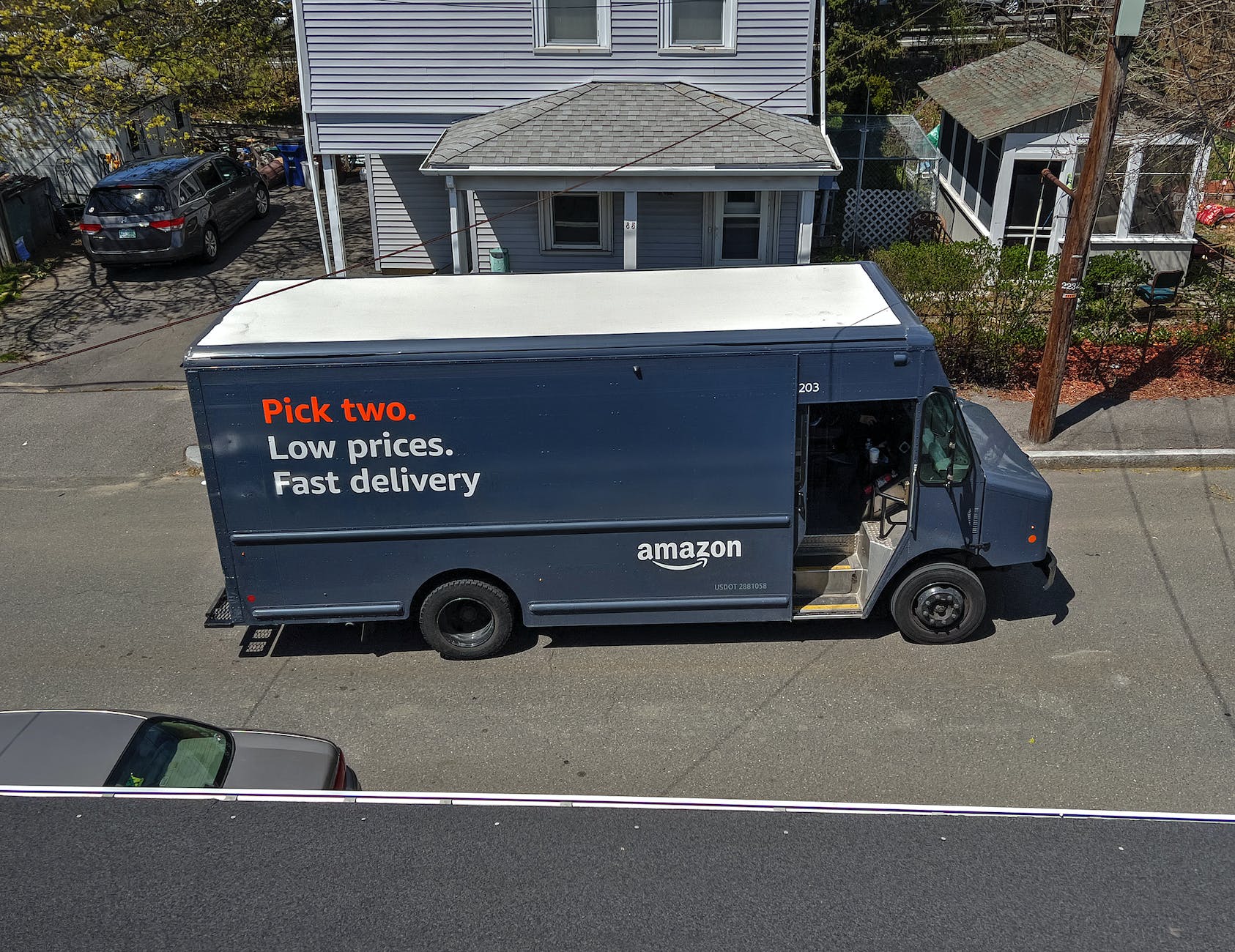
Call them “logistics centers” rather than warehouses and I do not think suburbanites will like trading suburban HQs for them

With reduced demand for large suburban office buildings and headquarters, properties around the Chicago region are turning into logistic centers:

Photo by Pixabay on Pexels.com

Catalyzed by the pandemic, the demise of corporate campuses has created a development explosion, as dormant office space is transformed into industrial use for the digital age. Data centers provide the infrastructure for online commerce, while logistics centers deliver the goods to your doorstep.

The warehouse facilities also deliver tax revenue for municipalities, construction jobs and depending on the use, some permanent jobs as well. But the economy-boosting days of 5,000 employees descending on a community may be a thing of the past…

Chicago has the most transportation, distribution and logistics firms in the U.S., and Illinois ranks No. 4 among states with 20,500 companies employing more than 331,000 people, generating nearly $39 billion in annual economic output, according to Intersect Illinois.

In October, with many of its 5,400 Chicago-area employees working remotely, Allstate sold its north suburban corporate campus along the Tri-State Tollway for $232 million to Dermody Properties. The Nevada-based developer is turning the 232-acre property, which was annexed by Glenview, into a 10-building, 3.2 million-square-foot logistics park…

The project, which is expected to cost more than $500 million including land acquisition, will be one of the largest urban logistics developments in the U.S., bringing a projected 1,900 jobs, a new streetscape and vastly different traffic patterns than the former insurance headquarters.

It is best to state this at the outset: empty properties are not desirable in suburbs. Even if something is paying the property taxes, empty properties decrease the status of a community and do not bring in additional benefits like jobs and tax revenues.

That said, many communities and suburbanites would see the trade from a prestigious headquarters or office park to warehouses as a big downgrade. They will not be fooled by calling them “logistics centers.” Gone are white-collar jobs and a Fortune 500 company. In are trucks, traffic, and blue-collar jobs. Gone are steel and glass buildings that signify progress and higher status. In are preformed panels and boxy structures. Residents like having goods delivered to them quickly but they do not necessarily want to see the fulfillment and delivery process happen next door.

The truth is that not every community will attract developers who want to build a large mixed-use development. Or, waiting for a developer who has an attractive idea and does not want too much public money might take a long time. Some communities will move faster than others to turn vacant structures into working properties. Others will resist and be able to turn down these options.

But, the spread of warehouses in suburban areas to even middle- and upper-class suburbs means changes for these communities. Once marked by pristine offices serving as status symbols, some of these communities will now be home to logistics centers sending out goods far and wide.

Remembering the frenzy and promise regarding Amazon HQ2

Amazon announced part of their HQ2 is coming along on schedule but the full project will soon go on pause:

Photo by James Anthony on Pexels.com

John Schoettler, Amazon’s real estate head, said in a statement the company is pushing out the groundbreaking of PenPlace, the second phase of the sprawling northern Virginia campus. The first phase of the campus, known as Metropolitan Park, is expected to open on time this June and will be occupied by 8,000 employees.

The move comes as Amazon CEO Andy Jassy has taken steps to curtail expenses across the company in the face of slowing revenue and a gloomy economic outlook. That’s led to the company announcing the largest layoffs in its history, totaling more than 18,000 employees, while also reevaluating its real estate portfolio and sunsetting some projects…

PenPlace encompasses three 22-story office buildings, more than 100,000 square feet of retail space and a 350-foot-tall tower, called “The Helix.” The development is larger than Metropolitan Park, which sits south of PenPlace, and includes two additional, 22-story office towers, as well as a mixed-use site featuring retail, restaurants and green spaces.

Amazon selected Arlington as the site of HQ2, in addition to the Long Island City neighborhood of Queens, New York, as part of a closely watched, splashy search for a second headquarters that kicked off in 2017. The company announced in 2019 it would halt plans to build its new headquarters in New York after it faced pushback from local activists and city council leaders.

Numerous communities across the United States submitted proposals to host this second headquarters and the company sought tax breaks. The promise of the new headquarters involved at least these two big features: the status of Amazon in your community plus the thousands of jobs in a corporate headquarters.

With the changes in the world, will these promises pan out for Arlington, Virginia and the D.C. metro area? It sounds like at least 8,000 employees will be onsite. However, the headquarters may never be as big as once envisioned. Does Amazon have the same status in 2023 that it did in 2017? This include everything from its financial outlook to its recent layoffs to changes in the everyday Amazon experience for customers.

On the whole, I would guess local leaders will still pitch this as a big win. We got Amazon and all these jobs (and implying that others did not). The long-term effects might be less clear, particularly if tax breaks for Amazon and opportunity costs and the longer-term fortunes of the company are factored in.

In the consternation over Caterpillar moving from Illinois to Texas, a reminder that the company moved from Peoria to a Chicago suburb in 2017

Caterpillar Inc. recently announced plans to move from Deerfield, Illinois to Texas. This prompted concerns about another big company (following the announced exit of Boeing’s headquarters) leaving the Chicago area and Illinois.

Photo by The Vien on Pexels.com

While this fits one narrative of Chicago, the region, and Illinois losing residents and companies to places with growing populations and more conservative business climates, this is not the only move Caterpillar has made in recent years. The company started in 1910 in Peoria and stayed there for a long time before relocating to Deerfield in 2017. Here is how the Chicago Tribune described that move:

Caterpillar will take over the former headquarters of premium spirits maker Beam Suntory, which announced plans last year to move its 450 employees and global headquarters to Chicago’s Merchandise Mart, joining corporations including McDonald’s, Motorola Solutions, Kraft Heinz, Wilson Sporting Goods and Conagra Brands that have recently moved or made plans to relocate downtown. Beam Suntory’s move will be completed by the end of June.”

“Following a thorough site selection process, we chose this location because it is approximately a 20-minute drive to O’Hare airport and convenient to the city of Chicago via commuter train, achieving our goal to be more accessible to our global customers, dealers and employees,” Caterpillar CEO Jim Umpleby said in a news release Wednesday. “This site gives our employees many options to live in either an urban or suburban environment. We know we have to compete for the best talent to grow our company, and this location will appeal to our diverse, global team, today and in the future.”…

In 2011, Caterpillar’s then-CEO Doug Oberhelman talked of moving jobs out of Illinois because of the state’s tax and spending policies. But in 2015, the company said it would stay in Peoria and build a new corporate headquarters, reassuring employees worried about a move. That changed again in January, when the company said it was abandoning plans for the new downstate headquarters.

So is this a story about Chicagoland and Illinois losing important companies or a broader example of companies responding to global markets and leaving behind long roots? Caterpillar is a company started and based in a smaller Rust Belt city for decades and now will move to two of the biggest metropolitan areas in less than a decade. How long will it be in Irving, Texas before again seeking greener pastures and business advantages?

Sears in decline leads to another large available suburban office campus

Sears recently closed its last department store in Illinois and just announced that their large suburban campus will soon be up for sale:

Photo by Hugo Magalhaes on Pexels.com

The Hoffman Estates campus features a 2.3 million-square-foot corporate office and 273 acres, including 100 acres of undeveloped land. It was home to more than 4,000 Sears employees as recently as 2017, according to company filings…

When Sears Tower opened in 1973, it was the world’s tallest building, a fitting corporate home for the nation’s largest retailer. Sears left its namesake home in 1992, moving its corporate headquarters to Hoffman Estates and selling the tower two years later. In 2009, the name of the building was changed to Willis Tower as part of the deal for the London-based insurance firm to lease office space there.

Sears is not the only corporate mainstay to pull up stakes recently and put its suburban campus on the market.

Last month, insurance giant Allstate reached an agreement to sell its longtime headquarters in unincorporated Northbrook for $232 million to an industrial developer that plans to turn the 232-acre corporate campus into a massive logistics facility.

And what will happen to these properties? There are multiple options including:

  1. Staying as office or corporate space. Could there be another company or organization who would want this property? A suburb can spend a long time looking for a comparable replacement.
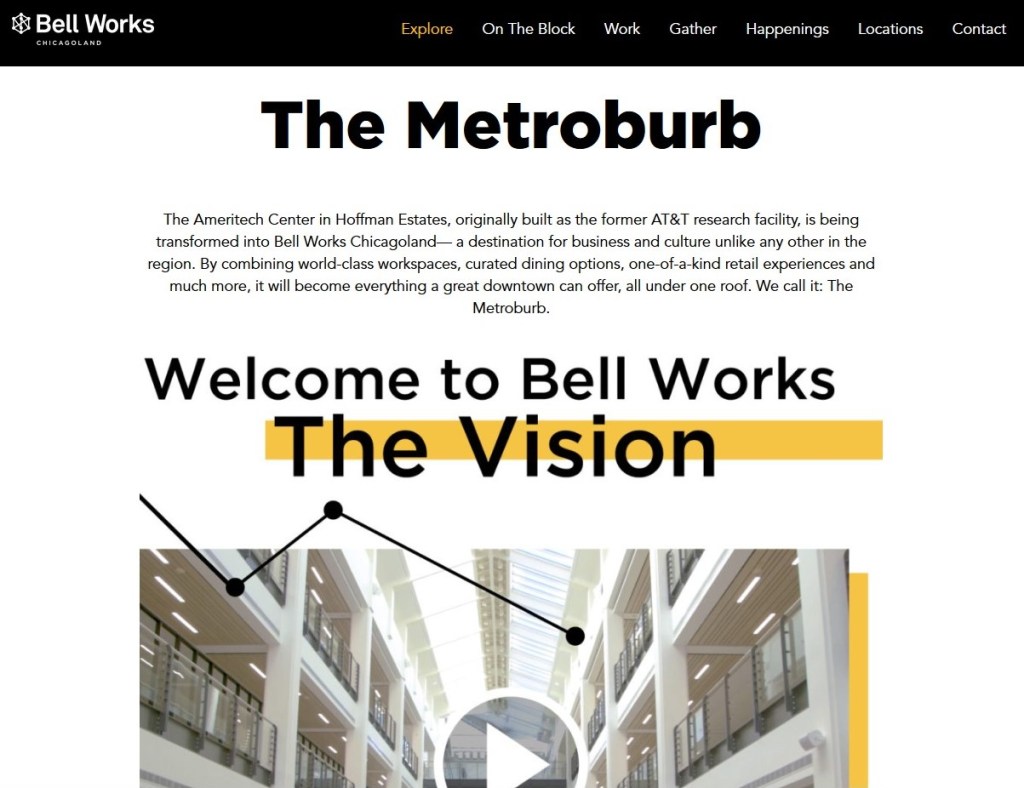
  2. Redevelop the land as a mixed-use development. See “The Metroburb” not too far way created from a former Bell Labs facility. This is a trendy approach that mixes commercial or office uses with residences.
  3. Convert the property to housing. There is demand for new housing in attractive suburbs and large tracts of land do not come open often.

Making this choice will require negotiation and conversation between the parent company of Sears, potential buyers, municipal leaders, residents, and others (which could include regional officials and actors in the real estate world). The whole process could take years and the outcome might retain some hint of the Sears headquarters or it might not.

“Welcome to the Metroburb” in the NW Chicago suburbs

This week I heard a radio ad saying “Welcome to the Metroburb.” Here is more on this new development outside of Chicago:

Chicago area suburbs advertising their communities is not unusual; see examples here and here. Far less common are new suburban developments making broad appeals in mass media. This project has been in the works for a while now – see an earlier post – and it is on an intriguing site as Bell Labs was important for the Chicago region (read more about the effects on local development of their Naperville facility) and the country as a whole.

If you ran a business or were searching for a residence or wanted to be part of an interesting scene, would this ad or website persuade you? This is a unique development and a large one. Suburbs around the United States are looking to fill empty suburban headquarters, denser suburban areas are popular, and standing out in a crowded suburban landscape can be difficult.

Interestingly, there is also a partner project involving the former Bell Labs facility in Holmdel, New Jersey.

Agglomeration, working from home, and the character of places

Why do certain industries cluster together in one location? Social scientists have answers:

Photo by Chris F on Pexels.com

Economists believe agglomeration — like the clustering of tech in the Bay Area — has historically been the result of two main forces. The first is what they call “human capital spillovers” — a fancy way of saying that people get smarter and more creative when they’re around other smart and creative people. Think informal conversations, or “serendipitous interactions,” over coffee in the break room or beers at the bar. These interactions, the theory says, are crucial to generating great ideas, and they encourage the incubation and development of brainiac clusters. The other force is the power of “matching” opportunities. When lots of tech firms, workers and investors clustered in Silicon Valley, there were lots more opportunities for productive marriages between them. As a result, companies that wanted to recruit, grow or get acquired often gravitated to places like the Bay Area.

However, remote work could actually improve certain matching possibilities. Companies can hire smart people anywhere in the world when they drop the requirement that they physically be in a central office. Not only that, they can pay them less. Moreover, killing the office can significantly lower costs for companies, which no longer have to pay for expensive real estate.

So, in this theory, the future of work and the economic geography of America really hinges on whether companies can create those “human capital spillovers” through computer screens or in offices in cheaper locations.

This is a phenomenon with a pretty broad reach as cities could be viewed as clusters of firms and organizations. What has been interesting to me in this field in recent years is how places like this come to develop and what it means for the character of the place.

Take Silicon Valley as an example. This is the home of the tech industry and, as the article notes, the big firms have committed to physically being there with large headquarters (including Google, Apple, and Facebook). These headquarters and office parks are themselves interesting and often a post-World War Two phenomena as highways and suburbanization brought many companies out of downtowns to more sprawling campuses. At the same time, the impact of all of this on the communities nearby is also important. What happens when the interests of the big tech company and the community collide (see a recent example of a Facebook mixed-use proposal)? What did these communities used to be like and what are they?

This is bigger than just the idea of employees working from home. This potential shift away from clustering would affect places themselves and how they are experienced. If thousands of workers are no longer in Silicon Valley, what does this do to those communities and the communities in which more workers are now at home? Silicon Valley became something unique with this tech activity but it could be a very different kind of place in several decades if there is new activity and new residents.

The same could be said for many other communities. What is New York City if Wall Street and the finance industry clusters elsewhere or disperses across the globe? What happens to Los Angeles if Hollywood disperses? And so on. The character of places depends in part on these clusters, their size, and their history. If the agglomerations shift, so will the character of communities.

Companies moving out of California – yet continuing offices and operations in California

I have read several news stories discussing the move of companies out of California. Such news feeds chatter about companies and residents leaving places because of politics, taxes, discontent, etc. But, the details in this one story suggest some companies are shifting some workers and activity while retaining operations in California.

Photo by KEHN HERMANO on Pexels.com

“Oracle is implementing a more flexible employee work location policy and has changed its corporate headquarters from Redwood City, California to Austin, Texas,” the filing said. “We believe these moves best position Oracle for growth and provide our personnel with more flexibility about where and how they work.”

The company already has a significant presence in Austin, opening a five-story, 560,000 square-feet campus overlooking Lady Bird Lake. It also has employment hubs in Redwood City, Santa Monica, Seattle, Denver, Orlando and Burlington…

Oracle follows a handful of similar moves by California companies and high-profile business leaders leaving the state. Tesla CEO Elon Musk announced he had moved to Austin last week at The Wall Street Journal’s CEO Council summit. His exodus followed months of bashing California for its handling of the pandemic. The billionaire CEO said he is maintaining company operations in California, but also has significant operations for Tesla and SpaceX in Texas…

HP Enterprise also announced its decision to relocate its headquarters from San Jose to the Houston suburb of Spring earlier this month. Palantir Technologies relocated from Palo Alto as well this year, landing in Denver. Tech giants Google and Apple have also been expanding their presence in Austin over the last several years.

Headquarters are important, particularly for cities. Attracting the headquarters of a major company is a big status symbol for any big city. See the interest in trying to attract Amazon’s second headquarters. The implication is that the new location has a favorable business climate and is on the rise (with the opposite assumed of the previous location).

But, headquarters are just part of a company. They may be the nerve center and the physical home of company executives. Yet, large companies today can have offices and plants all over the place connected to a headquarters elsewhere.

Another way to read the moves out of California above is to suggest that these companies are hedging their bets by being located in numerous advantageous locales. Having multiple locations can help take advantage of local tax breaks for particular purposes, build on local work forces, maintain their place in local social networks, and provide points to pivot around when conditions change. The headquarters may have moved but they may move again and the companies still see some value in keeping operations going in California (even if some of this is simply due to inertia).

This suggests a different future reality than one where cities serve as anchors for major corporations. Instead, major multinational corporations keep offices and facilities all over the place, ready to move when needed or when an opportunity arises. Austin and Houston might be attractive now, Miami or Denver in a few years (just sticking to US locations). And as cities continue to look for an edge over their competition, attracting another big company is important…even as that company is actually rooted in multiple locations.

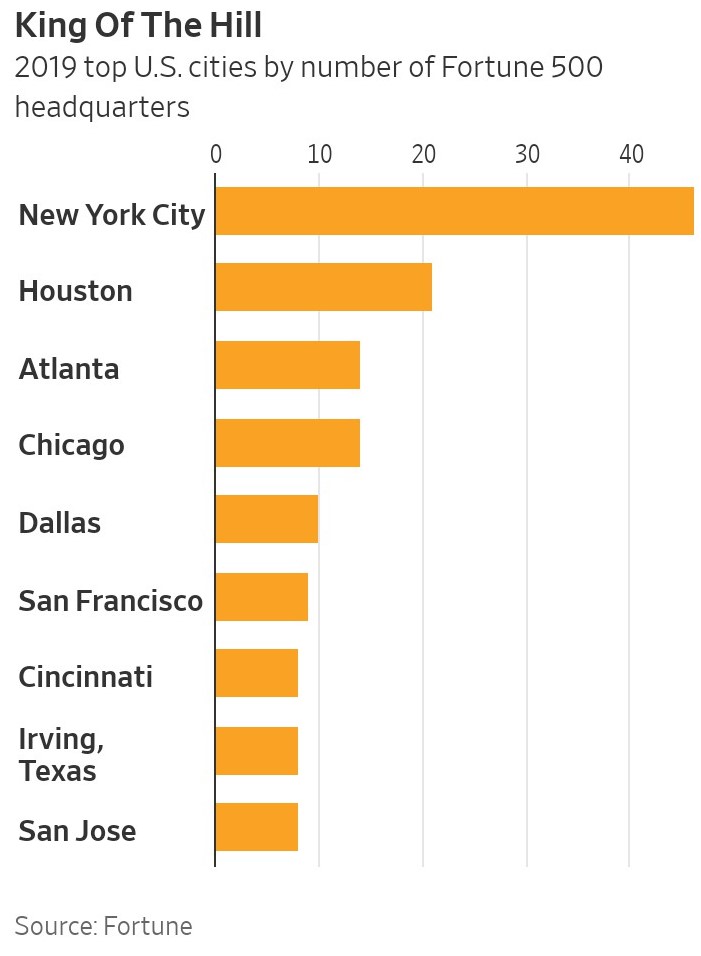
The top US cities for Fortune 500 company headquarters, COVID-19 edition

In an article about working remotely, the Wall Street Journal included this graphic about the locations of the headquarters of Fortune 500 companies:

Fortune500HQLocations

This is an interesting topic to raise as more workers are laboring away from the office. What will happen to headquarters?

One option would be that headquarters remain even as organizational workforces scatter. There will always be a need to at least occasionally hold meetings or access resources or project a presence in a major city. Cities would like this as headquarters are a status symbol.

Another option is that headquarters move to locations more central to their workers or more attractive for workers. This is more unlikely but the same factors pushing workers away from major cities – high housing costs, traffic and congestion, density with threats of pandemics – could affect headquarters as well. It could be a big strategic move to follow workers to a city not on the list above.

The effects of either could be big for cities. Consider New York. It is the clear leader in terms of headquarters, it is a leading global city, and it is not just a center for business but also for news, entertainment, the arts, and other spheres. Even if the headquarters stay, the loss of high-status employees hurts. If the headquarters leave or become shells of themselves, there could be a loss of status.