Given the high cost of purchasing a home at the current moment in the United States, what can the President and the Executive Branch do on their own? In addition to supporting legislation for a new tax credit, the Biden White House has ideas about its own actions:
Brainard suggested that President Joe Biden will not wait for Congress. The administration, for example, said that it was advocating for zoning reforms that will help unlock the construction of affordable homes.
“Our Department of Transportation is making billions of dollars in low-cost loans available for developing housing near transportation,” Brainard said.
The administration has also been trying to help first-time buyers who have struggled to gain a foothold into homeownership. Home prices were nearly 6 times the median potential first-time homebuyer income in the third quarter, according to NerdWallet’s recent analysis.
The White House pointed out that it was trying to reduce costs for first-time buyers through the the Federal Housing Administration program. The effort, it said, helped reduce mortgage insurance premiums by 0.3 percent.
Many presidents from the early 20th century onward have promoted homeownership in rhetoric and policy. These proposed actions would continue this pattern. Could a president even if elected if they did not support homeownership for the masses? See great quotes in homeownership.
Of course, the President and the Executive Branch can only do so much in this area. Yet, a number of important changes to housing policy have come through this branch. Will Biden make a significant change or is this about temporary salves? All of these proposals do not alter the fundamental economic realities that make current homes so expensive. They offer incentives or help around the edges. Addressing zoning from a federal level could prove interesting as it is such a local matter.
The findings from one of the largest surveys done on these issues shows significant but varying support for 10 policy initiatives to encourage more housing. At the high end, nearly 9 in 10 (86%) say they would back efforts to expedite permitting processes, while at the lower end, about half (49%) support the concept of allowing smaller lots, and homes to be built closer together…
Support for most of the housing policies transcended the usual fault lines of political party, region, race, income, and gender. The eight most popular proposals received clear majority support from Republicans, Democrats, and independents. In addition, 9 of the 10 tested measures received majority support from both renters and homeowners. All of these policies have either already been shown to work in improving housing affordability in American cities and towns or have recently been enacted by state or city policymakers hoping to do so.
Some approaches that stood out as especially popular—earning support from more than 70% of respondents—are similar to state laws that have passed in recent years (although the survey questions themselves were not modeled on any particular laws). For example, in 2023, California, Montana, Texas, and Washington took steps to simplify permitting for new housing. In recent years, California, Massachusetts, Montana, and Utah have passed laws to enable more housing near commerce or transit. And Maine, Montana, Oregon, Utah, and Vermont, among others, have enacted legislation to allow houses to have an accessory apartment or dwelling unit, as have many cities…
Respondents also broadly supported the reasons behind efforts to create more housing, with 65% to 82% seeing each reason as excellent or good. (See Figures 3 and 4.) However, in some cases, Republicans and Democrats prioritized different reasons. For example, somewhat more Republicans (68%) than Democrats (62%) identified freedom for property owners as an excellent or good reason, while more Democrats (81%) than Republicans (49%) chose reducing racial segregation as an excellent or good reason. But large majorities of Democrats, Republicans, and independents see improving housing affordability and allowing more people to live near their preferred jobs and schools as excellent or good reasons to change housing rules to allow more homes to be built in cities and suburbs. Successful state-level efforts to allow more housing have consistently received bipartisan support, and the survey results indicate that people with different political views can come together to support policies to end the housing shortage and affordability crisis for different reasons.
Americans like the idea of owning housing. Add this to the current state of housing where both owning and renting is expensive and Americans broadly like more housing.
Thus, the expression of this majority for housing is difficult to put into practice. Even state laws are often fraught as it can run against local desires. Take the efforts in Illinois to promote affordable housing at the state level: the initial legislation had limited enforcement and more would need to be done for state-level policy to provide more housing.
As noted above, one of the routes forward that could gather more local support involves policies that provide more opportunities for current property owners. Adding ADUs, for example, provides a choice for current property owners to generate more income or provide housing for family. Other policies might be viewed as funneling money to outside developers or providing housing for people who would not be as welcome in the community. If policies can add housing units and enrich/protect homeowners, they might find more support.
New York City just unveiled its newest effort, which will hand 15 homeowners up to $395,000 to build an additional apartment. This could mean an extra unit in a garage, basement, or attic, or a tiny home in the backyard. The idea is to boost housing density in a city in desperate need of new housing.
New Yorkers can apply online for the funding, but high-income residents aren’t eligible — the income limit for a family of four is $232,980, the New York Times reported. And the ADUs that are built will have a limit on rent: a one-bedroom can’t be rented for more than $2,600.
The city’s department of housing preservation and development on Tuesday unveiled the “Plus One ADU” pilot program, similar to a state-wide initiative with the same name that has doled out tens of millions of dollars to help homeowners across New York State build ADUs in their backyards…
The effort is part of the city’s sweeping new housing reform proposal, which seeks to pave the way for 100,000 new homes in the city by encouraging conversions of commercial buildings into residential, boosting density near mass transit, and reducing space devoted to parking. The proposal also aims to legalize ADU construction across much more of the city.
Adding 100,000 units would be helpful as the city, like many major cities, needs lots and lots of units to provide more housing options and address housing costs. But, how quickly can these units be added and how much can they ease the housing issues? It would be worth looking at the math on this; at what point do the government funds lead to long-term savings? Hopefully, this is part of a comprehensive strategy that tries to add housing units in multiple ways.
Not all New York City is as dense as Manhattan but it is a pretty dense American city. How dense are city residents willing to go? Like many cities, there are different clusters of housing units in different neighborhoods. Adding a housing in basements or backyards can only happen in certain places and these changes would add residents. ADUs might be less visible than other means of providing more housing units – for example, high-rises would not be welcome in many residential neighborhoods – but Is there a point where residents feel there are enough ADUs?
Low interest rates, high salaries and membership discounts scored before and during the pandemic often can’t be matched today, binding people in golden handcuffs. Many feel comfortable, but stuck…
In matters big and small, people feel they cannot improve on their current situations. They’re mentally or emotionally ready for a change but can’t bring themselves to walk away.
This is how it can affect housing:
Their findings suggest that people with 3% mortgages today could be about 30% to 40% less likely to move than they otherwise would be, says Lu Liu, an author of the paper and a finance professor at Penn’s Wharton School.
When homeowners don’t move, that limits the number of houses that are bought and sold. And Liu found that those who locked in low mortgage rates are less likely to move in response to wage growth in nearby areas, potentially making the labor market less dynamic.
This all seems related to a basic assumption in the American Dream: life will continue to get better and better. The next generation will have it better than the current one or previous ones. Progress will continue to improve lives and outcomes.
But, what if this does not happen? Does improvement always occur over time?
The American Dream does not allow much space for stagnation or decline. There can be blips, temporary setbacks like a Great Depression or a housing crisis in the late 2000s. Otherwise, housing values should keep going up. The stock market should keep going up. Job opportunities should continue to be there. Standards of living should improve as should technology.
Whether the American Dream has peaked or whether room for improvement is limited because so much improved over the last century or so is interesting to consider. To some degree, we may not know for sure until we can look back and see the broad patterns. But, there are likely plenty of people willing to dig into the data and/or make these arguments.
The theory that the aging population would require fewer homes isn’t quite accurate. It turns out older consumers tend to prefer smaller dwellings but not fewer homes. The Barclays housing team makes the argument that currently more boomers are partly responsible for creating more households, putting pressure on housing demand…
“Hence, as an increasing share of the population shifts into older age groups, more and more households tend to be formed. That is, as a given household head ages, the size of the household (in terms of people) tends to become smaller and smaller, with children moving out and couples separating because of divorce or death,” the economist added…
“Retired people always are much more likely to be the head of a household than those in pre-retirement age. This is because a given person in this age group is much more likely to be a single head of a household, especially as they, inevitably, lose a life partner,” Millar told Yahoo Finance in an email. “The difference now is that this generation is a much larger group than the one that preceded it, which means that they demand much more housing.”
That leaves less existing inventory for the younger ones, especially millennials as they reach an age where they would form a new household and buy a house.
Do Americans have to take up more houses just because there are more people? This gets at American ideas about single-family homes and households. Is it most desirable to spread out and have numerous private dwellings? Is this also a reflection of sprawling development in the post-World War II era?
If future generations are smaller in size, they could theoretically occupy fewer houses just by having fewer people. But, they could also decide to live in different ways. Fewer detached housing units? Denser settings, even in the suburbs?
This story is not over as population changes and desires for housing are dynamic.
You can see it by looking at residential-vacancy rates, which have been as low as 2 percent in recent years. You can tell by looking at the size and price of rentals and homes for purchase: The average rent in Manhattan is more than $4,000, and the average home in Brooklyn costs roughly $1 million. You can see it in the shrinking of New York’s middle class and the stagnation of its population and the widening of its income and wealth inequality. Housing supply has simply not kept pace with housing demand, squeezing everyone except for the very rich.
The same forces shunting families to the suburbs are weighing on the migrants. The same forces driving New Yorkers out of unaffordable apartments and into homeless shelters are weighing on the migrants. Migrants cannot afford housing for the same reason that the city itself struggles to raise money for new facilities. New York really is full…
High housing costs have a way of making every problem a housing problem. A homeless person needing help with a substance-abuse disorder needs housing first. A migrant requiring legal aid more pressingly needs a roof over their head. And high housing costs, of course, force millions of vulnerable people into homelessness. “Our homeless-response system has turned into a crisis-response system,” Gregg Colburn, an associate real-estate professor at the University of Washington’s College of Built Environments, told me. “So many other systems have failed or delegated responsibility to it.”
The opposite is also true: Low housing costs make other problems simpler to solve. Cheap housing reduces the number of people who become homeless. It also allows the entities providing assistance to do more for less, because their overhead costs are lower. And it frees up lawyers to work on immigration cases, substance-use experts to work on substance-use issues, and mental-health counselors to work on mental-health issues.
It is enough to make one think that seriously and sufficiently addressing housing should be a major priority!
The problem is not just limited to New York City. Multiple big cities in the United States need more housing units and lower-priced yet good quality housing. Having a stable place to live at a reasonable price goes a long way to better life outcomes and opportunities.
But, adding a lot of good housing takes a lot of work and there does not seem to be political will to address it. Additionally, it can be easy to look for other solutions to some of the different problems listed above. Would building more good housing automatically solve these issues? No, but it could help a lot and make it more possible for people to live and enjoy major cities.
Perhaps the opponents are beginning to accept that their community is not, has never been, exclusively their own domain.
Who owns a neighborhood? In many American communities, the people who live there might feel this way. They expect to provide input and exercise some oversight of what happens in their neighborhood. They want to exercise control over their own properties and those around them.
But, they do not do this on their own. They interact with other property owners and also engage with local governments. These local governments typically represent a broader community and have regulations about what can and cannot be done in neighborhoods.
Or, here is another way to address the same questions: if every neighborhood will change over time, who gets to street this change and/or benefit from this change? Those with means and vested interests will have their own perspective and goals while a broader community might have another point of view.
This dynamic—front-yard proclamations contradicted by backyard policies—extends well beyond refugee policy, and helps explain American 21st-century dysfunction.
The front yard is the realm of language. It is the space for messaging and talking to be seen. Social media and the internet are a kind of global front lawn, where we get to know a thousand strangers by their signage, even when we don’t know a thing about their private lives and virtues. The backyard is the seat of private behavior. This is where the real action lives, where the values of the family—and by extension, the nation—make contact with the real world.
Let’s stick with housing for a moment to see the front yard/backyard divide play out. The 2020 Democratic Party platform called housing a “right and not a privilege” and a “basic need … at the center of the American Dream.” Right on. But the U.S. has a severe housing-affordability crisis that is worst in blue states, where lawmakers have erected obstacle courses of zoning rules and regulations to block construction. In an interview with Slate, Senator Brian Schatz of Hawaii, a Democrat, took aim at his own side, saying progressives are “living in the contradiction that they are nominally liberal [but they] do not want other people to live next to them” if their neighbors are low-income workers. The five states with the highest rates of homelessness are New York, Hawaii, California, Oregon, and Washington; all are run by Democrats. Something very strange is going on when the zip codes with the best housing signs have some of the worst housing outcomes.
Housing scarcity pinches other Democratic priorities. Some people convincingly argue that it constricts all of them. High housing costs pervert “just about every facet of American life,” as The Atlantic’s Annie Lowrey has written, including what we eat, how many friends we keep, how many children we bear. “In much of San Francisco, you can’t walk 20 feet without seeing a multicolored sign declaring that Black lives matter, kindness is everything and no human being is illegal,” the New York Times columnist Ezra Klein wrote. But in part because those signs sit in front yards “zoned for single families, in communities that organize against efforts to add the new homes,” the city has built just one home for every eight new jobs in the past decade.
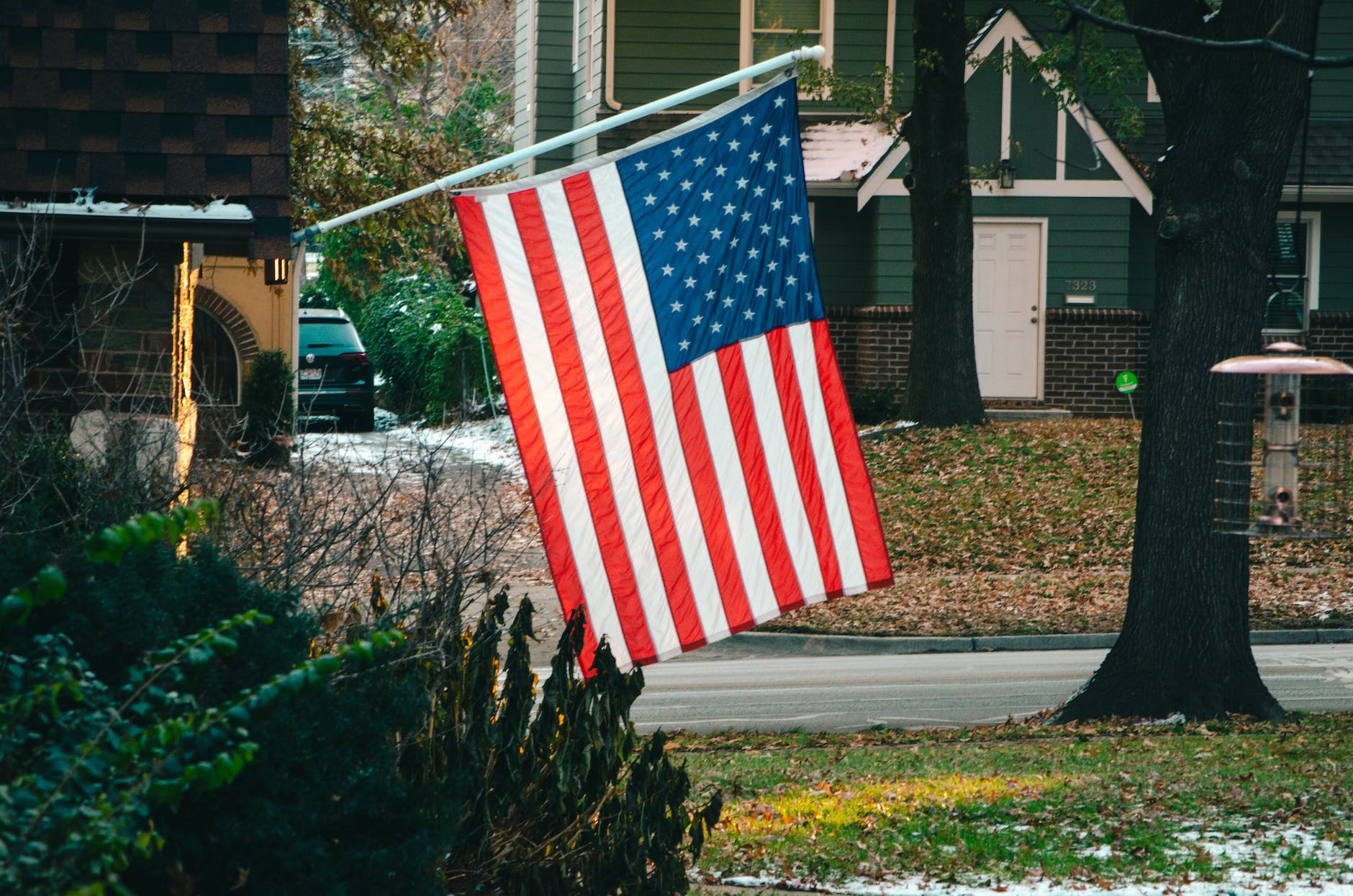
The image here is from a single-family home, a familiar symbol and sight in the United States. The front yard is visible to others. Homeowners put certain things in the front yard and do certain things in the front yards. Meanwhile, the back yard is a more private space, often out of sight from the front and even from others with fencing, plantings, and more blocking possibly blocking views.
Is the front yard just performative? For American homes, people put a lot of effort into a lawn, a facade, signs, and more to present a particular image to the world. It is not necessarily fake or inauthentic; it is just one angle available to the public. It can affect perceptions, interactions, conversations.
Perhaps this is similar to front-stage and back-stage from sociologist Erving Goffman? In public settings, we practice impression management and we play particular roles. We perform in ways that align with or resist social conventions. Back-stage allows for less of this.
In the area of housing, I have seen what is described above: when communities have opportunities to discuss and plan for affordable housing or denser housing or cheaper housing, they often throw up obstacles. They are not necessarily opposed to the need for such housing; they just do not want it near them. Housing as an issue ends up being a hyper-local concern as community by community debates development.
Perhaps it is less about front-yard, back-yard and more about general/national versus local. It is one thing to support policies at a national level or for others to follow. It is another to commit to one’s own actions as well. Could a growing YIMBY movement supersede all the NIMBY activity?
“We have a supply problem with housing,” Marc Norman, associate dean at the NYU Schack Institute of Real Estate, told Yahoo Finance Live (video above). “We’ll see the price declines, but I think the income gains that we are seeing lately are still not keeping up with the prices that we are seeing in the market — in most markets.”…
“We, for the last 20 years, have underbuilt the housing,” Norman said. “In 2008, we saw the sort of demand go down, but it never came back in terms of supply.”
After the 2008 real estate crash, residential construction activities in the private sector never recovered to the level of 2006. Although home building slowly increased year over year during the last decade, projects remained well below early 2000 levels, according to figures from the Census Bureau and. Department of Housing and Urban Development.
Several thoughts in response:
The United States has never fully recovered from the housing bubble in the late 2000s. The rise in housing values, homeownership, and lending activity led to a lot of trouble.
How much money has the real estate and development sector made since the late 2000s? How much money has been left on the table by not building (or not being able to build, as discussed in the article, due to zoning and other restrictions)?
How many older homes are retrofitted or renovated to meet current standards and tastes each year compared to how many new housing units are needed? Both routes could help provide housing.
Americans have been through a tough few years, but I am optimistic about our country’s economic prospects. Americans’ resilience has helped us recover from the economic crisis created by the COVID-19 pandemic, families are finally getting more breathing room, and my economic plan is making the United States a powerhouse for innovation and manufacturing once again.
In the list of economic accomplishments, I could find no mention of housing. None. Zero. There could be a few reasons for this:
There is little good news on the housing front.
The new about housing is less good or clear than the areas Biden cites.
Housing is not viewed as a winning political topic.
What could political leaders do to help deliver a Christmas housing present for Americans? How can they talk about jobs, incomes, taxes, and opportunities without mentioning one of the most basic pieces of the good life in the United States: a pleasant home or residence in a decent location?
I keep thinking about the car commercials that have run for years featuring people getting new cars, SUVs, or trucks as Christmas gifts (sometimes with a bow). This might be the ultimate in Christmas consumption: a true big ticket purchase on the biggest consumer day. At the same time, Americans like cars and driving and are willing to shell out for it. Americans also like single-family homes; could someone develop a Christmas housing share gift program? Or, “give a mortgage”?







 Legally Sociable