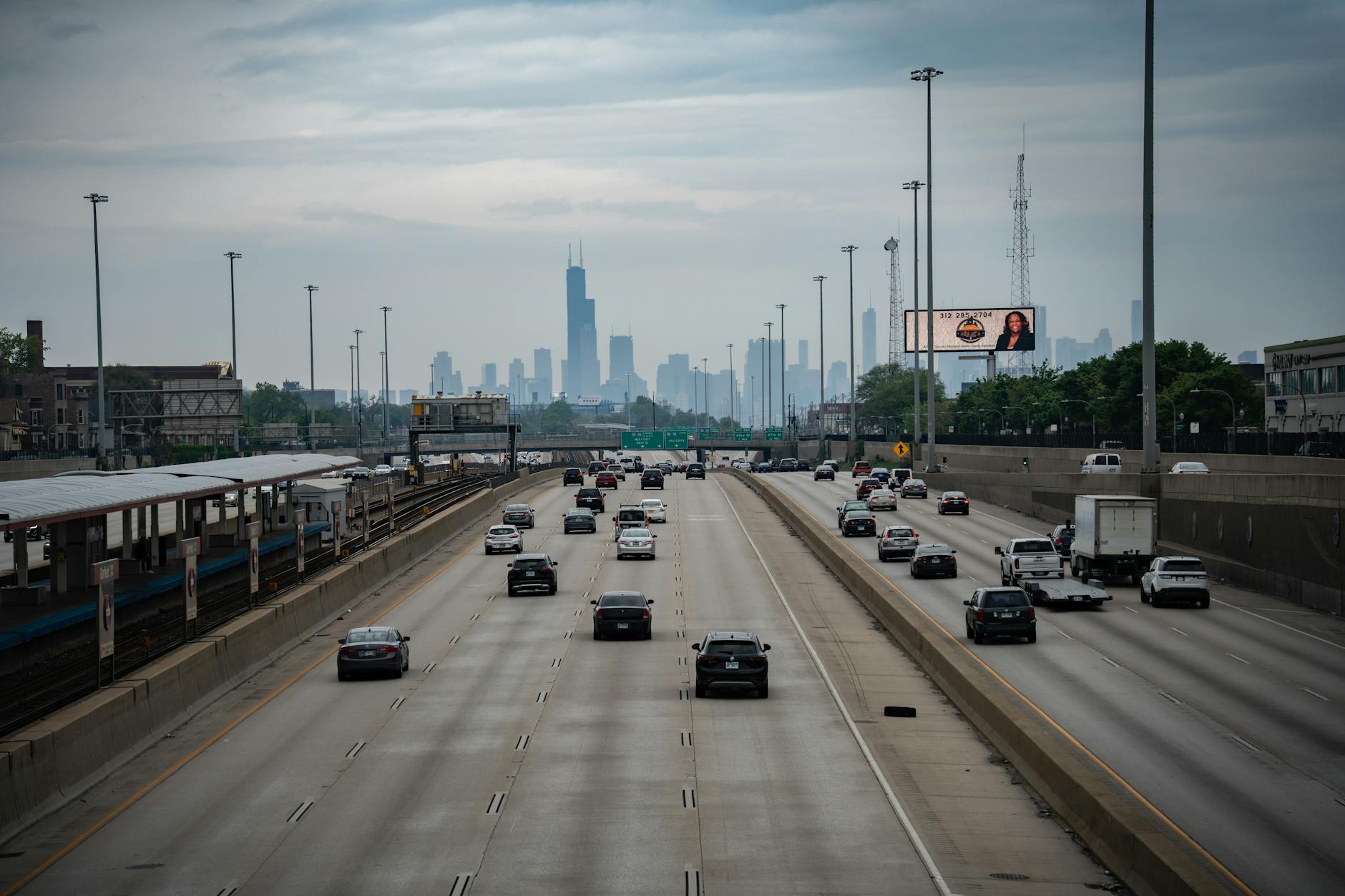
Naperville as “the second largest economic engine (in Illinois)”

The last paragraph of a story about NCTV in Naperville hints at the economic activity in the suburb:

Photo by Karolina Grabowska on Pexels.com

Spencer said she views additional city funding for NCTV17 as an investment into what the station does for the community.

“We think we’re more important and more relevant than ever to Naperville as the fourth largest city and the second largest economic engine (in Illinois),” she said. “We think we provide a really big service. … With a little support from our friends at the city, (we think) we can weather this storm and arrive at port bigger and better than ever.”

What features of Naperville would mark it as such a large economic engine? Its population puts it in the top four communities in Illinois, following Chicago, Aurora, and Joliet. But population alone does not tell the full story. Some more features of Naperville

Lots of human capital and economic resources among residents: “The region has a civilian labor force of 79,726 with a participation rate of 69.2%. Of individuals 25 to 64 in the Naperville city, IL, 74.0% have a bachelor’s degree or higher which compares with 34.3% in the nation. The median household income in the Naperville city, IL is $127,648 and the median house value is $424,800.”

Nearly 80,000 jobs in the suburb.

Certain job sectors well represented: “The largest sector in the Naperville city, IL is Health Care and Social Assistance, employing 12,989 workers. The next largest sectors in the region are Professional, Scientific, and Technical Services (12,897 workers) and Retail Trade (8,375). High location quotients (LQs) indicate sectors in which a region has high concentrations of employment compared to the national average. The sectors with the largest LQs in the region are Professional, Scientific, and Technical Services (LQ = 2.22), Utilities (2.08), and Management of Companies and Enterprises (2.05).”

Lots of office space available: “The office market in Naperville, IL incorporates 10,451,396 square feet of office space across 56 buildings that are at least 25,000 square feet in size.”

-A vibrant downtown.

Lots of awards from different outlets.

Billions of dollars each year in retail sales.

-Multiple corporate headquarters in the city.

-Part of the I-88 corporate corridor, access to multiple major highways, and close to two major airports and Chicago.

As I put together this list, Naperville indeed sounds like an edge city.

In a state dominated by Chicago, it is noteworthy to be second in line as an economic engine. I wonder what other Illinois communities are trumpeting their economic prowess and how many of them are suburbs.

Questioning Census population estimates when they show declines in Illinois

A story on Census population estimates for Illinois’ communities includes some pushback against the numbers:

Photo by Thiago Matos on Pexels.com

While the 2020 census counted responses from household surveys, the annual estimates between the 10-year counts are based in part on counting births, deaths, and moves in and out, using the number of tax returns and Medicare filings.

The numbers do not reflect the recent influx of 41,000 migrants bused and flown to Chicago since August 2022. Census methodology does not account for migrant arrivals. Immigrants are typically hard to count because they may be transient, may not speak English and may want to stay under the radar, researchers said.

Oak Lawn Mayor Terry Vorderer, for one, didn’t buy the new estimates, noting that his town has added new townhomes while not losing housing stock…

Gov. J.B. Pritzker’s office also threw water on the results, highlighting past faulty counts made by the Census Bureau.

“For the last decade, the narrative that Illinois is losing population was fed, by what turned out to be, inaccurate annual preliminary estimates,” Pritzker spokesperson Alex Gough said in a statement. “Illinois remains one of the most populous states in the nation and is on the rise.”

International migration — which has risen nationwide — has nearly tripled in Illinois since 2021, Gough said. The state is in the process of challenging census data to ensure it receives adequate federal funding for programs like Medicare, affordable housing and homeland security, he added.

Is this about methods for counting populations or is this more about politics? For better or worse, these annual estimates have become media stories. Some places are gaining residents, others are losing. Communities with population loss have a hard time shaking all the associations that come with it. The implication is that population loss indicates decline and problems while growth is good.

On the other side, measuring populations is a sizable task. This is why so much effort is expended every ten years. The annual estimates have their own methodologies. They are estimates. This means there is some margin of error. These margins of error should be reported, even if the emphasis in the media continues to be on a concrete number of people gained or lost.

Census numbers might not be perfect but I would be interested in seeing the compelling evidence to suggest their estimates of population declines in some Illinois communities are far off or completely wrong.

We need solutions to continued low turnout – less than 20% – in Illinois elections

The primary elections earlier this week in Illinois excited few voters:

Photo by Tara Winstead on Pexels.com

Though thousands of properly postmarked mail-in ballots are still being tallied through April 2, state election officials believe it will be hard to crack 20%.

Unofficial results from the 20 most populated voting jurisdictions in Illinois — which represent more than 81% of all voters in the state — show less than 17% voter turnout combined.

Turnout tallies in the suburbs remain below 20% as well, with Lake County currently showing only 11.7% of registered voters cast a ballot.

Why so few voters?

“Most of the races were completely uncontested, with just one contested county board race on the Democratic side,” said Lake County Clerk Anthony Vega. “That lack of motivation could have resulted in voters not coming out.”

With that lack of choice, combined with the fact that Democratic President Joe Biden and former Republican President Donald Trump had all but secured their nominations ahead of Tuesday’s vote, low turnout was inevitable, experts said.

These are plausible reasons. Yet, I have heard little about significant solutions. Such options could come from multiple angles: local officials, voters, advocacy groups, the state government, employers, civic organizations, etc. Illinois may face serious problems in numerous areas but this strikes me as one that affects numerous others and is foundational for the supposed American system of government.

The one feature of this I think about is the ways that the suburbs grew, in part, because Americans like being closer to local government. Compared to big cities, states, and the federal government, a suburban resident can more easily interact with local officials and local government activity. But, if people do not even want to vote for those local measures – and there is a suggestion in this article that local referendums might have pushed voter turnout up a few percentage points – then this interest in or connection to local government may be severed.

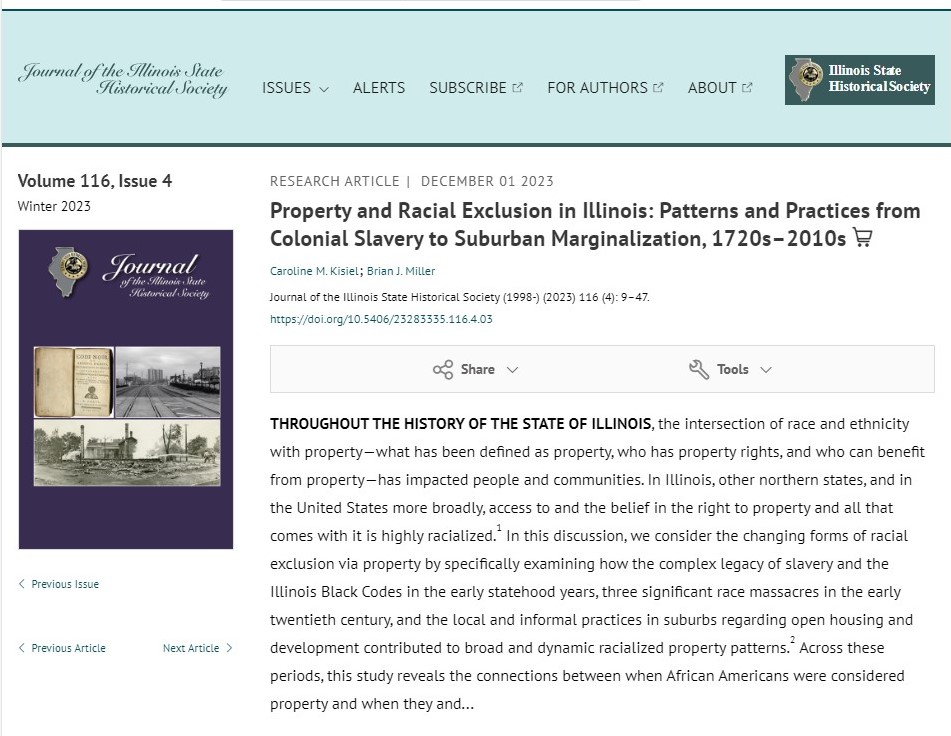
Kisiel and Miller new publication – “Property and Racial Exclusion in Illinois: Patterns and Practices from Colonial Slavery to Suburban Marginalization, 1720-2010s”

Caroline Kisiel and I have a new publication in the Journal of the Illinois State Historical Society. Here is a link to the article/journal issue:

This paper has been several years in the making and the helpful feedback we received along the way made it better.

Adding MENA to Illinois forms

An Illinois bill will make the state the first in the country to recognize MENA groups on forms:

Photo by Alex Green on Pexels.com

Illinois is on its way to becoming the first state to recognize Arab Americans when collecting public data.

This month, H.B. 3768 passed both houses of the General Assembly and is on its way to Gov. J.B. Pritzker’s desk. When signed into law, Arab Americans and minority groups from the Middle East will be recognized separately in state data.

Pritzker tweeted his support upon the bill’s passage in the House on May 18: “History made! With HB 3768 passage, our MENA or Middle Eastern and North African communities will now have their own category on state forms and surveys.”…

Illinois has one of the largest populations of Arab Americans in the nation. But on most registration forms, Arab American is not an option when selecting ethnicity, something groups such as Arab American Family Services, advocates and community leaders have sought to change for years.

It will be interesting to see if this helps move along the conversation at the national level where the MENA category was not added to the recent Census. I assume if enough states did this, it would then be easier to add it at the federal level to make sure there is data from all parts of the country.

Radio interview on Illinois history, race, and property on “The 21st Show” on Illinois Public Media yesterday

On Monday, March 27, I contributed to a conversation on “The 21st Show” titled “Illinois’ history with slavery and its links to the present.” You can listen here and I first talk at the 39:55 mark.

Photo by Jean Balzan on Pexels.com

Some of the conversation is based on a co-authored research article in progress with Caroline Kisiel of DePaul University. We discuss the working out and legacy of race and property over 300 years of Illinois history. My previous work in looking at the development of several suburbs in western DuPage County – earlier work published here, here, and here – adds to the latter portion of this history as race and ethnicity influenced decisions about development, zoning, and who was welcome in different communities.

State of Illinois has grant money to help develop megasites of 200+ acres, including suburban locations

A new grant from the state of Illinois makes money available to develop “megasites”:

Photo by Jahoo Clouseau on Pexels.com

Gov. J.B. Pritzker on Monday announced the creation of a $40 million grant program to help businesses find and build on large development-ready areas known as “megasites” across the state, including several in the suburbs.

Megasites are large swaths of land intended for businesses such as factories, warehouses and distribution centers. Pritzker said developing these sites will help make Illinois more competitive, especially as sectors including clean energy and manufacturing are rapidly expanding in the U.S…

Intersect Illinois, an independent economic development nonprofit working with the state on the program, lists among 151 megasites two in Hoffman Estates, one in West Chicago, four in Lake County and five in the Fox Valley. Several more are in South and Southwest suburbs, and more than two dozen are southwest of Joliet around Minooka, Channahon and Morris…

The program is open to private entities, nonprofits and local governments, and the application portal is open through April 6. Those receiving the grant must match each dollar granted by the state with other private or local funding.

This is a good example of how governments and private interests work together in the United States to develop land. The state government provides money in concert with more local funding in order to help spur development. Without the government money, the development may not happen.

This money is marked to help with large projects. Is the assumption that it is difficult to entice companies to such sites in Illinois or that local governments do not have enough resources to address needs for properties this large?

If these properties are not developed as megasites (versus being developed in parts), how much is lost?

This will be worth checking on in a decade or two to see what exactly emerges on these megasites.

Why might suburban leaders head up legal challenge to IL law ending cash bail?

A lawsuit led by suburban officials challenges a new Illinois law in court:

Photo by Pixabay on Pexels.com

When more than half of Illinois’ state’s attorneys go to court in Kankakee County next month in a last-ditch effort to block the controversial SAFE-T Act, the proceedings will have a distinctly suburban flavor.

The offices of McHenry County State’s Attorney Patrick Kenneally and Will County State’s Attorney James Glasgow have been chosen to serve as lead counsel in a lawsuit they and 61 of their peers have filed seeking to have the massive criminal justice reform bill ruled unconstitutional…

The state’s attorneys argue that violates several parts of the state constitution, including the Separation of Powers Clause by stripping judges of their full authority to detain defendants, set monetary bail and revoke bail. They also argue that a portion of the Act that gives police discretion to release defendants without bail on low-level offenses unlawfully takes that authority away from the courts…

The state’s attorneys argue that violates several parts of the state constitution, including the Separation of Powers Clause by stripping judges of their full authority to detain defendants, set monetary bail and revoke bail. They also argue that a portion of the Act that gives police discretion to release defendants without bail on low-level offenses unlawfully takes that authority away from the courts.

Suburban counties are not the only ones party to this lawsuit, but is it meaningful that they are leading the effort? A few general patterns scholars might point to:

  1. The image and ideology of suburbs suggests they are safe places relatively free of crime.
  2. Where does crime happen? It is viewed as a problem of cities and urban centers.
  3. The first two points are connected to long-term suburban patterns of exclusion by race/ethnicity and social class. Who commits crime? Not the typical suburbanite.
  4. Suburbs have a long history of fear of crime. And they act regularly in their suburban communities regarding crime, ranging from creating gated communities to supporting police efforts to choices about development and amenities.
  5. A suburban fear of crime is linked to particular political patterns and activity, including Nixon and the Republican Party’s “Southern strategy” to then-President Trump’s 2020 claim that the suburbs are under threat.

Put these factors together and suburban leadership on this issue may be no surprise.

Can anything be more horrifying than small town “Everytown, USA” set in Illinois?

The fictional Haddonfield, Illinois has a grim past:

Photo by Toni Cuenca on Pexels.com

As far as I can count, for a town of only 40,000 or so (I think; no census data for the place exists), it has seen more than 150 murders since 1978, nearly all during October.

As the setting for the “Halloween” horror films, the town has an accumulated history:

What makes Haddonfield important, though, is what made Sherwood Anderson’s Winesburg, Ohio, and Hawkins, Indiana, of “Stranger Things,” and many other fictional Midwest small towns, so indelible. These are places that retain the allure of an America we’re promised, full of kindness and nurturing, alongside the hypocrisy we’ve always known. Like Spoon River, Bedford Falls, Grover’s Corners, Brigadoon, Lake Wobegon and Springfield in “The Simpsons” — some Midwestern, all too good to be true — Haddonfield will be defined not as One of the Best Places in America to Live but One of the Best Places to Remind Yourself That Small Town America was Never a Vacuum…

If you take all the “Halloween” films as reference: There are also low-slung elementary schools surrounded by chain-link fencing. Boulevards lined with Victorian and Cape Cod-style homes with welcoming porches and big lawns. There are farms just outside town, and two newspapers and two hospitals inside. The University of Illinois is mentioned but there’s also a community college there and a strip club, tavern and small police force. It’s middle to upper-middle class, but with pockets of inbred poverty. No one mows the cemetery, and despite the violent history, there are more shadows than streetlights…

The real Haddonfield, of course, is South Pasadena, in California. That explains the lack of foliage (and mountains in the background). According to the Los Angeles Times, the 130-year-old home used for the Meyers house has since been made a historic landmark.

But if Haddonfield existed in Illinois, it would most likely be around the Bloomington-Normal area, said Jim Hansen, a professor of English and critical theory at the University of Illinois at Urbana-Champaign who also teaches classes on horror. It seems to sit off I-55. That said, Bloomington-Normal is south of Livingston County, the (real) county referenced in the series. On the other hand, isn’t it scarier if we don’t know?

I have multiple thoughts in response to this:

  1. Are horror films more effective in supposedly idyllic small towns or suburbs? The contrast between normal everyday life and the activity of horror films is high. If the Midwest is a home to American virtue, is it also home to its repudiation?
  2. Put 13 films together and a devoted fan base and this fictional place becomes a known one. Certain sites are familiar, the logic of daily life is known. Relatively few places depicted on television or in movies can become so familiar.
  3. The filming location is very interesting. If you know the filming took place in South Pasadena, does this ruin the image – visual and conceptual – of small town Midwestern life?
  4. This small town needs the services of Encyclopedia Brown, or perhaps an older detective; someone who could put an end to the horror business.

Too many taxing bodies in Illinois to easily count them

How many taxing bodies are in Illinois?

Photo by Karolina Grabowska on Pexels.com

Anyone who gazes at a property tax bill realizes Illinois is awash in local government: townships, school and park districts, road and bridge agencies, community colleges, police and fire departments, and a collection of water, housing, cultural, cemetery, and even mosquito abatement districts. The Cook County treasurer’s website lists eight taxing districts for Chicago, 11 for Winnetka, and 10 each for Norridge and Hodgkins.

There are so many entities that even the experts differ on their number. The Civic Federation, which charts government spending and claims to have done the most exhaustive search, says Illinois has 8,923. That’s higher than the 6,032 tally from the Illinois Policy Institute and the 6,918 listed in a 2017 U.S. Census Bureau report — 2,000 more than second-place Pennsylvania.

Americans like local government. Do they like local government this much? Perhaps the presence of this many taxing bodies in Illinois, Pennsylvania, and other states is the answer: “yes they do.”

However, it seems like it should be easier to count the number in Illinois. The state government itself does not keep track? How could the Civic Federation and the Census Bureau differ by roughly 2,000 taxing bodies? While the rest of the article goes on to detail how difficult it is to consolidate these governmental bodies or to eliminate them, having an accurate count might be an important start.