Will millennials kill McMansions?

Millennials get blamed for a lot of things and here is another possible area where their choices may have consequences: the selling and buying of McMansions.

The end of so-called “McMansions” has been predicted several times over the years, but those large, mass-produced houses that the baby boomer generation (born 1946-1964) favored as a status symbol kept coming back. Now, baby boomers are entering their 70s and 80s and many are looking to downsize, but they are finding it hard to offload these large homes, facing a paucity of buyers among the millennial generation (born 1982-2000), who are unable to pay the prices they want.

For anxious sellers, however, respite could be around the corner as mortgage interest rates ease, and the millennial generation becomes qualified for more and bigger loans, experts say…

A big problem for the McMansion market is the mismatch between where millennials prefer to live and where those large houses have been built. The younger generation gravitates to cities – where their jobs are — whereas baby boomers have built their homes in suburban locations…

Keys wondered if the housing preferences of the younger generation have truly changed or if there is only a “delay” in the demand for McMansions. Those homes may not be desirable to people in their late 20s but instead to people in their late 30s or 40s, he noted.

This is not the first time I have seen the suggestion that millennials have less interest in McMansions: Builder had a piece on this a few years back. And the baby boomers may have a problem bigger than just McMansions: who will buy all their homes, McMansions and otherwise? When housing becomes a primary investment for so many Americans, not having enough future buyers can become problematic.

More broadly, this discussion follows a typical pattern for stories and studies about millennials: will they act like previous generations (and have not done so thus far for a variety of reasons including an economic crisis and student loan debt) or do they truly have different tastes and want to lead different lives? In the realm of those who care about cities and suburbs, this is an ongoing discussion spanning years: will millennials be suburbanites or city-dwellers? Will they reject lives built around single-family homes and driving and prefer denser, diverse, culturally-rich communities (or a mix of both in “surban” places)?

If I had to guess, this group will exhibit some change from previous groups but probably not drastic change (based on the idea that social change tends to happen more slowly over time). Reversing suburban culture, ingrained among many American institutions and residents, would like take decades and not just one generation. The McMansions of older residents may not all sell at their preferred prices but barring another housing bubble (which could happen), they will be worth some money.
The late 2000s “global economic meltdown” and values of McMansions

One columnist connects the economic crisis of the late 2000s and McMansion values:

Perhaps you thought the last decade’s global economic meltdown, which crushed stock prices and McMansion values, would most hurt the wealthy. Nope. The gap between rich and poor in the U.S. expanded in the aftermath of the Great Recession. The (sarcastic) good news: America’s wealth gap expanded less than Bulgaria’s between 2010 and 2017.

Three quick thoughts:

  1. McMansions are often cited as a symptom of the problems that led to the economic crisis and housing bubble of the late 2000s. The spirit of consumption in the United States with lenders providing more and more risky loans (and not recognizing the problematic loans and then selling and buying them as if they were good investments) plus decisions by consumers to purchase more and acquire debt all contributed to the larger issues. If you needed one symbol of excessive consumption from the early 2000s, commentators often go for the McMansion or the SUV.
  2. While the McMansion became an important symbol, housing prices almost across the board declined precipitously. Not just McMansions were affected. And since most American single-family homes are not McMansions, it seems a bit odd to single them out here. Many Americans who would not or could not purchase McMansions felt the effect of declining property values.
  3. Housing construction declined during and stayed depressed for a number of years after the economic crisis. Even during this down time, builders continued to construct McMansions. And once the economy started to pick up, more McMansions appeared. While the economic trends certainly affect how many McMansions go up, the style of home has some staying power. Even if such homes helped contribute to the economic crisis, some Americans still want to build and buy them. The value of such homes may not be the only reason people build and buy them.

If Americans can celebrate and preserve ranch and modernist homes and Brutalist architecture, we can expect to see preserved McMansions

McMansions are rarely celebrated and are often skewered (read more here and here). Yet, given the number of McMansions constructed in recent decades plus the number of Americans who live in McMansions, I predict this: we can expect to see preserved McMansions in the future. Imagine at least a few McMansion preservation districts or homes converted into museums and/or local history sites to help future American residents envision the past.

Critics argue McMansions have a multiple negative traits including their size, their architecture, and what they stand for. At the same time, not all buildings and structures that are preserved or celebrated are ones that all Americans celebrate. Take but three examples: ranch homes, modernist homes, and Brutalist buildings. Ranch homes have their own proponents and backers but they are also derided for their simplicity and lack of traditional architecture, particularly in mass-produced suburbia. Modernist homes may catch the eye of architects and those interested in minimalist design but I think more Americans would prefer a McMansion. And Brutalist architecture may come under fire but a number of prominent public buildings in this style still stand and will be preserved.

If future Americans want to understand typical life at the turn of the twenty-first century, they may need to see and tour a suburban McMansion. This does not mean that the presentation will be all positive. Those future visitors may scoff at the open design, the architectural mish-mash, the hobby rooms and copious amounts of storage space, the granite countertops and stainless steel appliances, the use of McMansions in horror stories, and the rows upon rows of such homes. Or, such a preserved home might endeavor to explain why Americans continued to buy McMansions even with the negative connotations of the term.

I look forward to seeing some of the first McMansion preservation sites. These may be both business and community opportunities as well as part of an effort by Americans to better understand their own past. And because there are so many McMansions and they are so emblematic of a particular era, let the era of McMansion preservation begin.

“McMansions are the largest physical boomer legacy soon inherited by their children”

A Connecticut architect considers the McMansion legacy left by a generation of homeowners and builders:

Skyscrapers are the image of New York. The White House is more America than a home. And McMansions have become a punchline. When I sought to find land in 1982, a broker pushed a building lot in a McMansion development, pushing its allure by flatly asserting, “We’re talking about some seriously beautiful homes here.”…

Time has not been kind to we boomers. We basically tanked the entire world’s economy with “irrational exuberance” that found its most publicly grotesque distortion in those McMansions. Make no mistake millions of less-than-McMansions had more distortional impact on the credit markets than the hundreds of thousands of McMansion, let alone the one-off attempts by individuals who try to buy social legitimacy by building large homes — the real mansions…

McMansions are the largest physical boomer legacy soon inherited by their children, the millennials, who have had the worst economic birthing since the Great Depression. Kate Wagner was barely in her 20s when she called out the final fruits of 40 years of serial housing booms that afflicted America. But the impact of in-your-face domestic chest-beating is especially present in Connecticut, which realtor.com trumpeted as having the “metro” with the third most McMansions in the country. And that impact was doubled down by the added insult of unending instant “tear-downs” of those homes built in the previous generation in the tight Northeast.

As an architect I have remade any number of these instantly dated ego vehicles. We have also revived any number of raised ranches, garrison colonials and Capes. Often those homes need strategic expansion. But with McMansions, removal of the offending detail and pretense is often the first remediation.

I like the idea that a social group – here the emphasis is on Baby Boomers – can leave a physical legacy for later members of the same society. People do not just pass down values, norms, and behaviors; they also leave a physical landscape and places that they have made and shaped. Even though we do not focus much on this in the United States, these places shape us and also provide inertia for what future residents will experience. McMansions have the potential to influence millions of lives even as the original designers, builders, and residents may no longer be present.

At the same time, I wonder how obvious the excesses of the McMansion were while they were being constructed in large numbers. It is relatively easy today to look at them with disdain or wonder at what prompted them. A blog like McMansion Hell has the benefits of hindsight as well as new eyes from a younger resident from a different generation. Did this architect call out McMansions back in the 1990s when wealthy Connecticut communities built them in large numbers? My own research suggests the tide starts to turn against McMansions in the early to mid 2000s as consistent critiques of their architecture and consumption arise as well as there are enough of them in communities across the United States to see them as a single phenomenon.

Going forward, I don’t think McMansions will disappear. There is plenty of money to be made in McMansions compared to building smaller housing units. It is not clear that all millennials or future homebuyers will see them as homes to be avoided. And many of the McMansions critics say are poorly built and designed will last for decades.

McMansion literary tales: a proposed teardown leads to local dysfunction

The McMansion continues to feature in literary works. A new book from a Washington D.C. area author uses a proposed teardown McMansion to highlight suburban issues:

Coincidence or not, Langsdorf’s success comes after leaving her longtime suburban existence. Following her 2012 divorce, Langsdorf moved to Adams Morgan in the District and devoted herself to writing while teaching yoga on the side. And yet, the book takes her back to that former life: “White Elephant” seems to channel all of the frustrations she felt juggling her identities as a mother and creator in a stifling suburb. The novel follows the residents of the fictional enclave of Willard Park — inspired, in part, by Langsdorf’s hometown of Kensington, Md. — where an interloper’s plans to build a McMansion amid the cozy bungalows leads to angry town halls, scandalous romantic dalliances and shady high jinks.

Like Langsdorf, two of the main characters in her ensemble are mothers grappling with their identities beyond being wives and mothers. Allison Miller, who has lived (mostly) happily in Willard Park for more than a decade, wonders what to do with her photography — more than a hobby, less than a career. Her new next-door neighbor, Kaye Cox, can’t figure out who to be, caught between her role as a fixture in her husband’s behemoth of a house and her own interest in interior decoration. These women and their author are well-acquainted with the eternal dilemma for parents, the pull between caregiving duties and other interests, professional and personal…

Almost every neighborhood in the D.C. region has experienced a version of the changes in “White Elephant.” Even Adams Morgan: The Line hotel, for example, occupies a building that was once a church. Langsdorf laughs about some of the struggles she’s seen in her own building, hastening to add that her fellow co-op residents are all great neighbors.

The residents of Willard Park come to realize that houses matter less than their inhabitants — and that the suburbs aren’t for everyone. Langsdorf understands this, too; in her current existence she feels more herself. “My life is much more vibrant,” she says. “I love being able to walk everywhere, and I do have more time to write.”

That a proposed McMansion could lead to “dalliances” and “high jinks” is intriguing to consider…the angry public meetings are much easier to verify.

While it would not have been possible to discuss McMansions before the 1980s since the term did not exist, it sounds like this new work draws on several common suburban critiques featured in novels, films, television shows, and other cultural products. Suburban residents, particularly women and mothers, feel trapped by suburban expectations and a landscape that does not easily lead to human connection or diverse experiences. They then look for ways to break free of the suburban mold and explore different outlets.

These works tend to emphasize those that feel “the suburbs aren’t for everyone.” At the same time, many Americans live in the suburbs by choice and I assume a good number of suburbanites feel their existence is at least okay. Is it because cultural works need crises to overcome (the hero on their journey must overcome something) or are the suburbs are a unique target because they are so common in the United States (over 50% of residents live there) and so reviled?

Could giga-mansions relieve the negative attention directed toward McMansions?

The term McMansion is likely to stick around (even if is used poorly at times) but more interest may be shifting to the giga-mansion.  A Motley Fools podcast provides some information:

First we had mansions. Then we had mega-mansions. And McMansions. Now we have giga-mansions. Yes, it’s a growing trend of massive houses usually built in the LA area on spec. They are massive, expensive, and outrageously ostentatious. Let’s see if you two can answer some trivia around some of the most expensive pieces of residential real estate on the market…

The One will be America’s largest house on the market at 100,000 square feet. It will be the most expensive private residence when it comes to market. It boasts four swimming pools, a nightclub, a room where the walls and ceiling are filled with jellyfish. It will have a 30-car gallery. Because of this price you don’t call it a garage. Of the 20 bedrooms, how many are in a separate building just for your staff?…

Let’s move on and talk about the house called Billionaire. It’s 38,000 square feet. It was America’s most-expensive house on the market when it was listed for $250 million in 2017. The property is in the exclusive Los Angeles suburb of Bel Air. It has 12 bedrooms, 21 bathrooms, three kitchens, a 40-feet James Bond-themed cinema, six bars, two fully stocked champagne cellars, and the helicopter from what 1980s television series? Rick knows this. He can’t wait to say it…

Southwick: A $1 billion lot. Now we’re going to go to The Manor. The largest home in LA was actually built in 1988 by the TV show producer Aaron Spelling and his wife Candy. The 56,000 square foot, 14-bedroom, 27-bath home originally was built for $12 million. They sold it all in a cash deal for $85 million in 2011 to the 23-year-old daughter of someone wealthy. Don’t worry about it. She renovated much of the house, since it had some very quirky spaces, including a flower-cutting room, a humidity-controlled silver storage room, a barber shop, and three rooms for doing what common birthday and Christmas activity?

One of the major critiques of McMansions involves their symbolic nature: they are associated with sprawl, wealth, and conspicuous consumption. All of these appear to be in play with the examples from the Los Angeles area cited above: a region known for cars and highways, entertainment celebrities and executives along with other wealthy people, and a constant need to stand out from the rest of the area.

But, McMansions have key differences from this supersized homes. They are generally smaller – roughly 3,000-10,000 square feet – and more often found in “typical” neighborhoods. They are often mass-produced. They are often criticized for their architecture while megahomes take more flak for their size. Perhaps most importantly, McMansions are within the reach of more Americans. Depending on the housing market, an upper-middle class household can acquire a McMansion but these giga-mansions are only for the wealthiest.

If the ultimate concern behind critiques of McMansions is their unnecessary size and flaunting of wealth, then the spread of giga-mansion might relieve some of the pressure. Granted, there will always be more McMansions but it is easy to focus on these outsized homes and their owners. Why criticize the top 10-20% of American homeowners for their McMansion choices when the giga-mansions of tomorrow constructed and owned by the top 0.1% of homeowners are so ridiculous and unnecessary?

The bigger and feature-filled “New American Home”

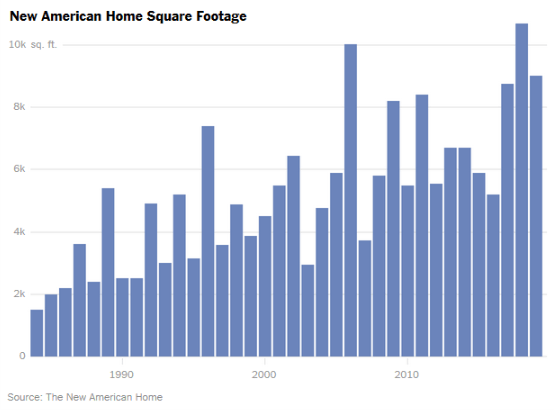
What the National Association of Home Builders displays as the “New American Home” just keeps getting bigger and bigger:

The first New American Home that N.A.H.B. built, in Houston in 1984, was 1,500 square feet and cost $80,000. By 2006, at the peak of the housing bubble, the N.A.H.B. home – a lakeside McMansion in Florida with a tri-level kitchen island and a waterfall off the master suite – was over 10,000 square feet and listed for $5.3 million in what is today one of the nation’s foreclosure capitals, Orlando.

That 1984 project was the smallest; square footage hasn’t dipped below 2,200 since 1985. The 2018 version, also in Florida, is “Tuscan”-inspired and is close to 11,000 square feet, with eight bathrooms and both an elevator and a car elevator in the garage. The 2019 version, to be unveiled soon, is 8,000 square feet and has an “inner sanctum lounge” and a view of the Vegas strip.

NewAmericanHomeSquareFootage

The N.A.H.B. house may be meant to highlight trends, but they’re not necessarily the trends homeowners want (and certainly not what most people need). Instead, they’re what builders, kitchen and bath manufacturers and real estate agents would like to sell them: Think cathedral ceilings, granite countertops, gift-wrapping rooms and, more recently, “smart” appliances like a refrigerator that can text you when you’re low on milk and eggs.

Many builders will tell you that though these houses are large, they are more efficient – even that they have a small carbon footprint. But this is like bragging about the good gas mileage of an S.U.V. While a 10,000-square-foot house built today uses less energy than a 10,000-square-foot house built a decade ago, a home of this size requires a phenomenal amount of energy to run. (And most likely has an S.U.V. or two in the garage.)

I see enough from the NAHB to guess that they have some influence in the housing industry, particularly among national or larger builders. That their show home put together each year keeps getting bigger on average and with more and more features suggests the emphasis is on new and profits. At the same time, it might be hard to show a direct causal link between these annual productions and what homes are actually built. Builders in the United States have constructed many large homes in recent decades but the median square footage has dropped slightly in the last few years.

I suspect it would also be interesting to analyze the architectural and design choices for the New American Homes. Americans may like big homes but not necessarily modern ones. How many of these homes are modernist, Craftsman, or Mediterranean (and which styles are studiously avoided)? Are they all open concept in the main living areas? Is storage a priority and/or large garages? This sort of project could then be expanded to model homes in different areas or among different builders to think about how what builders present influence buying patterns.

New Bel Air homes of over 17,500 square feet cannot be called McMansions

In recent years, a number of extra large houses have been constructed in Bel Air. But, these are not just regular McMansions:

Rosen rallied his neighbors in a mini-revolt against City Hall. The result was 2017’s Bel Air mansion ordinance, a more rigid version of the ordinance imposed on the rest of Los Angeles. While many of the hauling trucks are now gone, the wealthy enclave is still grappling with the legacy of its McMansion years. Between 2014 and early 2017, the city issued 28 permits for mansions in Bel Air of 17,500 square feet or larger, most of which are still under construction, according to an analysis by The Real Deal. The projects are exacerbating a spec-home building spree that rattled longtime Bel Air residents and is dramatically altering the landscape of the area, not to mention its real-estate market.

As of Wednesday there were 12 homes in Bel Air of 15,000 square feet or larger currently sitting empty and unsold in, according to MLS data cited by Steve Lewis, President of CORE Real Estate Group in Beverly Hills.

These are not regular McMansions in suburban neighborhoods: these are megahomes going for megaprices and constructed by and for the ultra-wealthy.

Meanwhile, on Chalon Road, Thomas Barrack Jr., the Colony Capital CEO and pal of President Donald Trump, is nearly done building out an eight-acre compound with a 77,000-square-foot mansion being designed by Peter Marino. Barrack is building it on behalf of the royal family of Qatar. Other competing giant offerings, including the Mountain, a 157-acre plot in Beverly Hills Post Office now listed for $650 million, and a 120-acre site owned by an entity linked to the late Paul Allen asking $150 million, don’t have plans or permits in place for mega-mansions, Blankenship said.

Massive spec mansions on the market right now include Bruce Makowsky’s 38,000-square-foot estate at 924 Bel Air Road, asking a much-reduced $150 million, and the Mohamed Hadid-developed mansion at 901 Strada Vecchia, which is the subject of an FBI probe and a lawsuit from neighbors who want to see it torn down.

Granted, it sounds like some of the activity in Bel Air may be consistent with several features of McMansions: big homes, teardowns, and status symbols for the wealthy. For those who live in Bel Air, it could be disconcerting to see the scale of new construction. But, this article focuses primarily on the really big homes, the ones that are not just someone upgrading from a 2,000 square foot ranch to a 5,000 square foot home with a mishmash of architectural features. The last example in the piece illustrates this difference between a McMansion and mansion: a billionaire/actress couple want to tear down a home under 8,000 and more than double the square footage in a new home. Again, that is a scale far beyond the average upper middle-class American (and that does not even include the price it takes to buy into this particular neighborhood). Perhaps the real goal of using the term McMansion here is to denigrate the new homes and not grant them the status of mansion.

I would argue McMansions are roughly 3,000 square feet to 10,000 square feet. The bottom end may seem rather small but this size home could be quite large if constructed in a home of small homes. The upper end is a rough cutoff when a home goes from regular big home to extra large/wealthy big home. Size is a critical factor in defining a McMansion and these Bel Air homes are way beyond McMansion limits.

McMansions lead to water runoff damage in Kirkwood, Missouri

The construction of new housing can lead to water issues for existing homeowners. See the ongoing case of Kirkwood, Missouri homeowners dealing with more water due to the construction of McMansions:

Next week, a new Kirkwood water runoff regulation will take effect, but longtime residents say it’s all too little too late…

Like many other longtime Kirkwood residents, Liskew said water began invading her home when new construction started near her neighborhood. Behind her home, she noticed new, large homes—often called ‘McMansions’—were being built on small lots…

That special council created a new storm water management regulation. The ordinance requires all “infill development” to capture rainfall runoff, and submit a plan to the Metropolitan St. Louis Sewer District for review and approval prior to the issuance of any building permits…

And she said it’s been an expensive, never-ending problem to worry about. In addition to several French drains, Liskew has installed a sump pump, taken out basement windows, graded a large portion of her yard and even commissioned a water runoff study to find out where the water was originating. The study found the water was coming from the neighborhood directly behind her home, and heading directly into her backyard.

See an earlier blog post on the Kirkwood situation. To some degree, the construction of any new residential units is likely to affect water runoff. Switching land from non-use or agricultural use to homes, driveways, yards, and streets will have an effect. Add to that the pejorative term McMansions used here: big homes take up more space and in the interest of keeping water away from them even more water is channeled elsewhere.

I sometimes wonder if the way water issues in suburbia work is like this: every new development attempts to push the water somewhere else and the problem simply moves onto someone else’s property. Generally, developers and municipalities do their best to move the water away from existing buildings and uses but this may not be possible depending on the topography and existing infrastructure. Cleaning up the water issues after the fact – such as in Kirkwood or the Deep Tunnel project in the Chicago region – is costly and very frustrating. But, without a commitment to avoid sprawl or widespread adoption of greener techniques, the water problems will just get pushed down the road. Flooding will continue to be a major suburban problem.

Publication on the Soprano’s McMansion

The home of Tony Soprano and his family on HBO’s The Sopranos is a key setting for the show. It is here that Tony considers his own unrest and anxiety, where the family interacts with each other alongside Tony’s other “family,” and the home embodies the search for the suburban good life as encapsulated in a spacious home in a wealthy neighborhood.

I am grateful for the opportunity to explore this in more detail in a recently published paper: “A McMansion for the Suburban Mob Family: The Unfulfilling Single-Family Home of The Sopranos” in the Journal of Popular Film and Television.