McMansions and Beanie Babies

A new documentary suggests the Beanie Baby craze began among big houses in Naperville:
Photo by Kayley Dlugos on Pexels.co

The Gist: It all started with a few white ladies in Naperville, Illinois – because of course it did. In the mid-1990s in the culs-de-sac of the affluent suburban Midwest, where triple-wide driveways flank brick McMansions, Joni, Becky and Mary Beth decided they liked cute little hand-sized stuffies produced by modestly sized toy company Ty Inc., and wanted to collect them all. An inauspicious beginning, yes, but one that would find Ty founder, future billionaire and eventual criminal tax evader H. Ty Warner ignoring how Mary Beth helped stir nationwide consumer frenzies for his products, and suing her for copyright infringement. So this story has its heroes and villains, a couple who fall somewhere in-between, and a nation of millions who caused a subsequent consumer demand for plastic totes so they can shove their hundreds of worthless Beanie Babies beneath the basement steps. (The real winner here? Probably Rubbermaid.)

Based on this short snippet, I am thinking of several possible connections between McMansions and Beanie Babies:

  1. These homes offer lots of space for storing and displaying the toys. All those bonus rooms and square footage mean the owners can have hundreds, no, thousands, of Beanie Babies.
  2. The people who can afford McMansions can afford a lot of Beanie Babies.
  3. Related to #2, those who live in McMansions, homes often criticized for their architecture and design, want to own lots of toys that became a fad.
  4. Perhaps the simplest explanation: roughly 50% of Americans lived in the suburbs by the 1990s, most McMansions are in the suburbs, Naperville’s population was booming at this time, and Ty Warner is from the Chicago area…meaning all of these spaces happened to collide in this toy boom.

Passed down McMansion an albatross or a financial windfall?

One money advice column recently addressed a question regarding what to do with an unwanted McMansion passed down from family:

Photo by David McBee on Pexels.com

Dear Pay Dirt,

My husband and I have been struggling to find a house to buy. Despite having a down payment saved, we still pay rent, and the market is insane where we live. My in-laws have several homes and decided to turn their vacation home into their retirement one. After their last renter moved, they offered their old suburban house to my husband and myself for free. It is very generous—unpromptedly so!—but I hate the idea. It was built in the mid-1990s and never updated. It is huge, designed in echo-y open concept style, with half the space barely useable for everyday life. Other than the downstairs master’s, the utility room, and the upstairs bedrooms and baths, there are no doors. You can overhear a normal conversation in any part of the house. The back and front yard are huge (did I mention my husband and I have black thumbs?) The commute would be horrible enough, with the house over an hour away from where we work, but given traffic and the never-ending road construction, that time can almost triple. And the local culture here is barren—no theater, no art, no nightlife unless you want to go to a chain restaurant.

There is no question that my in-laws will be insulted and offended if we reject moving into the house and chose to sell it and use the funds to buy something better for our lifestyle. They will call us ungrateful. My husband thinks we need to take the offer and wait a year or two before selling it. I don’t know—the market can’t stay like this forever, and I do not want to get dragged into a house flip. The commute will kill my mental health. Right now I can walk to work. My husband bikes when he isn’t working from home. There is some sentimentality at play, since my husband spent his last year of high school in this house, and his sister grew up in it. And my in-laws are thin-skinned and very proud. Is this the golden goose or a white elephant?

—House Hunters

Dear House Hunters,I wouldn’t say it’s a golden goose or a white elephant, I’d say it’s more of a “hold your horses” situation. Here’s why. You want to offload the house while the real estate market is hot, and for good reason. It sounds like you’ll be miserable there. No one wants to be miserable, nor should they be made to feel so.  Life’s too short! But I am hearing a lot of reasons why you shouldn’t be living there, not why your husband shouldn’t be living there. It actually sounds like he’d be okay staying there, and stacking some cash. Depending on how much you’re currently paying in rent, you could easily save over five figures. This cash can be put towards the down payment that you currently have saved, but that isn’t enough to get you a competitive offer in your desired area. It could also go towards repairs, to make the house more comfortable, so you could use it as a rental and secure cash flow for your future mortgage payment in the house you actually want.

Also, if you sell the house before living in it for two years, you’re at risk of paying up to 20% of your profit to the IRS. A capital gains tax is a levy on a profit of an investment after it’s sold. One of the items on the list of investments subject to a capital gains tax is real estate. Not to mention, you’d probably make your husband’s life a living hell with his parents if you take the money and run. Who wants that?

You can handle a shitty commute and no museums for a year or two. Offer your husband a compromise, and put a time limit on living in your new digs. Stack the money for over two years. Make enough upgrades to the home that you can charge market value if you sell it—or get a renter, and a cash flow to subsidize your life in your dream house.

Short summary of the advice: you can survive a McMansion for a short time if you can financially benefit from it (and family relationships remain positive).

Two points of this exchange interest me:

  1. The letter writer defines the home in such a way that seems to fit with the moniker “McMansion” applied in the headline. What McMansion traits does this home have? Three are clear here: it is large home with an unpleasant layout located in a suburban area. The relative size of the home is not discussed. The potential homeowner is not fond of such a home.
  2. This is a situation that many younger adults might face in the future. As people age, they may be interested in passing along their suburban McMansions. Do the younger adults want to live in McMansions or would they rather have nothing to do with the actual homes and what they represent? The answer above tries to take an approach in the middle: the home could prove beneficial in the long run even if the younger adults do not wish to stay there long. The McMansion is not shunned but it does have value.

If the younger adults are willing to use the term McMansion to describe the homes of their parents, this could send a particular message about what they think of the house.

Does Ben Simmons live in a McMansion or a mansion?

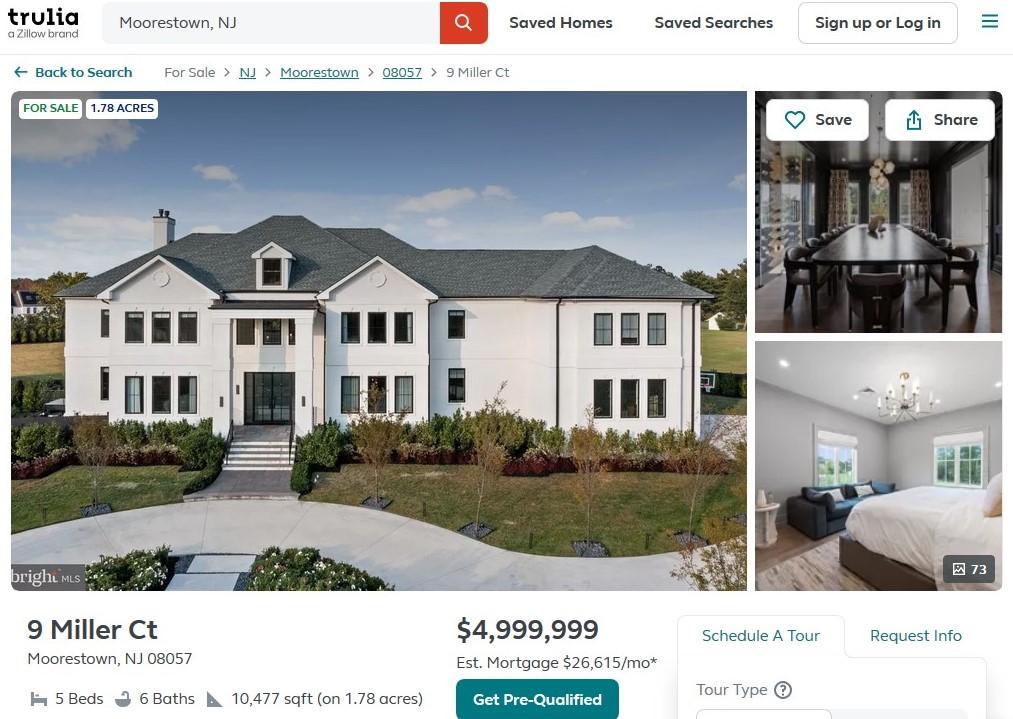
Basketball all-star Ben Simmons has his house on the market and one publication calls it, in the final paragraph, a McMansion:

Now his McMansion, replete with dedicated “Simmo the Savage” room, has popped up on the market for five big ones. It’s almost too perfect to believe.

Is his suburban home a McMansion? Here are more details about the house from the first two paragraphs of the story:

9 Miller Court, Moorestown, New Jersey. Five beds, six baths. 10,477 square feet of high-end appliances, Cambria quartz countertops, and floor-to-ceiling wine walls blooming from an awe-inspiring grand foyer with a spiral staircase climbing up from its center. All of this and more could be yours for just $4,999,999.

Now at this point, you may find yourself wondering: What sort of small-time CEO or TV actor would occupy such an extravagant abode in southwest New Jersey?

I have seen similar stories before: any big recently-built house of a wealthy person could be labeled a McMansion. And this one is owned by a star in the news! But, some of the details above do not line up with the idea of a McMansion:

  1. The size. This is a large house. I would put the upper cut-off for a McMansion more at like 8,000 or 10,000 square feet. This is not a run-of-the-mill large suburban home.
  2. The price. This is a $5 million home. This is out of the reach of even many wealthy people.
  3. The architecture is a bit strange – the facade mixes styles, features a two story entry, and has modern windows – but the interior finishes seem high-end, not necessarily mass-produced. The home overall does not appear gaudy.

While the home may not look like a traditional mansion or one associated with old money, I would argue it is not a McMansion. This is a big expensive home with a lot of finishes that puts it beyond the typical suburban McMansion.

Redfin – and America – selling an unattainable American Dream of homeownership?

The CEO of Redfin recounts how he has viewed who can and should be able to purchase homes:

Photo by PhotoMIX Company on Pexels.com

Rampant speculation and skyrocketing property values have left Kelman feeling almost nostalgic for those years leading up to 2008, which, in retrospect, were the last time the working poor could reasonably aspire to home ownership in America. “I used to read stories about strawberry pickers buying McMansions in central California, and everybody viewed that as just the absolute apex of insanity,” Kelman told me. “But reading Piketty five years later, is it so bad that the strawberry picker had a nice house?”

Conceding that the picker probably could not afford his McMansion, and that the loans that put him in it were untenable, Kelman nevertheless liked this gaudy permutation of the American Dream. More than that, he disliked the level of “elitist judgment” surrounding these types of homes, which he views as nothing more sinister than the market’s attempt to grapple with problems politicians are content to ignore. In Kelman’s view, the left is eager to help the poor rent homes but not own them, while the right tends to ignore their plight altogether. Meanwhile, rampant NIMBYism prevents the kind of building that might help bring home prices back down to earth.

It had put him in a mood to reflect somewhat darkly on the future of housing in America. “The original premise of my stint at Redfin was that we’re selling the American Dream and the idea that everyone can afford a house sooner or later if they work hard and play by the rules,” he said. “Recently, I’ve had this feeling that there are so many people who are never going to become Redfin customers — that maybe the product we’ve been selling just isn’t a middle-class product anymore but an affluent product.” In February, anticipating a future in which homeownership is out of reach for more and more people, Redfin spent $608 million to acquire RentPath and its portfolio of apartment-leasing sites.

The story as written suggests that Kelman originally subscribed to the idea that Americans who work hard and follow the rules would be able to purchase a home. This has been at least an implicit idea for decades, particularly in the postwar era. He did not like commentary that suggested some were less deserving to own homes or political positions that limited homeownership. But, after the housing bubble burst in the late 2000s, he realized homeownership was not available to all.

If this is correct, the Redfin pivot to apartment-leasing is an interesting choice. This could be a good business decision as rental housing is needed in many communities. At the same time, this does not necessarily line what up with what Kelman expressed. Apartments can provide housing but they do not provide the same kinds of opportunities as housing – such as building wealth – nor are apartment dwellers viewed the same way as homeowners. Americans continue to say that they would prefer to own a home.

Redfin and similar sites could play important roles in what homeownership looks like in the future. Exactly what influence they will have is less clear.

McMansion as a symbol of a lot of something and more

A ranking of every Weezer song includes using the term “McMansion” for the second-worst song on the list:

Photo by freestocks.org on Pexels.com

204. “Beverly Hills,” Make Believe

To this day, Weezer’s highest charting single – which makes sense, as it’s about as close to the lowest common denominator as the band has ever sunk. A lumbering monument to the pursuit of wealth and luxury, “Beverly Hills” matches its vapidity of message with a McMansion’s worth of painful musical ideas: the clumsy half-rapping of the verses, the annoying “gimme, gimme” rejoinder of the chorus, the talkbox solo of the bridge. Even louder than the caveman thud of Pat Wilson’s opening drum salvo was the sound of dyed-in-the-wool diehards stampeding for the exit, finally ready to accept that the glorydays of Pinkerton weren’t coming back.

The most obvious use of the word here is to suggest the song has a lot of bad ideas. McMansions are criticized for their size and their poor architectural ideas.

But, there could be more here in this paragraph. A few quick ideas:

  1. Beverly Hills is a wealthy neighborhood with a lot of big houses. Are some of them McMansions? McMansions are connected to displays of wealth and excessive consumption.
  2. The reference to “the lowest common denominator” could be linked to the critique that McMansions are vapid and mass produced. They are not real mansions; they are attempts to mimic higher quality construction and more architecturally pure mansions.

All together, the use of the term McMansion here does not refer directly to the actual homes. Rather, it highlights how familiar the term is in order for its use in a music review to highlight abstract ideas.

Sustaining McMansion purchases with low interest rates

If architecutural critiques of McMansions do not dissuade potential buyers, enticing interest rates might prove persuasive. One Southern California mortgage broker explains:

Photo by Andrea Piacquadio on Pexels.com

Maybe you, too, can afford a Southern California McMansion. How about paying just interest, not principal, at a rock bottom 1.875% mortgage rate for the first three years?

For a $1.5 million loan on a $2 million home, your house payment is locked down at $2,344. Assuming monthly property taxes of $2,083 (1.25% annual property tax rate) and $250 for monthly homeowners’ insurance, your total house payment is $4,677…

If rate and payment uncertainty gives you too much heartburn, you can find longer interest-only lock terms of five, seven or 10 years in the 2% to 3% interest rate range on 30-year mortgages.

Even 30-year jumbo fixed rates are super cheap. I’ve found rates as low as 2.375% for Inland Empire properties, where jumbos start at $548,250. In Los Angeles and Orange counties, where jumbos start at $822,375, rates are as low as 2.625%.

Why buy a McMansion? Because it is relatively cheap due to low interest rates. As the commentary notes, renting a McMansion could be significantly more costly than buying. Since Americans like large houses and this is an expensive real estate market, a large McMansion at reasonable rates may look like a good deal.

At the same time, the idea of even cheaper interest rates for just three years should cause some pause. What happens if interest rates go up? This sort of approach sounds like some of the mortgage options of the 2000s that helped lead to difficulties for some in keeping up with their mortgage.

Another way that McMansions could continue to be an attractive financial option in the future is if their relative value drops compares to other homes. If fewer people want such a home, this might depress values to a point where others who value space or like other McMansion features might be able to get a bargain.

An additional reason to dislike Chicago McMansions: contributing to lower population density

One Chicago observer suggests teardown McMansions impoverish the city in three ways: they suburbanize neighborhoods, they are poorly built and do not fit in with the architectural context of the city, and help lower the population density of neighborhoods. More on this third point:

Photo by Jona on Pexels.com

But Chicago’s density is declining, and some of the city’s most prominent neighborhoods have actually started to lose residents. Lincoln Par, once home to 102,000 people, barely housed 70,000 in 2020. Lakeview, once holding 124,000, was at 103,050 around the same time. North Center had decreased from 48,000 to 35,114, and nearby community such as West Town and Bucktown had similar fallen in scale.

These neighborhoods are becoming more expensive, and much of this de-densification may be due to a “spreading out” of sorts; wealthier people are moving in and are able to afford more space.

But there’s more to it than that. Previously, when a neighborhood in Chicago was in demand, builders capitalized, and the housing stock swelled. Chicago’s zoning laws, however, have changed, and while they allow for high-rise development in various downtown areas, they prohibit this same approach in neighborhoods. One thing is for sure, though: No matter how strict the zoning ode is in residential areas, single-family homes are pretty much always allowed.

One theory, termed “The homevoter hypothesis,” speculates that this is due to the control that homeowners have on urban development. Their interests have the most influence on local aldermen and, therefore, residential development. The good of the community and the city is not a factor in their agenda, which instead focuses on home value growth, and how to wield zoning changes in order to achieve it.

The argument seems to make sense: those who want to live in more well-off Chicago neighborhoods bring resources and an interest in larger homes. This could mean converting structures to single-family homes or tearing down older structures and starting over from scratch. If there is indeed an increase in larger single-family homes in Chicago, there should be data to support this. Anecdotally, my occasional travels in some of these neighborhoods suggests a good number of new homes nestled between two-flats and three-flats.

Additionally, there may be other forces at work that could also be leading to de-densification in Chicago neighborhoods:

  1. Chicago residents are leaving neighborhoods faster than people want to come in, regardless of what housing stock is available. The population is down in a number of neighborhoods across the city.
  2. The demand for new housing is higher in locations in and around the Loop because of the concentration of jobs and cultural opportunities plus the activity of developers. While Chicago has been known as a city of neighborhoods for a long time, the neighborhoods might not be as hot as the center.
  3. Developers and builders also want these new single-family homes because they can make a lot of money on each property.

Put all of this together and the new Chicago McMansions represent a change to numerous streets and neighborhoods.

Rare McMansion mention on HGTV

For a network focused on single-family homes, the term McMansion is rarely uttered on HGTV. Here is one example I ran into a few weeks back on My Lottery Dream Home:

On the top left of the image, you can faintly see some of the narration over the image: “Willow Park Way that almost looked like a McMansion.”

Almost a McMansion. The exterior here has some interesting features that might place it in McMansion territory: multiple roof lines, interesting window placement, a large house, in a sprawling Texas community.

Even as the couple did not select this home at the end, it is interesting the term was applied to this home and not the others which also could have been viewed as McMansions. Present a large suburban home with a front meant to impress yet some questionable architectural choices and McMansions may just come to mind.

Why the term McMansion is not used much on HGTV is probably very straight forward: it is not a positive term and does not connote the kind of quality of home the network would like to depict. Whether the McMansion is too large, a teardown, aesthetically unappealing, or connected to sprawl or excessive consumption, few people would likely loudly say they like such a home or live in such a dwelling.

At the same time, this episode was set in suburban Texas where housing tastes are different than in more sophisticated markets. In my comparison of the use of the word McMansion in the New York and Dallas regions, there was more openness in Dallas to such homes and what they represent. Surely, some McMansion dwellers and afficionados watch HGTV and they might be in markets where McMansions are not so disliked.

I will keep checking for more mentions of McMansions on HGTV. As I do, I am much more likely to hear terms like mid-century modern or country farmhouse much more than the term McMansion.

The importance of a house’s roof to its longevity

In thinking of houses in light of both recent tornado activity in the Chicago area and reading the book The World Without Us, I was reminded of the importance of the roof for a building. Here is how author Alan Weisman puts it when discussing an abandoned home:

Photo by Jeffrey Czum on Pexels.com

The resin in your cost-conscious choice of a woodchip roof, a waterproof goo of formaldehyde and phenol polymer, was also applied along the board’s exposed edges, but it fails anyway because moisture enters around the nails. Soon they’re rusting, and their grip begins to loosen. That presently leads not only to interior leaks, but to structural mayhem. Besides underlying the roofing, the wooden sheathing secures trusses to each other. The trusses – premanufactured braces held together with metal connection plates – are there to keep the roof from splaying. But when the sheathing goes, structural integrity goes with it.

As gravity increases tension on the trusses, the 1/4-inch pins securing their now-rusting connector plates pull free from the wet wood, which now sports a fuzzy coating of greenish mold. Beneath the mold, threadlike filaments called hyphae are secreting enzymes that break cellulose and lingin down into fungi food. The same thing is happening to the floors inside. When the heat went off, pipes burst if you lived where it freezes, and rain is blowing in where windows have cracked from bird collisions and the stress of sagging walls. Even where the glass is still intact, rain and snow mysteriously, inexorably work their way under sills. As the wood continues to rot, trusses start to collapse against each other. Eventually the walls lean to one side, and finally the roof falls in. That bard roof with the 18-by-18-inch hole was likely gone inside of 10 years. Your house’s lasts maybe 50 years; 100, tops. (19)

The roof helps connect all of the walls and hold the house together and it also serves to keep the elements out from above. Once a hole begins and air, sun, rain, snow, and creatures can get in through the roof, it is just a matter of time before it all starts falling apart. Without a functioning roof, a house may not last long.

Granted, the scenario above discusses when homes are abandoned, an unlikely outcome in many communities. At the same time, this provides a reminder of the need to stay vigilant about roofs. For many homeowners, this is not an easy task: it might be hard to view all of the roof from the ground or from inside the house, accessing the roof might be difficult, and not everyone regularly looks at the underside of the roof depending on the layout of the home and the access.

So when people complain about the build quality of homes or McMansions, I wonder how much they consider the roof. If a mass produced McMansion truly is inferior in quality, would the roof go first or the siding or the walls or the foundation or something else? All could be problematic for the longevity of a home but the roof in particular presents important problems.

Would city residents rather live next to a 6,000 sq foot teardown McMansion or a fourplex?

With one proposal in San Francisco to tear down a 1,200 square foot older home and replace it with a 6,000 square foot home, the neighbors say they would rather have a fourplex in its place:

Photo by picjumbo.com on Pexels.com

The even crazier part? One super-rich family can live in 6,000 square feet, but the same-size box in Noe Valley and the majority of San Francisco could not include homes of 1,500 square feet apiece for four families. (This proposal would include an in-law unit, but the city doesn’t check whether they’re occupied, and it’s believed there are thousands of vacant units around the city.)…

“We would 100% support this if it was four families,” said Schwarz, who bought his own home in 2004.

So would his neighbor Steve Boeddeker, who said he’s irked developers are scooping up homes all over the neighborhood to turn them into McMansions and resell them for many millions…

The current rules for McMansions aren’t working. They’re allowed, though neighbors can file a discretionary review application, arguing there are “exceptional and extraordinary circumstances” that require more analysis. Five families have done that for the Noe Valley home, including Shannon Hughes and her husband, Schwarz.

This is an interesting case as San Francisco is often considered ground-zero for issues of overpriced housing, the need for affordable housing, and NIMBY responses to new development.

At least in public comment, few people would say they want to live next to a teardown McMansion. The extra-large size of the new home in comparison to the existing older homes plus the new and poorly regarded architectural design mean that plenty of neighbors do not like the new land use. The teardown is a threat to the existing character of the neighborhood.

At the same time, relatively few residents want to have a single-family neighborhood convert land into higher density residential units. Even as one fourplex is not that many more units, Americans often have negative ideas about renters in apartments or feel that increased density will threaten their property values and neighborhood feel.

My guess is that plenty of urban homeowners would prefer that neither option arrive next door: keep the teardowns and the conversions into multiple units somewhere else. But, if the choice is between the two, the McMansion may be the worst option.