Naperville as “the second largest economic engine (in Illinois)”

The last paragraph of a story about NCTV in Naperville hints at the economic activity in the suburb:

Photo by Karolina Grabowska on Pexels.com

Spencer said she views additional city funding for NCTV17 as an investment into what the station does for the community.

“We think we’re more important and more relevant than ever to Naperville as the fourth largest city and the second largest economic engine (in Illinois),” she said. “We think we provide a really big service. … With a little support from our friends at the city, (we think) we can weather this storm and arrive at port bigger and better than ever.”

What features of Naperville would mark it as such a large economic engine? Its population puts it in the top four communities in Illinois, following Chicago, Aurora, and Joliet. But population alone does not tell the full story. Some more features of Naperville

Lots of human capital and economic resources among residents: “The region has a civilian labor force of 79,726 with a participation rate of 69.2%. Of individuals 25 to 64 in the Naperville city, IL, 74.0% have a bachelor’s degree or higher which compares with 34.3% in the nation. The median household income in the Naperville city, IL is $127,648 and the median house value is $424,800.”

Nearly 80,000 jobs in the suburb.

Certain job sectors well represented: “The largest sector in the Naperville city, IL is Health Care and Social Assistance, employing 12,989 workers. The next largest sectors in the region are Professional, Scientific, and Technical Services (12,897 workers) and Retail Trade (8,375). High location quotients (LQs) indicate sectors in which a region has high concentrations of employment compared to the national average. The sectors with the largest LQs in the region are Professional, Scientific, and Technical Services (LQ = 2.22), Utilities (2.08), and Management of Companies and Enterprises (2.05).”

Lots of office space available: “The office market in Naperville, IL incorporates 10,451,396 square feet of office space across 56 buildings that are at least 25,000 square feet in size.”

-A vibrant downtown.

Lots of awards from different outlets.

Billions of dollars each year in retail sales.

-Multiple corporate headquarters in the city.

-Part of the I-88 corporate corridor, access to multiple major highways, and close to two major airports and Chicago.

As I put together this list, Naperville indeed sounds like an edge city.

In a state dominated by Chicago, it is noteworthy to be second in line as an economic engine. I wonder what other Illinois communities are trumpeting their economic prowess and how many of them are suburbs.

Naperville continues to rank highly, even for gardening

Recent rankings of cities or communities by different sources continue to include Naperville:

Photo by Lisa Fotios on Pexels.com

Since April, Naperville has made the grade in 2024 for being among the Top 100 Best Places to Live in the U.S. as determined by the publication “Livability; Safest Cities in America,” per the home security review site Safewise; Top Destinations for a “White Picket Fence” Lifestyle, from DatingNews.com; and Best Cities for Naked Gardening, from online platform LawnStarter…

Naperville earned a LivScore of 862 out of 1,000. There were only a handful of cities that received a higher score than Naperville on the 2024 ranking. Those were Carmel and Fishers in Indiana, Cary in North Carolina and Columbia in Maryland…

Last month, the site released its 10th annual safest cities report and placed Naperville in the No. 12 spot…

Naperville came in at No. 30. Several other Illinois cities also proved to be up to the bare snuff, with Chicago ranking No.11, followed by Evanston at No. 13, Elgin at No. 17, Schaumburg at No. 23 and Arlington Heights at No. 25.

Add these to the March 2024 ranking as Niche’s best place to live:

On Tuesday, the site released its 2024 lists for Best Places to Live in America. And for the first time ever, Naperville came out on top of the some 230 cities evaluated in this year’s rankings.

It was also named the No. 1 U.S. city to raise a family and the city with the best public schools.

Three things strike me about these rankings and sources:

  1. Naperville is at the top of some lists and not others. There are thousands of communities in the United States.
  2. There is a proliferation of rankings of communities. Why? I would guess it is due to the easier access to data about communities plus the rankings drive clicks and impressions.
  3. With the growing number of rankings, will communities list all of them? Will Naperville claim all three of these?

In other words, we are a long ways from Naperville ranking as the #2 place to live according to Money in 2006.

“There are no known organized efforts in the suburbs for residents to take in asylum-seekers.”

As municipalities in the Chicago region develop regulations to limit migrants from staying in their communities, one local leader wonders if residents would house migrants in their homes:

Photo by khairul nizam on Pexels.com

McBroom said Naperville has provided migrants safe passage to Chicago without spending taxpayer dollars to house or aid them.

But with more migrants arriving in the area, McBroom says the city should look into whether any residents or organizations are willing to help.

“My idea would be let’s find out … let’s find out who’s willing to help,” he said, adding that Naperville is an affluent community with many large homes. “If there are people who would do that, God bless them.”

There are no known organized efforts in the suburbs for residents to take in asylum-seekers…

Meanwhile, McBroom acknowledges there are many unanswered questions about his idea to have Naperville residents voluntarily house migrants. Some of those include the impact the proposal may have on local schools and what role the city would play in managing a list of volunteer hosts.

Thus far, few communities have indicated much interest in helping migrants find opportunities in the suburbs. I have only seen efforts in this direction from Oak Park. Most communities in the news have been developing regulations so that migrants do not stay and/or they are making sure migrants dropped at suburban train stations make their way to Chicago.

This idea has the potential to bypass community-level initiatives and instead coordinate efforts of residents and property owners. How much space might be available in homes and buildings in a suburb with nearly 150,000 residents? How many people would volunteer?

I could only imagine what might happen among (1) neighbors of people who are willing to house migrants and (2) if names and addresses of individual hosts became known to the public.

We will see where this goes, but I imagine it would not go too far if there is the possibility of state money available to communities in the near future.

A $100k welcome sign within a $600+ million suburban budget

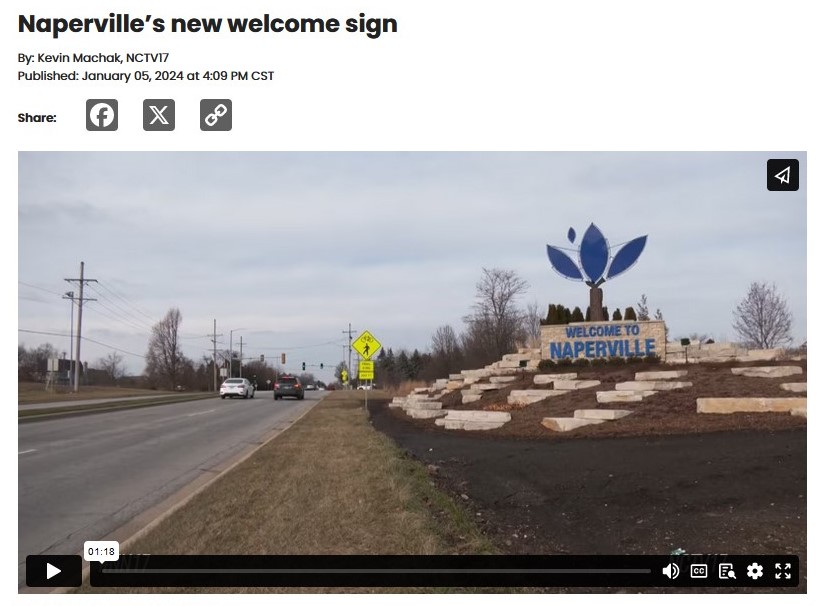
Naperville spent $100,000 for a unique sign welcoming people to the community along its border with Bolingbrook. Amid some concerns from residents about the price, here is information about the sign and the overall budget of the city for 2023. First, the sign:

A freshly-completed “Welcome to Naperville” sign sits along the entry route, just next to the trails among DuPage River Park and just across from DuPage River Sports Complex.

The design stems from the city of Naperville’s official logo of 50 years, which depicts a tree with water running underneath. Surrounding the sign are limestone slabs.  The city plans to add fresh vegetation to the area in the spring.

The new greeting, which costs $100,000, is just one of a number of beautification projects that have been planned for since 2021 and officially budget-approved for since the fall of 2022.  At that time, the city council approved of $250,000 for the Department of Public Works to make multiple improvements throughout the city…

Second, the 2023 budget:

Keeping the current economic climate, our mission, and strategic priorities in mind, the 2023 City of Naperville budget is recommended at $603.46 million, an overall increase of 11.6% from the $540.58 million 2022 budget. Additional capital expenses are the primary driver behind this increased investment in our organization and community. It is worth noting that the 2023 budget leverages existing revenue streams and fiscal policies. No new taxes, fees, or other revenues are recommended to support the 2023 budget proposal.

From my math, this means the sign cost less than one-tenth of one percent of the city’s budget. Even building one of these on each other side of the city – north, east, west – would not take much money.

Is this an unnecessary expenditure? That is a different question. Signs are not necessarily cheap and they can be bland or strange. For example, see this recent one in Naperville for a new subdivision. This new one welcoming people to the suburb is unique with its 3D form and landscaping. Naperville has a history of spending money for parks and beautification: just look at the Riverwalk over time (and I would guess many would say this was a good investment). Additionally, Naperville is a unique suburb that sees itself as having a particular status.

If the goal is to continue to brand the community in a particular way, this sign stands out and is a small fraction of the budget.

How many landmark buildings should a suburb have?

As Napervillians debate the fate of the Scott house, a 156-year-old home constructed by one of the community’s first families, the number of historic landmarks in the suburb stood out:

Photo by Tim Mossholder on Pexels.com

As things stand right now, there are no protections that would prevent future owners from altering or tearing down the house. Its location is just outside of the Naperville Historic District, where regulations dictate standards for exterior home improvements. It is part of a federal historic district, but their rules is not nearly as restrictive, according to the Illinois Historic Preservation Office.

Preservation is possible were it to be made a city landmark, a process open to any Naperville property over 50 years old, but that requires the recommendation of the Naperville Historic Preservation Commission and the approval of the Naperville City Council.

There are only four historic landmarks in Naperville.

Heap said he and his fellow co-owners are keeping options open but acknowledges the house’s future will hinge on who it’s sold to. That also goes for whether Heap’s law practice stays on as tenants.

This is not a new debate in Naperville. As the article notes, the suburb has a historic district that developed over time and through much discussion. Naperville has lots of teardowns where public debate could pit the property rights of the owners against the interests of neighbors or the community.

Is four historic landmarks, then, good or enough? The current four include two houses, one former church, and a former library building. One way to figure this out would be to do some comparing to other suburbs. I do not know these figures but someone or an organization might have them. Another way to think about it is that Naperville has a track record of preserving its past and telling its own story, such as through Naper Settlement and other actors. A third option would be to have some sense of what leaders and residents want concerning landmarks; do they want to save particular structures or have guidelines for more buildings and properties?

The matter of preserving buildings in the suburbs is an ongoing conversation as buildings from a prior era come up against changing conditions and styles. This includes homes (even McMansions eventually?) but also civic buildings and business structures. The American suburbs have had a particular look for decades but there is no guarantee that much or all of that remain in the future unless there are dedicated efforts to the contrary.

Naperville is the equivalent of 4th and 29 for a Bears opponent

Naperville is a highly-ranked suburb but is rarely described in sports terms. On the Fox broadcast of Bears-Lions yesterday, play-by-play announcer Adam Amin invoked Naperville in a difficult late-game situation for the Lions:

Why Naperville? Two quick theories. First, Amin announces a lot of games in Chicago due to being the play-by-play guy for the Chicago Bulls. He would be more familiar with the region and local communities. The Bulls do not have many ties to Naperville but it is the third largest community in the region (after Chicago and Aurora).

Second, Naperville is sufficiently far from Chicago and Soldier Field to be the distance equivalent of needing 29 yards for a first down. Naperville is roughly 30 miles southwest of downtown. Fourth and 40 might get you to Elgin and Fourth and 45 might get you to Joliet. I am up for more yard-to-mileage comparisons in Bears broadcasts though it might work better on a local radio call than a national broadcast.

And if the Bears end up in Arlington Heights or Naperville or another suburb, then can the fourth down distance go the other direction? “It’s fourth-and-Bronzeville” or “fourth-and-Logan Square”.

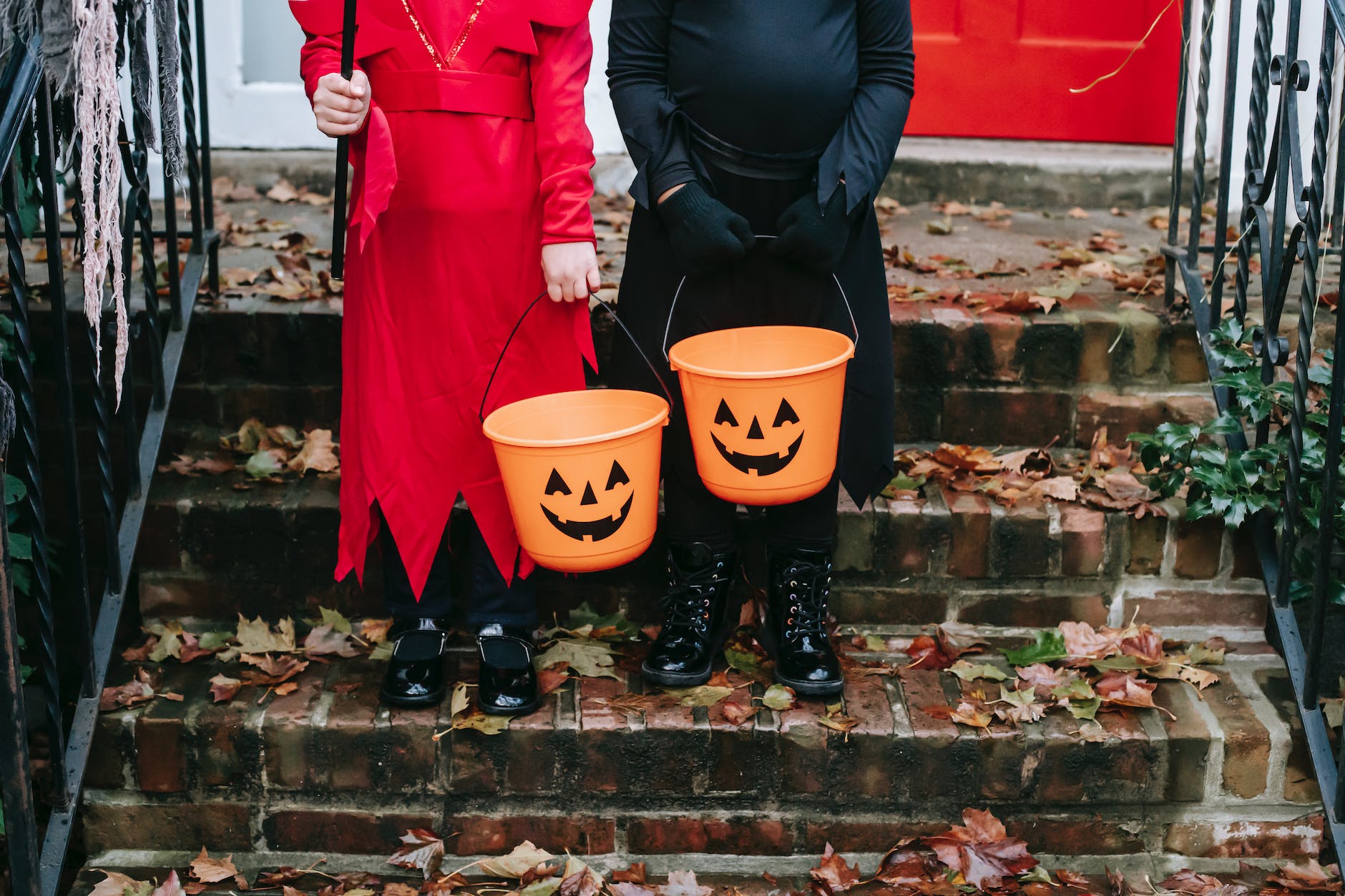
Naperville now top trick-or-treating community in the United States

Naperville has accumulated a number of high rankings over the years and now it can claim to be the best place to trick-or-treat in 2023:

Photo by Charles Parker on Pexels.com

For innocuous thrills and chills, the city is No. 1, according to a recently released study ranking the top safest U.S. cities to go trick-or-treating. The list, compiled by product research company Chamber of Commerce, considers factors like crime, pedestrian deaths and law enforcement presence to determine where a worry-free Halloween is most likely to happen.

Naperville came in first out of more than 300 places evaluated across the country. That’s a step up from even last year, when the city ranked No. 4 on the same tally heading into Halloween 2022…

For Naperville, the company found the city “retains the charm and security of a tight-knit community” with few registered sex offenders, an “excellent record of property crime” and relatively few violent crimes reported across the whole city over the past year.

No word on the quality of candy available among the city’s households and businesses? There has to be some way to get at the experiences of people trick or treating in the community.

This adds to earlier rankings that had Naperville as a best place to live, a good place for families, and high level of wealth within the region.

From the first post-WWII house constructed in Naperville (by Harold Moser) to today

Can one property help highlight the changes in Naperville, Illinois in the last century? I ran into this news item first published May 30, 1946 in The Naperville Sun:

The Moser Fuel and Supply company has just completed the first new house to be built in Naperville since the outbreak of the war in 1941. This “No. 1” house, as it is referred to by Moser employees, is at 417 S. Sleight St., and is a little dream in brick veneer with chocolate-color mortar. Ten other Moser houses are going up around No. 1, eight of which are in the 400 block of south Sleight Street and two on South Wright Street.

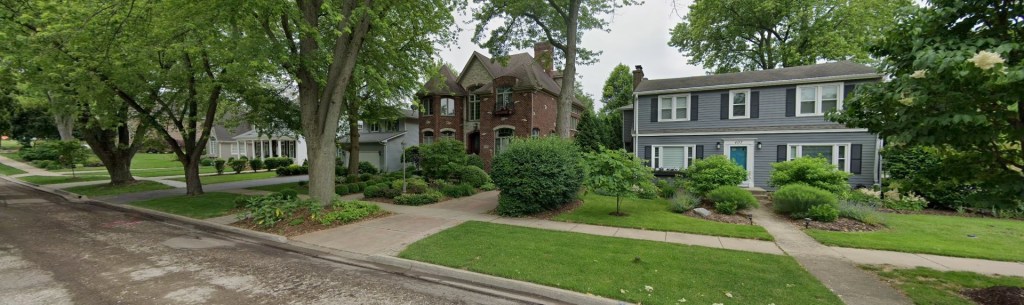
According to multiple real estate websites, the current house on the property was constructed in 2004 and is worth over $1 million. Here is a June 2019 Google Street View image of the block, including the newer home on the property:

Several patterns worth noting:

-Naperville was a different place after World War Two: much smaller in population, lots of farms and agriculture around.

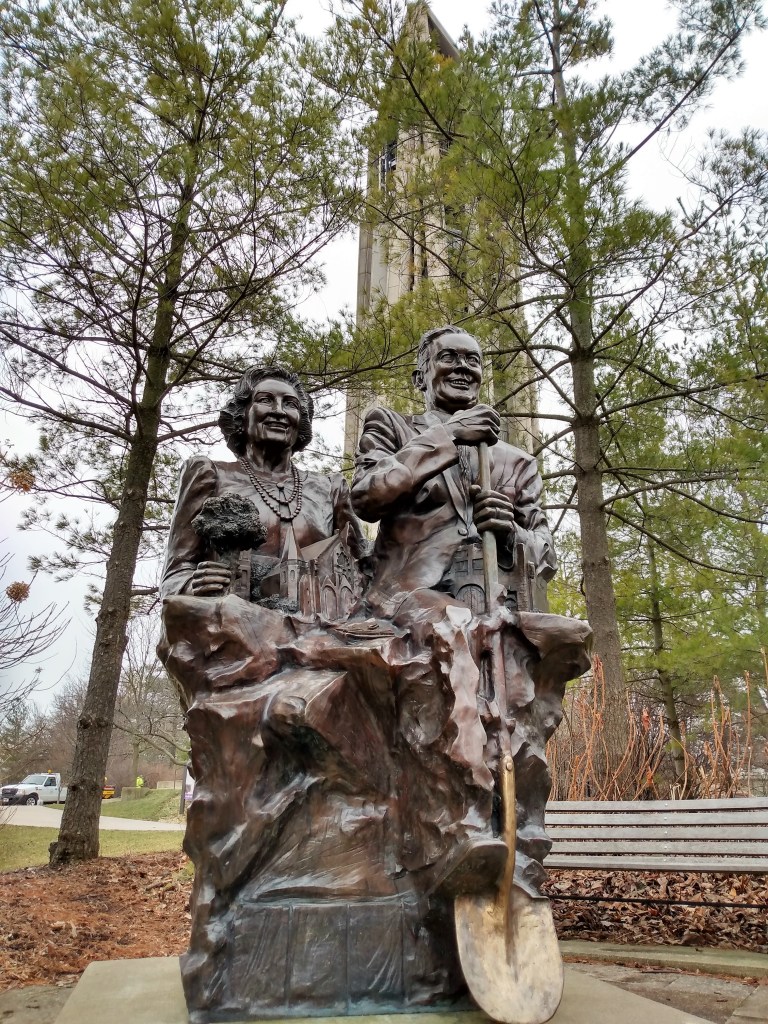
-Harold Moser and his firm ended up building thousands of units in Naperville. Moser Highlands, one of his first subdivisions, is just south of this location. He and his wife are honored in a statue along the Naperville Riverwalk:

-There are lots of teardown homes in Naperville, particularly near the downtown. As Naperville expanded in population and its status grew, some of the older suburban homes built decades earlier gave way to larger structures. I studied patterns in some of these new homes in a 2021 article.

In other words, this was not just one home constructed by a resident who owned a local business; it was part of larger changes to come in a suburb that became large and wealthy.

The ongoing transformation of the Bell Labs site that helped create modern Naperville

A large office building is coming down at the northwestern corner of Naperville and Warrenville Roads in Naperville. This is not just any office building; this is the site that helped jumpstart Naperville’s growth and status. Here are some details on the changes:

Constructed in 2000 at the northwest corner of Naperville and Warrenville roads, the five-story glass and steel complex at one time was touted as a technological hub with the potential to sustain thousands of jobs.

But with the recent arrival of cranes, excavators and other heavy equipment, a new era is beginning for the 41-acre site that’s part of the city’s Interstate 88 corridor.

Oak Brook-based Franklin Partners — which in April finalized the purchase of 1960 Lucent Lane for $4.75 million — in June received a demolition permit from the city to raze the 500,000-square-foot building and the three-story parking garages on either side…

Discouraged by city officials to develop warehouses on the property, Franklin Partners replied by saying it would seek a technology-based alternative.

I describe this property’ contribution to Naperville in a 2016 article titled “A Small Suburb Becomes a Boomburb” in the Journal of Urban History:

The arrival of a high-status tech company on this suburban plot helped give rise to more white-collar employers in Naperville plus numerous subdivisions.

This property has been ripe for change for a while now. Last year, I noted the amount of available parking behind the facility and a new subdivision back there as well (sign for the development, a new park).

It is too simple to say that the fate of this land could do much to affect Naperville’s future trajectory. At the same time, it is a large parcel of land that once helped affect Naperville’s future. It sounds like the city clearly does not want the property to become warehouses, but what could arise here that contributes to a vibrant future?

More suburban sprawl = disappearing night sky

A resident of Naperville, Illinois describes one consequence of the growth of the suburb and the Chicago region:

Photo by Benjamin Suter on Pexels.com

Growing up, Carhart said he learned the intricacies of the Milky Way from his suburban backyard in Naperville. But slowly, the 64-year-old said, he watched the stars disappear. If someone were to visit his childhood home today, he said, they could count the number of stars they see on their fingers…

“The light pollution is tremendously worse. Out by Naperville we could see the glow in the nighttime sky of Chicago off in the distance, but it only went a little ways up in the sky,” he said. “Over the years we watched it get brighter and then extend overhead and all the way to the other horizon and just take over the sky.”

What can help reduce this light pollution in a large metropolitan area?

The National Park Service suggests considering whether outdoor lighting is necessary, or if reflective tape or reflective surfaces could be used instead. Other sustainable outdoor light specifications, according to the Park Service, are LEDs at 2700 Kelvin. These lights emit a warm color hue instead of blue or white. The Park Service also recommends purchasing LED bulbs that have the lowest lumens possible — the unit of measurement used to specify brightness — and ones that can accommodate motion detectors or dimmers, which it says can enhance health and safety…

Referencing a study from 2020 that found only about 20% of a city’s brightness can be linked to streetlights, Walczak said regulation or policies surrounding light pollution should be directed toward commercial businesses, such as parking lots or building facades.

The proposed solutions – and another suggested later in the article that uses special equipment to avoid certain light wavelengths – are efforts to work around the sprawl of the region. If there are over nine million people living in the Chicago region, is it possible to have a visible night sky?

This could be another argument against suburban sprawl. As Americans develop more land outside of cities, light spreads. Homes and yards have lights. Roadways have lights. Buildings have lights.

Naperville’s success – rapid population growth, vibrant downtown, lots of jobs – comes with lights. It could come with less light than it might have now . But, how many suburbanites are willing to trade lights for seeing the night sky? How many lights are for safety purposes that suburbanites care about (roadways, properties, etc.)?

It would be interesting to see some major suburban communities lead the way on this. And it would likely take significant regional efforts or numerous communities going this direction to make a visible difference.