McMansions lead to water runoff damage in Kirkwood, Missouri

The construction of new housing can lead to water issues for existing homeowners. See the ongoing case of Kirkwood, Missouri homeowners dealing with more water due to the construction of McMansions:

Next week, a new Kirkwood water runoff regulation will take effect, but longtime residents say it’s all too little too late…

Like many other longtime Kirkwood residents, Liskew said water began invading her home when new construction started near her neighborhood. Behind her home, she noticed new, large homes—often called ‘McMansions’—were being built on small lots…

That special council created a new storm water management regulation. The ordinance requires all “infill development” to capture rainfall runoff, and submit a plan to the Metropolitan St. Louis Sewer District for review and approval prior to the issuance of any building permits…

And she said it’s been an expensive, never-ending problem to worry about. In addition to several French drains, Liskew has installed a sump pump, taken out basement windows, graded a large portion of her yard and even commissioned a water runoff study to find out where the water was originating. The study found the water was coming from the neighborhood directly behind her home, and heading directly into her backyard.

See an earlier blog post on the Kirkwood situation. To some degree, the construction of any new residential units is likely to affect water runoff. Switching land from non-use or agricultural use to homes, driveways, yards, and streets will have an effect. Add to that the pejorative term McMansions used here: big homes take up more space and in the interest of keeping water away from them even more water is channeled elsewhere.

I sometimes wonder if the way water issues in suburbia work is like this: every new development attempts to push the water somewhere else and the problem simply moves onto someone else’s property. Generally, developers and municipalities do their best to move the water away from existing buildings and uses but this may not be possible depending on the topography and existing infrastructure. Cleaning up the water issues after the fact – such as in Kirkwood or the Deep Tunnel project in the Chicago region – is costly and very frustrating. But, without a commitment to avoid sprawl or widespread adoption of greener techniques, the water problems will just get pushed down the road. Flooding will continue to be a major suburban problem.
Lawns as sources of and signs of boredom

In a discussion of the development of the concept of boredom in The Tech-Wise Family, Andy Crouch explores the boredom of the lawn:

This world is lost to many of our children, and to ourselves. Even the “nature” that surrounds many of our homes is shallow in a technological way. A typical suburban lawn depends on many technological devices, each of which makes something far easier than it was for previous generations: lawn mowers, pesticides and fertilizers, highly refined seed, and automatic sprinklers. The lawn itself is a kind of outdoor technological device, composed of uniform green grass, kept crew-cut short, with little variety or difference.

A peasant family in the Middle Ages had none of this technologically uniform pleasantness. They would not have had a lawn, or possibly even a yard. Their children would have wandered out into meadows and perhaps the thin edges of forests. A meadow has countless different species of grasses and other plants, plus flowers in the spring and summer, of different heights and habits. If you pay attention, you cannot possible get bored in a meadow. It is all too easy to be bored on a lawn…

It is surely not coincidental that all the earliest citations of the word bore in the Oxford English Dictionary – from the mid-eighteenth century – come from the correspondence of aristocrats and nobility. They did not have technology, but thanks to wealth and position they had a kind of easy everywhere of their own. The first people to be bored were the people who did not do manual work, who did not cook their own food, whose lives were served by others. They were also, by the way, the very first people to have lawns. (144-145)

The common American lawn is indeed a peculiar piece of “nature.”

The connection between lawns and technology is helpful, particularly since this link is likely lost amidst all the new technology of recent decades. Yet, having a lush and short lawn requires a lot of tools and innovation that many now take for granted. I’m reminded of running into advertisements between competing grass seeds: there is a lot that goes into the components of the lawn.

It also strikes me that the lawn has become increasingly boring in recent decades. It is true that American children in the last 70 years had very different experiences with nature than Middle Age peasant children (though humans have affected nature throughout history and contexts). At the same time, children today spend less time outdoors and utilize those boring lawns even compared to just a few decades ago. Perhaps we could argue that the lawn never offered much and once the world of television, video games, and fears about safety set in, it was exposed for the boring item it really is.

Finally, the lawn continues to be a status symbol just as it once marked the properties of the wealthy. Those with lawns have pressure to keep their lawns free of weeds and leaves and can differentiate their lawn from those of others. Failing to follow these norms can lead to problems.

Every house should come with pictures of the land before houses were built

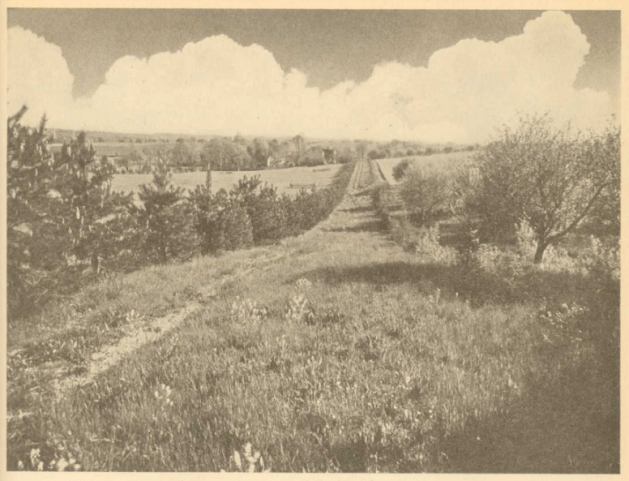
While recently working on a research project, I found 1930s pictures of the place where my in-laws live. Later the home to a master-planned suburban community, the picture presents quite an alternative vision:

SuburbanFields

Having such images could help give current suburbanites a better sense of what came before their home as well as some insight into how their home fits into an altered landscape. There would be some continuity between then and now – similar natural elements including wildlife, foliage, and topography – and notable differences such as the presence of modern roads and buildings.

Tracking down these images is often not easy. Many communities have historical societies or museums that keep such images. To see them, a community member or researcher would have to go ask for them. (And there is no guarantee they have pictures of every property; they are likely to have pictures of the more famous buildings in town.) Searching online can reveal some old maps and images of places but much of the material of local historical groups is not kept online.

“The conceit of the American suburb is that we’re all in a great park together”

In a recent documentary, Michael Pollan discusses the American lawn:

“The conceit of the American suburb is that we’re all in a great park together,” Pollan says in the film. “The lawn symbolizes that continuity.” And yet, Pollan explains, despite the fact that lawns are the largest irrigated crop in the country, Americans tend to avoid spending time on them.

“Pollan raises this question in the film about what our relationship with our front lawn says about our relationship with our neighbors,” Fabrizio told The Atlantic. “I find that really interesting. We don’t go out on our front lawn; we hunker down in the back where no one can see us. I wonder what that says about us and how we all get along these days.”

The lawn of the single-family American home often serves two purposes:

1. A supposed connection to nature. It is evidence that suburbanites want to be away from the city and all its pollution, concrete, and density and instead want to connect with nature. This has a long history in American suburbs dating back to the mid-1800s ideas that suburban homes should be cottages in the woods. The fact that well-manicured lawns do not occur “naturally” in nature does not matter much here.

2. The lawn is a showpiece that is intended to both enhance the impression and value of the home as well as indicate how much the property owner cars about their investment. Regular care and maintenance, usually aimed at producing a green, lush, and relatively low-cut lawn free of weeds and edged by attractive bushes and flowers, broadcasts a message about the class status of the owner.

As Pollan suggests, the front lawn is then not really for use, either by the community (like a park) or the homeowners (who would prefer to limit their outdoor activities to the more private space in back). Indeed, certain activities in the front would be quite odd, such as grilling in the front of the house or placing a swings set in the front lawn.

Indicating social class by having no leaves present on the lawn

Now that blooming dandelions are not a threat and warmer weather and thick green grass is less common, how can the suburbanite indicate his social class through his or her lawn in the fall and keep it a notch above his or her neighbors? No leaves may be present.

Within the next month or so in the Chicago region, leaves will fall at varying rates and cover lawns. These could be leaves from trees in that yard or, given occasional high winds, leaves from several houses away. They could be wet or dry, big or small, green, red, orange, or other shades. And Americans will spend countless hours trying to corral them all, stuff them in bags or bins, and ship them somewhere else.

Why? Because even in the fall, a season that can be good for growing grass, the sanctity of the lawn must be upheld. Even as trees and bushes grow sparse and the flowers that once adorned the property wither, the well-kept lawn is important. Rakes must be employed. Blowers can be even better (at least when the leaves are drier) to efficiently move large amounts. Mowers can be used not only to keep that grass looking uniform but to mulch leaves.

And the best fall lawns, the ones showing the suburbanites of a higher social class or those who care the most about their property (values), will have no visible leaves. They are a blemish and may be removed daily. Carpets of leaves may be pretty in more natural settings but not on the suburban lawn: it must continue to show off the home and its owner until either covered by snow or gone dormant for the winter.

People can live in modernist glass houses…if they have 6 acres in the woods

I have argued Americans prefer McMansions to modernist homes. Another reason this might be the case: the glass modernist house works better on certain kinds of properties.

But it wasn’t until they found the perfect piece of property in the Lake Minnetonka community of Woodland that they were able to make their glass house dream a reality.

They’d been planning to sell their three-story Arts & Crafts-style home in Orono, and were on the hunt for secluded, wooded acreage in the western suburbs…

In 2012, a 6-acre property with wetlands, a bog and a small lake popped up on the MLS. The land, which was in foreclosure, was in Woodland.

Kathleen was entranced by the tiny woodsy hamlet of twisting and turning roads. So, the couple consulted architect Tim Alt of ALTUS Architecture + Design about the property. He advised them to go for it.

This home holds all kind of appeal to modernists: black, low to the ground, lots of windows, multiple wings for different uses, and utilizes materials that fit with the unique natural setting. Yet, how realistic is it to expect such a home to be located near other homes? Even residents who like such architecture are unlikely to sacrifice all their privacy by living in this home within a traditional neighborhood. Americans like single-family homes partly because of the privacy they tend to offer away from prying eyes of neighbors of the government.

Then, finding the right kind of property – away from other homes, attractive nature views – becomes an extra burden or set of resources required for this kind of modernist home. These requirements likely mean it is outside the reach of many homeowners. The modernist home becomes the elite home.

All this means that it is unlikely such homes will be popular. Perhaps this was already clear since one of the models for the Minnetonka home dates back to 1949 and that design is not exactly all over the place. Such modernist homes will continue as curiosities or give people a home to aspire to even as they continue to buy mass-produced McMansions and ranches.

Cities, animals, and intelligence

Research regarding the effect of cities and urban areas on wildlife can be fascinating. See the discussion about how cities could affect the intelligence of different animals:

One of the great mysteries of urban adaptation is what, if anything, living in cities does to animal minds. Research on urban wildlife has already shown that cities can have jaw-dropping effects on animals’ behavior. Gehrt’s coyotes have not only learned where it’s safest to cross roads, but have also learned to avoid traffic based on its speed and volume. Do behavioral shifts like this reflect deeper changes in how urban animals think? In what urban animals are?

These questions vex the small subset of wildlife ecologists that is wading into the murky waters of urban-animal intelligence. In several metropolitan areas, researchers have devised simple puzzles—usually difficult-to-open boxes of food—in order to compare the problem-solving abilities of city-dwelling creatures with those of their wild relatives. The results have been tantalizing: Urban animals as varied as Canadian raccoons and Barbadian bullfinches can outperform their rural counterparts. While it pays to be cunning in almost any setting, some scientists propose that foreign, volatile environments like cities demand an especially broad range of cognitive abilities. Eventually, the thinking goes, cities may bend evolution enough to make whole populations of animals within them smarter—if, of course, the animals can survive city life in the first place.

This is a controversial theory. Even researchers who back it are quick to warn that intelligence is complicated. No one is suggesting that new situations are the only driver of animal smarts: The ways animals interact, how they learn from one another, and the nature of their physical surroundings are all thought to influence how individual animals behave and how their brains take shape over generations, no matter where they live…

But studying animals in new environments may help scientists develop a definition of intelligence that applies across species. Along with others in her field, Benson-Amram has zeroed in on flexibility, long considered an essential criterion for intelligence. “When the environment is changing, you’re able to change your behavioral response, and you don’t perseverate on old responses that used to work but no longer do,” Benson-Amram says. This way of defining intelligence—which researchers also call “behavioral plasticity”—is notably distinct from what could be considered an animal’s specific intelligence. A scrub jay that hides away thousands of seeds and remembers the location of each one certainly has a particular kind of acuity, Benson-Amram notes. But an animal needs a diverse, general set of mental skills—perceptiveness, resourcefulness, foresight, and so on—to tackle the foreign obstacles of cities, she posits.

A simplistic popular approach to these questions might say this: cities and urban development is simply bad for animals and nature. Because such development takes up land and subjects it to particularly harmful uses (pollution, poor water run-off, etc.), humans should limit their development and its effects.

On the other hand, this research and others suggests human-wildlife interaction can be quite complicated. And could it even possible lead to positive change for some animals? I’m also thinking of the book Subirdia which suggests some bird species do well in urban environment even if others do not.

Humans may have the upper hand here and have done some pretty destructive things regarding the environment in recent years. Yet, in the long run, both humans and wildlife adapt to each other.

Why Americans love suburbs #7: closer to nature

A consistent appeal of suburbia for many Americans is to be closer to nature and green space. While suburbanites appreciate their proximity to urban amenities without having to actually live in the big city, they also often appreciate more open space and closeness to nature. American suburbanites may be out of touch with nature and children may be exposed to less nature these days but the suburbs are viewed as offering access to nature just outside the single-family home.

As cities grew in the nineteenth century, they became dirty places. While this is an ongoing issue in many large cities still (think smog in Paris or air quality in Beijing), these growing cities had particular problems including how to construct sewers (Chicago’s efforts in battling excrement helped it grow), dealing with waste from all the horses, and soot (see pictures of Pittsburgh turned dark in the middle of the day). The suburbs offered some distance from the grime of the city and more proximity to pristine nature.

Exactly what kind of nature suburbanites experience is up for debate. As one critic of suburbia suggests, the suburbs often involve “nature band-aids.” Suburbanites may be interested in farms or “agrihoods” but the average suburban dweller has a small plot of land around their home. I am reminded of one situation I discovered in my research on suburban development where residents of a newer subdivision complained vociferously when the adjacent cornfield turned into a new development. This common process of suburban development – more agricultural or rural land or open space is turned into sprawl – can frustrate many residents.

One consistent experience involves using and caring for the lawns that surround many single-family homes. The green lawn is an important symbol of the owner’s social class as well as a space for outside recreation. Caring for the lawn is vitally important. Neighborhoods and communities exert pressure. Residents make sure their lawns are green in a variety of conditions ranging from watering during droughts, painting their lawns, and searching out the best seeds. They often have plenty of trees, prized by suburbanites for their foliage, functioning as key symbols of nature, and ability to define edges of properties and hide views of others.

Beyond lawns, suburbanites are often interested in parks, forest preserves, and green spaces. Theoretically, these uses limit the possibility that the green space can be turned into other uses. Even somewhat protected green space like a golf course can provoke concerns if it is turned into something else. Additionally, these spaces enhance property values of single-family homes, allow space for children to play, and can become sites of local social activity. Some of these places can offer more authentic nature (less controlled by humans) though many of these sites are carefully kept. Furthermore, even in these preserved spaces, it is difficult to truly escape the suburban noise and evidence of civilization.

Sometimes, nature can be perceived as the enemy of suburbanization. A great example is dealing with water. Flooding is a persistent issue. More housing alongside roadways and parking lots do not allow water to soak into the ground. Think the Houston area after a hurricane. In spaces with less human activity, flooding and waterways changing course do not have the devastating or annoying effects that they can in suburbia. Turning land into suburbia can have the effect of bulldozing over natural ways of dealing with water and instead trying to channel it or eliminate it around homes and other uses. This is not always successful and much money can be spent on the issue. For example, the Deep Tunnel project in the Chicago region is a massive civil engineering project born out of urban and suburban development.

Of course, the opposite can be true as well: suburbanization can be the enemy of nature. Rachel Carson’s influential work emerged by suburban settings. At the same time, nature itself can also adapt to suburbanization. The wildland-urban interface can move as creatures like coyotes, deer, baboons, and birds adapt to human activity.

While critics of suburbs may not understand why suburbanites cannot see the ugliness of sprawl, many Americans believe the suburbs offer a little more natural space in which to move and breathe.

Suburbs, “mutilated urbanism,” and “nature band-aids”

James Howard Kunstler’s TED Talk “The Ghastly Tragedy of the Suburbs” includes a discussion of the role of “nature” in suburbia. This excerpt starts at about 10:15 into the talk:

Then because the relationship between the retail is destroyed, we pop a handicapped ramp on that, and then to make ourselves feel better, we put a nature band-aid in front of it. And that’s how we do it.

I call them nature band-aids because there’s a general idea in America that the remedy for mutilated urbanism is nature. And in fact, the remedy for wounded and mutilated urbanism is good urbanism, good buildings. Not just flower-beds, not just cartoons of the Sierra Nevada mountains, you know, that’s not good enough. We have to do good buildings.

(photo: two pictures of tree lined pedestrian paths, caption: “Role of ‘Green’ In City Center Is Formal”)

The street trees have really four jobs to do, and that’s it. To spatially denote the pedestrian realm, to protect the pedestrians from the vehicles in the carriage-way, to filter the sunlight onto the sidewalk, and to soften the hardscape of the buildings and to create a ceiling -a vaulted ceiling- over the street, at its best. And that’s it. Those are the four jobs of the street trees. They’re not supposed to be a cartoon of the north woods, they’re not supposed to be a set for The Last of the Mohicans. You know, one of the problems with the fiasco of suburbia is that it destroyed our understanding of the distinction between the country and the town, between the urban and the rural. They’re not the same thing. And we’re not gonna cure the problems of the urban by dragging the country into the city, which is what a lot of us are trying to do all the time.

(new photo, unshown on screen)

Here you see on a small scale- the mother-ship has landed, R2D2 and CP3O (sic) have stepped out to test the bark mulch to see if they can inhabit this planet.

This last paragraph, in particular, always gets me: comparing two lonely bushes stranded in a suburban streetscape to aliens is funny.

But, his larger point holds: suburban settings often use nature as a possible enhancement and often afterthought rather than a fundamental feature of the space. Why save original trees when you can just plant new ones later? If there is not enough greenery, add a flower bed and some bushes. Make sure the suburban yards are always lush and green (even if this does not really happen in nature). Put in some parks here and there so people can experience wildlife displaced from other settings.

The suburban nature millions of Americans see on a daily basis is not the real nature that was once in these locations (though you would have to go back quite a ways before any human intervention and this is important to remember) or that could be there given different choices by local officials, developers, and residents.

Rachel Carson’s Silent Spring emerged from suburbia

Rachel Carson’s influential Silent Spring may have emphasized nature but according to Crabgrass Crucible: Suburban Nature and the Rise of Environmentalism in the Twentieth Century, the suburbs played an important role:

As global a vision as one might concoct, Silent Spring nevertheless had its firmest roots in suburban locales. The letter sparking Carsons’s commitment to write the book came from a woman in suburban Boston who had watched a DDT spraying decimate the birds in her own and her neighbors’ yards. Carson also drew heavily on the 1957 anti-DDT lawsuit on Long Island. Her research began with the trial transcript, and Marjorie Spock, leader of the lawsuit, then became Carson’s “chief clipping service.” The web of experts Spock had brought in to testify at the trial served as Carson’s own. They and others on whom Carson most relied lived and worked in suburbs, including Dr. Morton Biskind of Westport, Connecticut, and Wilhelm Hueper, at the National Institutes of Health headquarters in Bethesda, Maryland. Even Carson herself was, arguable, a suburbanite: though she loved her spot on the Maine coast, she spent most of the year in Silver Spring, Maryland, on the edge of Washington, D.C.

Silent Spring reached out to suburban readers in a host of ways, both subtle and overt. Ignoring cities, limiting her invocations of the urban to “a small town in the heart of America,” Carson flattered the conceit of the suburban better-off that their homes were not in any “suburbia,” that they led essentially nonurban lives. Factories also feel into the shadowy backdrop: quick-striking maladies and death among workers appeared only briefly and in passing. Dwelling at much great length on cancer and other chronic ailments, more likely to trouble a suburban readership, she studiously avoided mention of infectious diseases, whose absence suburb dwellers of this period, at least in metropolitan New York and Los Angeles tended to take for granted. On shifting from dangers to human health to threats to wildlife, Carson explicitly summoned the self-interest of the “suburbanite.” For the “suburbanite who derives pleasure from birds in his garden,” she wrote, “anything that destroys the wildlife of an area for even a single year has deprived him of a pleasure to which he has a legitimate right.” (256-257)

These two paragraphs remind me of several aspects of American suburbs:

  1. Given that more Americans lived in suburbs than cities by the early 1960s, does this simply reflect the movement of Americans in large numbers to suburbs?
  2. Could the wealth of suburbia – the ability to own a home, have a middle-class or higher lifestyle – provide more resources to pursue causes like environmentalism compared to being concerned with subsistence in other settings?
  3. From the beginning of American suburbs, they were touted as spaces close to nature. This argument was primarily made in comparison to cities which by the late 1800s were viewed as dirty and overcrowded. (Of course, the nature of suburbia has always been carefully shaped by humans rather than being untamed nature.)

More broadly, nature and the environment likely looks different from the suburbs than from urban or rural settings. If Sellers is correct in his argument about Silent Spring‘s suburban roots, perhaps it should be more widely read with the suburban context in mind.