Suburbs, “mutilated urbanism,” and “nature band-aids”

James Howard Kunstler’s TED Talk “The Ghastly Tragedy of the Suburbs” includes a discussion of the role of “nature” in suburbia. This excerpt starts at about 10:15 into the talk:

Then because the relationship between the retail is destroyed, we pop a handicapped ramp on that, and then to make ourselves feel better, we put a nature band-aid in front of it. And that’s how we do it.

I call them nature band-aids because there’s a general idea in America that the remedy for mutilated urbanism is nature. And in fact, the remedy for wounded and mutilated urbanism is good urbanism, good buildings. Not just flower-beds, not just cartoons of the Sierra Nevada mountains, you know, that’s not good enough. We have to do good buildings.

(photo: two pictures of tree lined pedestrian paths, caption: “Role of ‘Green’ In City Center Is Formal”)

The street trees have really four jobs to do, and that’s it. To spatially denote the pedestrian realm, to protect the pedestrians from the vehicles in the carriage-way, to filter the sunlight onto the sidewalk, and to soften the hardscape of the buildings and to create a ceiling -a vaulted ceiling- over the street, at its best. And that’s it. Those are the four jobs of the street trees. They’re not supposed to be a cartoon of the north woods, they’re not supposed to be a set for The Last of the Mohicans. You know, one of the problems with the fiasco of suburbia is that it destroyed our understanding of the distinction between the country and the town, between the urban and the rural. They’re not the same thing. And we’re not gonna cure the problems of the urban by dragging the country into the city, which is what a lot of us are trying to do all the time.

(new photo, unshown on screen)

Here you see on a small scale- the mother-ship has landed, R2D2 and CP3O (sic) have stepped out to test the bark mulch to see if they can inhabit this planet.

This last paragraph, in particular, always gets me: comparing two lonely bushes stranded in a suburban streetscape to aliens is funny.

But, his larger point holds: suburban settings often use nature as a possible enhancement and often afterthought rather than a fundamental feature of the space. Why save original trees when you can just plant new ones later? If there is not enough greenery, add a flower bed and some bushes. Make sure the suburban yards are always lush and green (even if this does not really happen in nature). Put in some parks here and there so people can experience wildlife displaced from other settings.

The suburban nature millions of Americans see on a daily basis is not the real nature that was once in these locations (though you would have to go back quite a ways before any human intervention and this is important to remember) or that could be there given different choices by local officials, developers, and residents.

Rachel Carson’s Silent Spring emerged from suburbia

Rachel Carson’s influential Silent Spring may have emphasized nature but according to Crabgrass Crucible: Suburban Nature and the Rise of Environmentalism in the Twentieth Century, the suburbs played an important role:

As global a vision as one might concoct, Silent Spring nevertheless had its firmest roots in suburban locales. The letter sparking Carsons’s commitment to write the book came from a woman in suburban Boston who had watched a DDT spraying decimate the birds in her own and her neighbors’ yards. Carson also drew heavily on the 1957 anti-DDT lawsuit on Long Island. Her research began with the trial transcript, and Marjorie Spock, leader of the lawsuit, then became Carson’s “chief clipping service.” The web of experts Spock had brought in to testify at the trial served as Carson’s own. They and others on whom Carson most relied lived and worked in suburbs, including Dr. Morton Biskind of Westport, Connecticut, and Wilhelm Hueper, at the National Institutes of Health headquarters in Bethesda, Maryland. Even Carson herself was, arguable, a suburbanite: though she loved her spot on the Maine coast, she spent most of the year in Silver Spring, Maryland, on the edge of Washington, D.C.

Silent Spring reached out to suburban readers in a host of ways, both subtle and overt. Ignoring cities, limiting her invocations of the urban to “a small town in the heart of America,” Carson flattered the conceit of the suburban better-off that their homes were not in any “suburbia,” that they led essentially nonurban lives. Factories also feel into the shadowy backdrop: quick-striking maladies and death among workers appeared only briefly and in passing. Dwelling at much great length on cancer and other chronic ailments, more likely to trouble a suburban readership, she studiously avoided mention of infectious diseases, whose absence suburb dwellers of this period, at least in metropolitan New York and Los Angeles tended to take for granted. On shifting from dangers to human health to threats to wildlife, Carson explicitly summoned the self-interest of the “suburbanite.” For the “suburbanite who derives pleasure from birds in his garden,” she wrote, “anything that destroys the wildlife of an area for even a single year has deprived him of a pleasure to which he has a legitimate right.” (256-257)

These two paragraphs remind me of several aspects of American suburbs:

  1. Given that more Americans lived in suburbs than cities by the early 1960s, does this simply reflect the movement of Americans in large numbers to suburbs?
  2. Could the wealth of suburbia – the ability to own a home, have a middle-class or higher lifestyle – provide more resources to pursue causes like environmentalism compared to being concerned with subsistence in other settings?
  3. From the beginning of American suburbs, they were touted as spaces close to nature. This argument was primarily made in comparison to cities which by the late 1800s were viewed as dirty and overcrowded. (Of course, the nature of suburbia has always been carefully shaped by humans rather than being untamed nature.)

More broadly, nature and the environment likely looks different from the suburbs than from urban or rural settings. If Sellers is correct in his argument about Silent Spring‘s suburban roots, perhaps it should be more widely read with the suburban context in mind.

Now that the dandelions are almost gone, how lawn owners of different social classes can set themselves apart

I argued nearly two months ago that how different households treat dandelions in their yard could be a sign of their social class. Now that dandelion season is mostly over in our area, how might homeowners continue to exhibit their social class through their lawns?

  1. Green grass. Significant patches or brown spots are not good signs of a higher social class. This reminds me of celebrities and leaders in California caught with very green lawns even during a severe drought.
  2. The lawn should be cut to a good height regularly and meticulously trimmed. And this should probably done by someone else to indicate a higher social class.
  3. Sprinkler systems, soaker hoses, and elaborate ways to water the grass and plants indicate both caring more about the lawn as well as additional money to pull it off.
  4. Attractive plants, bushes, and trees. Many a real estate listing says yards are “professionally landscaped” but the implication is that more professionalism in this area – presumably related to expertise, thought, and effort – improves the quality of the property. A nice house with a sizable yard that is only the greenest lawn is likely not going to be as desirable as the greenest lawn complemented by other natural features.

Now that I have listed these options, I wonder at what point these different measures must be done in certain neighborhoods and communities. Imagine having a brown lawn in a less desirable neighborhood versus a ritzy one or being the one with a million dollar home who still cuts the lawn and trims the edges on their own. Perhaps there is a baseline of lawn care expected in most American locations and then extra features accrue depending on local practices and social class.

The never-ending summer hum of lawn mowers, construction, ACs, pressure washers, and more

As soon as the weather started turning warmer, the summer drone began. Not crickets or the sounds of children playing baseball or swimming at the pool. Rather, it was the background noise of summer that seems unavoidable for months: in a suburban subdivision with numerous nearby subdivisions, there is always someone within a relatively short distance using a lawnmower, a weedwacker, a pressure washer, or construction equipment. The noise starts as early as 7:30 AM and stops around 8 PM.

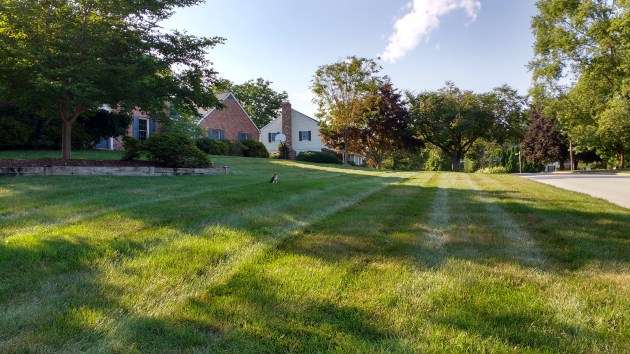
The typical idyllic summer looks something like this with green lawns, sunshine, and peaceful looking homes:

Lawn

But, this image fails to include the background noise that is ever present. That noise is often less than idyllic, particularly if it is close and/or persistent.

I know the expectation of having quiet is one that is not possible in many settings, particularly in urban areas. Many American residents have little exposure to true quiet (and may even find it unnerving). But, the early suburban ideal of the mid 1800s was to help urban residents get back to nature (or an altered environment that fit certain standards of “nature). That quiet of nature – rustling trees, bird calls, insects, stillness – is simply not possible in most suburban settings today either. Some of this is due to location and the need to locate near major roads or other land uses (such as commercial or industrial properties). Some is due to the rise of air conditioning which made development possible in certain climates. Yet, it also comes from all the maintenance required for single-family homes and their environment. Home upkeep to typical standards, such as a good looking lawn, is aided by noisy tools.

I thought recently about having noise free days in suburban neighborhoods. Could everyone in a certain portion of a community schedule their outdoor maintenance for two or three days a week? This would make it more difficult to schedule things but the trade-off could be less noise for everyone. This could work with homeowner’s associations since they already contract for regular lawn service that typically happens on the same day each week. Imagine residents could have at least one weekday in which they knew the only noise outside would be from vehicles – would it be a better experience?

Fight McMansions to slow down the sixth mass extinction

A letter to the editor in the Eugene Weekly links McMansions and broad environmental concerns:

We’re living through the sixth mass extinction. We see this firsthand in Lane County. Oak savannah is the most endangered habitat in the United States…

In this context, a group of neighbors and I are fighting a multi-million dollar “McMansion” development project in our area. “The Vineyards at Gimpl Hill” describes itself as a selection of “gracious estates” for “secure, sophisticated country living … the premier development in Lane County for discerning people.”

This project will destroy or impact 80 acres of prime wildlife habitat home to deer, elk, bears, cougars, wild turkeys, bobcats and a wide variety of other species.

Destroying large areas of habitat and impacting the area with higher traffic and additional access roads is a course of action I cannot support. These ostentatious houses will cost millions, and the developer (Roy Carver) stands to make millions more.

On one hand, 80 acres of land is a drop in the bucket of land in urban areas in the United States. On the other hand, this argument involving McMansions is a common one: McMansions represent the senseless sprawl that is gobbling up land, threatening wildlife, and contributing to our destruction of the environment.

I also suspect that because these homes are larger and more expensive (as well as more profitable, as this letter notes), they tend to get more attention in the same way that McDonald’s and Walmart receive attention for their environmental impact in their own sectors (fast food restaurants and retail stores, respectively). Sprawl over the past century or so in the United States involves a broad range of homes and other buildings, not just the big homes for the wealthy.

It also helps in this case to have a pejorative term for these large homes. They are not just “luxury homes” or places where wealthier people live; they are mass-produced, inferior quality homes that do not deserve the space they are taking up.

Finally, I wonder what the more compelling environmental appeal is to other locals: is it better to refer to (1) massive-scale change like the sixth mass extinction, (2) the loss of local nature (land and animals), or (3) the unnecessary use of land and resources for these larger homes? I suspect each of these could appeal to different people.

The number of dandelions in the yard as an indicator of social class

It is the time of year around here when dandelions are sprouting now that we have some warmer weather and rain. If you walk, bike, or drive around, it is not hard to spot stark differences between yards with no dandelions and those with a lot of dandelions. Here are some quick connections between the number of dandelions and social class:

  1. There are certain expectations in the United States, particularly in suburbs, about lawns. Americans are obsessed with lawns: it must be green (even under drought conditions), of a certain height (lest you violate local ordinances), and free of weeds. It is big business to help Americans keep their lawn looking good. Residents experience pressure from neighbors to keep their lawn nice. Even senators can be attacked for not keeping their lawn in a way that pleases the neighbors.
  2. Those with more money can more easily (a) pay for lawn care and treatments as well as (b) pay for lawn care products that they apply themselves. It is not necessarily cheap to keep a pristine lawn. It is not just a matter of avoiding dandelions but having lush greenery all around, consistency in the kind of grass, and a regularly manicured height.
  3. A nicer and larger lawn is connected to wealth and social class. It is a signal of the homeowner’s ability to tame and maintain nature. It supposedly shows they care about their property. It suggests they want to present a tidy image, which is always connected to property values.
  4. As a test of numbers 1-3 above, imagine trying to sell a decent priced house in a major metropolitan area where the yard is just covered in dandelions. Even if the house is in good shape, wouldn’t all those dandelions harm the image of the home? How many realtors would want to present an image of a lawn filled with dandelions to prospective buyers?
  5. Homeowner’s associations for townhouses, condos, apartments, and houses tend to do a good job of keeping dandelions in check. I assume this has to do with keeping up a positive appearance for the community. Fewer dandelions means a better image, more exclusivity, and higher rents or prices.
  6. The landscaping on our campus tends to look really good around graduation time when plenty of families and visitors are in town. The dandelions are largely in check.

In sum, I would suggest that the dandelion-free yard is yet another American status symbol. Just as people passing by might infer the social class of residents based on the size of the dwelling and the exterior appearance and the cars in the driveway, the number of dandelions may be used as a marker of social class.

(There certainly could additional factors that influence the number of dandelions in the yard. In addition to resources as noted above, addressing the dandelions requires time and physical ability which could be in short supply for a variety of reasons.)

Lawn, yard issues affect even senators living in exclusive gated communities

The attack on Senator Rand Paul by his neighbor may have involved disagreements about yard maintenance:

That day may have come last month, when Boucher’s attorney said in an interview his client attacked Paul over long-simmering disagreements between the two about the care of grass, trees and other landscaping on their adjacent properties in an exclusive gated community…

“There is absolutely no political motivation behind this,” said Boucher’s attorney Matthew J. Baker. “It all stems from maintenance, or lack of it, at these two neighboring properties.”…

Skaggs said Boucher was exacting about the standards for his yard — landscaping bags filled with waste were a common site on his property. Neighbors said Paul had a reputation for a more relaxed style that some felt didn’t always jibe with a community that features gas lamps, Greek statuary and a 13-page packet of rules.

The senator had a pumpkin patch, compost and unraked leaves beneath some of his trees. Goodwin said it annoyed Boucher that Paul did not consistently cut his grass to the same height, and leaves from Paul’s trees blew on his property.

Early on in the article, this dispute is described as “the type of small-time neighborly conflict that has vexed many a suburban relationship.”

To some degree, this is why people move to gated communities or places with homeowner’s associations: they expect that the level of wealth or quasi-governmental oversight will relieve of problems with their problems. Instead of having to talk with their neighbors about potential problems, the issues are covered by community rules that can be enforced by a party that does not live on the property. And people often think that their property values are on the line: if my neighbor has a scraggly pumpkin patch or doesn’t rake their leaves, then I am going to be hurt by their lack of action that can clearly be seen from my house.

Still, even if such disputes are common, it is rare that they would reach the level of physical assault. More common is what the article describes as a lack of communication between the neighbors for years, what Boucher’s lawyer called “a cold war of sorts.”

Linking environmental degradation and McMansions

A recent op-ed discussing how to respond to the extinction of species suggested building McMansions is not the way to go:

The solution is simple: moderation. While we should feel no remorse about altering our environment, there is no need to clear-cut forests for McMansions on 15-acre plots of crabgrass-blanketed land. We should save whatever species and habitats can be easily rescued (once-endangered creatures such as bald eagles and peregrine falcons now flourish), refrain from polluting waterways, limit consumption of fossil fuels and rely more on low-impact renewable-energy sources.

This is an interesting perspective of McMansions: they all include clearing broad swaths of land for giant houses and large lawns. If they all had 15 acres, these would be some pretty expensive McMansions. Indeed, I’m guessing these would be far out of the reach of the typical McMansion buyer (or builder) and this is territory for the true mansions.

At the same time, it hints at one of the key critiques of McMansions: they are an unnecessary use of resources. Because of their large size, they often require sizable plots of land to add the yard that is often required for American single-family home life. This does not even include how the resources to build the McMansion were procured. McMansion critics would often rather to build denser housing on smaller lots with more sustainable materials rather than carve out a large domain for one home in a large house.

Presumably, there is some middle ground between 15 acre McMansions and more acceptable McMansions. What if they did have much smaller lots? (This then often leads to complaints that they are too big for their lot.) What if they could be made with sustainable materials? What if they could be net-zero energy homes? What if they were built in denser areas where driving was not as necessary? (This can lead to concerns that they do not fit the character of denser neighborhoods.) There are some possibilities here that might render the McMansion more environmentally friendly.

Alaska suburbs to become less Alaska, more suburban

Changes are coming to the suburbs of Alaska:

PALMER, Alaska — For years, pet owners in this Anchorage suburb of big homes and lawns have fretted over snares set in the local parks by fur-trappers going after fox, lynx and rabbits. But in a quiet revolution this spring, dog lovers got the upper hand, and after a series of public meetings where few trappers showed up to fight back, trapping was banned by the borough council. The suburbs had won.

“That part of old Alaska is moving further out into the bush,” said Mike Albright, 44, a business owner who was lounging at a park with his three dogs on a recent afternoon. “It’s a good thing.”…

But many longtime residents, writers and businesspeople here said that the sense of “only in Alaska” exceptionalism underlying this place and its identity for generations is fading. Improvements in communications and transport are shrinking the sense of physical distance. High-speed internet is reaching tiny villages, opening communities and families to greater connection with the outside world for everything including social media and commerce.

Sadly, the rest of the article says little more about suburbs and instead looks at the whole state and the Alaska spirit. Yet, it is interesting that this nature-human interchange is used an example of how the suburbs are changing. This comes up occasionally with American suburbs across the country as some suburbs encroach on natural habitats while other places experience natural adaptation (such as overpopulations of deer or the reemergence of coyotes).

This could also lead to helpful questions of how people would know that Alaska suburbs are truly no different than other American suburbs. Cookie-cutter subdivisions? Little to no open land? A landscape dominated by single-family homes and driving? An emphasis on middle-class family life and excluding those who don’t fit those categories? Given that suburbs today take many forms, it may not be very easy to say Alaska suburbs have finally crossed the line.

Flooding as a major suburban problem

Suburbs are often derided for their sprawling development that chew up acres of land and significantly alters more rural settings. Within that sprawl, one problem that consistently shows up but receives less attention than it should is flooding. For example, the significant rain received in parts of the Chicago region this past Wednesday (July 12) has impacted a number of suburbs:

While some suburban communities Saturday saw water levels begin to recede in the wake of Wednesday’s downpour, others still are bracing for the worst of the fallout from flood-ravaged rivers experts expect will crest later today into next week.

In Algonquin, the Fox River reached 11.79 feet by noon Saturday, with the National Weather Service predicting it will crest nearly a foot higher, at 12.9 feet, sometime Tuesday.

As of noon Saturday, The National Weather Service reported the Des Plaines River near Gurnee had reached a record-setting 11.96 feet and was expected to crest at about 12 feet sometime in the next 24 hours. In Lincolnshire, the level had dropped to 15.5 feet, but official predictions indicate the river may rise again to crest at 16.3 feet sometime Sunday.

While Wednesday’s rain was unusual (and we could argue about how frequently such big storms do and should occur), the results highlight a common issue across suburban landscapes: what happens to all that water? Suburbs don’t just change rural or farm land into developments; they change how water flows and is absorbed into the soil.

A variety of techniques are available to deal with the water. Common in this area are retention ponds, sunken areas within developments that are often dry but serve as places where water can pool when excessive rainfall occurs. In the Chicago area, the need to deal with flooding led to one of the largest civil engineering projects in the world: Deep Tunnel. Floodplains are fairly visible during heavy rains as homes and other structures near large bodies of water, particularly rivers, are affected. Less easy to see are  formerly swampy or marshy land which have been filled in, the channeling of creeks and rivers (or even covering them up completely), and covering the ground with less permeable surfaces such as roads and driveways (this can be combated by using different kinds of surfaces).

Instead of viewing flooding within major metropolitan regions as the unfortunate result of large storms, we should see it as a regular issue within suburban settings. And if we do so, that might prompt better plans to avoid the flooding that comes when so much land is altered.