The importance of state laws in promoting racial integration in Willingboro, New Jersey

In Perfect Communities: Levitt, Levittown, and the Dream of White Suburbia, historian Edward Berenson notes one important factor that led to racial integration in the Levittown community in New Jersey:

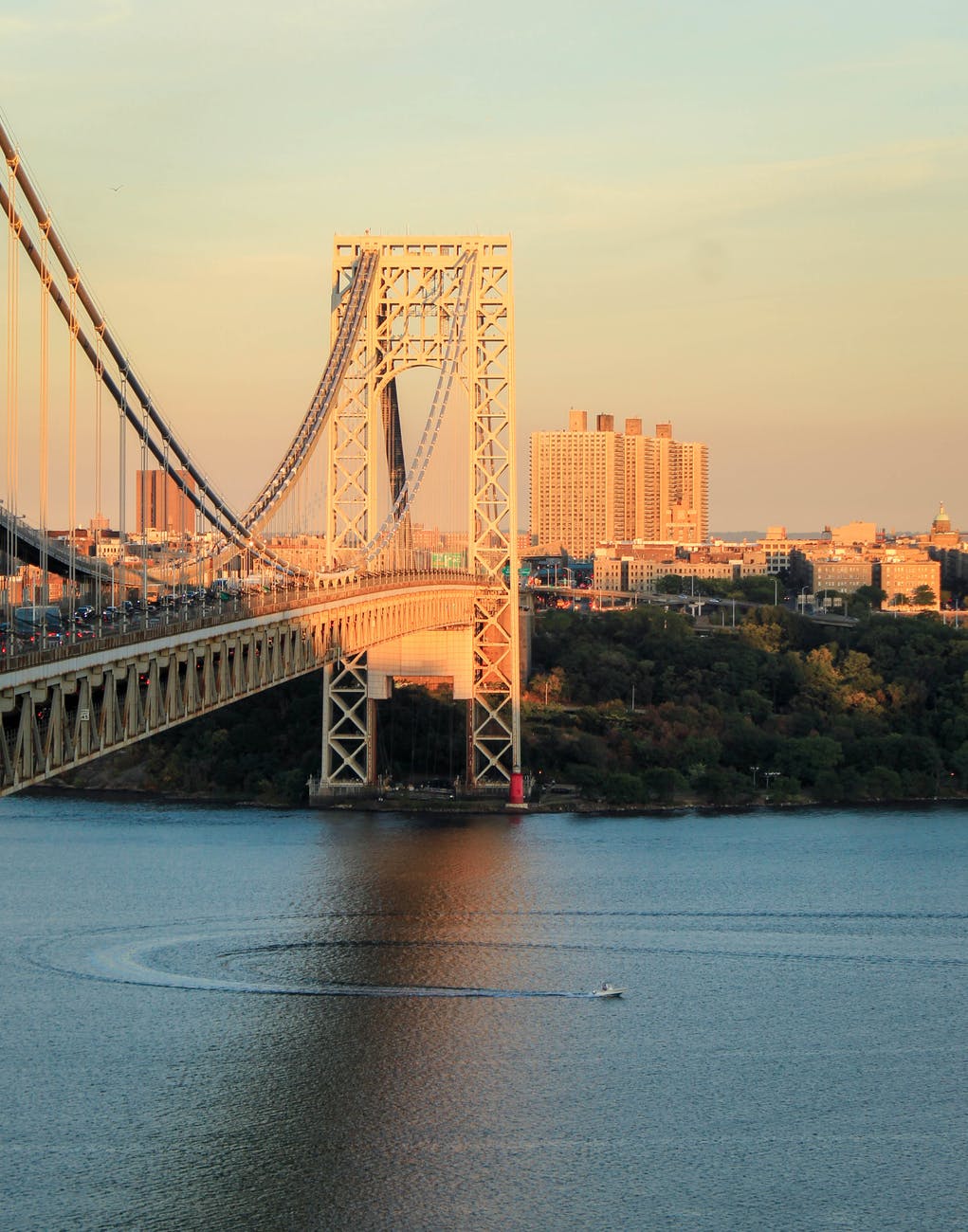
Photo by Pixabay on Pexels.com

What made Willingboro different was the existence of strong anti-discrimination state laws and courts willing to enforce them. Neither New York nor Pennsylvania had such laws when their Levittowns were being built. The New Jersey laws forced Levitt to drop his whites-only policy, and he decided that since integration was going to happen, it should unfold as smoothly as possible. Above all, Levitt wanted to avoid another situation like the one that greeted the Myerses in his Pennsylvania development, which had given Levitton a bad name both among white segregationists, who now saw Levittown’s whites-only promise as unreliable, and more liberal-minded people unwilling to live in a community known for racial antagonism. (156-157)

In his previous two communities, pressure brought by organizations and individuals was not enough to push Levitt to allow Black residents. But the conditions were different in New Jersey: the state had already acted. And the way it sounds above, Levitt wanted to both work with the different context and avoid bad publicity.

Thinking about residential segregation and housing issues more broadly, this approach – adopt state-wide policies – is still contentious today. Should a state be able to pass legislation that then limits the ability of local governments or developers to do what they want? Suburbanites tend to like local control; they move to the suburbs, in part, because the local ordinances and kinds of development can limit who might live there.

Earlier in the book, Berenson describes how Levitt said he limited his communities to whites because he was worried about how potential white buyers would respond to integrated communities. He might have been looking out for his bottom line but state legislation or policies could take a different or broader view.


A New Jersey suburb with the country’s oldest mayor at age 100

Suburban mayors can help guide community decisions and care for a community. But how many could do it at age 100?

Photo by lil artsy on Pexels.com

Vito Perillo, the mayor of Tinton Falls, Monmouth County, died over the weekend at the age of 100. According to Governor Phil Murphy, Perillo was the country’s oldest mayor.

According to the borough’s website, Perillo had served for 8 years. He started serving as mayor at age 93.

We sometimes see stories of young mayors, perhaps a college student or young adult who is elected. They are at the start of adult life and may be perceived as not having the life experience that could help in leading a community.

On the other hand, being elected mayor at 93 could mean the community benefits from the wisdom of many years lived. That person could have decades of relationships and experiences in the community. They could have a sense of what the community was and how it understands itself.

In some suburbs, the mayoral role is less involved than the city manager role. Mayors are elected by residents while managers are professionals who take care of day-to-day operations. Mayors may be the ones who show up at community events, vote in local council meetings, and cheerlead for local happenings.

At what age would suburban residents say someone is generally too old to be mayor? At least in this suburb outside New York City, residents elected Perillo twice to lead the community.

Shopping malls and blue laws in New Jersey

Can stores in a shopping mall be open on a Sunday? One Bergen County mayor is not happy about open retailers:

Photo by Mikhail Nilov on Pexels.com

Paramus officials say they’re exploring a lawsuit against American Dream, after learning that retail shops at the Meadowlands megamall are open for business on Sundays in defiance of Bergen County’s Blue Laws.

The stores at American Dream have been operating in violation of those laws for nearly a year, The Record and NorthJersey.com reported last week, despite the county’s longstanding prohibitions against the sale of nonessential items such as furniture, appliances and clothing. The restrictions, in place since the 17th century, exempt some services, including groceries and drugstores.

Paramus residents in particular have been proponents of the Blue Laws over the years. Supporters say they grant them a day of reprieve from heavy traffic that plagues the town the rest of the week due to the borough’s four malls…

“Being mayor of Paramus, I know how important the Blue Laws are to our way of life and the peacefulness of Sundays,” he said in an interview. “[It gives us] the ability to move around town, the ability for our emergency services to have less calls and regroup. As mayor, I’m going to fight like heck for Paramus and the county as a whole.”

Such regulations used to be more common across the United States. It can be surprising for some to hear that places would continue to follow these guidelines or businesses might choose to follow them (see some of the conversations around Chik-Fil-A in different parts of the country regarding their practice of not being open on Sundays). Even the article above notes that these restrictions date back hundreds of years; are these simply archaic local idiosyncrasies?

The explanations given by these suburbanites regarding the purposes of the blue laws are interesting in today’s context. Is Sunday a day of rest from traffic? Are the malls bringing in so many vehicles from outside the county that their closure on one day makes it easier for locals to get around? Do the EMTs and police need time on Sunday to regroup from all of the accidents and calls on the other six days of the week? The website of another suburb in the county highlights the Sunday prohibitions but does not say why they exist.

My guess is that the Bergen blue laws originate in religious motivations. Sunday is the Christian day of rest. I wonder how much of the current support for the blue laws is religious support as opposed for other reasons for having a day of rest.

Many municipalities in the United States want more local revenue. Having multiple local shopping malls is a good thing because it can increase commercial activity and sales tax revenues. Can communities still thrive if they limit shopping mall activity on one of the weekend days?

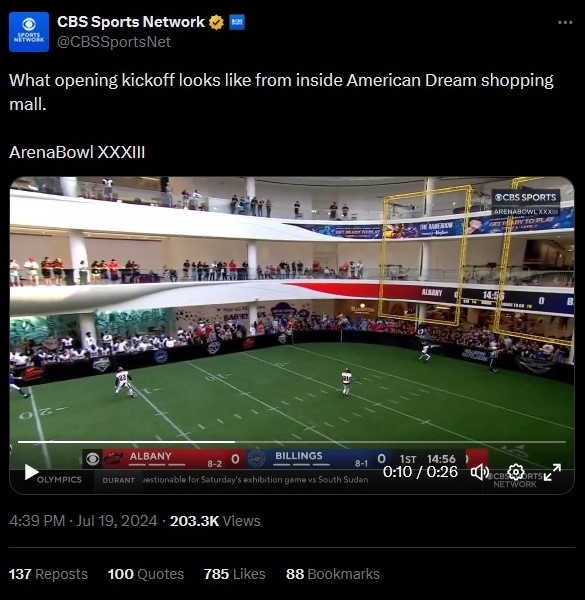
A championship football game played in a suburban shopping mall = peak American Dream?

The Arena Football League recently played their championship in a New Jersey shopping mall:

As shopping malls seek to add more entertainment options, why not add sports? It could be at the professional level or amateur level. Imagine a high school basketball tournament hosted inside a mall with space for sports. Or a kids baseball tournament. Or a tour pickleball tournament. Sports could help bring in more visitors. It puts more people in proximity to the shops and restaurants.

Even though malls are big, many may not be big enough to do this. The American Dream Meadowlands in East Rutherford Mall, New Jersey is the second-largest mall in the United States and has plenty of entertainment options – a ski slope, a hockey rink, an amusement park, an aquarium, and more – in addition to 450 stores and lots of food options. This complex has sports already in mind. Many malls would need to reconfigure space or add facilities.

Given how much Americans like football and shopping malls (even with their decline), how many events can get more American than this? And held at a place named American Dream?

The most important sporting event in the world will take place…in an American suburb

The World Cup final in 2026 will be played in East Rutherford, New Jersey:

Photo by Riccardo on Pexels.com

The 2026 World Cup final will be held at MetLife Stadium in East Rutherford, New Jersey, on July 19, world soccer governing body FIFA announced on Sunday…

“It’s going to be a special World Cup,” Berhalter said after the announcement was made. “To have the final in New York, New Jersey is a dream come true for me. Being from that area, and I’m sure for most people from that area, it’s an area with a rich tradition of soccer and producing players.

“To think about when I was little, going to watch the [New York] Cosmos and them selling out Giants Stadium, and now this stadium is going to host a World Cup final. It’s really special.”

MetLife Stadium is home to the New York Giants and Jets who play in suburban New Jersey. The stadium is about 9 miles northwest of Times Square and about 13 miles northwest of Wall Street. When the Super Bowl was played here in early 2014, I assume more TV shots and attention was paid to New York City rather than the New Jersey suburbs.

It might also be worth noting that the 1994 World Cup final, the only one in the United States thus far, also occurred in the suburbs:

In 1994, the United States played two of its group-stage matches at the Rose Bowl in Pasadena, California, and the other at the Silverdome in Detroit. The Rose Bowl also hosted the final that year — with Brazil topping Italy in a penalty shootout — and again in 1999 for the Women’s World Cup, when the United States beat China, also on penalties.

Set in Pasadena, the Rose Bowl is roughly 11 miles northeast of downtown Los Angeles. This region is famously sprawling – and the 2028 Summer Olympics will take advantage of the full region for all of the events.

All the talk of soccer taking off among kids in the American suburbs may find its peak in this experience.

NJ suburb home to the second largest Hindu temple in the world

Here is a sign of increasing diversity in the increasingly complex American suburbs: the world’s second largest Hindu temple just opened in suburban New Jersey:

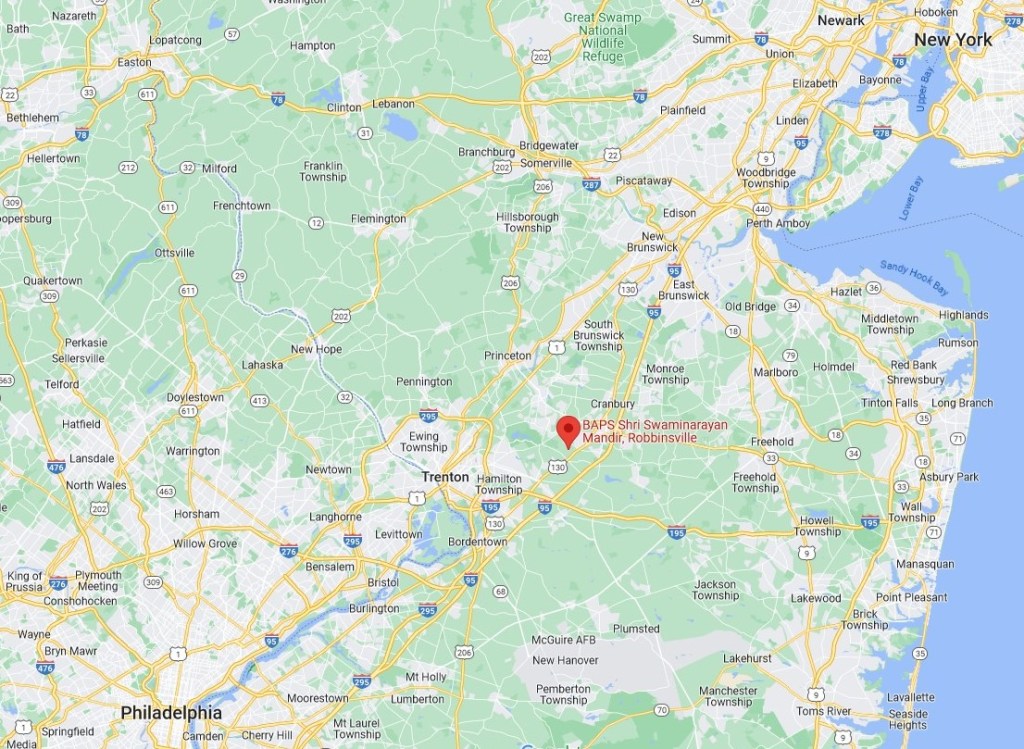
The official inauguration for BAPS Akshardham, the massive 87,975 square-foot, 191-feet tall temple in Robbinsville, New Jersey, is scheduled for Sunday…

Spanning 185 acres, the grand temple is dedicated to Bhagwan Swaminarayan, a revered Hindu spiritual leader from the 19th century. 

The temple is made of stoned of Marble, granite, and limestones – sourced from various places in Europe and shipped to India, where artisans carved intricately.  

Stone pieces were then shipped to the U.S. and assembled by volunteers from all over the world under guidance of artisans from India…

The New York tri-state area is known for its large Hindu American population and community of Hindu devotees.

According to Wikipedia, this suburban location is part of the New York City region but it also right next to the Philadelphia region:

Robbinsville Township is a township in Mercer County, in the U.S. state of New Jersey. Located at the cross-roads between the Delaware Valley region to the southwest and the Raritan Valley region to the northeast, the township is considered part of the New York Metropolitan area as defined by the United States Census Bureau,[21] but directly borders the Philadelphia metropolitan area and is part of the Federal Communications Commission‘s Philadelphia Designated Market Area.[22]

Recent research helps explain the increasing amount of religious diversity within metropolitan regions. For example, Religion & Community in the New Urban America details this in the Chicago region and I detail patterns in debates about zoning and land throughout the New York region and involving multiple religious traditions.

Yet, I suspect such a building would surprise many who do not think of suburbs in the United States this way. With new populations in the suburbs and new religious groups, many suburban communities have changed in recent decades. Suburbs do not only consist of white bedroom communities; suburbs are more racially, ethnically, and religiously diverse.

American sprawl consequential because of its scale

An environmental activist in New Jersey describes suburban sprawl in his state in ways that hint at its vast scale:

Photo by Seva Kruhlov on Pexels.com

The origins of this devil-may-care approach to development stretches back decades. “One of the things we’re going to look at is all that development in the 60s, 70s, and 80s, where we just sprawled out along the highways, built office complexes in the middle of nowhere, and built these five acre McMansions on farm fields. With all those policies, we’re going to have to reverse them at some point where we need to develop in a smarter, better way: places that are more walkable, fewer cars, more green space, less pavement. It’s not going to be easy because we, in some ways, have to fix the mistakes of the past, like on stormwater, where so many of our cities and towns are already paved, how do you go back and retrofit them? How do you break up these heat island effects in places like North Jersey? With planting trees, putting in more green space, green roofs, and stuff like that. That’ll take some money and it takes political will in New Jersey. I’ll just say that we have a flood of problems and a drought of action on some of these issues. We need to have the political will to make some of the tough choices and then make those kinds of investments. So far, we just keep kicking the can down the road.”

By the 1960s, Americans had a history of suburban homes stretching along railroad lines, streetcars lines, and roads. The ideal of the single-family home was well established. Plenty of people had fled cities. New transportation options provided speed and opened up new land for development.

But, the sprawl of the postwar era happened on a scale beyond these earlier efforts. Completely free of railroads and streetcars, potential homeowners could reach any property with a car. Large-scale builders could construct new subdivisions or communities in a relatively short amount of time. Metropolitan regions expanded out and small communities outside the city could grow very quickly. A whole lifestyle around homes, driving, and suburban day-to-day life for millions emerged.

Reversing these significant changes will require significant shifts in different directions plus time. Forget New Jersey; would Americans as a whole, particularly the majority of residents who live in suburbs, want to reverse these patterns or do they enjoy suburban life (or dislike the alternatives) so much that they would resist major changes? Either way, the consequences of sprawl will continue to affect society for decades to come.

A positive on-screen depiction of New Jersey

In contrast to the typical depiction of New Jersey on TV and movies, one writer suggests a new show portrays a positive vision of the state:

Photo by Noriely Fernandez on Pexels.com

I don’t want this attention. Jersey’s bad reputation for being America’s garbage dump has done a great job of keeping people out and our blocks relatively affordable. For years, Jersey City was protected by a forcefield of bad representation. Jersey is by far America’s favorite punchline of a state. Futurama imagined America’s founding fathers dubbing New Jersey “our nation’s official joke state.” Movie after movie refers to Jersey as “the armpit of America.” Even in Marvel’s What If…?, Harold “Happy” Hogan laments the only escape from a zombie apocalypse: “Just when you thought things couldn’t get any worse, we gotta go to Jersey.” MTV’s Jersey Shore continues to do a fantastic job of finding the best cast to represent the state and all it has to offer folks on the outside. Snookie and J-Wow knew exactly how to lay out the red carpet. The Sopranos also knew exactly how to showcase Jersey’s finest hospitality. Come for the bar fights, stay for the gabagool.

I would argue few places are depicted well on television or in films where the emphasis is usually on character and plots rather than on places, neighborhoods, and communities.

At the same time, certain locations can acquire a particular character through the way they are depicted over the years. Viewers might see only a particular perspective on or a portion of a place.

What would the average American think New Jersey is like based on what they have seen on screen?

Rebuilding beachfront McMansions

A journalist argues the construction and reconstruction of large homes near Atlantic beaches is a losing proposition in the long run:

Through federally funded flood insurance, huge appropriations for beach nourishment projects, and generous, well-intended relief aid, government policy allows developers and wealthy investors to build huge houses and hotels on beachfronts and low-lying barrier islands at high risk from coastal flooding as well as hurricanes. Uncle Sam’s generosity makes it all possible…

Writing just as the extensive damage from Hurricane Florence became apparent, Gaul covers the waterfront, so to speak — from Hurricane Katrina to South Florida, to the halls of Congress. In North Carolina, he stops Down East in Columbia, Creswell and other towns of North Carolina’s “Inner Banks,” where rising water levels and flooding are washing away entire communities…

According to Gaul, things began to tip in the 1980s, when multistory “McMansions” began to supplant the simple Cape Cods. (A similar trend has transpired on the north end of our state’s Outer Banks). Disasters such as the Ash Wednesday flood of 1962 did little to discourage development. On the contrary, real estate dealers saw storms as “clearing the market,” blowing down older, ramshackle structures and making way for the new, bigger units that buyers seemed to want.

Real estate prices went up, and increasingly retirees and residents with modest incomes were squeezed out. But there were always more customers in line for resort property.

I wonder if the primary objection is that big homes are being built and someone is profiting from the government money or should there be no homes on these properties? If the goal is to protect the beach and taxpayer dollars, less development in these areas is better. If the problem is profiting with the government’s money, there could be restrictions on the size of the new home or how the money is used.

It would be an interesting thought experiment to consider what this would look like without any government intervention. The argument here is that the government’s funding for rebuilding simply encourages the cycle of building larger and larger homes. If there were no regulations, what would the market bear? Or, as the author seems to suggest, would different regulations be better for the long-term fate of the beach and tese communities?

The rise of beach McMansions in New Jersey, Florida

Large homes are not just for suburban locations. Two recent pieces highlighted their role in changing beach communities. First, from New Jersey:

Decades ago, when I was a teenager, I rented a surf shack in the then-humble town of Beach Haven on the New Jersey shore. Four of us crammed into a squat cinder-block hut tucked behind a bungalow. We worked as lifeguards for $2.50 an hour. Still, our rent was only $187.50 each for the summer. We had a place to sleep, shower, and create memories. We didn’t need more…

But there is another less visible cost that rarely gets mentioned when Americans talk about coastal development and risks. Since the modern coast emerged after the Second World War, a series of land bubbles have wildly inflated land values, to the point that many ordinary families can no longer afford to live at the coast, or even afford a weekly summer rental. On Long Beach Island, a popular resort in Ocean County, where I worked as a lifeguard, $15 billion worth of property now crowds a narrow, 18-mile-long shoreline. The average price of a new home is about $1.1 million, with many costing millions more. Rentals run as high as $5,000 a week. Yet, paradoxically, the island was conceived by Morris Shapiro and other developers as an enclave for middle-class and blue-collar families – teachers, plumbers, electricians, and so forth…

I suppose it is unsurprising there are few, if any, surf shacks left. Most beach towns have been supersized. But unanticipated costs have come with that growth. High school and college students have few places to live and the labor pool for lifeguards, waitresses, hotel workers, amusement-ride operators, and so on has shrunk dramatically. Many shore towns now rely on a special federal visa program to supply summer help. Workers come from Eastern Europe, Ireland, even Australia. Even so, some businesses have been forced to cut hours or even close.

The change over multiple decades is drastic.

And from the Gulf Coast of Florida:

Anna Maria Island may be largely built-out, but that hasn’t stopped developers from buying older existing homes, tearing them down and replacing them with new high-end homes…

Officials in the cities of Anna Maria, Holmes Beach and Bradenton Beach say it is a worrisome long-term trend and that they are doing their best to maintain the island’s unique character and sense of place…

Stephen Gilbert, building official for the city of Bradenton Beach, said the land is often much more valuable than the existing older home that sits on the lot.

Of the new homes built in the last decade in Bradenton Beach, only a couple were intended as homes for the owners. The others were intended as investments to be quickly turned over for more cash, he said.

While the change here has come more recently, it sounds like a similar process: people with money and/or an interest in investments come in, tear down older homes, and construct beach McMansions. This has happens over a sustained period of time and the feel of neighborhoods and communities changes.

These changes certainly have local effects on hundreds of beach communities across the United States but there are larger processes at work. Are the big homes the cause or the symptom of bigger issues? The nature of real estate capital today plus the rapid rise in real estate values puts even small communities at the mercy of global markets. Communities can respond but turning down big amounts of new money is not easy and often requires significant opposition from local residents and leaders.