Religion in the American suburbs: a diverse religious landscape

In the postwar era, Will Herberg described American religion as primarily involving Protestants, Catholics, and Jews. The same was assumed to be true in the suburbs. With suburban populations growing, Protestants, Catholics, and Jews moved in and added to existing congregations and founded many new ones.

Photo by Zac Frith on Pexels.com

These groups also had to adjust to suburban life. Practicing faith in the suburban context looked different than in urban neighborhoods or rural areas. Critics within these traditions suggested the suburban version of their faith had serious deficiencies. Supporters of the suburban faith highlighted new possibilities and energy.

With changes to the population in the United States, including changes prompted by the Immigration and Nationality Act of 1965, the suburban religious landscape changed. Today, there are still plenty of Protestant, Catholic, and Jewish congregations in the suburbs but they are located near the congregations of Muslim, Buddhist, Hindu, Orthodox, Sikh, and other religious traditions. Increasing racial, ethnic, and class diversity in the suburbs goes alongside religious change. The complex suburbia of today includes a complex religious landscape.

Add to that the growing number of residents of the United States who do not identify with a religious tradition or faith. The suburban landscape may include religious activity throughout the week but it also is full of residents with no religious affiliation or other understandings of religion and spirituality.

This is easy to see in many suburban areas. Pick a populous county outside a major city – whether Washington, D.C. or New York City or Chicago or Los Angeles – and you can find religious and non-religious activity all over the place. The suburban landscape may be dominated by single-family homes and roads but there are plenty of congregations in a variety of traditions. It is visible when driving down major roads. You can see it in county-level counts of religious congregations.

This means any quick description of suburban religion is hard to do given the number of practices, beliefs, and belonging present in American communities. One way to see this diverse religious landscape is in the religious buildings of the suburbs – this is the subject of the next post.

Who suburban leaders say affordable housing is for – another example

Federal money will help in constructing a new affordable housing apartment building in suburban Glen Ellyn. Who might live there?

Photo by Bidvine on Pexels.com

Chicago-based nonprofit Full Circle Communities is seeking to build an apartment complex with up to 42 units. The developer would set aside no less than 30% of the units as permanent supportive housing for people with disabilities under the terms of an agreement to purchase a portion of the village-owned property.

U.S. Rep. Delia Ramirez requested federal dollars for demolition and site remediation work to make room for the proposed affordable housing project. Ramirez, whose 3rd Congressional District runs from Chicago’s Northwest Side into DuPage County, announced the funding at a news conference with Glen Ellyn Village President Mark Senak and other elected officials last week.

Affordable housing allows “senior members of our communities to stay close to their families so that grandparents can see their grandchildren,” Senak said, echoing remarks he made at a village board meeting last month.

“It gives adults with developmental disabilities the opportunity to remain in the community where they went to school, where they grew up, where their families live, where their friends live, and where many of them work,” Senak said.

This follows a common pattern among west suburban leaders in recent years. Affordable housing is for (1) seniors who want to stay in their community and (2) adults with developmental disabilities who want to stay in their community. These are indeed groups with housing needs.

Would more communities be open to affordable housing for people who do not have much money? The two examples above suggest affordable housing is for people already in the community who want to stay. Is there interest in housing for workers with lower wages?

My study of suburbs suggests that in wealthier suburban areas there is less interest in affordable housing that is open to any residents who might qualify. Americans generally do not like the idea of government money for public housing, with some exceptions. This is probably even more true in suburbs where a primary focus is on single-family housing.

Workers cottages and a growing suburban dream in the Chicago region

What kinds of homes did early suburbanites in the Chicago area live in? Some lived in workers cottages:

Photo by Steve Johnson on Pexels.com

Thanks to a plentiful supply of lumber from old growth pine forests in Wisconsin and Michigan, as well as new milling processes such as kiln drying that gave precut wood precise standardized measurements, a new form of structure started appearing. Workers cottages were more affordable than elaborate, but they came with the promise of a better standard of living for working class families.

A century and a half after they started being built in earnest, an effort is afoot to celebrate and preserve the cottages, houses that have continued to offer utility and accessibility for generations…

The lecture was arranged by the nonprofit Chicago Workers Cottage Initiative, a group organized to celebrate and promote the houses, built mostly from the 1880s to the 1910s, that they say “represent the origins of the ‘American Dream’ of homeownership and the investment and pride of Chicago’s new immigrants.”…

“Some of these cottages were really spartan four-room houses,” Bigott said. “They cost like $600 on a $200 lot. It was a simple frame building, with two bedrooms, a living room, a kitchen.”…

It was a model that worked, and its backbone was the workers cottage. Elaine Lewinnek, a professor of American Studies at California State University, Fullerton, argues in her 2014 book “The Working Man’s Reward: Chicago’s Early Suburbs and the Roots of American Sprawl” that the idea of house ownership as “the working man’s reward” was one of Chicago’s most impactful exports, setting the scene for suburbs everywhere.

The suburbs have a longstanding reputation that they are full of people of wealth who are able to purchase a home and afford a suburban lifestyle. Imagine neighborhoods of McMansions, rampant consumerism, and newer vehicles.

This may be largely true and yet it is not entirely true. The homes described above could house the working class in suburban settings. This is not the only area where this occurred; historian Becky Nicolaides described working class houses in the Los Angeles suburbs.

And the housing today in the suburbs can also be varied. Postwar housing also had some variety from larger homes to smaller ranches. Wealthy suburban communities in the Chicago region today sit not far from neighborhoods with more modest housing.

If this article looks back at what was over 100+ years ago, what housing today will be viewed as housing for the working person in the suburbs in 2100?

Buses, migrants, and race and social class in the United States

How are buses viewed in the United States? Two recent stories offer hints. First, communities in the Chicago area are restricting buses from dropping off migrants.

Photo by Ricky Esquivel on Pexels.com

Second, inter-city bus travel will be more limited as stations are bought and the land redeveloped:

An investment firm know for buying up newspaper publishers then gutting them is behind the recent shuttering of dozens of Greyhound bus stations across the country, a new report has revealed.

Twenty Lake Holdings LLC, a subsidiary of Alden Global Capital, purchased 33 Greyhound stations across the U.S. from transport company FirstGroup in 2021, reported Axios

Since the change of ownership two years ago, Greyhound has closed scores of its central bus stations around the country, either by cutting services completely, or moving to far out sites as a cost-saving measure to sell off the depots to real estate developers…

But as demand fell – with passengers numbers dropping by a third from 1960 to 1990 and then halving again between 1980 and 2006 – and running costs increased, they became less economically viable to run.  

Given the American emphasis on driving, buses offer opportunities to move a lot of people along existing road networks. This limits the needs for fixed railroad tracks and buses can make more stops.

Yet, I have discussed before who is willing to ride buses and who avoids them if they have the resources to drive. A story from several years ago highlights these persistent patterns:

Like most transit hubs, buses and bus stations are shared spaces where members of different neighborhoods or social classes mix—which has made them important symbolic battlegrounds in civil rights history.

Black Americans, escaping the Jim Crow South for better opportunities in the north and west, used Greyhound buses during the Great Migration. The Freedom Riders used Greyhound buses to protest segregation and to test new protections on interstate passenger travel. In 1961, a mob beat and firebombed the Riders’ bus in Anniston, Alabama, attempting to trap the passengers, who escaped through the windows and door; the Riders had to be evacuated from Anniston through a convoy…

The accessibility of bus services and the mutability of their routes have historically made it an effective method for cities to move systemic problems elsewhere. Prior to the 1996 Olympics, for example, Atlanta leaders aimed to make the city more hospitable to the world by reducing its hospitality to people experiencing homelessness. The city bought thousands of one-way bus tickets to other locales to remove homeless populations from sight.

With more emphasis in the United States on driving individual vehicles – and this is a marker of self-sufficiency and freedom – buses can get short shrift. For those who cannot afford cars and other travel options, buses can offer opportunities – if they are available.

Americans need a lot of money to achieve the American Dream

Two estimates of how much money it takes to live out the American Dream suggest that many Americans will struggle to do so:

Photo by Nadi Lindsay on Pexels.com

The “American Dream” costs about $3.4 million to achieve over the course of a lifetime, from getting married to saving for retirement, according to a recent analysis from financial site Investopedia. 

Meanwhile, median lifetime earnings for the typical U.S. worker stand at $1.7 million, earlier research from the Georgetown University has found. 

Such figures underline the financial pressures that many families face trying to afford a middle-class life as expenses like child care, college tuition and buying a home continue to climb. The Investopedia analysis tallies the average cost of achieving other aspects traditionally associated with the American Dream, such as owning a house and raising two children to age 18. 

Another analysis, from USA Today, found that funding the American Dream costs about $130,000 a year for a family of four. Median household income stands at about $74,450, according to the Census Bureau.

One key facet of the American Dream is that it is supposed to be available to all. That never meant everyone would achieve it, particularly as Americans often emphasize individual hard work and taking advantage of opportunities. But, it should be reachable in a society where many Americans value and see themselves as middle-class.

Perhaps this is why there is a market or demand for particular experiences that provide part of the American Dream or a taste of it. One traditional marker of the American Dream in the United States is owning a home. This is displayed on TV, illustrated in toys, and promoted by presidents. If people can just own a home, they have a strong case to make for attaining the American Dream. Or, consider the freedom of driving down the road in your vehicle to wherever you want. This experience offers a taste of the larger American Dream.

If large numbers of Americans cannot obtain the American Dream now and in the coming years, this could mean the Dream becomes redefined. Maybe it will have different elements. Or, perhaps it will be more commonly viewed as attainable only by some. It could be a status symbol of the elite. Or, new policies and conditions could renew aid and efforts toward achieving the American Dream. Politicians could run on this idea while grassroots movements could promote it.

Those with the right jobs and resources can move where they want in the United States

In a story about people leaving Texas (even as the state gained population last year), I was struck by the patterns in the stories of people moving out the state: they could do so. Here is what I mean:

Photo by Terrance Barksdale on Pexels.com

While people have been moving into the Lone Star state to take advantage of its relatively affordable real-estate market, political atmosphere, and work opportunities, some of those same qualities are driving others out. Over 494,000 people left Texas between 2021 and 2022 (though the state gained a net population of 174,261.) It’s a trend that could intensify as housing costs surge and the state’s political landscape becomes more polarized

For Texans, “the Midwest has emerged as popular recently because it is just by and large the most affordable region,” Hannah Jones, Realtor.com’s economic research analyst, told Business Insider in October. “We’re seeing this trend of buyers looking for affordability really explode.”…

In Austin, some tech workers who flocked to the city during the pandemic just can’t seem to get out fast enough

Jules Rogers, a reporter who relocated from Portland, Oregon, to Houston in 2018 for a position at a local newspaper, left Texas less than two years after moving to the city…

Theoretically, Americans can move wherever they like. In reality, the ability to move is constrained by a variety of factors, including financial resources and jobs.

In this story, people can move in and out of Texas relatively easily. Some came in recent years and want to move back out. Others are leaving Texas for cheaper housing elsewhere.

This may be possible for some. But, it is not easy for everyone to do this. Americans do not just move to places where housing is cheaper. People have numerous reasons for locating in certain places and not others. Those with resources and particular jobs that are in demand or available in many places have some flexibility that others may not have. White-collar workers, in particular, may be able to more easily move from big metro region to big metro region (or even out of these regions as some did during COVID-19).

This would be hard data to collect but it would be interesting to compare people moving for different reasons and how long they stay. Do retirees who move to certain places stay longer than those who move for jobs or cheaper housing?

Some older buyers with money doing just fine in the housing market

With money from having owned a home before, some older participants in the real estate market can get what they want:

Photo by RDNE Stock project on Pexels.com

The Zinnick’s aren’t alone: Older buyers are prevailing in America’s hot housing market. This year, the median age for a repeat buyer – someone who has bought a home before – was 58, according to data released Monday by the National Association of Realtors. That’s down just a smidgen from last year’s record of 59, but it’s up significantly from 36 years old in 1981, when NAR began conducting its survey.

Lately, grandparents have been edging out younger buyers who are struggling to get into the market for the first time. Nowadays, first-time buyers make up 32 percent of the market, well below an average of 38 percent since 1981, according to NAR. They’re also more likely to be in their mid-30s today, in contrast to their late 20s in the early 1980s…

There are many reasons. For starters, older buyers are also likely to be selling a house, which provides them fresh cash. Indeed, the typical home seller was 60 years old in 2023, according to NAR, the same as last year.

And with so few homes available, sellers often go with the potential buyer making the most attractive offer – be it a large down payment, stellar credit or all cash. There, too, older buyers have a leg up…

That often leaves seniors and aspiring first-time buyers competing for similar types of homes – just a couple of bedrooms, not too much upkeep. Usually, there’s a clear winner.

If you have the wealth from owning a home, you can then put that wealth into something else – if you so choose. So, if housing values have tripled to quintupled, there is plenty of resources to apply to a new home. The home gets turned into a new home (and perhaps leftover cash). One advantage begets another, what some have called The Matthew Effect.

In theory, this is how Americans expect homeownership to work: you purchase a home, you get to live in the home, and then at some point you cash out because the home offers a strong return on investment. But, as this story notes, this is not a good story for everyone. Others who might be competing in the housing market may not have the same resources. Or, not mentioned are seniors who have not owned homes or owned properties that did not appreciate much.

Is this just a blip in the grand scheme of things because of unique conditions in the housing market? Or, is this a long-term change where those who bought homes in the past now reap certain rewards? The outcome of this could help influence the life outcomes of a lot of Americans in the coming years.

Liking colorful leaves and flowers but preferring monotonous green lawns

Plenty of people like the colorful leaves at this time of year in the Midwest and other parts of the country. But, why do they like such colors in leaves or in flowers throughout the year and also prefer lawns that are green only?

The lush green lawn free of weeds and leaves is the ideal. People will even paint their lawn green. Why monotone green? A few possibilities:

-Green signals verdant and healthy.

-If green is the color of spring (for grass, leaves, etc.), then keeping that signal of spring and life as long as possible is a positive.

-The green lawn lobby has been very successful.

-Keeping a lawn green throughout the year is a sign of money and resources.

-A consistently green lawn provides possibilities for contrasts with other colors used for house exteriors and other landscaping. If yards were other colors, the contrast colors change as well.

-Americans likes earth tones less compared to green. They do not want to be reminded of earth but rather the ways humans have changed the earth.

I am sure there is a historical and cultural answer to this question. In the meantime, I will observe both the changing colors of leaves – it all happens relatively quickly – and how these leaves cover green canvasses across suburbia.

Pew Research calculator to determine your location-controlled social class

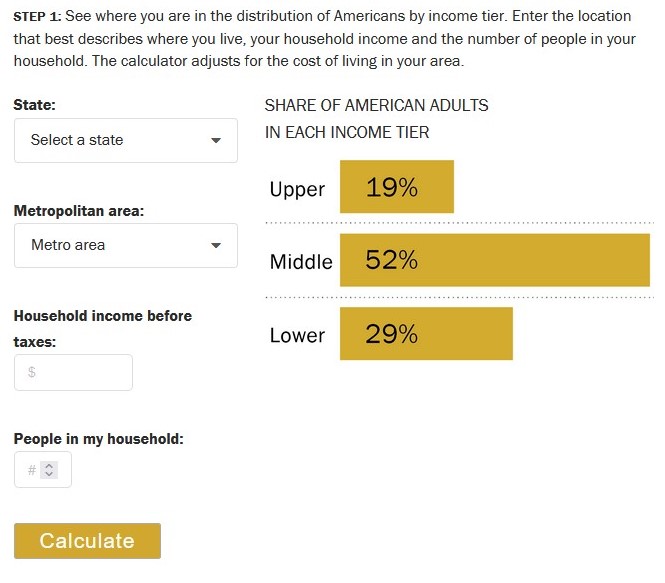
This calculator offered by the Pew Research Center factors in your location to determine which social class you belong in:

On how the calculator considers location:

The calculator takes your household income and adjusts it for the size of your household. The income is revised upward for households that are below average in size and downward for those of above average size. This way, each household’s income is made equivalent to the income of a three-person household (the whole number nearest to the average size of a U.S. household, which was 2.5 in 2018)…

Your size-adjusted household income and the cost of living in your area are the factors we use to determine your income tier. Middle-income households – those with an income that is two-thirds to double the U.S. median household income – had incomes ranging from about $48,500 to $145,500 in 2018. Lower-income households had incomes less than $48,500 and upper-income households had incomes greater than $145,500 (all figures computed for three-person households, adjusted for the cost of living in a metropolitan area, and expressed in 2018 dollars).

The following example illustrates how cost-of-living adjustment for a given area was calculated: Jackson, Tennessee, is a relatively inexpensive area, with a price level in 2018 that was 19.0% less than the national average. The San Francisco-Oakland-Hayward metropolitan area in California is one of the most expensive areas, with a price level that was 31.6% higher than the national average. Thus, to step over the national middle-class threshold of $48,500, a household in Jackson needs an income of only about $39,300, or 19.0% less than the national standard. But a household in the San Francisco area needs a reported income of about $63,800, or 31.6% more than the U.S. norm, to join the middle class.

Key here is the idea that incomes go further in some places and have less purchasing power elsewhere. By itself, income may not be that great of a measure for determining social class. Including location helps get at local variations in class.

Of course, there are other factors that go into assessing social class. This includes education, wealth, social networks, and more.

(Note: this calculator is based on 2018 data so there could be some important changes here in 2023.)

“Anybody can be suburban. It just takes money…” misses the intersection of class, race, and local control

As some states pursue affordable housing guidelines for communities, one critic argues it just requires money to live in the suburbs:

Photo by Travis Saylor on Pexels.com

Racial discrimination is abhorrent and should be prosecuted. But as a Brookings Institution analysis of the 2020 census shows, race isn’t a barrier to suburban living. Blacks are moving to the suburbs at a faster pace than whites. Anybody can be suburban. It just takes money — especially in Connecticut. In 2017, developer Arnold Karp purchased a colonial house on tree-lined Weed St. in small, ultra-wealthy New Canaan. There are no commercial or multifamily buildings on the street. He now wants to build a five-story, 102-unit apartment complex with 30% set aside for affordable housing.

The data does suggest people in all racial and ethnic groups are moving to suburbs. Here is what William Frey concluded from 2020 Census data:

This analysis of suburban and primary city portions of the nation’s major metropolitan areas shows that these big suburbs are more racially diverse than the country as a whole. Moreover, in contrast to how white flight fueled growth there in the past, most big suburbs have shown declines in their white populations over the 2010-20 decade. Their greatest growth came from Latino or Hispanic Americans, Asian Americans, persons identifying as two or more races, as well as Black Americans—continuing the “Black flight” to the suburbs that was already evident the 2000-10 decade. 

Today, a majority of major metro area residents in each race and ethnic group now lives in the suburbs. And for the first time, a majority of youth (under age 18) in these combined suburban areas is comprised of people of color.

But, as a sociologist of suburbs, here is what is missing from the critics’ analysis: people of different racial and ethnic groups are not evenly distributed across suburbs and not all racial and ethnic groups have the same wealth, income, and resources to obtain suburban homeownership.

In other words, because social race and race and ethnicity in the United States are connected, it is not just about money in reaching the suburbs.

What is really at stake? From the critic:

Local control will be obliterated. Albany will call the shots on what your town looks like, how much traffic there is and ultimately what your home is worth…

Ensuring a supply of affordable housing within a region is more reasonable than demanding every town alter its character.

Suburbanites like local control and local government. These arrangements allow leaders and residents means by which to decide who can live in their community. This is often done through housing values and prices; ensure the land and homes or rental units expensive enough and the community can be exclusive.

Additionally, one of the problems of affordable housing – and other land uses less desired by suburban homeowners (including drug treatment centers and waste transfer facilities) – is that few suburban communities want it. Communities with means and political voices will keep affordable housing out. This means affordable housing is not plentiful often and is often clustered in particular locations. One reason states are pursuing this at a metropolitan level is that there is not enough affordable housing in the current system that prioritizes local decision making over what is good for the region.

Suburban residents may not like the idea of affordable housing arriving in their community. However, the legacy of housing in the United States is often one of exclusion and restriction, not about communities and residents coming together to provide housing for all.