Making the sacred profane and the profane sacred at the Super Bowl

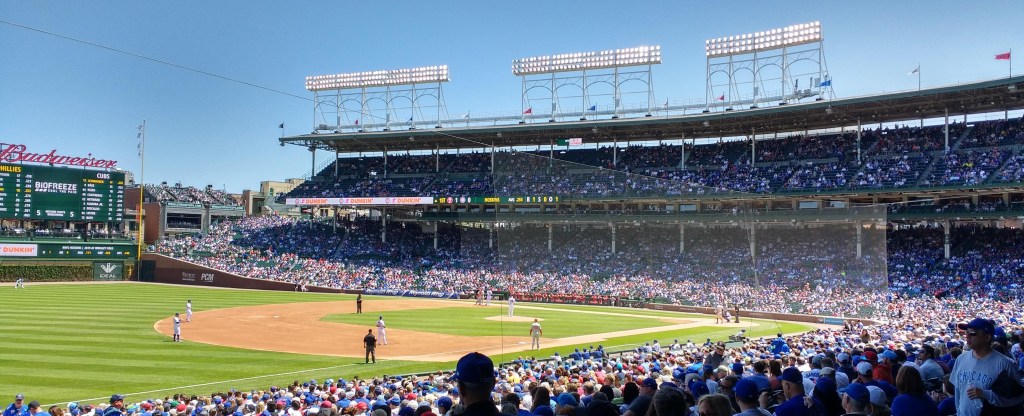
The Super Bowl itself may qualify as a religious event given all of its pageantry and symbolism. But, yesterday’s game included at least a few more explicit mentions of religion beyond the patriotism, American consumerism, and big audience already there.

Photo by Shelagh Murphy on Pexels.com

The Super Bowl advertisements from “He Gets Us.”

The ad for prayer app Hallow.

The ad from the Church of Scientology. And see their past ads here.

From Super Bowl MVP Patrick Mahomes: “I give God the glory. He challenged us to make us better. I am proud of my guys. They did awesome. Legendary.”

In early sociological work, theorists discussed the boundaries between sacred and profane. In the Super Bowl, these lines can get very blurry. Is this just an athletic event or is it about our collective lives together and supernatural forces? Can advertising for religious groups and beliefs break through the noise of food and football? Should all of these forces be mixed or is there a time and place for each?

This is not new but it does highlight the ongoing interactions in American society between religion and other spheres. Similar things can and have been said about politics. A football game is not just a football game; it is an opportunity for numerous actors to put their own stamp on what we are doing together.

Trying to diversify a city economy through sports

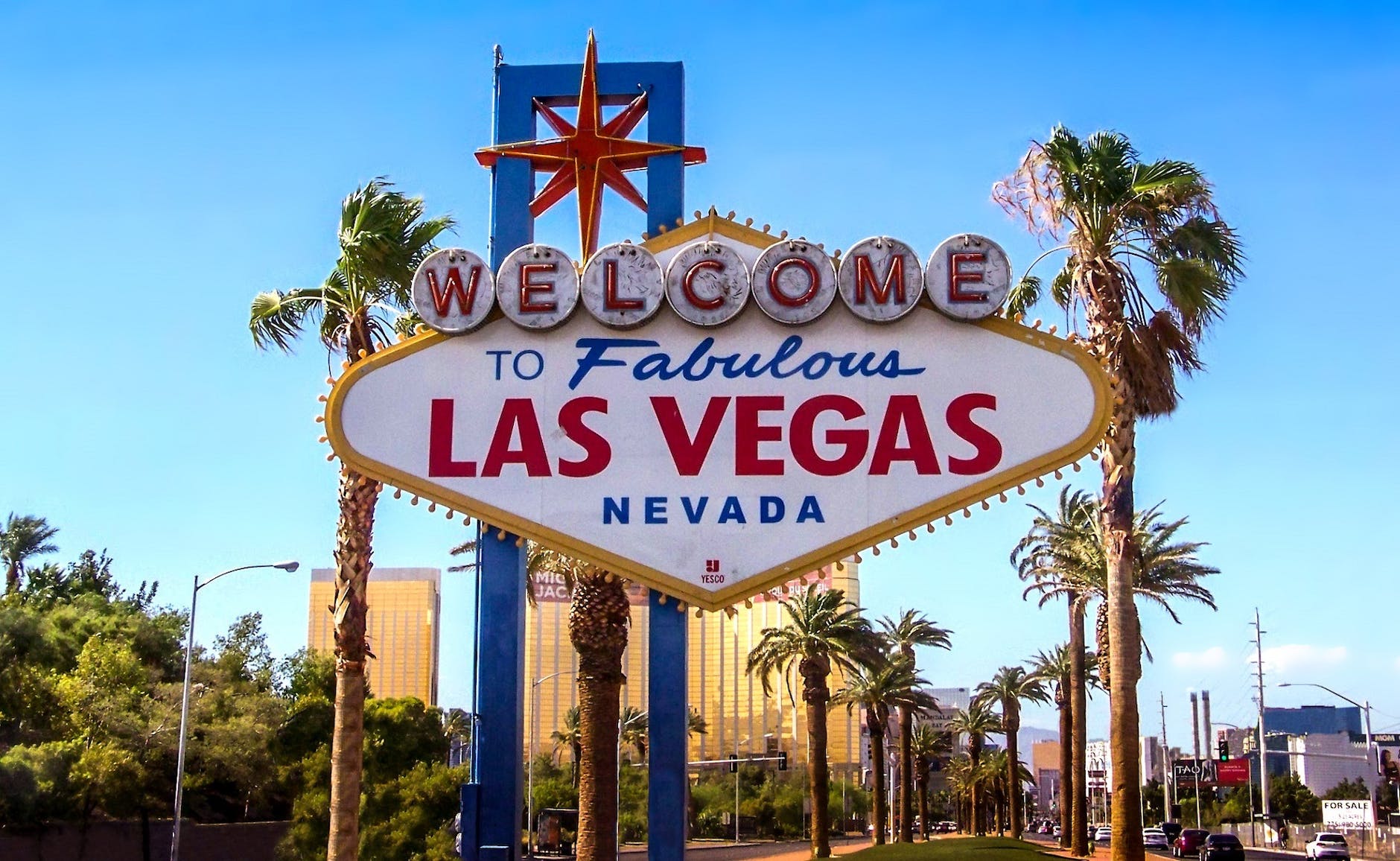
Las Vegas has gambling and all that goes with it, including significant recent investments in sports:

Photo by Pixabay on Pexels.com

In under a decade’s time, the desert city long known for its casinos, food and live entertainment has become the home to four major league sports teams (the latest being MLB’s Athletics), six minor league teams, a major sports organization in the Ultimate Fighting Champion, and four large sports venues playing host to events such as NCAA tournament games, NFL Pro Bowls, and, coming this February, Super Bowl LVIII.

At least a half-dozen more venues are in the planning stages, and the city appears poised to be one of the top picks for an NBA expansion team and an MLS team, as well…

The initial economic impact estimates for Sunday’s Formula 1 Las Vegas Grand Prix and the February 2024 Super Bowl were $1.3 billion, and $500 million, respectively. (But this was before ticket prices slid for F1 when the championship was won earlier in the season).

That total would match the estimated $1.8 billion contributed to the metro area by all sporting events from July 2021 to June 2022, according to an economic impact study released this summer by the Center for Business and Economic Research at UNLV’s Lee Business School.

Earlier research on public money used for new stadiums suggested teams benefit the most from that spending. Will the money spent here on facilities increase the size of the economy, generate additional new jobs, and other benefits or does it simply shift money around? Will residents and businesses move to Las Vegas just because of sports?

Perhaps the pitch with Las Vegas is that it has the added bonus of lots of tourists. If some of them can be enticed to sporting events and other local attractions, this is extra money. This might work for major events, but I would guess it is harder for a regular season MLB game.

Here is just one guess of how this all might look in 10-15 years: local officials will say that sports helped enhance the city’s status, the team owners will be happy with their facilities and revenues, and the local economy will not be enhanced much just because of sports (when accounting for the debt and costs associated with sports).

Playing Chicago suburbs off each other to get the best deal for the owners of the Bears

Which Chicago suburb might give the Bears the best option to make money off a new stadium and development around it? Enter Naperville, the largest suburb in the region:

Photo by Pixabay on Pexels.com

“We will continue the ongoing demolition activity and work toward a path forward in Arlington Heights, but it is no longer our singular focus,” Scott Hagel, the Bears senior vice president of marketing and communications said in a statement. “It is our responsibility to listen to other municipalities in Chicagoland about potential locations that can deliver on this transformational opportunity for our fans, our club and the state of Illinois.”…

This isn’t the first time there’s been hopes of a Bears move to the suburbs. Through the years, the Bears have considered sites in Hanover Park, Hoffman Estates, Aurora, Elk Grove Village and Waukegan. And once before in Arlington Heights.

Wehrli’s letter touts Naperville as accessible through major highways, such as the east-west Interstate 88 and the north-south Interstate 355, as well the city’s downtown Metra train station. There are also Metra stops in nearby Lisle and on Route 59 in Aurora.

The meeting is a major splash for Wehrli, who was elected in April and has been mayor for only a month. A lifelong Naperville resident with family roots in the community dating back to the 1840s, his letter to Warren stresses the impact an NFL stadium would have on the city.

This strategy works for the Bears because they can seek out a community that will give them a good deal on land, permits, taxes, and more. Their goal is to make money off the stadium and nearby development.

This strategy might work for individual suburbs beyond Arlington Heights. If the Bears do not come to Naperville, does the new mayor lose anything by reaching out? Even a short conversation keeps his community in the news. If the Bears come, it could be touted as a big deal. (On the other hand, just as some residents and taxing bodies in and near Arlington Heights are not thrilled about the Bears locating there, I imagine there would be some resistance in Naperville.)

Ultimately, providing public money for stadiums tends to benefit the team owners the most. Someone will host the Bears in the future but the team will end up as the biggest winner.

Do sports fans want shorter games, more action, or a higher action to time ratio?

Baseball has taken significant steps this season to shorten the game through new features like a clock for pitchers and batters. A growing consensus over recent years has suggested fans want shorter games. College football is considering shortening games. However, in the absence of data I have encountered about what fans actually want, I wonder if it is really about shorter games. These might be two other options that sports fans in America want:

-More action. Studies have shown sports like baseball and football actually do not have much game action across the multiple hour experience. Pitch clocks make the action happen quicker but do not necessarily mean there will be more balls in play or runners on base. Baseball has moved in recent years to more three true outcomes: strikeouts, walks, and home runs. These involve limited action.

-A higher action to time ratio. Perhaps what fans want is not shorter time but more action within the time of the game. Shortening the time with no change to the action would provide a higher ratio. Shortened times plus more action would further increase the ratio. Other sports have more flow or continuous action, like hockey or soccer (though many American fans might consider these action low-stakes or boring action). Or, watching a condensed game where the time between all pitches or all football plays is removed can be an interesting experience.

I suspect there might be plenty of experimentation in the coming years regarding finding formulas for sports in order to retain or attract the attention of fans. This will also happen with ongoing interaction with other forms of entertainment that offer different experiences and timelines.

“The stadium is the spiritual home”

With the opening of a new stadium for Nashville SC, the team’s CEO described its importance:

Photo by Tuur Tisseghem on Pexels.com

“For any team, whether it’s in soccer or other sport, the stadium is the spiritual home,” Nashville SC chief executive officer Ian Ayre said. “If you’re renting, it’s not the same as owning, right? Of all the infrastructure and the parts we build, it’s the most important.”

The team’s coach added:

Nashville SC coach Gary Smith called the crowd “magnificent,” adding that the players felt the energy from the moment they walked onto the field for warm-ups. “The expectation and excitement that surrounded this opening game was huge,” he said after the match. “To think that the players didn’t feel that would be inhuman. The atmosphere was terrific.”…

“To have our own home is vitally important,” Smith said. “This venue now will be the place over the coming years and decades that fathers and sons will come to and look back on and say, ‘Do you remember?'”

As a sports fan, I understand this sentiment. Going to the physical home of your favorite team or to an interesting stadium or a stadium where there is clearly fan interest is exciting. It is not just watching teams play in a physical setting; there is a collective effervescence that can arise to the level similar to how people describe spiritual experiences.

On the other hand, the team benefits from this spiritual home in the terms of dollars and cents. The stadium and all it entail makes money. It is an improved property. And increasingly so these days, owners and teams develop the land around the stadium in ways to further enhance revenue. This is not a sacred place maintained for the well-being of people who visit; it is for a business.

This mixing of business and spirituality is not uncommon in the United States or elsewhere in the world. Is the spiritual homeness of the sporting event ruined because money is being made? Perhaps not for most of the fans who are there for what the trivial can produce. For some of those fans, the sports stadium is more sacred than a religious building or congregation. At the same time, a new stadium and sports in general are big business where producing spiritual homes and transcendent experiences keeps consumers coming back for more and cities eager to keep teams or introduce new teams to the local economy.

Peytonville, the suburbs, and football

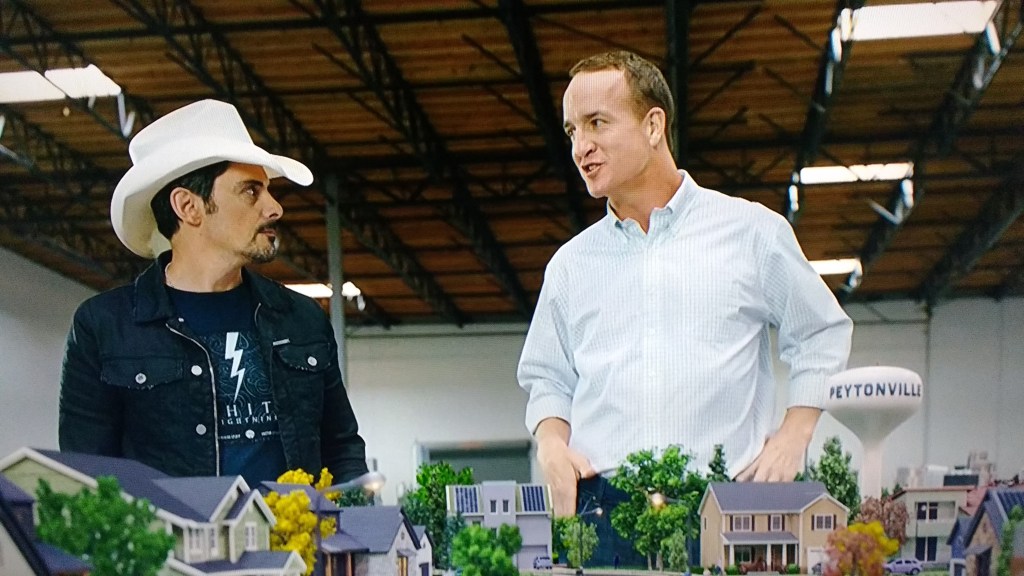
With the return to the airwaves of Peytonville ads from Nationwide, I noticed something in the commercials I had not thought about before (see Peytonville Parts 1, 2, 3, 4, and 5): the possible connection between suburbs and football. Notwithstanding a possible caveat that Nationwide might want to appeal to suburban customers, here are some ways the suburbs, football, and Peyton Manning might go together.

First, the majority of Americans live in suburbs. It is a slight majority but the percent in suburbs outnumbers the percent living in cities by a little more than 20%. Where is football played the most? Which communities have the most interest in football? The romanticized image of a football community might be a small town in the Heartland obsessing about football on fall Friday nights but much of the activity might be happening on suburban fields and on suburban television screens.

Second, the Peytonville commercials at least hint at college and pro football as well as suburban and urban life. For both college and pro football, where are the majority of fans? For college, perhaps the thousands of alumni for major football schools have largely settled in suburbs. With a college degree, people have the opportunity for higher-paying jobs and put those resources into suburban single-family homes. For pro teams, the majority of residents in a metropolitan region are suburbanites. Take Chicago as an example: there may be a lot of Bears fans in Chicago but there are over 6 million more residents in the suburbs than the city.

Third, the social and cultural life of the suburbs might lend itself to football (and other sports as well). With games on the weekend, many suburbanites are free to sit at home and watch or attend games. For kids, families have the resources to enroll them in activities and there are plenty of organizations ready to funnel kids into high school and college football.

Perhaps this is off yet certain sports are associated with certain places. Is football truly a suburban sport or does it belong to all of American places?

Videogames under the tree to sizable global industry

The flood of new gaming consoles and new game titles to Americans for the Christmas season hints at the size of the video gaming industry:

Photo by lalesh aldarwish on Pexels.com

Global videogame revenue is expected to surge 20% to $179.7 billion in 2020, according to IDC data, making the videogame industry a bigger moneymaker than the global movie and sports industries combined. The global film industry reached $100 billion in revenue for the first time in 2019, according to the Motion Picture Association, while PwC estimated global sports would bring in more than $75 billion in 2020

The videogame industry has boomed in recent years because of the variety of ways to play games. Gone are the days when all one had to track were console sales and games sold for their respective consoles and PCs. With the rise of digital-copy game sales, mobile games, in-app purchase freemium games, cross-platform games that aren’t limited to a specific console, streaming game services like Microsoft’s Game Pass, games-as-a-subscription models, and online distribution services like Steam, along with varying levels of transparency, anyone wanting to make apples-to-apples comparisons encounters an unwieldy fruit basket.

While console sales will get a boost from new versions, that’s not the biggest chunk of the industry, nor the fastest-growing. The biggest gain is expected to come from mobile gaming, with China playing a big role in smartphone and tablet gaming revenue, Ward said. Excluding in-game ad revenue, world-wide mobile gaming revenues are expected to surge 24% from a year ago, to $87.7 billion.

The gamification of the world is well underway.

Seriously, it is interesting to compare the status of videogames compared to the two industries mentioned in the article: movies and sports. These are established industries with prominent actors around the world. They have been established for decades. Videogames, on the other hand, are more recent – only several decades in the hands of the global public – and still have negative connotations for many (too violent, a waste of time, played only by a certain segment of the population, etc.). Since videogames are big business and part of their spread is due to the smartphone, which many have, will videogames have a different status in a few years?

Televised sporting events as vehicles for commercials

If people were looking for more reasons not to watch major sports – and there are plenty at the moment – then consider the commercialism involved in any televised sporting event. I quote from an article featured in an earlier post:

Photo by Negative Space on Pexels.com

The 11 minutes of action was famously calculated a few years ago by the Wall Street Journal. Its analysis found that an average NFL broadcast spent more time on replays (17 minutes) than live play. The plurality of time (75 minutes) was spent watching players, coaches, and referees essentially loiter on the field.

An average play in the NFL lasts just four seconds.

Of course, watching football on TV is hardly just about the game; there are plenty of advertisements to show people, too. The average NFL game includes 20 commercial breaks containing more than 100 ads. The Journal’s analysis found that commercials took up about an hour, or one-third, of the game.

The game itself could be interesting. I have watched numerous games that contained amazing sports moments and I am consistently surprised how often something new or rare happens.

But, even with those great moments, I always get a big dose of commercials. Break after break after break selling me products, brands, and an American way of life based on buying more and more.

Perhaps this is the true message of American sports: the observer, someone who probably was not able to play the sport in question at a high level, can live the good life through purchasing goods and experiences. Even while I am watching, I can purchase a lot through my phone or computer. And I can upgrade the sports watching experience with an even bigger television, more food and drinks, tailgate accessories, and ways to travel to the sporting sites.

And this may be the big message of American life in general. Community might be nice as might finding contentment with what you have. But, the guiding impulse that will help keep the economy humming and the consumer satisfied by novelty and acquisition is to just keep wanting and buying.

A reminder of the absurdity of sports

The MVP Machine is a good look at the data feedback player development angle in Major League Baseball today. Roughly two-thirds through the book, there is a reminder about what sports actually are:

It also strikes me as silly that I’m so excited about being a bit better at hitting a ball covered in cowhide with a wooden stick, an ultimately meaningless activity that American culture collectively decided would be worth many millions of dollars when performed with a certain skill. Rational or not, though, the fulfillment is real.

Similar descriptions could render all major sports as absurdist activities. And yet, they are viewed by millions, they are tied to local status and civic togetherness, and there are billions of dollars tied up in them. Sports today are big business, big entertainment, and big stakes for fans all rolled up into one. But, I imagine some sports moments could be made better with this reminder of what sports are at their most basic level.

Redeveloping golf courses and incurring the wrath of neighbors

Turning land from a golf course to a housing development could be a bumpy process:

Consider that the average 18-hole golf course is 150 acres. At standard densities, that means that your average golf course can host at least 600 new single-family detached homes. Mix in townhouses and apartments, and a single shuttered course could provide housing for thousands of new residential units. This is land in desirable communities: Golf-centric subdivisions built in the 1990s and 2000s feature courses threaded among affluent McMansion-style developments, meaning that the new housing could go in areas with access to high-quality schools and work opportunities…

But the main variable blocking new housing on old golf courses might be old-fashioned NIMBYism. Golf courses, after all, are often interpreted as high-status amenities that raises the value of neighboring homes, despite evidence to the contrary. If golf courses are gone and not coming back, residents often ask, why can’t they turn into permanent parks? Indeed, converting former greens into open space, wetlands, and natural preserves is happening nationwide in places where local land trusts have been able to purchase the tracts.

This can be a more appealing option for neighbors—often much higher income than the average resident of their region—who push to block permits and rezonings that might allow for infill housing redevelopment on idle greens. Earlier this year, voters in Lynnfield, Massachusetts, an outer suburb of Boston with a six-figure median income, voted down a zoning change that would have allowed for a 154-unit senior housing facility on part of the struggling Sagamore Spring Golf Club. Voters in the Rochester suburb of Penfield, New York, meanwhile, recently passed a $3.65 million bond to buy out the golf course and turn it into a park…

Golf probably isn’t coming back, at least not at the kind of scale it once boasted. Whether or not this bust can be a boon or a wash for suburbs and cities will likely be decided by hundreds of small zoning fights like these over the next decade. If recent pushes to downzone and preserve golf courses are any indication, it will take some effort and forethought on the part of planners and policymakers to get former greens productively redeveloped. Once the physical embodiment of tony upper-crust seclusion, these silent driving ranges and ghostly sand traps can be an effective way for more people to find housing in exclusive suburbs—or another means of keeping newcomers out.

There are few things suburban homeowners like less than finding out that the open, green, or park land they moved next to is now going to be a new development. Sometimes this anger is misplaced: if you move into a new subdivision recently created out of farmland and it is next to more farmland, you can probably expect that more farmland is going to be developed. Parks, forest preserves, or land trusts appear to offer more certainty: a private group or local government has committed to that green space and it would take a lot to choose otherwise. It seems like a golf course then falls in between these two options as it looks like green space but it dependent on a steady stream of users. If the golf course does not have enough customers, it cannot remain a golf course forever.

Also taking into account the social class and status of those who might locate on or near a golf course, I imagine communities that try to convert golf courses to new development will have a significant fight on their hands.