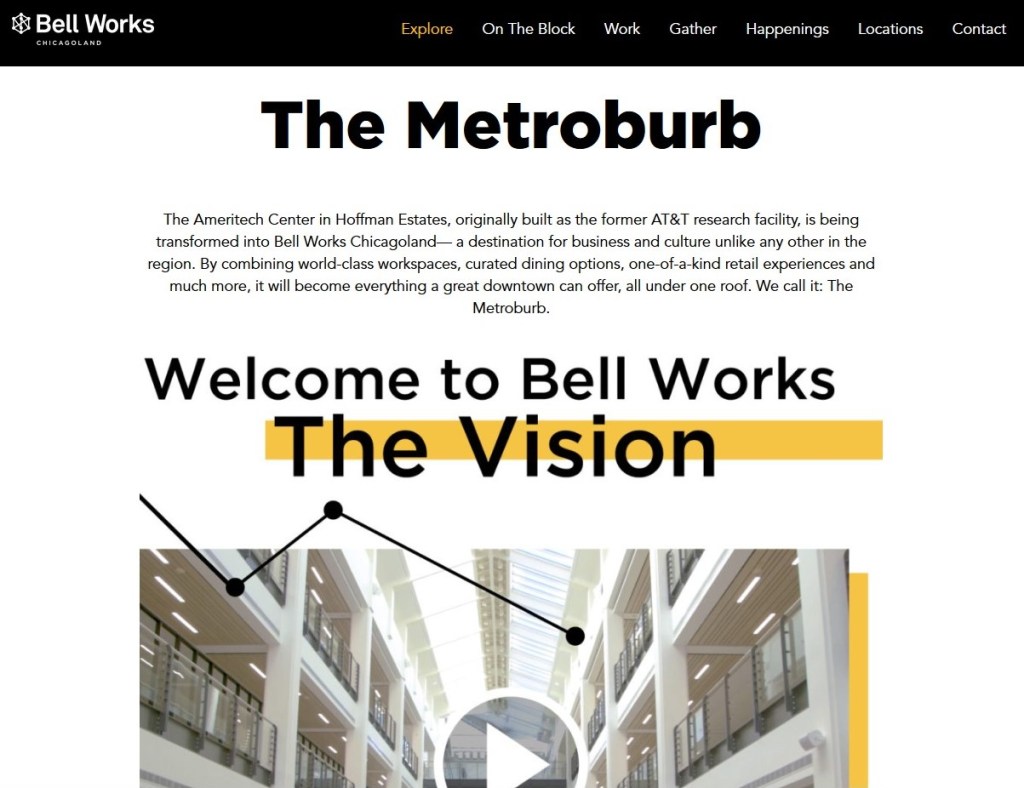
Chicago area suburbs advertising their communities is not unusual; see examples here and here. Far less common are new suburban developments making broad appeals in mass media. This project has been in the works for a while now – see an earlier post – and it is on an intriguing site as Bell Labs was important for the Chicago region (read more about the effects on local development of their Naperville facility) and the country as a whole.
In adding suburbia to the Democratic base, it turned out, Madigan also created a party that would no longer tolerate his Chicago ward boss style of leadership.
“Suburbanites tend to be less enamored of machine politics,” said Christopher Z. Mooney, a professor of political science at the University of Illinois-Chicago. “Machine politics is about one thing: getting jobs. Suburban voters tend to be more concerned about corruption. They’re a little better off,” and thus don’t need the government jobs political bosses can dole out…
While many suburban representatives had benefited from Madigan’s operation, the ComEd scandal marked the moment that “a limit had been reached,” Mooney said. “They felt that his usefulness was over. The fact that they were from the suburbs allowed them to have some cover. Madigan’s political tentacles are more effective in the city of Chicago or Cook County.”…
Suburbanites haven’t just changed the way politics is conducted within the Democratic Party, they’ve also made certain issues more important to the party. Abortion, for instance. In the 1980s, the Catholic Madigan declared himself “100% pro-life.” In 2019, he supported the Reproductive Health Act, which ensured that abortion will be legal in Illinois if Roe v. Wade is overturned, and declares that a “fetus does not have independent rights under the laws of this state.”
The explanations here suggest the changes in suburbs have had significant consequences for politics. As noted above, corruption turns off suburban voters – who often like the idea of more virtuous smaller local government – and there are more pro-choice suburban voters.
I could imagine several other factors involving suburbia that have influenced this change:
The suburbs have changed in demographic composition. There are now different kinds of suburban residents, including more racial and ethnic minorities and more lower-income residents. The whiter and wealthier suburbs still exist in places but so does more complex suburbia. The suburban voters today are not just more educated whites.
While the comparison above is between Chicago style politics and suburban politics, I wonder how suburbanites view the big city more broadly as compared to the past. Are more suburbanites interested in life in denser communities with more cultural opportunities (even if they are in the suburbs)? How essential is Chicago to the region and state compared to all of the activity – business, cultural, civically – in the suburbs?
Itasca’s plan commission on Wednesday unanimously agreed to recommend the village board deny Haymarket’s proposal. The Chicago-based nonprofit group is seeking permission to convert a former hotel along Irving Park Road into a 240-bed facility for adult patients with drug and alcohol use disorders.
The final decision rests with the village board. But trustees don’t want to rush their decision.
On Thursday, Mayor Jeff Pruyn said the village board plans to have at least two special meetings beginning in the middle of October. The first would allow public comment about the proposal. Haymarket representatives would make their case before the village board during the second.
As a result, the village board will not vote on the proposal until late October or early November.
Making a hasty decision may be in no one’s best interest. Particularly given the controversy surrounding the proposal, making sure everyone has a chance to voice their opinion and the board has all the time to make up their mind seems reasonable.
At the same time, what would change between now and then that would have a big effect on how the board members are viewing the situation? The proposal has been under discussion from some time and community members have made their voices heard.
This is not an easy decision for a smaller community to make. There could be consequences for life in the community and future development. Either way, some people will be upset. The village board decision will either agree with the plan commission or go the other direction (and the board is able to choose either option).
Yet, a decision needs to be made. I will be interested to see what happens: how will Itasca respond? Will Haymarket look for another suburban location? More broadly, what suburban communities might welcome land uses like these that are needed in metropolitan regions?
Renters now make up the majority of residents in more than 100 suburbs around the U.S., according to a new analysis of Census Bureau data from Rent Cafe. Another 57 suburbs are on their way to becoming predominately renter territory over the next five years, the apartment search website also found…
Overall, roughly a quarter of the more than 1,100 suburbs near the nation’s 50 largest metro areas are renter-dominated, according to Rent Cafe. Some 21 million people rented their homes in the suburbs as of 2019, up from 17 million a decade ago.
Millennials and members of Generation Z account for most suburban renters, Census data show. Rent Cafe notes that 55% of suburban renters are younger than 45, with median household earnings of around $50,000.
Meanwhile, the pandemic is expected to further fuel the shift away from suburban homeownership in favor of renting. Remote work opportunities have generated more interest in suburban areas within striking distance of cities.
If this is indeed the case, it would be interesting to know if these suburbs share characteristics. Do they tend to be close to the city or further out? Do they have particular hosing stocks compared to other suburbs? Are middle-class and up suburbs still devoted to residents owning single-family homes as a status marker?
My guess is that a majority of suburban residents would still say that they desire to home at some point. But, if more suburbanites are now renters, is the pathway to homeownership in their own community or other suburbs much more restrictive? This is part of the larger affordable housing conversation; people need any decent housing to live in but because many Americans aspire to own a home, having affordable ownership options is important as well.
An interesting middle path in some communities could be having significant numbers of single-family homes with long-term renters. The appearance and status of homes is maintained while renting adjusting for current conditions. On the other hand, many have argued that renters do not care for their properties or communities in the same way and communities may not like this trend.
This was not always the case. The urbanization of the United States was quite rapid and gave rise to numerous big cities by the mid-twentieth century. In the early 1900s, the United States was less than 30% urban and less than one hundred years later was 80% urban. See this table from a 2002 US Census publication:
Before this, certain cities boomed. Chicago went from a small community in the 1830s to the second largest city in the United States in 1890. Numerous Sunbelt cities exploded in population, whether Atlanta or Phoenix or Las Vegas.
But, the United States now has relatively few new big cities. For decades, numerous small suburbs have truly expanded. One of the most noteworthy, thank to journalist Joel Garreau’s work Edge Cities, is Tysons Corner, Virginia. Once a rural intersection, the construction of a shopping mall and the arrival of thousands of square feet or retail and office space created a new kind of suburban community: one dominated by business rather than residents. While Tysons Corner has plans for additional residential units, it is a convergence of business and office activity at the intersections of several major roads outside Washington, D.C. Instead of new big cities, Americans get office parks and retail in the suburbs that rivals that of smaller big cities.
More broadly, where other places around the world have focused some development attention and resources on new cities, the United States has continued to fund and pursue suburbs. There are multiple reasons Americans love suburbs – I highlight the top seven – but this is still an interesting choice given how new cities might have non-linear benefits in certain areas that could help people and the country meet new challenges.
The 2020 Census listed Meridian as one of the 10 fastest-growing large cities in the country. All the cities on the list grew at rates of more than 44 percent. They are all in the South and the West. And they are all suburbs…
Meridian and the nine other cities represent a trend, according to U.S. Census Bureau officials. As the country’s biggest cities grow and become increasingly unaffordable to many, their suburbs have ballooned, taking on their own identities…
The Phoenix and Dallas-Fort Worth metro areas have had suburbs on this list every decade, he said. “Sizable amounts of empty land for construction of housing” encourages this population growth, and that land is more commonly available in the West and South. Now, people are often going farther and farther from city centers to search for empty lots, especially in cities that have been growing for the past half-century, Perry said…
Meridian and suburbs like it, Perry said, are “a reminder that there are still some pockets of rapid population growth in certain areas of the country,” despite the past 10 years being the second slowest growing decade for the U.S. population. What the Census data makes clear is that many suburbs are taking on a life of their own.
This is a continuation of several longer trends. The population growth in the United States has generally shifted to the South and West and away from the Northeast and Midwest. Certain suburban communities continue to grow rapidly, driven by expanding metropolitan areas, a quest for cheaper land, and the celebration of sprawl and single-family homes. Many big cities are still growing but they are no longer the fastest-growing places.
At the same time, these ongoing patterns might be surprising for several reasons. First, the suburbs have endured critiques for decades yet the same pattern seems to keep repeating: small towns outside hot metro areas balloon in size and population over the course of several decades. As the article notes, this can bring a lot of change that is not universally liked by the residents there before sprawl or even some of the residents who join the sprawl. The rapidly-growing suburbs are no longer places like Naperville but the descriptions of what is happening are very similar. What have Americans learned in the seven-plus decades of postwar suburban growth?
Second, are these growth patterns sustainable in areas with water and other environmental concerns? Communities in the West are reconsidering growth amid water shortages. Is the land converted to subdivisions stable and have good drainage? Does the emphasis on driving contribute to smog and the use of land that was once more open?
Third, population increases are often accompanied by a gain in status. Larger communities are better-known, have more business activity, and become destinations. Will these rapidly-growing suburbs suddenly be put on the map (also suggesting that other places decrease in status)?
Put together, will there be cheap enough open land outside attractive cities for explosive suburban growth? Or, because there will always be some suburban land somewhere cheaper than properties in the most expensive markets, think New York City, Los Angeles, and San Francisco, there might always be a market for sprawl.
The suburbs have always been competitive political territory, but they have taken on a different significance with urban and rural voters spinning further and further away from one another. Last December, a top Democratic operative laid out for me one way of thinking about the party’s future: Had Democrats just rented the suburbs under Trump, or do they own them? The suburbs’ highly educated, middle-class, family-oriented, moderate, predominantly white, and (in terms of actual swing votes) mostly women voters may be ready to stick with the Democratic Party for the long haul. But just in case, McAuliffe and his fellow Democrats are doing their best to make sure that the former president is still a part of this year’s elections.
The battle for suburban voters continues (most recent posts on the topic here and here).
While Trump is the focus here, this seems to continue a pattern employed by both parties in recent years: tie local or state issues to who the parties think are disliked national figures. Democrats want to tie Republicans to Trump, Republicans want to tie Democrats to Nancy Pelosi. While these national figures might have some influence over more local contexts, there are also important local issues to consider.
Highlights include transitioning to clean and renewable energy, incentivizing energy efficiency, developing a plan for electric vehicle infrastructure, increasing public transportation use and recycling efforts, and focusing on the maintenance of natural resources.
Other objectives include a 4% annual reduction in waste, energy use and vehicle miles driven in conjunction with an increase in tree planting to help decrease greenhouse gases by 4% each year.
One of the recent steps taken by the city was hiring Ben Mjolsness as Naperville’s first sustainability coordinator. Mjolsness on Tuesday talked about the many options and incentives residents have with energy efficiency and recycling.
Councilman Patrick Kelly said he looked forward to showcasing Naperville as a front-runner in sustainability.
Many communities will be pursuing such plans in coming years. But, the particular context of Naperville is interesting to consider for multiple reasons:
It is a large and wealthy suburb. It has the resources to pursue this.
Naperville likes to be a leader among suburbs and this may help further this status in coming years.
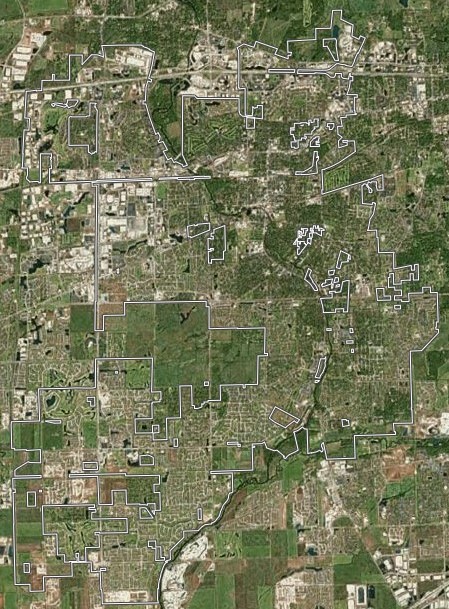
Sixty years ago or even forty years ago, Naperville was much smaller in population and had a smaller footprint in land use. Today, it has nearly 150,000 people and roughly 39 square miles of land with much of this involving single-family homes.
In one sense, the growth patterns that helped make the Naperville of today possible – explosive growth in the postwar era built around homes and driving – also make pursuing sustainability more difficult. Take the reducing the miles driven goal from above. Some residents of Naperville could do this but many are in subdivisions whose roads then feed to large arterial roads. This does not work as well for biking (and the weather in the area may not help). Additionally, the sprawl makes mass transit more difficult. In the past, Naperville has tried buses in the community but they do not get much use (even as the train stations are some of the busiest with commuters going toward Chicago). The best way for Naperville to achieve this goal may be to encourage local businesses to allow employees to work from home, thus limiting commuting needs.
Not mentioned in the news article above (it could be in the report) is the density of the community. One way to improve sustainability in the long run is to have denser housing, particularly near locations where other forms of transportation other than driving are possible. This could be in and around the downtown. It could be in different nodes around the community where there are jobs or where it would be possible to pursue transit-oriented development. As a bonus, denser housing might also provide more opportunities for affordable housing. Naperville has thought about these options in the past but they are not always popular given the single-family home character of the community.
As Naperville pursues sustainability, some actions will be relatively painless given what the community can do. Other conversations about long-term changes or how to address sprawl might take much longer for a consensus to emerge.
Q. Not urban, not yet suburban: One of my best friends just informed me, after I called him out on avoiding me for weeks, that because I am moving from the city where we both live to suburbia, he is no longer “feeling the friendship” and wants to end it. The TL;DR is that he has an enormous fear of being abandoned, and I think proactively decided to abandon me so I couldn’t do it to him—except that I had no intention of abandoning him, and was caught completely off guard.
He is single; I’m married with a preschooler, who adores him, by the way, and will definitely notice the lack of his presence—and he talked about how now I could be a “suburban mom” and forget all about my city friends. He gaslit me, making it sound like I had told him I wouldn’t miss him, wouldn’t come visit the city ever again (I’m moving 20 miles and a direct train ride away; it’s hardly a hardship to come see friends!), and because he doesn’t have a car and can’t come see me, there was no point to staying friends at the same level we have been. I never said or even came close to any of this! I admit that I’ve been talking a lot about my move very positively—it really does feel like a fresh start to me, having a home and yard after living in 750 sq. ft. apartment for the pandemic with a toddler—but he claims I’m just too happy about leaving the city and he loves the city so much that we can’t be friends the same way.
I’m so angry at him right now that I can’t see past any of this to consider contacting him again, but to not contact him would mean that he’s right, I moved away and abandoned him. But…is this a friendship worth salvaging? And if so, how? This all feels like so much bull to me. We’re in our 40s, by the way!
A: I can very much imagine getting a letter here from a single man saying, “One of my best friends moved from the city to the suburbs and all she talks about is countertops and lawn care and finding a nanny and it’s so boring and I just don’t feel like we connect anymore and don’t know if we’ll ever see each other again.” I would probably tell him to make an effort to talk about things that interest him, to give you a little space to be excited about your new life, to be deliberate about making plans together, and to hold off on declaring the friendship dead until trying these things.
But instead, he just cut you off. To me, that’s a sign of being a bit immature, selfish, and inflexible—and that he only valued you for the way you fit into his current life rather than who you are. If you don’t feel like contacting him, don’t—after all, he’s basically ended the friendship without your input. But maybe, like you said, this is just a tantrum over feeling abandoned. If once you get settled, you decide you’re still thinking about him and want to be the bigger person (and the person who rides the train to meet for dinner), tell him you miss him and offer to meet up somewhere convenient to him. If he accepts, you can feel out whether you enjoy the new iteration of your friendship and what it takes to maintain it. If he declines, you have your answer and you can live your suburban life in peace.
There are multiple factors at work here:
Even in an era of social media, video calls, and the Internet, proximity matters for friendships and relationships. Being further away makes it more difficult to get together. Twenty miles from city to suburb is not insurmountable but it is not necessarily easy depending on transportation and traffic. People can often form relationships with neighbors, people at work, and others they see regularly at groups and places even as they have the option to date and meet people through apps.
Suburban life is often focused on different things than urban life. The priorities can be different. Here is my list of why Americans love suburbs: single-family homes, family life and children, race and exclusion, middle-class utopia, cars and driving, local government and local control, and closer to nature. This leads to an everyday experience centered on private homes and family lives, driving, limited diversity and cultural opportunities compared to many cities, and distance from the big city. This could be contrasted with what residents of cities often say they value: being close to activity and cultural opportunities, more people around, less driving, and more diverse populations. Life in the suburbs and cities can look very different, though some of the things people like in each kind of place can be found in the other.
Possibly losing a close friend is hard. Social media makes it possible to hang on to relationships for a long time without much interaction but that is not the same as regular, in-person interaction.
Individual preferences and actions. The letter above speaks to a particular situation between two people even as it hints at broader patterns (#1-3 in the factors above).
Can city/suburbs relationships work? Yes. Does it have particular obstacles? Maybe. Do people like it when their friends move away? No.
Now, as recall ballots are dropping in mailboxes, children are returning to school amid heated battles over mask mandates and skyrocketing cases of the highly transmissible Delta variant. Leaders of the effort to remove Newsom for office are confident that women, exasperated by the effect of Newsom’s policies on their children, are the reason they will prevail.
“It’s gas on the fire,” said Anne Hyde Dunsmore, campaign manager for Rescue California, one of the main recall groups. “The whole time, it’s probably the single biggest ingredient in the campaign, in our success.”
Newsom “didn’t understand mad moms, which are the same as soccer moms,” Dunsmore said, referring to the pivotal group of suburban female voters. “Don’t piss off mommy.”
Newsom and his allies agree that these women are critical, but they point to polling that shows that well over a majority of the state’s women approve Newsom’s handling of the pandemic. If these women turn out, they will be a major factor in helping the governor retain his job.
Multiple recent election cycles have included efforts to sway suburban women. These two labels seem particularly aimed at suburban women, not all women in California or the United States. The two major political parties both think they can convince enough suburban women to care about their priority issues under the right conditions (examples here and here) and the suburbs are the spaces where elections are won or lost.
The shift from the “soccer moms” label that goes back decades to “mad moms” in mid-2021 could be worth examining further. In the label itself, soccer moms referred to driving kids to and from local practices. They cared about the future of their children and their communities. Mad moms suggests women are fed up with what is happening and/or what the future might hold for their families and communities. Especially in 2021, anger can be a powerful mobilizing force in politics.
Presumably, the mad moms are conservative women who want different political outcomes. For the women of California who disagree with their perspective, what is an apt moniker for the other side?








 Legally Sociable