Turning a large suburban office campus into a “metroburb”

There are plans in the works to transform the former 150-acre campus of AT&T in Hoffman Estates into a “metroburb”:

Village officials announced in mid-April that they were in talks with representatives of Somerset, who had recognized an opportunity to apply the lessons learned on their conversion of the 2 million-square-foot former Bell Labs building in Holmdel, New Jersey, into the mixed-use Bell Works project to the 1.6 million-square-foot AT&T buildings.

The key similarity apart from their overall sizes is the large central atriums both properties have, Somerset Development President Ralph Zucker said.

“All of our retail is facing that center court,” he said of Bell Works. “It’s really a vibrant street scene … literally a small downtown.”

Somerset’s concept plan proposes using the existing AT&T buildings for 1.2 million square feet of offices, 60,000 square feet of retail shops and 80,000 square feet of conference space, while new construction would add 375 apartments, 175 townhouse units and possibly a 200-room hotel.

Zucker said the term he coined for this concept at Bell Works — “Metroburb” — is one he hopes will become generally used among other developers.

Successful redevelopment of sizable properties is crucial to both cities and suburbs. Once companies make decisions to move away from existing properties, communities have two goals in mind. First, they need to find ways to make that land attractive to other users. Even a nice facility may not meet the needs of many other users or it may be sized wrong. Second, they often hope to turn the property into something that can generate more for the local tax base. At the least, property taxes are helpful but if retail can be incorporated into the property, sales tax revenue can be generated. The redevelopment proposed above seems to tackle both of these issues: it splits up the space into multiple desirable uses (and there are not that many single firms that need 1.6 million square feet) and has multiple uses (business, retail, and residential). This might have the bonus holy grail of redevelopment: the potential for a mixed-use property that could become a vibrant community on its own.

Given the initial use of this campus, it would be fun to see the AT&T history incorporated into the redevelopment. Bell Labs has an important research and development legacy in the United States and featuring its accomplishments could help set this redevelopment apart from other suburban palces that have less character or history.

City vs. suburbs in Nashville transit vote

An ambitious transit plan in the Nashville metropolitan area was roundly defeated by voters:

Had it passed, Let’s Move Nashville—the boldest municipal transit plan in recent memory—would have launched five light-rail lines, one downtown tunnel, four bus rapid transit lines, four new crosstown buses, and more than a dozen transit centers around the city. Depending on how you do the math, the scheme would have cost $5.4 billion or more like $9 billion, funded by a raft of boosted local taxes. More than 44,000 voters across Metro Nashville’s Davidson County came out in favor of the referendum, with more than 79,000 voting against it…

That’s a simplified version of the city’s politics, of course; while the vote fell broadly along urbanite versus suburbanite lines, a map reflecting the vote tally, and not just the vote result, would look more purplish. But not all that purplish. In the end, a vision for transforming transit in Nashville could not transform the politics of the city.

“There were a host of reasons [the proposal failed], like the cost ($9 billion), the scale (20 plus miles of light rail), the funding source (sales tax increase) and the financing structure (a decade of interest-only payments),” writes Emily Evans, managing director for healthcare policy for Hedgeye Potomac Research, in an email. Evans previously worked as a municipal financial analyst and served on the Nashville City Council for nine years.

A complicated plan like this has a lot of moving parts that voters could either support or vote against. At the same time, it can be a difficult sell for those outside the city core or in the suburbs to support mass transit plans that (1) they feel are not as necessary since they are able to drive where they need to go and (2) that might bring new people to their neighborhoods. When given a choice and their own personal resources, many Americans would prefer not to use mass transit, particularly if they would have to pay more for something they do not perceive helping them.

I would suggest this gets back to larger issues of whether regions really want to work together. Can cities and suburbs both thrive due to joint projects and shared resources? Or, is this a zero-sum game where resources can taken from one area and given to another in the same region is seen as a loss? The voters of Nashville remain to be convinced that mass transit is a big enough boon for themselves, let alone everyone.

When sidewalks and paths are in bad shape

I was reminded by seeing Blair Kamin’s complaints about a path at Northerly Island in Chicago that the condition of sidewalks and paths can matter a lot for those who want to use them. A few thoughts about my experiences with local sidewalks and paths:

  1. On one hand, I grew up near and am still located near a tremendous bike path system: the Prairie Path. Originally an electric interurban line that closed for good in the late 1950s, local residents and officials started converting it into a recreational asset in the 1960s. The path is generally wide, covers dozens of miles with connections of other trails, and offers access to a number of communities and parks. On the other hand, riding a bike on the path can be frustrating at times, particularly in sections with more roads and tracks that need to be crossed (and there are other parts where one can ride much longer without interruption) as well as more pedestrians who are less speedy and often take up more of the path. Additionally, the path offers access between communities but one can often be stuck with limited options with roadways and sidewalks as soon as they leave the path.
  2. Nearly all suburban roads are built for cars. People like to drive fast. Not all roads, particularly in older parts of town, offer adequate space for pedestrians or bikes. Many drivers do not look for bikes or pedestrians.
  3. Sidewalks are sometimes present and sometimes not. I know this is often dependent on the regulations when the road was built but it can be confusing how sidewalks suddenly appear and disappear.
  4. Sidewalks that do exist are often in various states of repair. Some are really narrow. Cracks are common as are different angles and difficult ramps on and off streets. This may be something I am more aware of because I have a road bike that can be harmed by these imperfections as well as young children who can more easily trip on uneven surfaces. Hence, I would almost always rather ride in the road because the condition of the street is usually much better than the sidewalk.

In other words, life for non-vehicles in the suburbs can be difficult, particularly when the infrastructure provided for them is less than ideal. I get it; the suburbs are about cars. At the same time, without adequate opportunities for walking and biking, people will likely simply not try them as much. And this likely continues to fuel a car-driving, suburban society.

(If one wanted to go further, the New Urbanists place a lot of emphasis on street life and allowing residents to get to important places within a reasonable walk. They are usually referring to mixed-use neighborhoods where people are consistently on the sidewalks. Some newer subdivisions are full of walking and bike paths, though these may have few connections to anything outside the neighborhood. In other words, there are some people arguing sidewalks and paths are important – particularly those interested in vibrant street life or interested in boosting property values – but this has not trickled down to all suburban places.)

Fallacy: if suburbs or a big city gain people, the other necessarily has to lose

The history of American metropolitan areas suggests that if a big city loses people, the suburbs gain people and vice versa. Yet, I argue this is an inadequate view of metropolitan regions. Consider a recent story on how the revival of downtown Detroit could harm its suburbs:

The failure of a few landmarks does not mean Detroit’s suburbs are doomed, but some local leaders see writing on the wall. Oakland County’s famously abrasive county executive, L. Brooks Patterson, has long taken a vocal pro-sprawl position, but even his government is making an effort to invest in the county’s handful of historic downtowns, via what’s touted as the “nation’s first and only county-wide Main Street program.” Archetypal suburbs like Troy are also getting in on the act. While it may be hard now to imagine walking along Troy’s main drag, a busy six-lane thoroughfare called Big Beaver Road, the city recently installed wider sidewalks, revised zoning to encourage taller buildings and multifamily housing, and took a stab at transit with a trolley-style shuttle bus.

“Everybody’s trying to create places in Southeast Michigan, which didn’t really have places before,” says Barry Murray, director of economic and community development for Dearborn, which borders Detroit to the southwest. “And there’s a lot of interest in diversified housing options, from young people who want to be in the hearts of downtowns.”

Dearborn, with a bustling commercial center of its own less than seven miles from Detroit’s, is in a better position to adapt to the changing times than most of its suburban peers. The city has been Ford’s hometown for the past century, and while a few thousand Ford workers might be moving down Michigan Avenue, the automaker is also spending more than $1 billion to reimagine its Dearborn headquarters along the lines of a Silicon Valley Tech Campus, and to create a new mixed-use development around Dearborn’s historic Wagner Hotel. Murray expects at least 1,000 new apartments to come online over the next few years—at present, he estimates, 90 percent of the city’s 38,000 housing units are detached single-family homes. Meanwhile, a declining mall where 1,800 Ford employees are temporarily occupying an old Lord & Taylor is “an active planning area,” Murray says. “We know these retailers are not going to be there forever.”

Southfield, just across Eight Mile Road from Detroit, could tell Dearborn a thing or two about disappearing retail—last year, it began tearing down Northland Center, the first shopping mall in America. Since Amazon turned down the city’s offer of the site for its second headquarters, Southfield is moving forward with a plan to crisscross the property with through streets and make way for offices, restaurants, apartments and a park—an effort to create a downtown in a city built without one. Says Mayor Kenson Siver, “We have a lot of plans here.”

This is a common approach to population changes: cities and suburbs are locked in a zero-sum mortal combat for residents. Suburbs have won this battle over time with over 50% of Americans living around major cities. (Hence, the countless stories in recent decades about a population migration to cities which will come at the expense of suburbs. I believe the data overall is limited regarding a major shift in American preferences for city life.)

I would suggest this view contains some truth – communities do compete with each other for prestige, jobs, their tax base, and residents – but also ignores the larger reality of how cities and suburbs work in today’s world. The metropolitan region is a connected unit and the communities and agents work together. The differences between suburbs and city are ultimately smaller than the differences with other metropolitan regions. If Detroit’s core attracts new businesses and residents, this can only be good in the long run. If Detroit is only able to attract businesses and residents from the suburbs, this is not real growth – it simply shuffling actors around within the region. When both Detroit’s suburbs and core bring in people from other regions, they can grow together and the metropolitan region (and all the people within it can thrive).

Of course, there are hurdles to coming to this perspective. Individual communities, city or suburbs, will not like if they lose assets and others around them gain. Racial and class differences lurk behind these current and historic differences. Money is tight. Ideally, suburban and urban leaders would come together to talk about how to proceed positively as a region. Going further, they could discuss how to share resources. (This is probably the toughest sell in American regions, particularly from wealthier communities who do not want to lose the resources they see as theirs.) But, working together for the greater Detroit area would pay off in the long run and help ensure a thriving region.

When all the suburban homes are the same, how can residents set themselves apart?

Continuing to draw from a 1953 Harper’s study of six mass-produced suburbs, Harry Henderson discusses an interesting aspect of the cookie-cutter houses:

Henderson3.png

We are used to the idea that a home, like many other goods one owns, is a means by which people differentiate themselves from others. Your car reveals your personality (or your financial resources). Your clothes celebrate your individuality. Your favorite TV show provides deep insights into your psychology. Your McMansion impresses those driving by with its size. And so on. But, what if residents do not have the luxury of differentiating their exterior?

Henderson suggests they then move their differentiation into activities: what groups are you a part of, what are you contributing, who do you know. But, I think this misses two features about homes:

  1. Even if these homes were mass-produced, it wouldn’t take long before residents could alter their homes and yards. Indeed, Barbara Kelly in Expanding the American Dream details how residents of Levittown made changes to their homes. People add additions, make landscaping decisions, paint their exteriors, and more. If you look at the streets of these homes sixty years later, you can both pick out some of the common architectural features as well as see significant efforts to stand out.
  2. After the section cited above, Henderson then goes on to say that the residents then emphasize interior decorating. They may be cookie-cutter homes from the outside but could have very different feels. While this is not as visible to the neighborhood, it does present an opportunity to show family and friends your own unique self.

There are current parallels to the dilemma Henderson poses: residents of condos, townhomes, and apartments have similar issues as their exteriors share characteristics with others around them.

This is also a reminder of a tendency of modern humans to look for ways to secure a higher status for themselves. Even in a supposed middle-class society, Americans want to be seen as their own individual, even if their housing choices are constrained.

Invasion of McMansions in Kirkwood, Missouri

Teardown McMansions have infiltrated an older neighborhood in a well-off St. Louis suburb:

Residents said not only are smaller historic homes getting wiped out in the process, but the large houses are causing problems for some of their next-door neighbors…

The one next door to her on Cleveland Avenue was erected last year and is nearly twice the size of the original home. It’s a four-bedroom home on the market for more than $800,000.

She said it’s created a real problem for her. The new home’s rain runoff has turned her driveway into a lake…

The city says the builders have followed all the community’s guidelines:

“…The new house on this site sits closer to the neighbor’s driveway, which may explain the confusion. Yes, the new home was built per permit specifications. The City requires the contractor to have the top of the foundation surveyed prior to beginning framing. The floor system is then verified to determine that the finished floor height is as allowed.

A follow-up story from several days later says the new McMansions are affecting more houses:

Since the homes were built around 2015, Reed said her mother’s basement has constantly been flooded and her backyard has turned into a swamp…

The ITeam recently discovered a Kirkwood ordinance that said new developments cannot cause water run-off problems for surrounding properties.

But attorney Paul G. Henry said getting the city to enforce it could be difficult…

We repeatedly asked Kirkwood officials about why they don’t appear to be enforcing their own ordinance but they declined to answer. Instead, they recommended that we file an information request.

Such issues could put a suburb in a sticky situation: should it protect the properties of elderly citizens who have lived in the community for a long time or allow new property owners to construct homes to their liking? Whose property rights prevail? There is probably some middle ground here where the teardowns can be regulated in such a way to provide a little protection to neighbors (whether this involves water issues or residents are concerned about the changing character of their neighborhoods) but these regulations could take some time to discuss and enact.

Living by “a week’s pay for a month’s rent” in the early suburbs

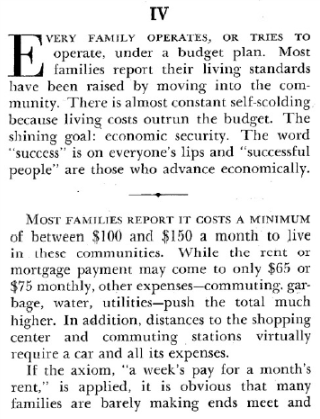
Within a set of observations in Harper’s in 1953 about the new way of life in six mass-produced suburbs, Harry Henderson discusses the financial situation of the new suburbanites:

Henderson1b

Henderson2

Three quick thoughts:

  1. If we still adhered to the guideline of one week’s pay to cover housing, a lot of suburbanites would be in trouble. That rule suggests 20-25% of earnings should be for housing, not 30% which was a more common guideline today. But, with the dearth of affordable housing in many metro areas plus a desire of many suburbanites to be in communities that will help them be successful (i.e. good housing values, high-performing school districts, middle- to upper-class neighbors, a community with a good reputation, etc.).
  2. The desire to achieve the American Dream of owning a home in the suburbs is a powerful one as these residents of mass suburbia were willing to stretch financially – taking on extra work, living with in-laws – to make it happen. I would guess that this is still the case today.
  3. The full article is both an interesting snapshot of suburban life at the beginning of mass suburbia as well as an odd read since it treats suburbia as the exotic. Henderson admits at the beginning that the notes are subjective but they both provide some interesting information as well as provide insights into how outsiders viewed these early suburbs.

Using comic strips to sell the suburbs to millennials

A suburb south of Chicago has a new marketing campaign intended to attract millennial residents:

“Think Homewood” ads, which debuted this month and will run through May, feature three comic strips that focus on affordability, schools, parks, community and creativity. The village, which is about 25 miles south of downtown Chicago, is spending $20,000 on the campaign focused on appealing to millennials…

In those comic panels, two moms stress over registering their kids for schools and park district activities. “I have an alarm set on my phone,” one mom cries when discussing her anxiety about plans to register for a gymnastics class. “If I’m late 30 seconds and miss the window to get a space, I’m so screwed.”

In the other Chicago strip, a dad driving from the grocery store with his wife and toddler shouts, “Frak!” after forgetting avocados for dinner. The couple decide they lack the fortitude to fight traffic and find a parking spot for a return trip to the store. “Goodbye, Taco Night,” an exasperated dad laments.

Those are contrasted with the relatively idyllic “Somewhere in Homewood” strips, where a return to the store for avocados is easy, and the park district has room for another kid in gymnastics even though classes start the next day.

Here is the first strip from ThinkHomewood.com:

https://i0.wp.com/thinkhomewood.com/wp-content/uploads/2018/04/CarCard_Homewood_Strip_1_FINAL-1.jpg

The comic strip seems to hit the right notes regarding one big reason many Americans head for the suburbs: they want a good place to raise a family. Emphasizing safety, lots of green space, good schools, and interesting activities fits into this category.

The strips also highlight a new dimension of suburbs: their growing popularity as cultural and entertainment centers in their own right. While a smaller suburb cannot compete with the restaurant or theater or sports scene in a major city, it can have more cultural amenities. These suburban pockets of fun help move communities past decades-old images of bedroom suburbs where everyone is inside by dinner and nightlife is non-existent. (Of course, most areas in suburbs are relatively quiet places and not every suburb can easily develop a thriving downtown like in Naperville.)

On the downside: many communities have such marketing campaigns. Do they really work? The article goes on to discuss several other Chicago suburbs that have mounted campaigns and the evidence seems thin about whether marketing really attracts people. It is difficult for a smaller suburb to stand out within a region like the Chicago area where there are hundreds of places to live. Would a comic strip be enough to convince people to look in Homewood rather than in dozens of other places?

Finally: do millennials read comic strips like this?

What could kill the McMansion, SUV, and suburban way of life: $10 a gallon gas

One of the ways that the American suburban way of life of single-family homes and driving could come to an end is really expensive oil. Here is one prediction of the fallout:

For decades, we’ve lived — and driven — in denial, somehow assuming we have the “right” to cheap gasoline, and therefore, low-cost transportation. Now it’s time to face reality and consider what will happen when — not if — gas hits $10 a gallon, not because of taxes, but because we will use up the planet’s petroleum…

Highways

Rush-hour on Interstate 95 is a breeze as half of all motorists can no longer afford to drive. But the highways are riddled with potholes as the price of asphalt — made from petroleum — quintuples, making it impossible to maintain the roads because gas tax revenues have dropped with decreased sales. With more people working from home or on flex-time, traffic congestion is a thing of the past.

Homes/offices

With home heating oil at $12 a gallon, people close off rooms in their “McMansions” and huddle in the few remaining spaces they can afford to heat, usually with wood stoves, which are also in short supply. Office buildings, by law, will be allowed to heat to no more than 60 degrees in colder months. Sweaters become a fashion rage…

Around town

Local traffic drops as people consolidate their few truly necessary shopping trips. Because farmers are so dependent on oil (for fertilizers, packaging and transport), food prices skyrocket. Food imported out of season becomes an occasional treat. Few can afford to eat out at now-chilly restaurants dealing with the same food shortages. Wagons and carts, bikes with racks, mopeds and scooters replace SUVs. Kids take the school bus daily instead of being chauffeured by mom. Suburban housing prices continue to fall as people flock to the walkable cities with good mass transit. Small town taxes rise, encouraging further migration. Schools can’t afford good teachers who must still commute from far away due to lack of local affordable housing.

If gasoline was indeed $10 or more a gallon, I imagine a lot would change. Perhaps even more so if there was a sudden spike to that price range instead of a gradual increase that would provide time for people and communities to adjust. Even with significantly higher gas prices, some would be very reluctant to give up the American lifestyle organized around driving.

One question to ask in this scenario is how quickly society could adjust. The American suburbs have been decades in the making. How quickly could they be dismantled? It is common now to hear social scientists, policymakers, and others discussing resilient cities and communities. Could the country adjust if the suburbs became unsustainable due to high gas prices? (According to this one prediction, we should all have bicycles on hand and hope we live close enough to mass transit lines.)

A second question: if the American government has spent many resources in support of the suburban way of life (such as socialized mortgages), would the various government actors try to sustain suburbia in the face of such a threat? Just because living in suburbia might be tougher does not necessarily mean Americans will stop wanting to live there.

What if Americans like the suburbs?

Critics of the American suburbs have long charged that suburban lives are incomplete, diminished, or not all they are cracked up to be. Yet, Americans keep moving to suburbs and aspiring to live there. I was reminded of this by seeing a quote from Bennett Berger’s 1960 study Working-Class Suburb: A Study of Auto Workers in Suburbia:

The critic waves the prophet’s long and accusing finger and warns: ‘You may think you’re happy, you smug and prosperous striver, but I tell you that the anxieties of status mobility are too much; they impoverish you psychologically, they alienate you from your family’; and so on. And the suburbanite looks at his new house, his new car, his new freezer, his lawn and patio, and, to be sure, his good credit, and scratches his head bewildered.

Why can’t Americans take the hint and stop moving to or living in the suburbs when the problems (an auto-dependent lifestyle, emphasis on private houses, limited community life, use of lots of resources to sustain daily life, etc.) are so clear? There are two possible answers to this question:

  1. Suburbanites are being duped or pushed by larger forces to live in the suburbs. There is little doubt that the federal government has promoted suburbia over decades. If they truly were free to choose, Americans would pick the dull or anxious life of the suburbs.
  2. Americans truly do want to live in the suburbs. They like the lifestyle associated with it with the ability to own a house and drive a lot. The American Dream, even if it is just aspirational and not easy to attain, involves moving to the suburbs.

At this point, Americans have been choosing the suburbs (with generous pushes and promotion from various sources) for over a century when they have the means to do so. To reverse this pattern would require a lot of change.