Low turnout elections and planning tax-related questions on the ballot

A low percent of eligible suburban voters turn out in some years, meaning relatively few people often decide the fate of certain questions on the ballot:

Photo by Karolina Grabowska on Pexels.com

But a Daily Herald analysis of vote totals for 22 ballot questions posed to suburban voters in Cook, DuPage, Kane, Lake and McHenry counties last April showed District 101’s turnout was the highest of those initiatives. Fifteen of the 22 were decided by less than a quarter of the eligible voters, including four that were decided by less than 10% of eligible voters, records show…

Another analysis showed similar findings of recent ballot questions in Cook County:

The study showed that 75 property tax-related questions posed to voters during that time were decided by less than a third of those eligible to cast ballots.

Having these tax-related questions on the ballot in low-turnout elections may be intentional:

Ryan Tolley, executive director of Change Illinois, a nonpartisan, nonprofit group that advocates for ethical government and elections, said taxing bodies are deliberate about when they decide to pose questions to voters that could affect their property tax bills.

“They’re thinking about it strategically by putting them in an election when voter turnout is traditionally low,” he said. “Low voter turnout is often advantageous to them at the ballot box.”

Because voter turnout is traditionally highest for presidential elections, many taxing bodies try to avoid posing expensive ballot questions to voters then. Instead, they rely on voter apathy during local elections in odd-numbered years, nonpresidential general elections or primaries like the one coming up in a few days.

Suburbanites have opinions about local taxes in Illinois, a state with a lot of governmental bodies and high property taxes. Yet, voter turnout is often low, even with questions involving taxes up for vote.

In the short term, I do not think it is easy to boost turnout. This has been a trend for years now. Many people do not exercise their right to vote.

In the long term, one solution would be to limit the number of election cycles governments have. Why not limit local elections to 2 and 4 year cycles that line up with House and national elections? This would also save money as governments could consolidate election resources.

Another option would be to reduce the number of local government bodies in Illinois, thus reducing the number of elected members and initiatives. For example, abolishing townships would eliminate one layer of government whose services could be picked up by others.

If Americans increasingly do not trust or feel they cannot get answers from local governments, what happens then?

Even as trust in the federal government has fallen in the United States, Americans often have a rosier view of their local governments. What if those local relationships become more adversarial or less open?

Photo by Pixabay on Pexels.com

The council’s silence leading up to the decision highlights what some observers say is a striking trend toward secrecy among local governments across the U.S. From school districts to townships and county boards, public access to records and meetings in many states is worsening over time, open government advocates and experts say…

Few states compile data on public records requests, and laws governing open records differ by state, making a comprehensive analysis difficult. However, a review by Cuillier of data provided by MuckRock — a nonprofit news site that files and shares public records requests – found that between 2010 and 2021, local governments’ compliance with records requests dropped from 63% to 42%…

Incidents of governments suing journalists and residents for making records requests also have become more common, said Jonathan Peters, a media law professor at the University of Georgia.

Accessing local government meetings is getting more difficult, too. Elected officials are discussing significant public business in closed sessions, observers say. In some regions, they’re engaging in more combative behavior with constituents.

Many Americans like suburban, small town, and city local governments because they are more responsive to local needs, directly use local monies for visible benefits, and are more accessible to residents.

But, if local governments end up looking like what many perceive the federal government to be – faceless, cold, distant, and untrustworthy – what happens? Local government often works on the idea that any resident can show up or see what has been discussed. It is easy to contact local officials. Things need to get done and long arguments about abstract ideals or petty issues detracts from the local quality of life. Getting elected to a local position does not necessarily require independent wealth or political partisanship.

If Americans get to a point where they do not like local government, they might withdraw even further from civic life. Already, local voting turnout is very low. We can already find people online to interact with and drive where we want to rather than engage with neighbors and community members. I hope there is room for local government officials and residents to find ways to work together to serve their communities.

Suburbanites like local government…but do not like voting in local elections?

One reason Americans like suburbs is that they are closer to local government, meaning they have more say in local matters and more access to local officials. They feel can make their voice and tax dollars heard.

Photo by Sora Shimazaki on Pexels.com

Yet, when given the option in the Chicago suburbs to elect local officials, not many people do. In recent years, local turnout has been under 20% in some elections (earlier posts here and here). There are likely lots of reasons for this.

However, the local control suburbanites like – the ability to influence what happens around their property, the oversight of local schools, pursuing community issues they care about, where their tax money goes – depends on community members voting. How do people get into office? By votes. How are people appointed to boards and commissions? Often by those voted into office. Who decides how to spend local tax dollars? Local officials. And so on.

There is still lots of time to vote today. There are plenty of candidates running in the Chicago region. There is a lot of information available about their platforms and goals. May voters turn out and contribute to the local government and control they say they value.

Chicago February municipal election turnout drops

The most recent elections in Chicago featured low voter turnout. From WBEZ:

Photo by cottonbro studio on Pexels.com

Citywide, preliminary turnout currently stands at roughly 34.3%, among the lowest turnout rates for a February municipal election in the last 80 years. The total number of ballots cast in this election isn’t final yet because there are still thousands of vote-by-mail ballots en route to the board of election commissioners.

In 2015 and 2019, the return rate for vote-by-mail ballots averaged nearly 80%. Assuming the same return rate this year, the city’s overall voter turnout rate could reach 35%.

From the Chicago Tribune:

Though early voters smashed city records, overall turnout was low in Tuesday’s municipal election.

Only about 1/3 of registered voters in Chicago cast ballots for mayor, city clerk, city treasurer, City Council and police district councils.

The citywide turnout rate this year was lower than it’s been in the last three municipal elections in 2011, 2015 and 2019. In fact, turnout in 2023 was about 10% lower citywide than it was in 2011.

Notwithstanding the issues of February elections not tied to other state or federal outcomes, I wonder at a few other possible factors involved:

  1. Are the people voting by mail voters who would otherwise not vote or people who would have turned up at a poling place in the past?
  2. Is the motivation of voting in a broader primary with more possible candidates – giving voters more options to find someone who might represent their particular interests – less inviting than having two candidates in the later election and the voters having to choose one or the other?
  3. In a city where leaders tend to be powerful figures, what else might interest voters in selecting these leaders?

“Suburbs are now the most diverse areas in America”

Increasing racial and ethnic diversity in the suburbs can lead to tension:

Photo by Daniel Ellis on Pexels.com

For a long time, the phrase suburban voter has been code for white voter. But suburbs are now among the most diverse spaces in American life, and tension is growing over who belongs in suburbia as NPR’s Sandhya Dirks reports.

The primary arena for conflict in this report involves politics:

DIRKS: Last year, white parents and some white folks who weren’t parents screamed at local school board meetings over teaching kids about racism or having diversity and inclusion programs. Most of the places where those fights flared were suburbs, and they were suburbs that are changing, suburbs that have grown more diverse. In some cases, like in Gwinnett County, they are also suburbs where Black people have started to get elected to local seats, like school boards.

KERNODLE: The difference between now and then is that we have power too.

DIRKS: Because as suburbs change, so does the power of the suburban vote.

This tension extends to numerous other areas including neighborhoods, housing, jobs, and schooling.

More broadly, this part of the process of “complex suburbia” where suburbs are changing. Some communities are changing faster than others, with these rates likely tied to social factors and patterns of resources and influence.

I received no shortage of political mailers this year and the only thing they may have helped with was name recognition

Our home mailbox has been filled for weeks with mailers for candidates at the national, state, and local level. What have I learned from all of these mailers? Very little.

Photo by Abstrakt Xxcellence Studios on Pexels.com

However, the one use they may have is for candidates’ names to catch my attention. I consider myself a fairly informed voter yet I cannot keep up with all of the local races. In a state with so many taxing bodies, there are numerous races for the Forest Preserve, County Board, municipal positions, and more. Who has the time to look at all of the positions of those candidates? I will enter the voting booth today with limited knowledge about dozens of names for positions that the average suburbanite has little knowledge about.

Thus, a mailer might catch my eye with a name in a way that another medium might not. All those texts from candidates in recent weeks? Most were automatically marked as spam by my phone and the others I did not look at. Political ads on television or radio? Easy to avoid by switching stations or using streaming services. News broadcasts about candidates? Can click past or avoid reading.

At the least, I took each of those mailers out of the mailbox, looked at them quickly, and then recycled them. Could they have planted a name or idea in my head? Perhaps.

The % of polling places in churches by state

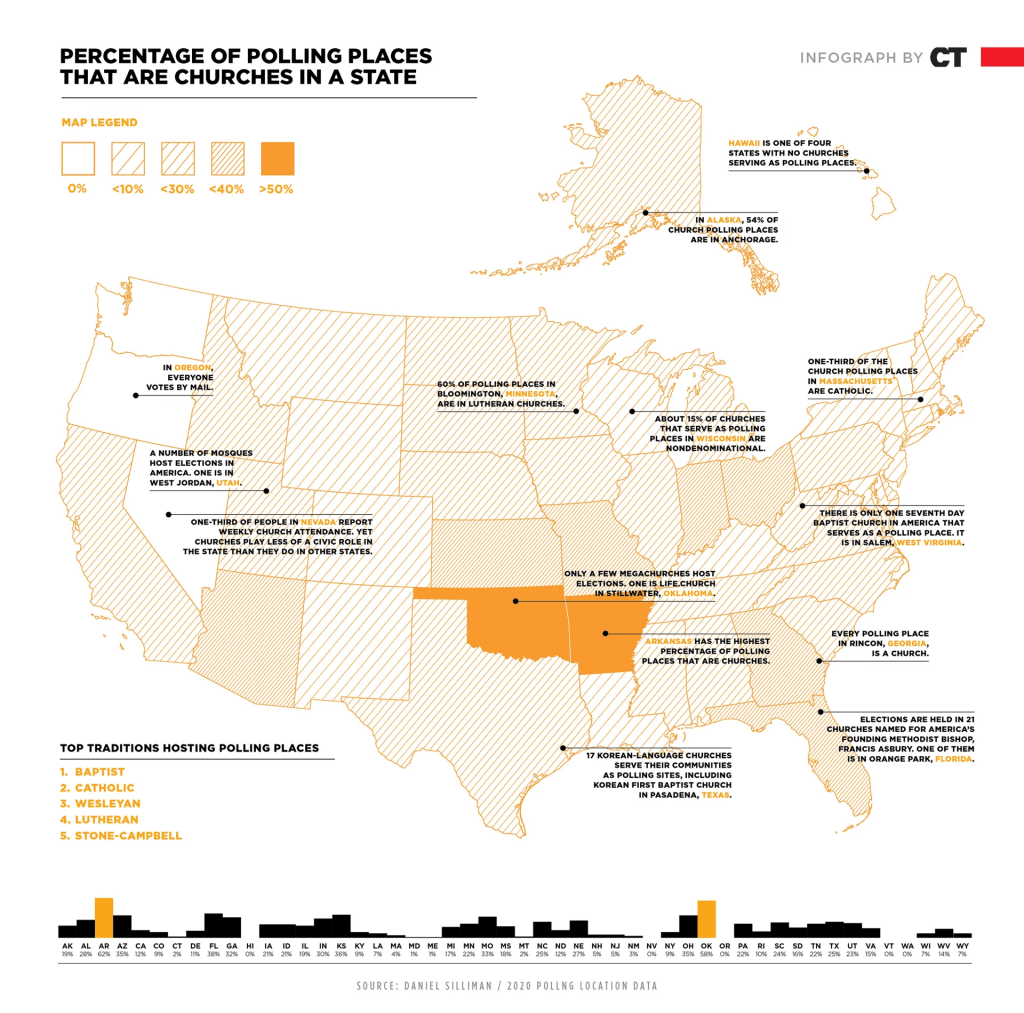
An infographic in Christianity Today highlights how many polling places are in churches:

If I am reading this correctly, here are two patterns:

  1. The percent of polling places that are churches can differ quite a bit from state to state. Generally, some of the Northwest and Northeast are less likely to have churches as polling place. The highest percentages are in more “heartland” states with some interesting exceptions (Arizona, Florida).
  2. Which religious groups host the most polling places can differ as well. It would be interesting to see more fine-grained data/ do these patterns of particular traditions hold up across states or is it because certain states have higher concentrations of certain traditions?

I imagine there might be all sorts of additional factors to consider when examining this.

Given the current political sentiments regarding the role or involvement of religious groups in politics, do these figures go up or down significantly in the coming years? And among which groups and locations?

Residential segregation – by political party

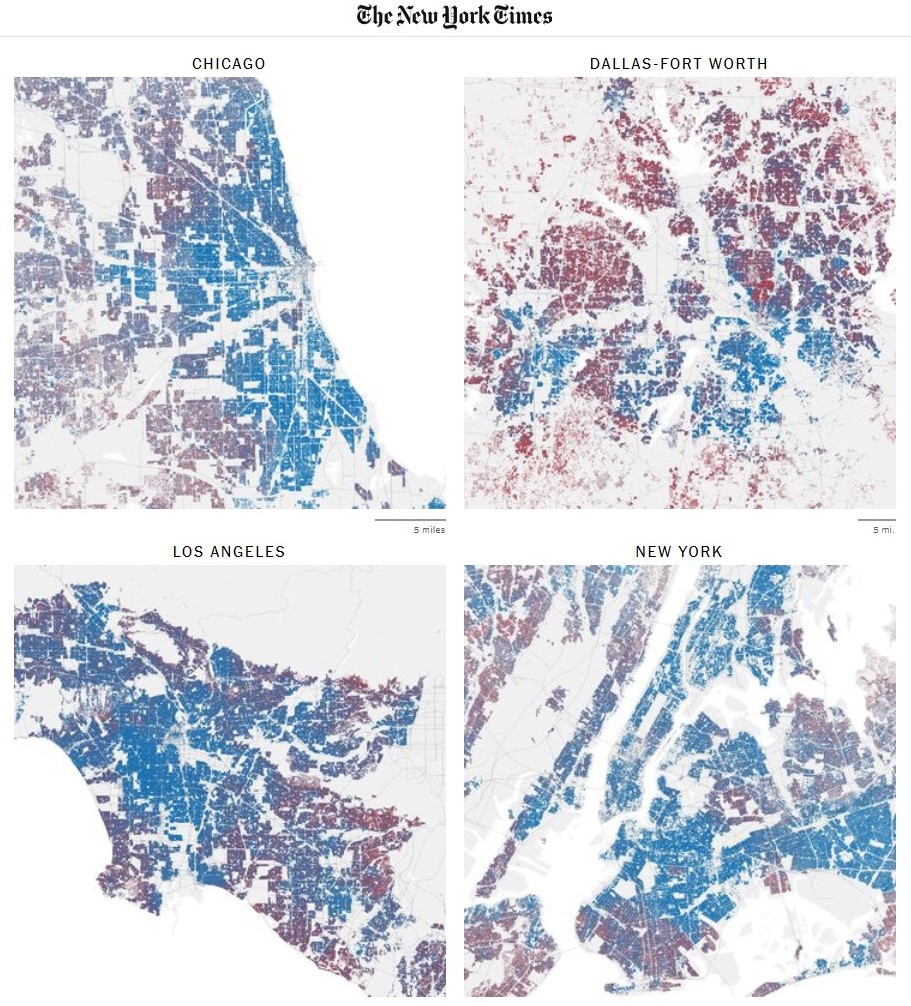
Residential segregation by race is a large issue and voting patterns in recent elections generally show Democrats winning in cities and close suburbs and Republicans winning in outer suburbs and rural areas. Put these two ideas together and you have residential segregation by political party.

https://www.nytimes.com/interactive/2021/03/17/upshot/partisan-segregation-maps.html

As new research has found, it’s not just that many voters live in neighborhoods with few members of the opposite party; it’s that nearly all American voters live in communities where they are less likely to encounter people with opposing politics than we’d expect. That means, for example, that in a neighborhood where Democrats make up 60 percent of the voters, only 50 percent of a Republican’s nearest neighbors might be Democrats.

Democrats and Republicans are effectively segregated from each other, to varying degrees by place, according to the Harvard researchers Jacob Brown and Ryan Enos. And at least over the past decade, they believe this partisan segregation has been growing more pronounced…

For each individual voter, tied to an address, the researchers looked at their thousand nearest voters, weighting those next door more heavily than those a mile away. Drawn this way, about 25 million voters — urban Democrats especially — live in residential circles where at most only one in 10 encounters is likely to be with someone from the opposite party. Democrats in parts of Columbus, Ohio, and Oklahoma City live this way. So do Republicans in the reddest parts of Birmingham, Ala., and Gillette, Wyo…

These studies together suggest that as places become more politically homogeneous, people there are more likely to conform and to publicly signal their partisanship. Maybe no one says, “I want to move here because of all these Biden yard signs.” But perhaps one neighbor is swayed by the people who put them up, and another neighbor concludes, “This isn’t the place for me.”

Lots of confounding variables to examine across a lot of locales. But, the underlying patterns are fascinating to consider: do geographic communities, even in an era of reduced neighborly contact and participation in local institutions, influence people’s political belief and behavior? With more focus in recent years on how online and social media behavior influences politics, this connection to geography has the opportunity to reinvigorate conversation about the power of local communities.

I would be interested to see how this plays out among local governments of communities with similar traits. Take a suburb closer to a big city that leans Democrat and a suburb further out that leans Republicans. Are the local decisions made that different? Do local elections look different?

Or, how often are there tipping points across communities and neighborhoods where a majority of voters are of one party or another? The patterns now show some stability but these have changed in the past and could change again in the future. What happens when they do change and does the character of the community change?

Selecting a suburban mayor by picking a ping pong ball out of a hat

Last week, one tied mayoral race in a Houston suburb came down to selecting names from of a hat:

Photo by Ingo Joseph on Pexels.com

Sean Skipworth and Jennifer Lawrence were vying to be the next mayor of Dickinson, but they each ended up with 1,010 votes after a runoff election last month and a recount earlier this week.

According to Texas law, a tie in a race for public office can be resolved by casting lots.

Skipworth became mayor after a ping pong ball with his name was pulled out of a hat during a ceremony Thursday that lasted about 10 minutes, the Galveston County Daily News reported…

Dickinson, located about 40 miles southeast of Houston, has more than 21,000 residents.

What a way to peacefully resolve an election.

Two things strike me in reading this. First, many Americans like having local government at a relatively small scale. This is a medium size suburb: it could be small enough to be considered a small town, large enough to feel bigger than a small town. Such elections can be decided by a small number of voters: the article suggests each candidate had 1,010 votes, meaning the front-runners had slightly more than 2,000 votes out of over 15,000 residents who might be available to vote (rough calculations from Census data).

Second, Americans often feel better about their local politics – from their community through their representatives in Congress – compared to national politics. Perhaps people want to think better about those from their places or the stakes at the local level are lower (though local disagreements can get heated). The mayor of Dickinson, Texas may not be able to do much in the grand scheme of things but local officials are often non-partisan and say they are about getting things done.

Because this happened at a very local level, there is likely little from this particular solution – casting lots – to apply to the national level. Yet, the spirit and means of local politics may provide regular reminders of what is possible and how politics can be conducted.