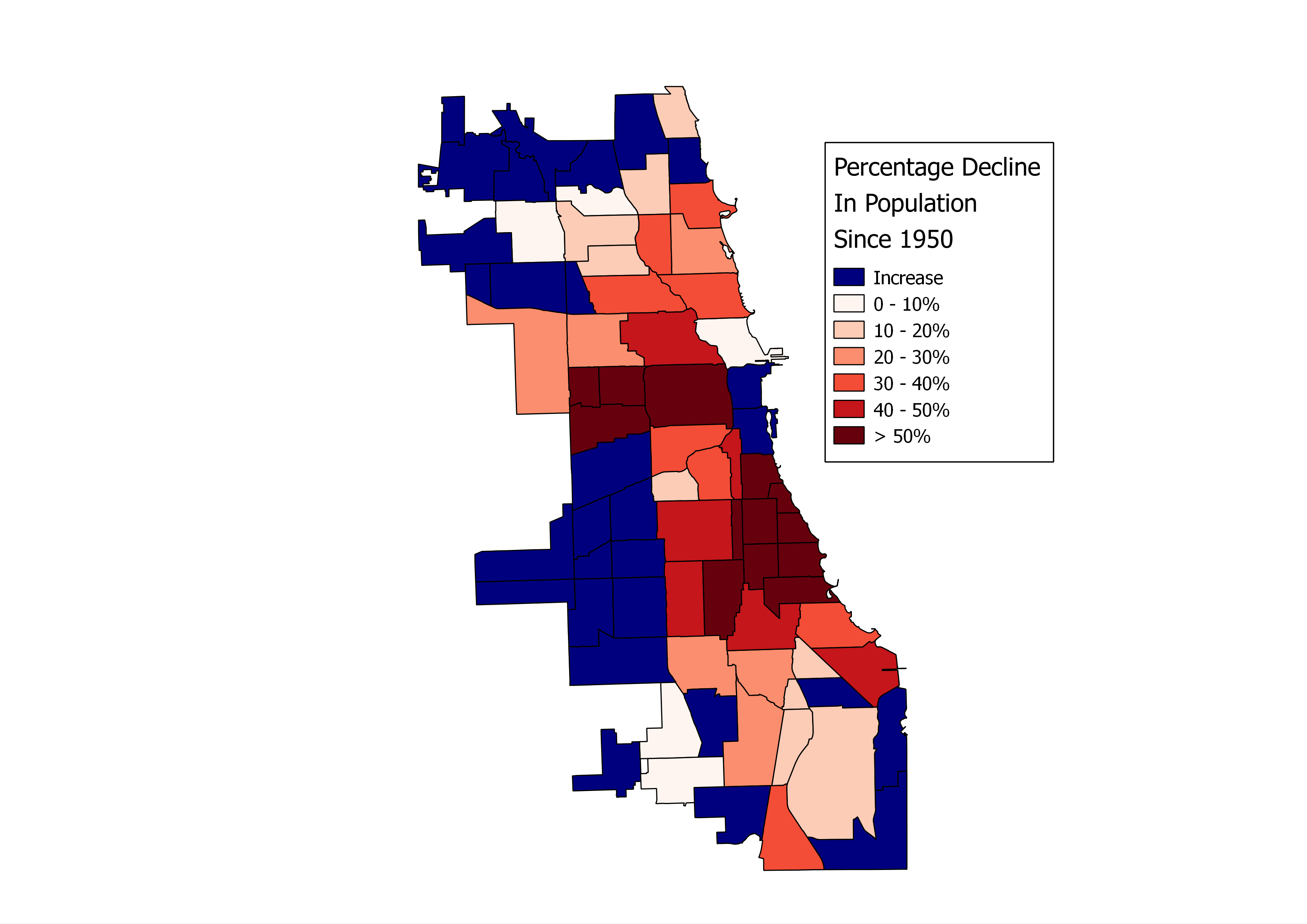
Even affluent Chicago neighborhoods, like Lincoln Park, have lost significant numbers of residents

Rust Belt cities like Chicago have declined in population since the mid-1900s and the population loss is not just limited to poorer neighborhoods:

For a long time, most accounts of Chicago’s lagging population have focused on parts of the South and West Sides where many residents, largely African-American, have decided to decamp for the suburbs or the South in search of better schools, less crime, and more jobs.But the under-appreciated flip side of population loss in those parts of the city is that places that ought to be growing like gangbusters are stagnant, often sitting 25% to 50% below their peak populations. Lakeview, for example, was once home to 124,000 people; its population is now 94,000. North Center is down from nearly 49,000 to under 32,000. West Town, which includes Wicker Park and Bucktown, has fallen from 187,000 to 81,000.

Decline5010

What explains the population loss in even popular neighborhoods? Here is one possible answer:

Since replacing a couple two-flats with a courtyard building is now illegal, developers make money by tearing down an old two-flat and building a luxury two-flat in its place. Or they build a mansion, and the neighborhood actually loses a housing unit. As a result, as a neighborhood becomes more attractive, the city encourages fewer people to live there.

Zoning (theoretically based on improving the neighborhood) plus chasing profits may just lead to population loss. This could be balanced out by approving more high-density housing in a particular area (like the Loop are in specific portions of popular neighborhoods as to limit their effect) but that leads to major changes in two places.

It is still worth noting that the areas that seen an increase in population are either (1) the Loop with a reemphasis on residential construction and (2) community areas on the edges of the city which other lower densities as well as potentially more open land since 1950.

Quick Review: Suburbia (the board game)

I study suburbs so it was appropriate that I received the board game Suburbia for Christmas. Here is my review of the game after three playings:

1. The game is built around constructing five different kinds of land: residential zones, commercial zones, industrial zones, civic zones, and lakes. You purchase hex pieces and your suburb grows as each zone gives you different abilities such as a growing income, a growing reputation (which increases your population), and more money. Because it is hex based, it is kind of like a cross between Catan and Carcassone where the hexes allow you do things but you have choices of what you build.

2. Like in real suburbs, zoning definitely matters. You have to keep certain properties away from each other. For example, industrial zones usually decrease the reputation of adjacent residential or civic zones. One residential zone, housing projects, have to be the most removed as they decrease your reputation if placed near residential, commercial, or civic zones. Because of these different zoning rules, you tend to have clusters of different properties. The one thing that can help break up the clusters? Lakes.

3. It is interesting that you have to reduce your income and reputation each time you cross a certain population size. As the game goes along, you have to find ways to keep your income and reputation up because as you grow, these go down. As the game suggests, quality of life is hard to maintain as your suburb grows larger. Thus, having a growing population is a kind of penalty even though you need the biggest population to win.

4. Getting a Casino and a PR Firm can really help you win – if you can afford them. They don’t come along until later in the game but they stop you from losing reputation/population (Casino) and income (PR Firm) when you cross each population threshold. These would be harder to obtain in a four player game but in a two player game where one player had both, they made for an easy win.

5. One nice twist of the game is that the players look at four common goals and then each player has an individual goal (unknown to the other players). Winning each goal (and ties do not count) leads to a population bonus so your planning and zoning is affected by these different goals. This helps vary the gameplay quite a bit.

6. One oddity: each player is building a borough and all of the boroughs constitute suburbia. The terminology for the level below suburbs as a whole likely reflects regional terminology. But, why not use municipality? Community? Just call each player’s board a separate suburb? Players actions can affect those of others so it makes some sense that each board is not a suburb but I found the word choice interesting.

As a suburban scholar, I think this game does a nice job simulating some of the broad aspects of suburban life. As noted above, zoning matters but a winning outcome also likely requires a mix of zones as a community needs population, income, and reputation to get ahead. Finding the right balance can differ from game to game given the goals.

Creating the “mobile-ghetto” in major cities

Affordable housing is scarce in many major global cities so one architect has a design for the “mobile-ghetto”:

So as Malka sees it, Parisians need a way to “reclaim” the city. His idea is a modular micro-city consisting of rooms that attach to scaffolding built around existing infrastructure, like barnacles clinging to a ship. He calls it the P9 Mobile-Ghetto, and has imagined them here hanging off the side of the Pont Neuf bridge in Paris.

“In a time when we are getting more and more mobile, not only regarding our phone and laptop devices, but also…the increasing number of freelancers or homeworkers, mobile-cities would totally change the uses and the morphology of the city,” Malka says. In practice, this means that the idea of a third space—in which city dwellers inhabit coffee shops and parks the way others gather in their living rooms, or regard shared bicycle programs as their own bikes—extends to include a smattering of rooms or event spaces created for the public, and run by the public. The bridge can become your meditation center; an out-of-use monument could become an art gallery.

Obvious complications with zoning and historical preservationists aside, Malka says the Voluntary Ghetto is technically plausible, and would just require using scaffolding to support shipping container-sized rooms. That said, this (conceptual) new layer of infrastructure says more about urban lifestyles than it does about feats of architecture. Would Parisians (or New Yorkers, or Londoners, or any city residents) delight in finding more intimate, indoor, spaces, or would it feel like a brash paint job on a historic city? “If there is an utopia in this project,” Malka says, “it’s more in its social dimension than its architectural aspect.”

Two quick thoughts:

1. Shipping container type structures are popular these days since they are relatively available and have a standard size. Yet, I wonder how communities would respond to the architecture that is often made with them. For lack of a better descriptor, it is boxy. It is one thing to supply affordable housing; it is another to put these sorts of designs on the Pont Neuf. Add that to the barnacle type image and it doesn’t necessarily look pretty.

2. A design like this or other recent innovations like tiny houses really can be limited by zoning laws. Major cities are often mazes of zoning regulations. While these zones exist for a reason, they can often make true innovation quite difficult. How much would cities be willing to revisit their zoning laws to allow spaces for these sorts of designs that are smaller and more flexible? I’m not imagine an overlay district – that is simply putting a temporary or permanent zoning change or exception over existing zones – but rather revisiting the whole thing to adapt to buildings and spaces in the 2010s.

Making something out of hundreds of unfinished subdivisions

The economic crisis of recent years had broad effects including stalling the construction of hundreds of suburban subdivisions across the United States:

There are hundreds of zombie subdivisions like this one scattered across the country. They’re one of the most visible reminders of the housing boom and bust, planned and paved in the heady days where it seemed that everybody wanted a home in the suburbs, and could afford it, too. But when the economy tanked, many of the developers behind these subdivisions went belly-up, and construction stopped. In some cases, a few people have moved into homes in these half-built subdivisions, requiring services to be delivered there. In others, the land is empty, except for roads, sidewalks, and the few street signs that haven’t been stolen yet. In some counties in the West, anywhere from 15 to 33 percent of all subdivision lots are vacant, according to the Sonoran Institute…

But if roads have been paved or a developer has installed infrastructure improvements, it’s very hard to just revert the space back to farmland. Local governments who try to stop building—even if there is little demand—can be sued for preventing development where it had once been approved…Still, some developers  have come up with creative ways to turn zombie subdivisions into something other than rows upon rows of empty McMansions.

Maricopa, Arizona, for instance, had issued about 600 residential building permits a month during the boom, and then saw many of these developments stall. Rather than just wait to see if demand would ever return, the city hooked up a Catholic church with the owners of an empty development. The church had been looking to erect a new building, and was searching for a site with existing water and infrastructure services. The developer had been looking for someone willing to build. With a little bit of rezoning help from the city, the church could start building on the land…

And in Teton County, Idaho, population around 11,000, where the Sonoran Institute estimates that 68 percent of land parceled into subdivisions was undeveloped, local officials passed ordinances that would allow subdivisions to be rezoned. One development, called Canyon Creek Ranch, changed its plans from a resort with 350 lots to a community project with only 21 lots, shrinking the infrastructure price tag by 97 percent and reducing the environmental impacts.

From zombie pedestrians to zombie subdivisions. It sounds like communities have to hope that someone wants the land – whether a residential developers or some other user – so they can do something with it. As noted, communities might be able to speed that up by rezoning the land for other uses. Perhaps this might lead to some ultra-flexible zoning where these spaces could be residential, commercial, industrial, or other as long as somebody has a plan.

I do wonder how many of these subdivisions would have legitimately filled up. Where were all the people going to come from? If they moved to the new homes, they opened up other units. Are there so many people rooming together or living with family to create the demand for all these new houses?

My suggestion for what these settings can be used for: sets for all of the post-apocalyptic or dystopian TV shows and movies. Studios could likely get cheap long-term deals on these properties and use them however they wish.

Rise of the granny flat in Portland

Here is another version of the smaller house movement: changes to regulations in recent years have led to more “accessory dwelling units” in Portland.

And additional living spaces are springing up everywhere, providing affordable housing without changing the feeling or texture of established neighborhoods the way high-rise developments can…

Eric Engstrom, a principal city planner, has seen these small structures become increasingly popular during his 16 years working for the city. And as he put it, “Given the low vacancy rate, when they’re done, you can rent them out in about an hour.” Which means that adding an accessory dwelling unit, or A.D.U., increases the value of a piece of property.

Since the 1990s, Mr. Engstrom said, zoning laws in Portland have been slowly changing to accommodate the buildings. “There’s been a lot of pressure on us to allow them,” he said.

But it was in 2010 when the biggest changes took place. That was when the city relaxed the limitations on size and began offering the equivalent of a cash incentive by waiving the hefty fees usually levied on new development. Other cities in the Northwest have been moving in this direction, but Portland is the first to offer a significant financial benefit and one of the few that does not require owners to live on the site, provide additional off-street parking or secure the approval of their neighbors — all of which have proved to be obstacles elsewhere. Apart from Santa Cruz, Calif., and Austin, Tex., where secondary dwellings have long been allowed, Portland is alone in this country in its aggressive advocacy of the units.

Seems like this approach could be a reasonable solution in many communities: allow small dwellings that can be used for multigenerational family space, generate a little extra income, provide more affordable housing opportunities, and/or expand the inhabitable space for the household. Yet, the article says little about why this has moved forward in Portland and a few other places but hasn’t caught on elsewhere. Is it seen more favorably in cities with limited space and relatively high real estate prices? Does it require more progressive politics?

Lawsuit again Chicago halfway houses may clarify rules on how they can operate

A new lawsuit from Chicago residents against several halfway houses on the north side may help clarify how such facilities can locate in residential neighborhoods:

Both lawsuits highlight tensions often exposed in neighborhoods when treatment and recovery facilities seek to move in. Doing so can be difficult, treatment experts say, when established neighborhoods often don’t want them there.

But the case could also break new ground in Illinois, the plaintiffs’ attorneys say, raising legal questions about how the federal Fair Housing Act protects substance abusers in a group home, whether such residents qualify as disabled and if the law affects the city’s regulatory authority…

“They’re not saying, ‘Judge, evict these people,'” attorney Michael Franz said of the neighbors’ complaints. “They’re saying, ‘Judge, please make them follow the procedures that any other business would have to follow in the city of Chicago on zoning variances.'”…

“Studies have shown that when you put a group of recovering addicts and alcoholics in good, single-family homes in good, single-family neighborhoods, the recovery process is enhanced and the residents receive a benefit,” Polin said. “Part of the reason is they’re not living in drug-infested neighborhoods, they’re living in good neighborhoods.”

Sounds like an interesting set of cases: homes for the disabled versus the ability of a community to set zoning laws to limit what can be located within a residential area. The typical homeowner would not want to live next door to such a home and yet it can be difficult for organizations to find suitable and welcoming locations. Halfway houses for substance abusers aren’t the only ones who draw objections: homes for ex-convicts, churches, and businesses can similarly draw the ire of residents who don’t want the character of the neighborhood nor their financial investments possibly disturbed. But, should all such facilities be located in areas beyond residential zoning?

Calling local McMansion restrictions a “McMansion diet”

Plenty of American communities have changed their zoning guidelines to limit the size of new McMansions, particularly teardowns in older neighborhoods. But, I’ve never seen this phrase before:

McMansion Diet? Continuation of Public Hearing to amend local law Chapter 197, Zoning, of the Rye City Code, Section §197-1, “Definitions and Usage”, to amend the definition of “STORY, HALF”, and Section §197-43.2, Subsection B, “Attics” to amend the Calculation of Attics in Gross Floor Area.

At its most basic level, the term implies the slimming down of McMansions. In teardown situations, a new home might not be that big compared to the average new home size in the United States of 2,500 square feet. But, if some of the neighborhood homes are 1,200 square feet and the new home is 2,300 square feet or the older and smaller homes are 1950s ranches and the new home is a Spanish with Tudor elements two story structure, the difference is more striking. The diet, which here looks like it relates to how attics should count toward square footage, will lead to smaller homes.

But, such a term also implies that McMansions need diets, that they are obese, that they may be the result of gluttony. These judgments are more involved with teardowns though the implication for McMansion in new sprawling neighborhoods is that they are unnecessarily large as well. And, some McMansion critics would argue, this diet should really be applied to an entire American consumption mindset that ranges from houses to fast food portions to SUVs.

I’ll be on the lookout for more links between McMansions and food diets and how this connection is presented.

Wheaton joins other communities in zoning medical marijuana dispensaries in manufacturing and industrial zones

Similar to Naperville, Wheaton wants to restrict medical dispensaries to manufacturing and industrial zones, near the city’s downtown:

City council members Monday gave their preliminary approval of zoning changes that would limit any dispensing operations to the industrial and manufacturing zones immediately south and west of the city’s downtown…

“[State law] pretty much excludes all property in Wheaton from having a cultivation center. The dispensing organizations have slightly different restrictions,” said James Kozik, director of planning and economic development. “It seems to be the trend that the locations where a community is permitting them seems to be in the manufacturing or industrial area.”

The state also prohibits businesses that will dispense medical marijuana from being within 1,000 feet of the property line of a school or day care, from opening in any type of residence or residential area, and from referring patients to a physician.

Under the state statute, Kozik said, without city action, dispensing operations could also be located in the Danada shopping area, East Roosevelt Road, portions of the Wheaton College campus and portions of the DuPage County Complex along County Farm Road.

City Manager Don Rose said he believes law enforcement officials would prefer to have dispensing facilities limited to the manufacturing district. Most council members agreed.

It will be interesting to watch how this plays out in Wheaton, given the community’s conservative political and religious character, as well as in other suburban communities.

Can a pleasant suburb like Naperville have medical marijuana facilities?

Naperville officials are looking into how to regulate future medical marijuana facilities in their community:

Naperville will begin considering zoning regulations for medical marijuana businesses Tuesday night as councilmen review staff recommendations to limit such facilities to industrial parks, set a distance requirement from residential areas and require all medical marijuana operations to be evaluated on a case-by-case basis instead of allowed outright.

The proposed zoning code updates, which also would prohibit medical marijuana cultivation centers or dispensing organizations from opening in downtown and general commercial areas, are set to be considered during a council meeting at 7 p.m. in the municipal center, 400 S. Eagle St…

Naperville’s possible zoning changes are in addition to state restrictions that say cultivation centers cannot be within 2,500 feet of the property line of a school, day care center or residential area, and only one can open in each of the 22 state police districts statewide…

He said keeping dispensaries out of downtown and allowing only one in each strip mall or collection of buildings under the same ownership will help prevent the new businesses from being too widespread…

“The dispensaries are more like a pharmacy and should be allowed in retail areas,” Chirico said. “Legal, prescribed medication shouldn’t be restricted to an industrial park.”

It will be interesting to watch how wealthier suburbs treat medical marijuana facilities which are legal but probably not very desirable in these communities. Are the dispensaries better or worse than tattoo parlors? (If I had to vote, I’d go with better.) The interest in putting a dispensary only in industrial areas certainly would help keep it out view and away from impressionable people.

But, I could imagine a scenario where a resident of such a community is able to effectively tell how they need the marijuana to relieve pain from a life threatening illness and they don’t want to be made to feel like a ne’er-do-well in their own suburb. Telling that story in the right setting might make the community leaders and residents look uncaring and callous.

Lawsuit brought by Bosnian Muslim congregation against Des Plaines

A Bosnian Muslim group that was turned down by the Des Plaines City Council in regard to converting a building into a mosque has filed a lawsuit against the suburb:

But aldermen say allowing any house of worship in an industrial park would endanger pedestrians and impede neighboring manufacturers.

“I don’t care if they’re Catholic, Jewish, Muslim, whatever. It’s not zoned for that particular area,” said Ald. Mark Walsten, who was named in the suit because he voted against an amendment to accommodate the mosque. “Whenever there are children involved in an industrial area, I will not have that on my conscience.”

Members of the American Islamic Center, who have rented space in a Rolling Meadows mosque since March 2011, had hoped to purchase the vacant building, formerly occupied by an insurance company. Many of the center’s 160 members fled Bosnia in the 1990s to escape war and genocide.

In fact, Bosnian immigrants opened the first mosque in Chicago almost a century ago, Agic said, and Illinois has the nation’s largest Bosnian-born population…

The Des Plaines Plan Commission unanimously recommended a zoning amendment to accommodate the center. But in July, the City Council voted down the proposed amendment.

Classic suburban case: zoning laws against the ability of residents to pursue their interests. And the Des Plaines City Council is appealing to safety and business concerns. There have been several cases in recent years in the Chicago suburbs having to do with requests from Muslim groups being denied by suburban communities. See this case involving DuPage County near Naperville, this case near West Chicago, and and this case in Lombard.

It is not unusual for a Plan Commission to recommend one thing and the City Council to vote the other way but it would still be interesting to hear their different reasons.