Watching the planes in style at SeaTac

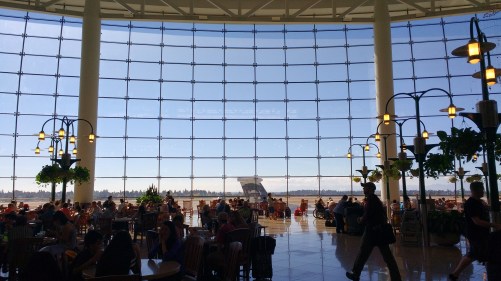
After walking through security at SeaTac, I entered the central food court and shopping area. I was greeted with this view:
IMG_20160823_155444200

From this gallery, you can watch the main runways as planes takeoff and land and you can do so seated in wooden rocking chairs (close to the windows). I assume many airports are designed with providing sufficient gates and access to planes in mind. Think of O’Hare or Atlanta where the concourses are long. Yet, this view took the mall court airport plan – common across many newer airports including ones I’ve seen in Tampa, Orlando, and Las Vegas – to another level: providing a large view of the most interesting work of the airport as planes travel at high speed.

An overview of the airport feature from when it opened in 2005:

The feature attraction, however, is the 60-by-350-foot glass wall that overlooks the runways and, in amenable weather, the Olympic Mountains. It’s more than just a big picture window. The panes are wrenched into a compound curve, convex in the vertical plane and concave in the horizontal. It looks more like a portal to a space warp than a mere window. The web of steel cables, struts and attachment spiders that allow the curtain wall to flex up to 11 inches in a worst-case windstorm or earthquake is all exposed to view, a celebration of virtuoso building technology…

Architect Curtis Fentress, the terminal’s principal designer, is convinced that people want to feel the excitement of travel again, and that it touches a deeper place than momentarily marveling at the apparent miracle of 400-ton cigars storming into the sky. He recalls a boyhood visit to the airport to see his uncle off to the Korean War. “We watched him wave to us from the plane,” Fentress recalls — an impression half a century old, burned indelibly into his mind.

Bonus: this area seemed to particularly fascinate small children. This is no small feat in the harried realm of traveling.

An official definition for a “smart home”

Two companies – Coldwell Banker and CNET – defined the smart home back in May:

Smart Home: A home that is equipped with network-connected products (i.e., “smart products,” connected via Wi-Fi, Bluetooth or similar protocols) for controlling, automating and optimizing functions such as temperature, lighting, security, safety or entertainment, either remotely by a phone, tablet, computer or a separate system within the home itself.

In order to be categorized as a smart home, the property must have a smart security feature that either controls access or monitors the property or a smart temperature feature, in addition to a reliable Internet connection. It must also include at least two additional features from this list:

Appliances (smart refrigerators and smart washer / dryers)

Entertainment (smart TVs and TV streaming services)

Heating / Cooling (smart HVAC system, smart fans or vents)

Lighting (smart light bulbs and lighting systems)

Outdoors (smart plant sensors and watering systems)

Safety (smart fire / carbon monoxide detectors and nightlights)

Security (smart locks, smart alarm systems or cameras)

Temperature (smart thermostats)

An interesting list. I would assume some of this is driven by availability of technology as well as which features are already most popular with homeowners: security and temperature. After either one of those, everything else is less common and may be harder for consumers to imagine their value. Will people truly choose a home because it has smart watering systems or a smart dryer? We’re consistently told this is the wave of the future but it will take some time for all of this to become standard.

Additionally, we can continue to ask about what benefits to family life smart homes will bring.

Redeveloping a few closed Chicago public schools into apartments

While many of the closed school buildings in Chicago are drawing little attention, a few are being redeveloped:

In a blog post on Medium, the Chicago Department of Planning and Development (yes, the DPD apparently blogs now) offered a first look at one of these adaptive reuse projects. They offer some details on how the process works: developers express interest in a property, seek landmarking designation for tax credits and waivers, and then begin the renovation. A suburban developer, Svigos Asset Management, is currently working to renovate the Elizabeth Peabody Public School at 1444 W. Augusta Blvd. and the John Lothrop Motley Public School at 739 N. Ada St. — of which both have addresses the highly coveted West Town area. The group is also working on getting landmark status for the Lyman Trumbull Elementary School in Andersonville for an adaptive reuse project there.

The developer is renovating these schools and turning them into new residential developments. In their post, the DPD reveals photos of the former James Mulligan School being transformed into apartments. To be fair, the Mulligan School has been shuttered for much longer than the schools that were closed a few summers ago. However, the building is nearly ready to go and the DPD indicates that the building’s new owner is gearing up for pre-leasing.

Not too surprising that the ones that are more attractive to developers are ones that are in more desirable locations.

Given the response to the closing of these schools, I’m a little surprised progress has been so slow. Granted, there are other major concerns in Chicago but given the city’s debt and the need for resources in some neighborhoods, these buildings represent an opportunity. Apparently there are plans for some other buildings:

The shuttered schools that have not been sold off still belong to the city and its residents, and some neighborhoods are looking to take these buildings back as community centers, food pantries, or other uses that would serve the surrounding residents.

These could be worthwhile ideas. Is the city determined to hold on to many of these structures rather than find community partners who could do some good? All of this reminds me of some of the fate of the properties where public housing high-rises stood for decades: often located in poorer neighborhoods, this land can sit empty for years. In fact, while Detroit gets a lot of attention for empty lots, Chicago has plenty of open space in certain neighborhoods. Outside of a long-term project of a land bank, what could be done to positively utilize these lots?

The power grid, Wall Street, and presidential elections as “critical infrastructure”

The Department of Homeland Security is considering oversight of the critical infrastructure of the presidential election:

“We should carefully consider whether our election system, our election process, is critical infrastructure like the financial sector, like the power grid,” Homeland Security Secretary Jeh Johnson said.

“There’s a vital national interest in our election process, so I do think we need to consider whether it should be considered by my department and others critical infrastructure,” he said at media conference earlier this month hosted by the Christian Science Monitor…

DHS describes it this way on their website: “There are 16 critical infrastructure sectors whose assets, systems, and networks, whether physical or virtual, are considered so vital to the United States that their incapacitation or destruction would have a debilitating effect on security, national economic security, national public health or safety, or any combination thereof.”…

Johnson also said that the big issue at hand is that there isn’t a central election system since the states run elections. “There’s no one federal election system. There are some 9,000 jurisdictions involved in the election process,” Johnson said.

The term infrastructure usually brings to mind public services like electricity, water, and transportation. This is a broader definition that hints at what the government think is essential to American society. Wall Street as infrastructure? If something crashed for a significant amount of time – whether through error or malfunction or nefarious intervention – the ripple effects could be huge. If the national election system couldn’t be trusted, it could have significant implications for a democracy.

See the full list of the 16 areas identified as critical infrastructure – including food and agriculture as well as critical manufacturing – at the DHS website. I wonder what other sectors could be added in coming years…

When software – like Excel – hampers scientific research

Statistical software can be very helpful but it does not automatically guarantee correct analyses:

A team of Australian researchers analyzed nearly 3,600 genetics papers published in a number of leading scientific journals — like Nature, Science and PLoS One. As is common practice in the field, these papers all came with supplementary files containing lists of genes used in the research.

The Australian researchers found that roughly 1 in 5 of these papers included errors in their gene lists that were due to Excel automatically converting gene names to things like calendar dates or random numbers…

Genetics isn’t the only field where a life’s work can potentially be undermined by a spreadsheet error. Harvard economists Carmen Reinhart and Kenneth Rogoff famously made an Excel goof — omitting a few rows of data from a calculation — that caused them to drastically overstate the negative GDP impact of high debt burdens. Researchers in other fields occasionally have to issue retractions after finding Excel errors as well…

For the time being, the only fix for the issue is for researchers and journal editors to remain vigilant when working with their data files. Even better, they could abandon Excel completely in favor of programs and languages that were built for statistical research, like R and Python.

Excel has particular autoformatting issues but all statistical programs have unique ways of handling data. Spreadsheets of data – often formatted with cases in the rows and variables in the columns – don’t automatically read in correctly.

Additionally, user error can lead to issues with any sort of statistical software. Different programs may have different quirks but various researchers can do all sort of weird things from recoding incorrectly to misreading missing data to misinterpreting results. Data doesn’t analyze itself and statistical software is just a tool that needs to be used correctly.

A number of researchers have in recent years called for open data once a paper is published and this could help those in an academic field spot mistakes. Of course, the best solution is to double-check (at least) data before review and publication. Yet, when you are buried in a quantitative project and there are dozens of steps of data work and analysis, it can be hard to (1) keep track of everything and (2) closely watch for errors. Perhaps we need independent data review even before publication.

Singling out a Houston McMansion

McMansionhell is back with a “snarky takedown” of a particular home in Houston. See the diagrammed pictures and explanation here.

It is not surprising that this researcher went after a Texas McMansion. I found in my article regarding uses of the term McMansion in both the New York Times and Dallas Morning News that there are some significant differences between the two areas of the country. The tone from New York City was that McMansions were overwhelmingly bad, even with their construction in suburban areas of the metro region. On the other hand, there were supporters of McMansions in Dallas. As McMansionhell noted, things are indeed larger in Texas and my study of the newspaper coverage suggested some people don’t mind celebrating this. Additionally, while sprawl is present in both places, a city like New York with such a dense center (some might argue the center of the world) does not celebrate the suburban conditions that encourage McMansions while residents of Dallas didn’t mind as much.

A side note: I found that design (example: Mediterranean architecture doesn’t work everywhere) and features of McMansions could differ quite a bit across regions. If this Houston McMansion is so notable, could one do something similar for garish McMansions in Orange County or Lake County or Westchester County?

Illinois Tollway, Canadian Pacific Railroad fighting over railyard land

Both railroads and tollways are important in the Chicago region so which should get their way when they both want the same land?

The Tollway has already built part of I-390 with the intention of extending it east to O’Hare. A new tollway would meet I-390 and connect it north to I-90 and south to the Tri-State Tollway along the airport’s western border. The project is expected to cost about $3.5 billion…

In March 2014, Canadian Pacific asked for $114 million for land acquisition and improvements to its Bensenville yard. The Tollway wants to use about 36 acres of the yard for the highway project. But the Tollway said CP restricted Tollway access to the yard, interfering with its ability to study the area to respond to the offer.

Schillerstrom said that the Tollway presented plans that addressed the railroad’s operational and land acquisition worries in November 2015, but CP ended discussions and since then has not been willing to discuss anything…

“With $140 million in federal dollars already invested in the project, Sen. Durbin is concerned about Canadian Pacific’s newfound unwillingness to work with the Tollway and other stakeholders,” Marter said. “After years of working toward a mutually beneficial solution, the railroad’s about-face is troubling.”

I’m a little surprised the state let this go so long and/or they didn’t wrap this piece of the puzzle up before they put themselves between a rock and a hard place. I imagine the public might rally around the cause of the tollway here – the road could help a number of drivers – but CP is correct about the level of railroad gridlock in the Chicago region. Say more about this particular railyard here; the picture at the top highlights the size of the facility.

Might this call for some sort of deal where the land in this railyard is traded for some other land or access elsewhere in the region? One solution to railroad congestion is to funnel more traffic around the edges of the region.


Journalist tries to summarize 8% of teens not on social media

Most American teenagers use social media. So, how should a journalist go about finding about those who do not?

Such abstention from social media places him in a small minority in his peer group. According to a 2015 report by the Pew Research Center, 92% of American teenagers (ages 13-17) go online daily, including 24% who say they are on their devices “almost constantly.” Seventy-one percent use Facebook, half are on Instagram, and 41% are Snapchat users. And nearly three-quarters of teens use more than one social-networking site. A typical teen, according to Pew, has 145 Facebook friends and 150 Instagram followers…

Most of the social-media abstainers whom I interviewed aren’t technophobes. On the contrary, they have mobile phones that they use to contact their friends, usually via text. They are internet-savvy and fully enmeshed in popular culture. And they are familiar with social media. They just don’t like it…

For many nonusers of social media, the immediacy of face-to-face interaction trumps the filtered intimacy of Facebook and Instagram. “I do love seeing kids otherwise attached to their phones equalize when they’re cut off,” says Katy Kunkel of McLean, Va., whose four children range in age from 7 to 12. None of them are on social media. Especially during the summer months, she notes, “The kids recalibrate much quicker than adults. They find a tribe, then fun or trouble in trees and creeks…. They are way more active by default.”

The children themselves don’t often feel that they are missing out. Even though “almost 100%” of his friends are on social media, Brian O’Neill says that he can’t recall a time when something important happened in his social circle and he didn’t hear about it. “They let me know if something is going on,” he said. Ms. Furman’s experience is similar: “Sometimes I wouldn’t understand a specific joke everyone was telling, but 90% of the time, it’s not really worth it—it’s just a joke.”

Small subpopulations like this – the 8% of teenagers not using social media – can be attractive to journalists and social scientists alike: what causes them to go against the pervasive social norms? However, studying such small groups is often difficult. Large-scale surveys will not pick up many of them as there aren’t many to find.

This journalist went the route of interviews which can provide more detail but take more time. Still, how do you find such teenagers to interview when they are not easy to track down online? (Well, these teenagers might be active on other parts of the web without being on social media.) Perhaps a snowball sample was used or a quota sample. And, how many teenagers should you interview? The article quotes just several teenagers – perhaps more were interviewed – and tries to suggest that these quotes are representative of the 8% of teenagers not on social media.

Does this article correctly identify the reasons behind why a few teenagers are not using social media? It is hard to know but I’m not too hopeful based on a limited number of interviews with teenagers who may or may not represent those 8%. This may work for a journalist but I hope it wouldn’t pass academic muster.

American property taxes have feudal roots

American property taxes have a long history in English law:

The origins of the property tax aren’t American at all. It, instead, has roots that date back to Europe’s feudal system. First instituted in England by William the Conqueror in 1066, the early tax system worked this way: A king (or conqueror) took over all the land in a given territory. He would then divide it among his lieutenants and supporters, who would pay him (with money or services) in order to keep that land. In return, landholders enjoyed the king’s protection and were able to rent the property out to others—who would live and work the land—for a fee. The punishment for nonpayment was forfeiture of the land, which could result in a considerable loss of money and status. At the time, this system was called “free and common socage,” according to John Joseph Wallis, an economic historian at the University of Maryland. The person who held the land was called a socman, his taxes, socage. The arrangement created a way for people to own land while still having to remain loyal to the crown, which also had rights to the land.

After expansion across the Atlantic started, King James made sure that this system traveled overseas with the first settlers at Jamestown, so that he could partake in the profits of exploration of the new land. The charter of the Virginia Company held that—as in feudal times—the king would protect the lands in Jamestown, and in return, the people living on the land would pay him a share of their profits there. All land of the colony would be held in “free and common socage,” according to the Virginia Company charter. This meant that land could be bought and sold in the colonies, as long as the new holder of land continue to pay the king.

And why did the system persist even after the American Revolution?

It’s a peculiar note of history that the founding fathers, who spoke often of abolishing the feudal system, kept this remnant of the Old World. But the rationale is very simple: They needed the money. In fact, the federal government levied a national property tax in 1798, 1814, 1815, 1816, and 1861. The tax in 1798, for example, charged households for their slaves (50 cents), houses, and land. It raised $2 million, according to Wallis. These taxes usually outraged residents, who would often revolt, but the system of collecting property tax remained. That’s because property taxes were locally spent and collected in the beginning, and often paid for things like roads and canals that property owners would be able to see, and that increased the value of their property.

If indeed property taxes are the most hated tax for Americans, I wonder if residents would prefer the alternatives. One advantage of the property tax is that the monies are often spent closer to home, usually on local school districts and municipal services. Eliminate the property tax and taxes may be collected by governmental groups further way that have fewer responsibilities to local residents. Americans may not like property taxes but they do like local control.


Claim that McMansions have proportionally lost resale value

A recent study by Trulia suggests McMansions don’t hold their value:

The premium that buyers can expect to pay for a McMansion in Fort Lauderdale, Fla., declined by 84 percent from 2012 to 2016, according to data compiled by Trulia. In Las Vegas, the premium dropped by 46 percent and in Phoenix, by 42 percent.

Real estate agents don’t usually tag their listings #McMansion, so to compile the data, Trulia created a proxy, measuring the price appreciation of homes built from 2001 and 2007 that have 3,000 to 5,000 square feet. While there’s no single size designation, and plenty of McMansions were built outside that time window, those specifications capture homes built at the height of the trend.

McMansions cost more to build than your average starter ranch home does, and they will sell for more. But the return on investment has dropped like a stone. The additional cash that buyers should be willing to part with to get a McMansion fell in 85 of the 100 largest U.S. metropolitan areas. For example, four years ago a typical McMansion in Fort Lauderdale was valued at $477,000, a 274 percent premium over all other homes in the area. This year, those McMansions are worth about $611,000, or 190 percent more than the rest the homes on the market.

The few areas in which McMansions are gaining value faster than more tasteful housing stock are located primarily in the Midwest and the eastern New York suburbs that make up Long Island. The McMansion premium in Long Island has increased by 10 percent over the last four years.

Read the Trulia report here.

Interesting claim. After the housing bubble burst, some commentators suggested that Americans should go back to not viewing homes as goods with significant returns on investment. Instead, homes should be viewed as having some appreciation but this happens relatively slowly. This article would seem to suggest that return on investment is a key factor in buying a home. How often does this factor into the decisions of buyers versus other concerns (such as having more space or locating in the right neighborhoods)? And just how much of a premium should homeowners expect – 190% more than the rest of the market is not enough?

This analysis also appears to illustrate both the advantages and pitfalls of big data. On one hand, sites like Trulia and Zillow can look at the purchase and sale of all across the country. Patterns can be found and certain causal factors – such as housing market – ca be examined. Yet, they are still limited by the parameters in their data collection which, in this case, severely restricts their definition of McMansions to a certain size home built over a particular time period. As others might attest, big homes aren’t necessarily McMansions unless they have bad architecture or are teardowns. This sort of analysis would be very difficult to do without big data but it is self-evident that such analyses are always worthwhile.