Bringing a cultural production perspective to the industry of Christian worship music

The Christian worship charts are dominated by relatively few artists. Why might this be the case?

“If a song is going up the charts, there’s pressure on the worship leader to play that song,” said John J. Thompson, who worked with Christian artists as creative director for Capitol CMG Publishing and now runs the website truetunes.com.

Because songs must be catchy, they focus on simplified melodic structures, fewer words, and limited emotional range, with the goal that the congregation can catch on to new songs by the second verse, said Thompson, now the associate dean of the Trevecca School of Music and Worship Arts and the author of Jesus, Bread, and Chocolate; Crafting a Hand Made Faith in a Mass Market World

Most of the songs on the list were written by Caucasians. Thematically, the songs tend to stay in the realm of praise and adoration without venturing too far into more complex themes like confession, doubt, and suffering.

Sandra Van Opstal, pastor, liturgist, and author of The Next Worship: Glorifying God in a Diverse World previously told CT, “…The worship industrial complex has become so influential that millions of people around the world are being discipled via iTunes. The narrative of God and faith is in the hands of a few worship movements who aren’t talking about how their social location, cultural values, and racial privilege shape their faith.”

In many culture industries, it can be difficult to predict what will become hits. There are hundreds, likely thousands, of worship tracks produced each year. There are ways that all industries try to hedge their bets. One route is to promote and support stars. In the list provided of popular songs, this means Chris Tomlin or Hillsong are better bets for hits compared to lesser-known artists. Another route is to try to cross-promote across platforms. Radio, even as a dying medium, can help drive traffic to streaming music and use of music in churches. Performing the songs in church can help drive congregants to the music and radio.

But, there are more factors at play. How does an artist become popular in the first place? At one point, Chris Tomlin was an unknown and the Hillsong movement had a limited reach. Stars can put out average or bad music. New artists can arise. The cross-promotion can fail to produce. Tastes and trends in music can change. Technology can change in both how music is made and delivered, boosting some and hurting others. How congregations view and utilize worship music could change. And so on.

More broadly, how culture and cultural objects come about is a complex process involving multiple social forces and institutions. In other words, this is not necessarily the way the Christian worship industry works at the moment or into the future. It is hard to know what kind of worship music will dominate ten or fifty years from now. Certain artists may be the music du jour today and be gone tomorrow.

Finding the Simpsons home in the sprawl of Las Vegas

A subdivision in the Las Vegas suburb of Henderson features a home made to look like the Springfield home of The Simpsons:

SimpsonsHomeHendersonNV

Once upon a time, the house on Red Bark Lane wasn’t just another address in a sprawling suburban development: It was originally built as a nearly exact three-dimensional replica of 742 Evergreen Terrace, the Springfield residence of Homer, Marge, Bart, Lisa, and Maggie Simpson. Working on a short schedule, architects and builders de-fictionalized the home featured in The Simpsons for a 1997 giveaway that was intended to leave one lucky fan with the ultimate in cartoon memorabilia. No detail was spared, from a food dish for their cat, Snowball II, to Duff beer cans in the fridge.

But controversy soon erupted in this faux-Springfield mock-up. The homeowner’s association wasn’t keen on having a cartoon house that broke conformity requirements by being painted solar yellow. The sweepstakes winner rejected it outright. And the current owner had to learn to live with the property being a source of perpetual curiosity for fans of the show who brazenly turn her doorknobs and peer through her windows at all hours of the day and night. As it turns out, the reality of living in a fantasy can get a little complicated…

Once the project was approved, Woodley and Gonzalez pored over 100 episodes of the show and storyboards on loan from the production to try and discern a layout. “We took a floor plan we already had and did things that still had to meet building code but was reminiscent of The Simpsons,” Gonzalez says. “We never would have put in a rounded door or windows in the spots they were in.”

The team’s goal was to be 90 percent normal, with occasional lapses into cartoon continuity. Door frames were widened and lengthened to accommodate Marge’s hair and Homer’s girth. The stairs leading to the second floor were slightly steeper than normal. The downstairs floor was poured and painted concrete rather than hardwood or carpet, the better to mimic the show’s flat colors. Bart’s treehouse was erected in the backyard.

Like other homes on TV, the floor plan doesn’t exactly work. What makes this case interesting is that this is an animated show that does not have the same constraints as one with actors. With live actors, homes may not have walls or have rearranged features to allow cameras to have wide views. The proportions with live actors will also be different.

The interest from fans is understandable; TV shows offer few physical spaces where fans can connect to a show. Fans can go to studio backlot to see locations (I have toured a few and it is an interesting experience to see places that are on TV screens for seasons) or track down interior and exterior shots (for example, see a comprehensive list of locations on The Sopranos). But, many family shows revolve around the single-family home. The famous opening credits end with the family in front of the TV in the family room. The family regularly gathers in the kitchen for meals. The kids and parents talk in bedrooms upstairs. The garage, basement, and backyard are home to many scenes. The article asks why the contest winner did not accept the home and make money off tours; perhaps the better question is why someone has not recreated the house elsewhere and catered to Simpsons fans.

Finally, that the replica is located in Henderson, a fast-growing suburb in the desert outside Las Vegas is a fun contrast to the small town charm of Springfield. The show creators have famously kept Springfield’s location secret but it would difficult to imagine the home located in a neighborhood like that shown in the Google satellite image above.

Quick Review: “Square-Footed Monster” episode of King of the Hill

Few television episodes tackle the topic of McMansions. Thus, here is a review of Season 13 Episode 3 of King of the Hill titled “Square-Footed Monster.”

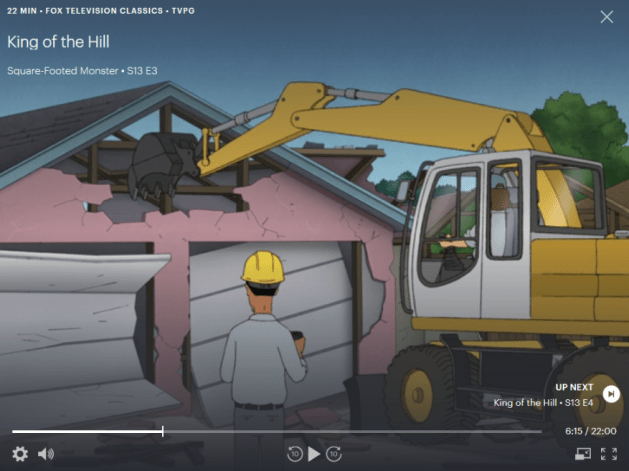
First, a quick synopsis of the plot and relevant dialogue from the main characters. The issues begin when an older neighbor lady dies and her nephew comes to fix up the ranch home to sell it. The men, led by Hank, help fix up the house. It sells in one day. The next day, the house is torn down by a large excavator and the local developer says he is breaking ground on a “dream home.”

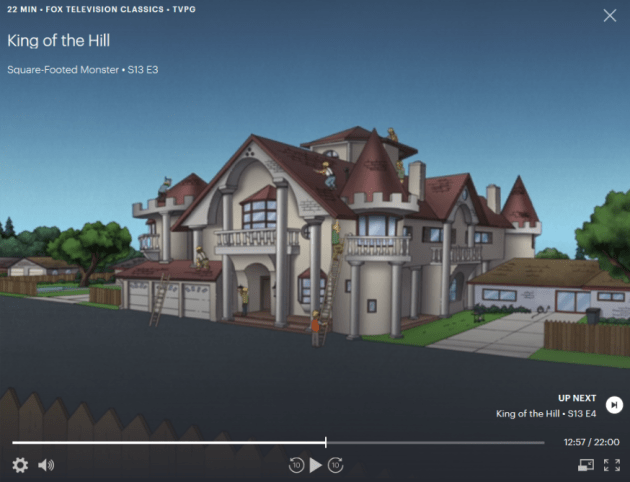
SquareFootedMonster1Amid scenes of constructing a large balloon frame, the builder brings the guys peach chardonnay (clearly indicating his different status) and shows them a rendering of the new home. Hank’s response: “Looks like a bank. No, a church. Wait, A casino? I don’t know what the hell I’m looking at.” The developer says it is a speculation house.

SquareFootedMonster2

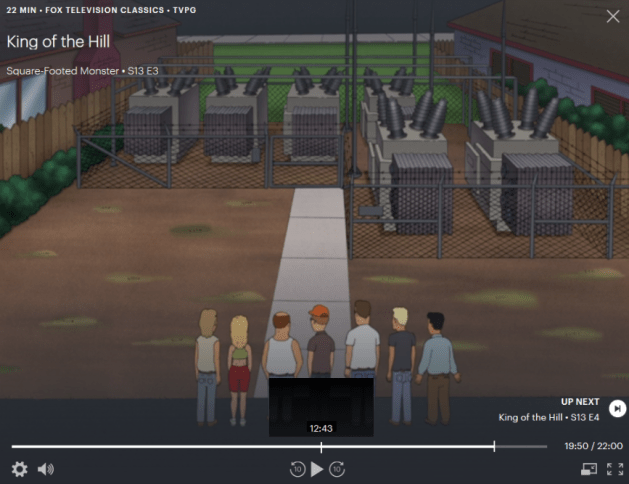
Hank and the guys decide to fight back. They go to City Hall and show images of the modest homes in their neighborhood compared to the new home with “4,600 square feet of obnoxiousness” (Hank’s description). The leaders say the home is by the books so construction continues. The guys consult the local legal loophole expert as Hank says, “someone is building a jackass McMansion that’s going to destroy our neighborhood.” There are no loopholes to help them.

SquareFootedMonster3

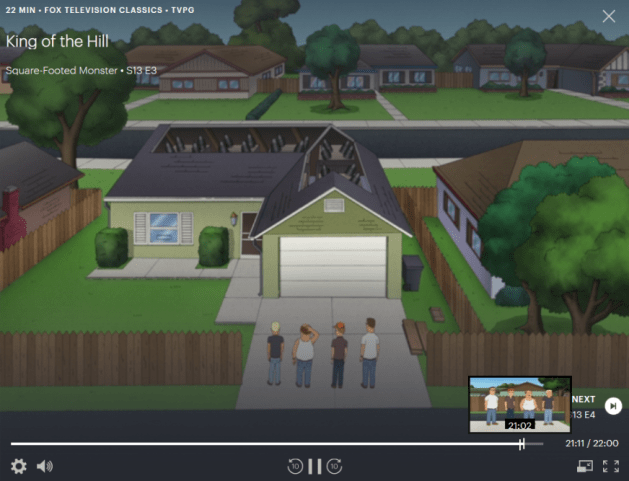
The next scenes show a massive McMansion blocking out the sun and going right up to its property lines. Hank notes, “Ted’s using cheap building materials too. It’s all spackle and chicken-wire.” In the subsequent big wind, the house starts falling apart. Wanting to protect their own homes, the neighbors take chainsaws, axes, and other implements to help the home collapse.

SquareFootedMonster4edit

The next day, the developer looks at the damage done by the neighbors and accuses them taking down the home. Hank responds: “We don’t have anything to hide. The only one who did something wrong here was you. Your shoddy McMansion was going to destroy our homes. We only took it down in self-defense.”

The case goes in front of a local judge who with some prompting by the local legal loophole expert rules in favor of the neighbors. The developer tries to get the last laugh by selling the property to the city to use as a power substation.

SquareFootedMonster5

After lamenting the new land use, the men construct a fake house around the substation. Hank says, “I’ll take a fake house over a big ugly one any day.”

SquareFootedMonster6

This episode contains several themes common to narratives about McMansions:

  1. The developer simply wants to make money without regard for the existing character of the community.
  2. A teardown McMansion can be very invasive: it looks out of place compared to nearby homes, it encroaches on lot lines and the street, it blocks the sun, and its construction is disruptive to neighbors.
  3. The new large home is poorly constructed – it starts falling apart in heavy winds – and has dubious architectural features including turrets, pillars, and balconies.
  4. Neighbors resent the intrusion of the new home but there is little they can do to stop it (hence the need to find obscure legal loopholes and attack the homes themselves). There is one neighbor who appreciates the new home for what it could bring to the neighborhood but he is in the minority.

In the end, the neighbors do win out: instead of a dilapidated ranch home next door, they have a substation that looks like a well-maintained ranch home.

In twenty-two minutes, this is a decent summary of how teardown McMansions could go. The episode does not provide much perspective from the view of the developer of the home or local officials outside of quick references to making money and an interest in large new homes. Some lingering questions remain including why construct such a large new home on a street of ranch homes of working-class residents. The neighborhood may have been saved but the episode also hints at how fragile a set of homes and the associated community might be if just one property falls into the hands of a developer.

(All screenshots of the episode are from Hulu.)

Novel suggests McMansions gentrify small suburbs

A new novel suggests McMansions can upset small suburbs:

Novels about small houses in small towns can feel cramped. But in Julie Langsdorf’s White Elephant, the locals fight to keep things that way in their property battle with a builder who puts up McMansions. Set in the suburban Maryland town of Willard Park, the story depicts a married couple’s struggle with their defunct sex life, middle school kids and their awkward, back-stabbing drama, a pot-head attorney whose marriage is in trouble, and numerous sketches of other denizens. White Elephant has a long, slow start, but once it gets going, it bolts straight to the end...

White Elephant is a gentrification story which focuses on suburbs and small towns. This tale will feel familiar to anyone who has lived in an inner suburb and woken up one morning to the shock of McMansions going up nearby. Suddenly all the talk is of assessments, property values, equity, and second mortgages. The new houses tower over neighbors. Or, if a block of expensive townhouses has been installed, suddenly the local school is too small. It’s not as pernicious as urban gentrification, booting out locals to make way for wealthy hipsters and their $10 latte watering holes, but it’s a menacing cousin. Costly houses and townhouses open the door for luxury apartments, and once those appear, all the old affordable ones raise their rents. A person working full-time on minimum wage can hardly afford a one-bedroom apartment in any American city, and this is the next step, as the blight of gentrification seeps out into formerly cheap suburbs.

I believe that McMansions can upset residents’ conceptions of their neighborhood or community. There are plenty of cases in the last 10-20 years that suggest some believe McMansions, whether in new subdivisions or as teardowns, ruin locations they like.

On the other hand, the description above of how all this works seems a bit odd to me. A few questions:

  1. How many inner suburbs become home to many teardown McMansions? Inner suburbs can be wealthy, working-class to poor, or somewhere in-between.
  2. My guess is that McMansions and more expensive housing do not just pop up in a community: there are precipitating qualities of the community that lead developers and local officials to think that the more expensive housing would take off. In other words, wealthier communities beget more housing for wealthier residents.
  3. Cheap suburbs, if just going by cost of housing, can be located throughout a metropolitan region. If gentrification is simply more expensive redevelopment, it could happen in many places throughout a region.
  4. Why is this gentrifiation not as pernicious if new development makes it harder for locals to stay? It may be happening in a suburban area but not all suburbs are that well-off.
  5. Is there a small-town suburban life worth defending? Decades of suburban critiques suggested suburbanites and their communities have all sorts of deficiencies. Are suburbs now to be saved from McMansions?

The McMansion is a monster to invoke in today’s fictional tales as its size and lack of good taste relegate it to at least shady, if not menacing, status.

I have bought hundreds of music albums for less than $5 each

I still purchase CDs. I am buying more than just a few CDs a year; I have over 1,000 albums total. I have not purchased any digital tracks nor have I joined the recent vinyl bandwagon and I have barely used any streaming music service. Isn’t this an expensive (and space taking) habit?

As I thought about all of these albums, I realized that in the last 15 years or so I have bought at least two hundred albums for less than $5. These cheaper CDs primarily come from two sources:

-Used book/music stores.

-Library sales.

This means the music I am buying tends to fall into several categories:

-Music people are looking to get rid of. It is always interesting to see what people are willing to sell and donate and what people do hold on to. Just as a quick example: certain classic rock bands always have plenty of CDs on hand for sale while others are hand to find. I am not buying all the extra copies of Top 40 albums people quickly ditched but I can find good albums by worthwhile artists.

-Music that does not command a high price. This usually means I am purchasing music that is not currently popular (it takes a while for music to filter down to lower prices) or music that was never that popular.

And here is why I will likely continue in this pattern of buying cheap music (even with all the space the songs take up):

-The purchase is usually cost effective. If I can get a CD for under $5 and I like more than 4 songs on the album, I come out ahead. (This assumes people still want to purchase music rather than pay a monthly fee or deal with advertisements to stream from over a million tracks.)

-I have a physical copy of the music. I find the trend toward streaming/renting all content a bit concerning for consumers and if I can find cheaper CDs, I will purchase them to help insure I have a copy.

-I generally like the process of going into stores to look at music. I know online shopping is convenient but finding an unusual and cheap CD is still a fun experience (and I do not devote too much time to this).

At some point soon, this might all end if CDs are phased out. Until then, I will keep looking for good music for cheap prices.

Filming the world around Hollywood and California

In working on some recent research, I ran into the classic 1927 map from Paramount Studios showing filming locations in California (reproduced in numerous works):

ParamountStudioMapCalifornia1927

Add this to the capabilities of shooting on backlots and the world may be relatively easy to access from Hollywood. There are likely other reasons the film and television industry chose to locate together in and around Hollywood but having such varied nearby locations likely helps.

One thing that is missing from this map: urban locations. This map certainly reflects an interest in more natural settings. Los Angeles in 1927 was still under development. Even later Los Angeles can be fairly distinctive – just look at all the car ads filmed in and around the city. San Francisco offers some spectacular scenery but its uniqueness means it could be hard for the location to double for other places.

Watching TV to see people use Zillow

In watching a recent episode of House Hunters on HGTV, I was treated to brief scenes of the couple using Zillow:

HGTVZillow

Caveats:

-I know this is how people shop for houses today. I have done it myself.

-I would guess this means HGTV and Zillow are working together on the show in some capacity. (See a similar clip on ispotTV.)

-House Hunters tries (!) to show what looking at houses might look like.

Commentary:

Even though the scene was brief, I found it odd. It either seemed like obvious product placement (use Zillow rather than Redfin or MLS or other options!), uninteresting storytelling (watch people look at a screen!), or signaled some major change. As the couple then moved to driving around by themselves and looking at houses, I thought for a short moment that they would not even need a realtor: they had found listings online, arranged their own details, and would tour on their own. (Alas, the realtor just met them at the first house tour.)

While there is a lot of potential for HGTV and other similar programming to incorporate devices and screens (mainly smartphones and tablets) into their portrayals of finding property, there is a bigger issue at play for television and film: how can you interestingly portray handheld screens that so many of us are buried in on a daily basis within a story that has to move at a rapid pace? This is not easy.

Wanting to preserve the past, music masters edition

A long piece details the calamitous fire that hit an important vault of music at Universal Studios Hollywood on June 1, 2008:

Eventually the flames reached a 22,320-square-foot warehouse that sat near the King Kong Encounter. The warehouse was nondescript, a hulking edifice of corrugated metal, but it was one of the most important buildings on the 400-acre lot. Its official name was Building 6197. To backlot workers, it was known as the video vault…

The scope of this calamity is laid out in litigation and company documents, thousands of pages of depositions and internal UMG files that I obtained while researching this article. UMG’s accounting of its losses, detailed in a March 2009 document marked “CONFIDENTIAL,” put the number of “assets destroyed” at 118,230. Randy Aronson considers that estimate low: The real number, he surmises, was “in the 175,000 range.” If you extrapolate from either figure, tallying songs on album and singles masters, the number of destroyed recordings stretches into the hundreds of thousands. In another confidential report, issued later in 2009, UMG asserted that “an estimated 500K song titles” were lost…

The vault fire was not, as UMG suggested, a minor mishap, a matter of a few tapes stuck in a musty warehouse. It was the biggest disaster in the history of the music business. UMG’s internal assessment of the event stands in contrast to its public statements. In a document prepared for a March 2009 “Vault Loss Meeting,” the company described the damage in apocalyptic terms. “The West Coast Vault perished, in its entirety,” the document read. “Lost in the fire was, undoubtedly, a huge musical heritage.”…

Today several of the company’s nearly 1,500 facilities are devoted to entertainment assets. Warner Music Group stores hundreds of thousands of master recordings in Iron Mountain’s Southern California facilities, and nearly all of Sony Music Entertainment’s United States masters holdings — more than a million recordings — are reportedly kept in Iron Mountain warehouses in Rosendale, N.Y. The Boyers, Pa., facility where UMG keeps most of its United States masters is a 1.7-million-square-foot former limestone mine. The facility offers optimal archive conditions, climate control and armed guards.

The boom in cultural products in the last 100 years or so with the rise of mass media and new technologies presents unique challenges for corporations, the public, and preservationists. How should all of this material be preserved? The amount of space needed for storage could be huge – even for digital files (see the Library of Congress efforts to collect tweets). Keeping all of that material safe from fire, temperature changes, water damage, and other forces is costly and requires constant vigilance. Technology changes and renders prior productions difficult to utilize. There may need to be an obvious payoff for whoever is storing this material in order to go through all the effort.

One solution to all of this is to get mediocre copies of things. The example at the end suggests music listeners can access so much through streaming services. One expert profiled in the story describes it this way: “The music sounds like it was mastered in a Coke can,” he says. “But on long drives, it’s the best.”” I suppose it could be argued that having access to music and films and other items is worth it, even if the quality is not that great.

But a bigger question is this: just how much material is worth saving? What will people in the future want to look back on? Will future people see big benefits from the most preserved material ever compiled by previous generations? How will future preservationists, historians, and others construct cultural narratives about life today based on so much material (both tremendously popular and not)?

Seeing kitchens of the future on TV and in movies

A look at the evolution of modern kitchens in the middle of the 20th century includes one paragraph on how the new kitchens ended up in the media:

Midcentury movies, TV shows, and cartoons are loaded with examples of Rube Goldberg–like futuristic kitchens that automated cooking and cleaning tasks, sometimes to an absurd degree. The Hanna-Barbera cartoon The Jetsons debuted on ABC in 1962, portraying a nuclear family living in mid-twenty-first-century Orbit City. The Jetson family—husband and wife George and Jane, son and daughter Elroy and Judy—lived as a typical early 1960s family would have. Jane was a housewife, and George worked (just a few hours per week, it’s noted) for a company called Spacely Space Sprockets. The Jetsons had a robot maid named Rosey, who wore an old-fashioned black-and-white maid’s uniform, and zipped around the Jetson household on a set of wheels. The Jetsons’ kitchen was like a futuristic version of the Horn and Hardart Automat, where customers could select meals and desserts from behind little glass doors. A device called the Food-a-Rac-a-Cycle offered tried and true dishes like Irish stew, beef Stroganoff, prime rib, pizza, and fried chicken on demand.

Perhaps the book says more about the mass media depictions of kitchens around this time – there is certainly no shortage of scholarly work on the TV shows and films of the postwar era, the time when more and more Americans moved to the suburbs and encountered new kitchens as well as new ideals about how kitchens should look and be used.

But, this paragraph does not give us the full picture of what kitchens looked like on television and in movies. Instead, we hear about lots of examples and one specific example from The Jetsons. Just how many depicted kitchens at the time actually had “futuristic kitchens”? And were these futuristic kitchens popular (part of popular television shows and movies) or influential (tastes changed because of the depictions)? This is less clear.

Indeed, as I suspect this book would argue, how exactly the modern kitchen evolved is a complex tale. This is true for many social phenomena as rarely can one firm or design or product upend everything. And accounting for changing tastes is quite difficult.

The ongoing low profile of sociologists on TV shows

A recent line in a Modern Family episode emphasizes the relatively low status of sociologists in the entertainment industry:

Now they won’t let me drive around anyone smarter than a sociology professor.

A bit more context: Alex Dunphy had the task of driving around a Nobel Prize winner in a golf cart on her college campus. Because she was starstruck by the researcher, she drove recklessly and he fell out. Thus, she could only be entrusted with a sociology professor (and lower?).

This is likely just a throwaway line and yet it reminds me that sociologists rarely exist in shows and films. From earlier blog posts:

Searches for those with sociology backgrounds to play roles is rare.

Michael Bay once had thoughts about a show involving a sociologist.

A sociologist could host “History Detectives.”

This reminds me of a quote about statisticians in the book Health and Numbers:

There are aspects of statistics other than it being intellectually difficult that are barriers to learning. For one thing, statistics does not benefit from a glamorous image that motivates students to persist through tedious and frustrating lessons…there are no TV dramas with a good-looking statistician playing the lead, and few mothers’ chests swell with pride as they introduce their son or daughter as “the statistician.”

Many academic fields likely do not come off well in shows and films. The exceptions, like Indiana Jones (though not exactly a representative exemplar of his field), are notable.