Arms race among new luxury apartments includes live-in musicians

If you have the resources, you have some options in shopping for a nice new apartment including a building musician:

Amenities for high rise buildings are generally culled from a well-honed list of known popular offerings—a lounge, gym, a pool, an outdoor deck, and grilling stations wouldn’t really lead anyone to blink an eyelash. Being LEED certified is often expected.

At the 34-story, 298-unit Exhibit on Superior, amenities for the studio, convertible, and 1 to 3-bedroom units include those, as well as keyless entry with smartphone integration, stainless steel appliances, in-unit washer and dryer and more. Quite nice—but the downtown luxury apartment market glut has led to an arms race to attract new residents and keep rents from being slashed.

And even though the price point is comparably lower (and the floor plans are comparably smaller) than other neighborhood offerings to attract a younger demographic, developer Magellan Development Group and MAC Management wanted to bring some artistry and magic to their building (and to their other properties, if this catches on). Here’s the idea.

A contest is open for the best acoustic guitarist and vocalist to live and play for one year at Exhibit on Superior. The winning musician gets free rent at an unfurnished studio for a year, the title of Musician in Residence, and the chance to hone their skills while playing against any number of cool nooks and spaces in the bKL Architecture-designed building. The residents get in-house live entertainment and bragging rights to live in a building with the first so-called Exhibit A-Lister.

My first thought was that sounds like the arms race among colleges to provide amenities for prospective students ranging from excellent food, state of the art gyms, and private and luxurious dorms. Then it hit me: these luxury apartment buildings may be going after that same demographic: college graduates who want the excitement of the city. If we could narrow it even more, perhaps they are employed in a creative industry or field.

After thinking this through a bit, it is clever to pair residential real estate with music. We might expect something like this in commercial spaces or privately-owned property that is trying to operate like public space (perhaps a park like area outside a major office building). But, this continues the trend of some of the other “weapons” in this residential arms race: providing building amenities that encourage sociability while simultaneously offering well-appointed private units. Let’s hope all the residents like the acoustic guitar scene…
From I Love Lucy in Connecticut to Desperate Housewives’ Wisteria Lane: Suburban TV Shows, 1950-2007

In my study of suburbs, I have run across numerous scholarly sources that discuss the role television played in promoting American suburbs. A number of them suggest that the idealized image of nuclear family life taking place in the single-family home presented in shows in the 1950s and 1960s encouraged Americans to make the move to the suburbs. My recently published paper (published online in Sociological Focus, forthcoming in print) aimed to put these arguments in context: just how common were these suburban television shows? Did such shows reflect the millions of Americans who already moved to the suburbs or create demand for the suburban life?

The short answer: suburban-set TV shows were relatively rare among the top 30 ranked shows from 1950 to 2007. There certainly were some classic shows – ranging from Father Knows Best to Home Improvement – but many of the top 30 shows were set in cities. Here is my concluding paragraph:

Even though the United States has become a suburban nation, its most popular television shows from the second half of the 20th century and the early years of the 21st century did not match this demographic shift. The suburban sitcom or drama, satirized in films like Pleasantville or featuring anti-heroes in more recent television shows like The Sopranos, was a relatively rare figure in the top 30 television shows. The suburban show is a recognizable form with its emphasis on family life in a single-family home without much social strife, and new fall lineups continue to include variations on the genre, yet many popular American shows were set elsewhere. Thus, these longitudinal findings suggest popular television shows had a limited influence on pulling and/or pushing Americans to the suburbs. America may be suburban but its most popular television shows are not.

There is much more to explore here. The scholarship on the topic thus far has focused on particular key examples of suburban-set shows but has rarely considered the full scope of television or how exactly watching a show set in the suburbs would change people’s behaviors.

Film about McMansions on Martha’s Vineyard

Here is a review of how a film examining the larger and larger homes built on Martha’s Vineyard:

The premise of the film begins on familiar ground, with Bena casting a critical, almost dogmatic eye on the issue:

“On the first day that I arrived I landed several jobs and it wasn’t long before I was working seven days a week. My main gig was carpentry. At first I really enjoyed the work, but over time I found myself working on larger and larger homes. The larger the home, the more my sense of uneasiness increased. And the fact that they were often third or fourth homes seemed incongruous with their enormous size. They looked more like bus stations or hotels, not summer cottages.

The houses were heated year round and I found the waste of resources shocking and depressing. Not only did the “starter castles” dwarf the cottages and historic homes they replaced, they seemed out of keeping with everything that I love about Martha’s Vineyard. I felt like I was ruining the place that I wanted to call home. And that is why I took off my tool belt and picked up a camera.”

But as the film progresses, Bena’s approach becomes much more nuanced. In talking with other local carpenters who work on these huge houses, we discover that their livelihood depends on these large contracts. We hear from long-time residents, some of whom are uneasy about telling newcomers what to build or not to build. In his interviews with some of these owners of these oversize mansions, we hear the human side of their stories as well. But we also see how some of these wealthy homeowners take advantage of legal loopholes — or even flout them completely — with serious consequences.

This sounds interesting and surprisingly multi-faceted for a story about McMansions.

At the same time, I suspect the story is complicated here because of tourism. This is not a “normal” location but rather one that locals as well as thousands of visitors might consider “home.” Additionally, there is a lot of money involved with what it takes to visit and build (with limited land). When the president travels there and draws attention to this particular issue, this is a special place. The story of McMansions at Martha’s Vineyard might be able to reach more people because of the known location but it isn’t necessarily the same McMansion story as teardowns in Los Angeles neighborhoods or in suburbs outside of Washington D.C. or new McMansions in the exurbs.

Aurora, IL a large suburb or a place that should celebrate pumpkins and strawberries?

A recent interview with the director of Wayne’s World included some comments about the suburb of Aurora, the hometown of Wayne Campbell.

“It’s starting in February and ending on July 4 with a headbanging session to ‘Bohemian Rhapsody’ in an effort to get more people than ever before together to headbang to that song,” Spheeris said in an interview with Entertainment Weekly posted online Thursday. “I can’t believe it. Don’t they have pumpkins or strawberries to celebrate? Isn’t that crazy?”…

For its 25th anniversary, the film is set to return to some theaters Feb. 7-8. Meanwhile, the Aurora Downtown group, the city of Aurora and the Aurora Area Convention and Visitors Bureau are organizing a celebration of the movie scheduled to start Feb. 3 and wrap up July 4.

Planned events include a children’s air guitar competition, a trivia contest and a headbanging event to try to beat the Guinness record…

“She may not be aware that Aurora is a city of 200,000. She may think it’s a lot smaller based on the ideas of the movie,” Rauch said. “I think she might just be thinking that her movie may not be as important as pumpkins or strawberries.”

This all sounds fairly lighthearted but it does provide an opportunity to highlight the second largest city in Illinois. Indeed, the Downtown Aurora group has a page dedicated to this topic: “Aurora, Beyond Wayne’s World“:

You might be aware that Aurora is the second largest city in Illinois. With a population of 200,456 it is second only to Chicago. But did you know that Aurora got it’s nickname “The City of Lights” by being the first city in the country to have all electric street lights? Or that Aurora has been scouted for top-name films in recent years? Here is a list of fun facts that you might know about Aurora, IL.

In the film, Aurora doesn’t look so big. At the same time, the population doubled over this time period (1990-today) from just under 100,000 residents to 200,000 residents.

Claim: popular 90’s TV shows prompted people to move to cities

This is not the first time I’ve seen this argument: Friends wasn’t just entertainment…it helped make cities cool again.

I tested out my hypothesis—that “Friends” triggered the proliferation of boutique coffee shops across the nation—on Facebook a few days ago, and found some agreement. My good friend Kenyon Farrow, an award-winning writer and advocate for HIV/AIDS awareness, who’s based in D.C., was with me on this, writing, “I think ‘Friends’ (and ‘Seinfeld’) are totally responsible for marketing cities to young white suburbanites, [which] helped fuel the market-demand side for gentrification to take place in the ‘90s and 2000’s.

”

That was about the extent of agreement on my “Friends” theory, though—my barista cred all damned to hell now. But others in the debate made the gentrification connection Farrow offered. Wrote Ben Adler, who I worked with at Grist: “Americans have increasingly become alienated by the social isolation of suburban, car-dependent life. That’s fueled both the urban gentrification that brings the cafes, and the cafes themselves.”

For others on our Facebook thread, the secret of the coffeehouse’s mainstream appeal was pure and simple: It’s just “a good idea,” wrote my buddy Justice Rajee, a family advocate at the Portland Opportunities Industrialization Center. “Having someplace to sit have a beverage and do what you need when you can’t go home is good.”

This is the reverse of the argument I’ve been thinking about in recent years: the proliferation of popular TV shows depicting happy suburban life in the 1950s and 1960s helped push Americans to the suburbs. At face value, this might seem to make sense as Americans are influenced by what they watch on TV (and they watch a lot of it). However, I have some data that suggests the connection is not as clear. (There is an upcoming paper coming out of this; more on the particular topic when it sees the light of day.)

Generally, we don’t know as much as you might think about how much television influences people’s behaviors. The argument for Friends or Seinfeld and cities suggests people viewed the shows and wanted to emulate that lifestyle. Is the link that direct? If we asked people why they moved to the city, would they cite a television show or would they be more likely to mention things like jobs, cultural opportunities and the lifestyle, or housing options? The influence of television may indeed be subtle which begs the question of how we might uncover as social scientists the empirical link between viewing and deciding where to live. If seeing things on TV mattered, wouldn’t others be turned off by city life with so many crime and police procedural shows?

The cultural bubbles of popular TV shows tell us what exactly?

This is a cool set of maps of the popularity of 50 different TV shows across zip codes in the United States. But, what is the data and what exactly can it tell us? Here is the brief explanation:

When we looked at how many active Facebook users in a given ZIP code “liked” certain TV shows, we found that the 50 most-liked shows clustered into three groups with distinct geographic distributions. Together they reveal a national culture split among three regions: cities and their suburbs; rural areas; and what we’re calling the extended Black Belt — a swath that extends from the Mississippi River along the Eastern Seaboard up to Washington, but also including city centers and other places with large nonwhite populations.

Some quick thoughts:

  1. Can we assume that Facebook likes are an accurate measure? How many people are represented per zip code? Who tends to report their TV show preferences on Facebook? Why not use Nielsen data which likely has a much smaller sample but could be considered more reliable and valid?
  2. How exactly does television watching influence everyday beliefs and actions? Or, does it work the other way: people have certain beliefs and behaviors and they watch what confirms what they already like? Sociologists and others that study the effects of television don’t always have data on the direct connections between viewing and other parts of life. (I’m not suggesting television has no influence. Given that the average American still watches several hours a day, it is still a powerful medium even with the rise of
  3. The opening to the article both suggests TV viewing and the related cultures fall along an urban/rural divide but then also split across three groups. The maps display three main groups – metro areas, rural areas, and areas with higher concentrations of African Americans. I would want to know more about two areas. First, political data – and this article wants to make the link between TV watching and the 2016 election – suggests the final divide is really in the suburbs between areas further out from the big city and those closer. Can we get finer grained data between exurbs and inner-ring suburbs? Second, does this mean that Latinos and Asian Americans aren’t differentiated enough to be their own TV watching cultures?
  4. The introduction to this article also repeats a common line among those that study television:

In the 1960s and ’70s, even if you didn’t watch a show, you at least probably would have heard of it. Now television, once the great unifier, amplifies our divisions.

We certainly are way into the cable era of television (and probably beyond with all of the options now available through the Internet and streaming) but could we argue instead that the earlier era of fewer channels and viewing options simply papered over differences? As numerous historians and other scholars have argued, the 1950s might have appeared to be a golden era but most of the benefits went to white, middle class, suburban families.

In other words, I would be hesitant to state that these TV patterns are strong evidence of three clearly different cultures in the United States. Could these television viewing patterns fit in with other cultural tastes differentiating various groups based on class and race and ethnicity? Yes, though I’d much rather see serious academic work on this developing Bourdieu’s ideas and encompassing all sorts of consumption items treasured by Americans (homes, vehicles, sports fandom, making those hard choices like Coke and Pepsi or McDonald’s and Burger King or Walmart and Target). Also, limiting ourselves to geography may not work as well – this approach has been tried by many including in books like The Big Sort or Our Patchwork Nation – as it did in the past.

HGTV is the third highest rated cable network after “embrac[ing] the real America” and avoiding conflict

American viewers – at least those still paying for cable – like what HGTV is showing:

The escapist appeal of looking at other people’s beautiful homes turned Home & Garden Television into the third most-watched cable network in 2016, ahead of CNN and behind only Fox News and ESPN. Riding HGTV’s reality shows, parent company Scripps Networks Interactive Inc. has seen its shares rise more than 30 percent this year, outperforming bigger rivals like Walt Disney Co., 21st Century Fox Inc. and Viacom Inc.

HGTV’s formula is relentlessly consistent: a shabby house gets a makeover, and a happy couple moves in. A variation on the theme — house-flipping for fun and profit — works too. The network has aired 23 different flipping shows over the past few years. Today “Flip or Flop” and “Masters of Flip” run in prime time…

“If you watch a lot of our competitors, it’s about bling-y expensive real estate in New York or crazy flipping in L.A.,” said Scripps chief programming officer Kathleen Finch. “For the most part, our viewers live in suburban houses with yards. We embrace the real America.”…

The key, Scripps executives agree, is a refusal to upset HGTV’s audience. There’s no profanity, and on-air conflicts are confined to paint colors or tile choices. Instead of making the network feel trivial, its fans say, the relentlessly pleasant programming is a comfort, especially in hard times.

Americans like houses, both in terms of what they might aspire to themselves (the home may be their number one opportunity to define themselves) as well as knowing what their “neighbors” have (don’t those people on TV count as neighbors in today’s world of limited deep social ties?). The lack of open conflict could also tie in nicely with M. P. Baumgartner’s work The Moral Order of a Suburb which argued suburbanites create community by avoiding conflict.

I’m also intrigued by the idea that showing “the best side” of suburbanites could be a winning formula on television. I’ve been working on several projects in recent years about the depictions of suburbia on television. In the 1950s and early 1960s, there were numerous shows that presented everyday suburban life (obviously, a very sanitized white, upper middle class perspective) but since that period, many shows that do this are doing it with a wink and nod or to laugh at suburbanites. Do the fairly wealthy viewers of HGTV enjoy seeing themselves on screen when few other shows or TV networks offer such an opportunity?

The state of reading books in America in 2016

Pew Research has recently put out several reports on book reading in America. First, the broad overview:

Yet even as the number of ways people spend their time has expanded, a Pew Research Center survey finds that the share of Americans who have read a book in the last 12 months (73%) has remained largely unchanged since 2012…

Americans read an average (mean) of 12 books per year, while the typical (median) American has read 4 books in the last 12 months.

Second, those who do read still do so in print most of the time:

Readers today can access books in several common digital formats, but print books remain substantially more popular than either e-books or audio books. Roughly two-thirds of Americans (65%) have read a print book in the last year, which is identical to the share of Americans who reported doing so in 2012 (although down slightly from the 71% who reported reading a print book in 2011).

By contrast, 28% of Americans have read an e-book – and 14% have listened to an audio book – in the last year. In addition to being less popular than print books overall, the share of Americans who read e-books or listen to audio books has remained fairly stable in recent years…

Nearly four-in-ten Americans read print books exclusively; just 6% are digital-only book readers.

Third, on why people read:

Among all American adults:

  • 84% ever read to research specific topics of interest (29% do so nearly every day).
  • 82% read to keep up with current events (47% nearly every day).
  • 80% read for pleasure (35% nearly every day).
  • 57% read for work or school (31% do so nearly every day).

Fourth, who isn’t reading:

Several demographic traits correlate with non-book reading, Pew Research Center surveys have found. For instance, adults with a high school degree or less are about three times as likely as college graduates (40% vs. 13%) to report not reading books in any format in the past year. A 2015 Pew Research Center survey shows that these less-educated adults are also the least likely to own smartphones or tablets, two devices that have seen a substantial increase in usage for reading e-books since 2011. (College-educated adults are more likely to own these devices and use them to read e-books.)

Adults with an annual household income of less than $30,000 are about twice as likely as the most affluent adults to be non-book readers (33% vs. 17%). Hispanic adults are also about twice as likely as whites (40% vs. 23%) to report not having read a book in the past 12 months.

Older Americans are a bit more likely than their younger counterparts not to have read a book. Some 29% of adults ages 50 and older have not read a book in the past year, compared with 23% of adults under 50. In addition, men are less likely than women to have read a book, as are adults in rural areas compared with those in urban areas.

Fifth, the book reading trends haven’t changed too much in recent years:

The share of Americans who report not reading any books in the past 12 months is largely unchanged since 2012, but is slightly higher than in 2011, when the Center first began conducting surveys of book-reading habits. That year, 19% of adults reported not reading any books.

While Internet use (with the included possibilities of streaming audio and video) is taking up more and more time in daily life, it may take quite a while for reading books to becoming an activity for a small minority. And how could is disappear completely from certain settings such as schools and colleges?

Board games for which I am thankful

On Thanksgiving, I’ll take this opportunity to highlight some board games I enjoy and some I wish to explore further. On a sociological note, these games are great ways to both enjoy time with friends and family as well as have structured competition. To the lists:

Games I enjoy the most (in rough order starting with my current favorites):

  1. Agricola. My favorite game set in Germany several centuries ago in an agricultural setting. This game has its complications but if you play with the card decks (which provide occupations and minor occupations), there is a lot of variety even as you try to acquire the same elements each game. In other words, it has some predictability alongside intriguing variation. And with the Farmers on the Moor expansion we recently acquired…
  2. Diplomacy. Awesome game, difficult to actually finish since you need seven players and lots of time. It is like Risk but there are no dice: your armies can only advance at the beginning by either cooperating with other players (who support your moves or don’t block them) or fighting them. There is a lot of negotiation. I’ve played a few complete games via email – a round per week – and this involved hundreds of emails.
  3. Race for the Galaxy. It took us forever to read the instructions and understand all the different symbols but the payoff has been really good.
  4. Innovation. This card game is like pursuing the technology tree in the game Civilization but with each player seeing different cards and paths from the Stone Age to now each time. There is a nice mix in the cards allowing actions you can take against other players, things you and other players can both do, and things you can do with your own tableau.
  5. Puerto Rico. Even though the rough idea is similar – build your own social group – to Settlers of Catan, I prefer this one much more. Perhaps it is because you can be a different role each turn? Perhaps because they are no numbers on your hexes deciding your fate?
  6. Trivial Pursuit. Yes, it is often seemingly random knowledge. Yes, the games can take forever – in recent years I have been part of several family games that took over three hours. Still, where else can people who know all sorts of “trivial” information come together?
  7. Stratego. In my mind, the key to this game is that you don’t know what pieces your opponent has across from you until you risk an attack. Few games have this much secrecy.
  8. Suburbia. I’m a sociologist who studies suburbs. The board game does a nice job simulating suburban growth (and the recent expansion pack we purchased adds some new elements). See my earlier quick review.
  9. Carcassonne. The building aspect plus seeing random tiles adds up to fun.

Games that were close to the favorites list: Guild Hall, 7 Wonders, Bohnanza, Chess (a game I am not very good at but is still alluring).

Games I would like to explore further/play for the first time:

  1. Memoir ’44. I haven’t played many war strategy games but this one consistently receives high marks.
  2. Splendor. This is on my Wish List for this year.
  3. Patchwork. It is hard to find good two player games and even though I have only played this once, I think this one could have a lot of replay value.
  4. For Sale. I’ve played this a few times and it is a rare filler game I would want to play a lot.

Games I used to like more but would still be happy to play:

  1. Monopoly. Still fun at times. However, too many family games of this ended in predictable ways.
  2. Scrabble. I like the game. However, different people want to play with different variations (i.e., not using a dictionary at all, using the latest official dictionary, looking up words in said dictionary).
  3. Careers. Lots of fond memories of playing this as a kid. But, if I only played once every years now, that would be enough.
  4. Settlers of Catan. The game that may have introduce Euro games to the United States. I generally like it but it is not a favorite and would almost always prefer a game from the favorite list above.
  5. Pandemic. Cooperative games can be interesting and this one, particularly with some of the expansions, offers some fun opportunities. But, it is almost too hard: even on the easiest levels, those epidemics break out too often.
  6. Ticket to Ride. This game always plays out the same way for me: I reject the long routes early on because I’m not sure I can complete them, I build a lot of short routes, and few points result. Still, the concept is fun.
  7. Risk. Somewhere between my notes above on Diplomacy and Monopoly.

Perhaps I tend to like longer building games with structured variety. These can take up a lot of time but they do require both more attention (with the player often thinking they alone hold their fate in their hands) as well as prolonged interaction with other players. I’m not entirely convinced that Euro games are more enjoyable for everyone just because they get to build something but most of the favorite games I listed above do allow for multiple strategies for winning.

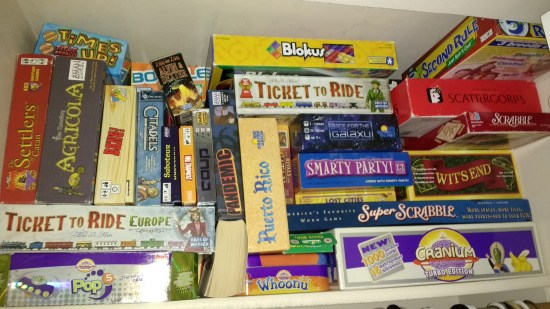
To close, a quick peek at our main game storage area (though other games, both classic and new, are scattered elsewhere):

gameclosetnov2316


Architecture based comedy: “McMansions have taken all of the Australianness out of the burbs”

An Australian comedian has several complaints about the McMansions of his country:

“They don’t work with the site, they’re too big on the block of land so you lose all your outdoor space. They’re too close to the neighbours and the real sadness is they’re also not great from an energy point of view,” Ross explains.

Ross says McMansions have taken all of the Australianness out of the burbs — “you could be driving down the streets of America” — and that the fashion for driving into the carport and walking into the house disconnects people from their neighbourhoods…

You might consider a comedian telling people how to live is some sort of joke. But Ross has corned a gap in the entertainment market — architecture based comedy — and it’s taken him around the world from London to Venice…

Ross’s two part series Streets of Your Town is about the contrast between the classic, well designed mid-century modernist homes and the not-so-great McMansions of today.

The TV series is coming up in a few days. As I’ve discussed before (see the most recent example here), I’m skeptical of the claim that modernist homes would entice more buyers or admirers in the United States. They may please the architectural community but not necessarily homeowners.

I am, however, very intrigued by the idea of “architecture based comedy.” I don’t know if this will be present much on the TV show – it sounds more documentary like – but seeing a standup routine based around architecture would be fascinating. For my money, one of the better architecture and urban planning based routines I have seen is James Howard Kunstler’s TED talk “The Ghastly Tragedy of the Suburbs.” On the other hand, another attempt at this – the film Radiant City – didn’t quite work as well.