Rethink Rezoning, Save Main responses share similar concerns – Part One

The suburb in which I live and the neighboring suburb both have proposed redevelopment ideas and each has attracted opposition from residents. Both sets of opposition have yard signs to voice their displeasure and residents have spoken at public meetings.

Part One of this analysis involves the basics of the proposed projects and how this fits into what suburbs generally try to do.

The Rethink Rezoning group is responding to a study commissioned by the city of Wheaton to improve development along the busy Roosevelt Road corridor that runs east-west through the center of the suburb. From the Daily Herald:

Wheaton’s East Roosevelt Road corridor has a hodgepodge of businesses and housing, obsolete office space and no consistent sidewalk network that encourages pedestrians to walk from one end of the nearly 2-mile stretch to the other…

Consultants propose a “Horizontal Mixed-Use Zone” from Carlton Avenue to West Street/Warrenville Road, currently a mix of low-intensity offices, houses and residential structures adapted into offices. In that subdistrict, the city should expand the palette of permitted land uses, including limited retail and “personal service establishments,” the report states.

Farther east, a “Commercial Core Zone” between West and President streets could concentrate new development of significant size — greater than anywhere else along the corridor — taking advantaging of proximity to the downtown and the Mariano’s grocery store. The Mariano’s intersection has traffic congestion when cars queuing up in the west turn-lane from Naperville Road to Roosevelt.

A “Mixed-Use Flexible Zone” from President to Lorraine Road “should encourage a broad range of uses, including retail, service, office and multifamily residential,” according to the report.

See a more complete draft report from earlier this year.

The Save Main group is opposed to a mixed-use five-story building to be built on the southern edge of Glen Ellyn’s downtown. Here is a 2018 description from the Daily Herald:

A new redevelopment plan for an old shoe store in downtown Glen Ellyn would replace the long-vacant building with an apartment complex that would rise above neighboring restaurants and shops…

Larry Debb and John Kosich are the two principals for the project that would demolish the Giesche store to make room for a five-story apartment building with about 5,360 square feet of first-floor commercial space. The footprint would include what is now the village-owned Main Street parking lot…

But in a letter to village planners, Kosich and Debb said they’re proposing a “condo quality” building with 107 rental units. A two-level parking garage would provide 147 public parking stalls on the first floor, with access off Main Street, Hillside Avenue and Glenwood Avenue. The garage’s second floor — reserved for apartment residents — would contain 142 stalls…

Such a mixed-use development with parking would align with the village’s 2001 comprehensive plan and 2009 downtown strategic plan, Hulseberg said. The latter recommends the village add at least 450 new residential units downtown.

Neither of these projects are unusual for suburban communities. Indeed, they both attempt to take advantage of unique traits already in the suburb.

In Wheaton, the Roosevelt Road corridor has been an area of interest for the city for decades. With tens of thousands of cars passing through each day, it presents an opportunity, particularly since it is just south of the downtown (and traffic does not necessarily turn off Roosevelt to go downtown) and north of the other major shopping area at Danada (along the busy Butterfield Road corridor). But, Wheaton has generally been conservative about what development they allow along this stretch. Compared to Glen Ellyn to the east or the Ogden Avenue corridor in northwest Naperville, the Roosevelt Road stretch in Wheaton is relatively void of strip malls, fast food restaurants, car repair places, and rundown facilities. Again: this has been an intentional effort to maintain a certain level of quality.

The proposed changes would build on this by updating some uses (most suburbs utilize single-use zoning but this can be restrictive in certain areas) and try to encourage some cohesiveness across stretches. What is now a hodgepodge of offices, some older houses, some more recent office buildings, could have a more uniform character and present a more pleasing aesthetic. I don’t know how many people will walk along such a busy road but it certainly does not lend itself to that now. All of this could help improve aesthetics and bring in more revenue from taxes in a revitalized district. Having a more uniform plan could help bring in more money for the city which then helps relieve local tax burdens.

In Glen Ellyn, such a project both fits with the village’s own goals and echoes what numerous suburbs in the Chicago region have tried to do: encourage mixed-use buildings in downtown areas near train stations and existing restaurants and shops. This new project would add to a fairly lively restaurant and retail scene while also adding more residents (and probably wealthier ones – this is not about suburban “affordable housing”) to a suburb that has little greenfield or infill development available. The new residents would patronize local businesses, utilize the train, and contribute to a density that could make the downtown even livelier. Again, one of the benefits would be increased tax revenues: the vacant property would have a more profitable use, the first-floor businesses would add sales tax monies, and the new residents who probably have limited numbers of children would bring in tax dollars.

If these projects are in line with suburban plans – let alone the long-term plans for each community – what are the residents objecting to? More on that in Part Two tomorrow.
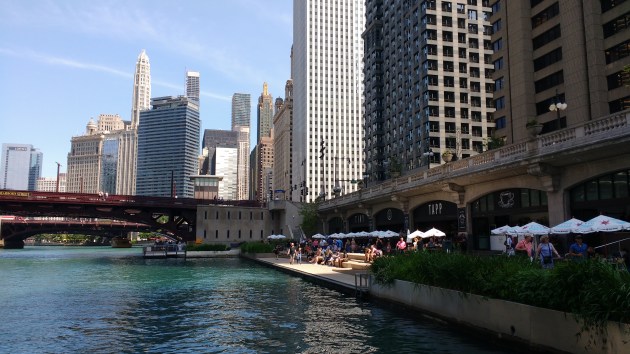
Chicago’s beautiful Riverwalk…what took so long to put it together?

On a recent beautiful summer afternoon, I had my first chance to walk the full Chicago Riverwalk.

ChicagoRiverwalk1ChicagoRiverwalk2

The city’s website suggests the plans for the Riverwalk started in the late 1990s. Why did it take so long for the idea to come together? For a city that has so much pride in its lakefront parks and protected areas, the river was overlooked for decades. In much earlier decades, economic activity was centered on the riverbanks: rail lines brought goods from throughout the region to ships and counting houses. But, it has been a long time since this activity ended and important buildings have lined this stretch for decades. If a Riverwalk can do much for places like San Antonio and Naperville, what took so long for Chicago to enhance this stretch?

Three thoughts on the finding that 7.5% of housing in Naperville is affordable

Naperville is a large – over 140,000 residents – and wealth – a median household income of just over $114,000 – suburb. It also does not have much affordable housing:

A state agency recently faulted Naperville as the only Illinois community of 50,000 or more lacking affordable housing, which, according to the federal government, means housing costs make up no more than 30% of a household’s income. In a report last year, the Illinois Housing Development Authority found just 7.5% of Naperville homes are considered affordable based on the regional median income, among the lowest percentages in the state.

Some elected officials fear Naperville’s high housing costs could drive out seniors and push away recent college graduates and middle-class professionals. As those city leaders consider a slew of new developments, they and housing advocates are debating how and whether to include affordable units that could bring in new residents and help people such as Melekhova stay…

Efforts to include affordable housing in Naperville developments have been met with some resistance. Residents have questioned the effects affordable units would have on their neighborhood and whether the look of buildings with affordable units would fit the character of the area.

One question submitted on a note card during a panel on affordable housing in May was more pointed: “What steps can landlords utilize to minimize the potential negative impacts of the associated tenants utilizing affordable housing?”

Based on my research on suburbs and Naperville, three quick thoughts:

  1. Naperville enjoys being a wealthy suburb. It has a really low poverty rate for a city its size. It has lots of white-collar jobs. While this tends to be put in terms of having a high quality of life, nice amenities, and good schools, there is clearly wealth.
  2. There is not a lot of affordable housing because that is not the kind of housing Naperville prioritized for the last fifty years. As the suburb really started to grow in land area and population in the 1960s, there were public discussions about building apartments. This is not what won out in the long run and the community approved subdivision after subdivision of nicer single-family homes. (See my 2013 article that details some of this.)
  3. More recent discussions and the comments highlighted in the article are common ones in suburban debates over affordable housing. When suburbs discuss affordable housing, they often are thinking of people that would desire in the community such as younger adults and retirees. They are not explicitly seeking out poorer residents. Such concerns can be put in different terms – privileging “quality” development or protecting the “character” of neighborhoods – but they often do not address housing for the many Americans working in lower-paying jobs. And there may be some support for affordable housing units but it is harder to find the suburban homeowners who want to live near those units.

All that said, truly addressing the issue of affordable housing requires more effort than adding a few units spread throughout the large suburb. A larger discussion about what kind of housing the community desires and what kind of residents it wants would have to take place before the number of affordable housing units would truly jump.

Freeway revolts had a point: evidence from Chicago regarding the problems with highways

Two economists at the Federal Reserve Bank of Philadelphia looked at the effects of building highways and found a number of negative effects for Chicago neighborhoods near the highways :

FreewayRevoltsWorkingPaper

The literature criticizing urban renewal and highway construction in major cities after World War II has made a similar point: the construction of highways broke up established neighborhoods and encouraged urban residents to leave for the suburbs since they could easily access the city via highway.

At the same time, it sounds like this working paper suggests highways themselves are not necessarily the issue. The bigger problem may be that the highway is located on the surface and creating negative local effects including acting as barriers. Sometimes, this may be intentional such as when the Dan Ryan Expressway on Chicago’s South Side had the intended side effect of separating black and white neighborhoods. Other times, the highway could bisect what was a connected neighborhood and sever it. But, if the highway was underground, perhaps everyone could win: there would not be a 6-12 lane barrier, local neighborhoods would not see or hear the highway in the same way, and suburbanites could still access the city center. While it is hard to imagine, picture the Eisenhower headed into Chicago underground with parks, surface level streets, social and business activity, and a CTA line above it. Local residents could still have access to the highway without having to live right next to it.

This solution would likely not satisfy everyone. If the goal of countering highways is not just to protect neighborhoods but also to limit driving and promote mass transit, burying the highway is not enough. The eyesore may be gone but the larger problem still looms: Americans like driving and the associated lifestyle and too many cities are subservient to cars rather than to pedestrians and community life.

Processes, events, and decisions add up to significant consequences from Chicago’s 1919 riots

With the 100 year anniversary of the 1919 violence and riots in Chicago approaching, the Chicago Tribune considers some of the long-lasting consequences of a violence-filled summer:

The riots ended after seven days, brought about by the intervention of the Illinois militia — which critics said came too late. The riots changed Chicago in ways it continues to grapple with. Days after the riot, the City Council, for example, proposed formalized segregation on the South Side that remains in place informally today…

Consequently, the trauma of the white assault on the black community left another lasting legacy: the black street gang. “To be sure, the 1919 riot contributed directly to Black gang formation in Chicago as Black males united to confront hostile White gangs who were terrorizing the Black community,” author James C. Howell wrote in his book “The History of Street Gangs in the United States: Their Origins and Transformations.”…

The end of the riots brought swift condemnation, expert groups to examine the cause and criminal charges — though primarily against alleged black rioters — but no real consensus on what to do. On the latter point, in the days after the riot, Cook County State’s Attorney Maclay Hoyne initially charged only black citizens with rioting, leading to a walkout by members of the grand jury hearing the cases…

“In the aftermath, you call it an interracial consensus that the best way to prevent something like this from happening again was to keep the races separate. That was the lesson that was mislearned from the riot,” he said.

This is a reminder that a long legacy of residential segregation, inequality, and racism in the city of Chicago does not just happen: it is the result of specific social processes (some under the control of Chicago leaders and residents and others not), particular events, and reactions to those processes and events. Similarly, it is not easy to simply “turn the page” from past events or reverse the consequences; the same processes, events, and decisions have to be countered with different options.

And if this latter statement is true, Chicago and many other American places have a long way to go regarding countering these legacies. Remembering the past processes, events, and decisions is very important. As the Tribune article notes, how many Chicagoans think the 1919 riots are an important part of the city’s legacy? But, then more work needs to be done. And at this point, it is hard to say that Chicago has done much to reverse these patterns started in the early 1900s.

Take a road trip to (downtown) Naperville

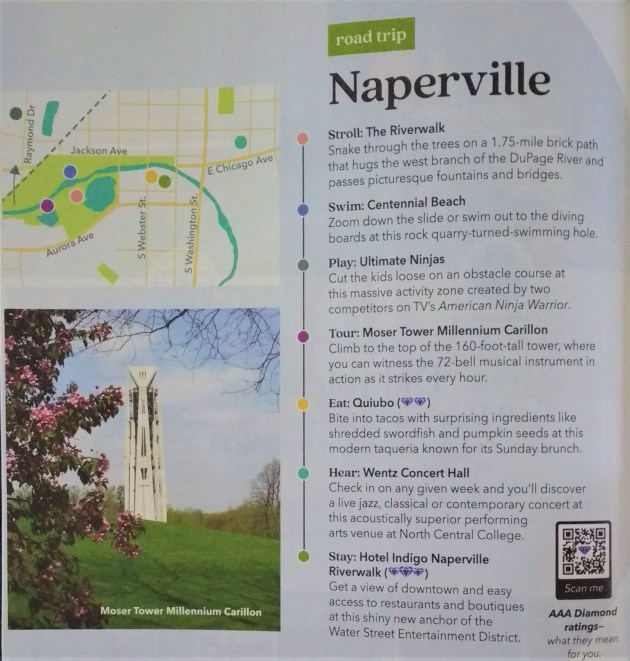
I found a suggested road trip to the suburb of Naperville, Illinois in a recent AAA magazine:

NapervilleRoadTrip

Several things strike me about this list:

1. All but one of the listed items to do is in downtown Naperville (with that other location almost out of the suburbs on the northwest side). This is a testament to the vibrancy and uniqueness of downtown Naperville.

2. Related to #1, all but one of the locations is walkable from the others. This is probably pretty unique in many American suburbs which are automobile dependent (as is the majority of Naperville).

3. What is missing from this list: Naper Settlement, the downtown shopping options, the rest of Naperville (see #5).

4. There is no mention here of proximity to Chicago. Naperville stands on its own with over 140,000 residents even though Chicago is accessible by car or train within roughly an hour. Would a road trip to a smaller and (perceived to be) safer location – a suburb – be more appealing to many Americans than a global city?

5. Does this accurately represent what Naperville is? On one hand, yes. The downtown features of Naperville represent a unique collection of recreational and consumer options within a suburban downtown. On the other hand, no. Naperville is a sprawling suburb marked by numerous subdivisions, strip malls, and lots of driving. Naperville is unusual both because of its downtown and its size and wealth with the latter two features perhaps not providing much appeal for a road trip.

1859 Chicago gas pipe finally out of service

Infrastructure in American cities can go back a ways. See this recent case in Chicago involving a gas pipe:

A small crowd gathered as a flatbed truck carefully backed into position next to a cavernous hole in the ground that revealed the retiree: a 17-foot-long piece of cast-iron pipe, believed to be the oldest natural gas pipe in the city of Chicago.

The pipe was in operation from 1859 until just last week, when the last customer relying on it officially switched over to a modernized polyethylene natural gas main, said Andy Hesselbach, Peoples Gas vice president of construction.

When the retiree began its work, the streets were paved with dirt and frequented by horse-drawn carriages. The Great Fire of Chicago wouldn’t occur for 12 years…

Replacements are prioritized based on risk, he said. In the last 30 years, the pipe excavated on Friday experienced 30 leaks, making it a prime candidate. Not every pipe that is retired is excavated, he said. Some are left in place while a new main is installed nearby.

Building good infrastructure to support all sorts of positive social and economic activity requires regular attention and maintenance. The cost to replace infrastructure can often seem prohibitive but upgrades are needed for systems that can be improved upon and/or consistently need repairs. Of course, it would be best to build for the long-haul at an efficient price from the beginning but this is not always possible as technology and places change.

Patterns in racial/ethnic change in Chicago area counties 2010-2018

Recently released Census data at the county level shows the shift toward larger non-white populations in the Chicago area:

The Chicago Tribune article also points out a few of the notable patterns:

The six suburban counties gained a total of 14,857 non-Hispanic black residents from 2010 to 2018, most of them in Will and DuPage, the new census data shows.

Cook County, meanwhile, lost 75,081 black residents over the same time period. Black residents’ share of the county population decreased the most of any racial group in the last eight years…

In each of the six suburbs surrounding Cook, non-white Asian residents grew by at least 13% since 2010. DuPage County grew by the most people, with an increase of 21,960 Asian residents in that time.

I’ll throw in three more patterns I see in the table:

  1. The further out counties, the more exurban locations (Kendall and McHenry Counties) have much higher proportions of white residents. It will be interesting to see how these change in the coming decades. Not only are those locations farther from Chicago, they also have fewer historic industrial suburbs (like Joliet in Will County and Elgin in Kane County) that attracted more non-white residents.
  2. In all of the six counties, Hispanics account for larger proportions of the overall population than black residents. Whether this translates into political representation or status within the region is debatable.
  3. The Asian population is more concentrated as a proportion in some counties – DuPage, Cook, and Lake – compared to others.

Coldwell Banker’s map of Chicago area locations missing parts of Chicago

A Coldwell Banker insert in the Chicago Tribune included a map and listing of all their Chicago area locations (zoomed in portion below):

ColdwellBankerChicagoMap060219.jpg

It is easy to see all of the suburban locations, particularly in the north and west suburbs. In contrast, check out the city map. From my count, there are seven Chicago Coldwell Banker agencies. Five of these are on the north side. Two are not: one in the West Loop and one in Hyde Park.

But, the Chicago map does not just show disparate locations. It is not an accurate map. The city is oddly shaped. Let me count the ways:

  1. It has an oddly drawn western edge that happens to make the south side much smaller.
  2. The west and south sides do not exist in their full form compared to the north side which looks like it has the biggest area.
  3. The West Loop location should be roughly in the center of the city – it is not. The size of the south side is diminished.
  4. The locations in Chicago have a weird relation to each other. Why are the West Loop and Hyde Park locations so close to each other? According to Google Maps, they are an over 8 mile drive away from each other. Yet, Google Maps suggests the West Loop and Lincoln Park locations are roughly 3 miles apart.

Perhaps this is a function of making a map with labels (the text all has to fit). Or, this may be about marketing: Coldwell Banker has particular clients and they want to highlight their proximity to those potential customers.

Yet, the map severely distorts Chicago. As noted above, the west and south sides do not fully exist. Recent Chicago maps aimed at particular audiences have done this before. This map also hints at the relationship between real estate practices and decades-long discrepancies in where people in the region live. Real estate professionals are not passive bystanders in residential segregation; they were active participants working alongside lenders and governments. Homeownership today is still not completely a free market and is more available to some Americans than others. Coldwell Banker does not have locations in certain places and this likely has ties to race, ethnicity, and class as well as practices and patterns developed over decades.

I am not asking that Coldwell Banker open locations in certain places. I am asking for an accurate map that clearly shows where Coldwell Banker is and where it is not.

(And for those who think I am reading too much into this, my starting position is this: I assume race is a causal factor in American social life until shown otherwise, not vice versa.)

With opposition to Google’s Toronto smart neighborhood, larger questions about powerful corporations, tax breaks, and public-private partnerships

Plans in Toronto for Google’s major development have hit multiple stumbling blocks:

As in New York, where fierce opposition to Amazon led the online retail giant to cancel plans to build a second headquarters in Long Island City, a local movement here is growing to send Sidewalk Labs packing. Their concerns: money, privacy, and whether Toronto is handing too much power over civic life to a for-profit American tech giant.

The #BlockSidewalk campaign formed in February after the Toronto Star reported on leaked documents indicating that Sidewalk Labs was considering paying for transit and infrastructure on a larger portion of the waterfront. In return, it would seek a cut of the property taxes, development fees and the increased value of the land resulting from the development — an estimated $6 billion over 30 years…

Separately, the Canadian Civil Liberties Association is suing the city, provincial and federal governments to shut down the project over privacy concerns. Michael Bryant, the head of the group, said Trudeau had been “seduced by the honey pot of Google’s sparkling brand and promises of political and economic glory.”…

Micah Lasher, the head of policy and communications for Sidewalk Labs, said providing more details about the business model for Quayside and plans for data governance earlier would have helped allay many concerns. But he also said the business model remains uncertain.

Any major development or redevelopment project in a major city can run into issues. But, there seem to be at least three larger concerns at play here:

  1. Google and the role of tech companies. The public may be more suspicious of these corporations today compared to ten years ago when all the technology seemed rather magical. Issues of privacy and power matter more today.
  2. Tax breaks may not be the answer they once were in cities and metropolitan areas in order to attract corporations and developers. Residents and local leaders may ask why Google, a very wealthy corporation, needs any tax breaks. And, if the tax breaks are not provided, will Google take its smart city development elsewhere?
  3. This might signal larger issues with public-private partnerships. For at least a ten years or so now, these have been hailed as a way to move forward in many cities: both the local government and the developers chip in to get things done with benefits to both sides. But, do such deals turn over too much control or too many of the benefits to the private side rather than spreading the benefits to the residents and the community?

It will be interesting to see how local political and business leaders handle this: can they afford to let the project die or go elsewhere?

Perhaps the long-term answer for companies like Google is to follow the lead of Disney and Celebration, Florida and create whole communities rather than entering in messy situations in already-existing communities.