NYC Council to Google: mark truck routes, no left turns

Two members of the New York City council have two recommendations for the routes provided by Google Maps:

Council members Brad Lander, deputy leader of policy for the council, and Ydanis Rodriguez, who chairs the council’s transportation committee, wrote a letter to Google on July 1 suggesting two enhancements to the company’s maps. One would create a “stay on truck routes” option for truck drivers. The other, which has a much broader application, would allow users to select “reduce left turns,” minimizing the number of such turns required on a given trip.

Why reduce left turns? In their letter, Lander and Rodriguez cited an extensive report from WNYC reporter Kate Hinds about the danger of left turns by motor vehicles in an urban environment where lots of people travel on foot and by bicycle. According to data compiled by Hinds and her colleagues, 17 pedestrians and three bicyclists were killed in New York by left-turning vehicles last year. The fatality rate for pedestrians struck by drivers making lefts in the city is the highest in the nation, according to Hinds’s report…

The city’s department of transportation has been redesigning intersections to make left turns safer by changing signals and incorporating other design measures. But Lander and Rodriguez got the idea to ask Google to help by giving its map users the chance to request a “reduce left turns” routing option. “We haven’t heard back yet,” says Rodriguez. “But we hope, knowing that Google is one of those good private entities, that Google can look at this.”…

Nationally, a quarter of motor-vehicle crashes involving pedestrians occur during left turns. A 2013 study found that when drivers make “permitted” left turns—in which they do not have the protection of a left-turn green arrow—they are not even looking to see if there is a pedestrian in their path as much as 9 percent of the time. Such turns, the study found, pose an “alarming” level of risk to pedestrians.

Generally, I would be in favor of Google Maps and others programs offering more route options for those who have particular routes they might want to choose. Routes with late night gas stations? Routes that are more scenic? Routes that avoid long stretches of strip malls? Scenic routes? Routes that involve driving near fewer semis? Routes with more interesting sights along the way? Just like Google Mail has lab features you can turn on and off, why not do some of this for driving routes?

Even if Google makes the left turn information available as an option, how much of an effect would it have on safety? The average driver probably doesn’t think much about reducing left turns. So, Google could help by suggesting people might want this but I could also imagine a public campaign advising against left turns. Now, if Google started eliminating left turns without telling people, that could get interesting…

Sociologist proposed moving Hong Kong’s population to Northern Ireland

Recently declassified documents show conversations about one sociologist’s plans to move residents out of Hong Kong:

Newly-declassified documents released at the National Archives in Kew, west London reveal how senior civil servants reacted enthusiastically to proposals in 1983 from a University of Reading academic that a chunk of Ulster – between Coleraine and Londonderry – be turned into a new home for Hong Kong’s 5.5m citizens.

The proponents of the plan, which one Northern Ireland office official declared should be “taken seriously”, suggested the mass transportation of Cantonese speakers would have the dual advantage of boosting the Ulster economy while solving Britain’s dilemma over what to do with the millions of Hong Kong residents concerned they would have no future under Chinese rule…

When details of the scheme, floated by sociology professor Christie Davies, appeared in a Belfast newspaper in October 1983, they caught the eye of George Fergusson, an official in the Northern Ireland office…

The academic, who has subsequently specialised in studying the nature of comedy, said: “I am glad my sensible idea was taken seriously. It was humorous but deliberately ambiguous. My test of a good humorous satire is if a significant minority take it seriously.”

Perhaps this is more revealing of those who were excited about this plan – we can simply move millions of people to solve two political issues at once! – than of the one who made the proposal. Deliberately relocating millions of people halfway around the world sounds like it could lead to all sorts of unintended consequences. How in the world would something like this even be carried off?

Another issue is whether a city could be swiftly moved and replicated elsewhere. Diasporas are not unheard of but the settlements in the new locations can’t completely mirror the original location or scene. Modern Hong Kong was formed out of a unique social and political context as was Northern Ireland. Building a Northern Ireland version of Hong Kong (or a Canadian Atlantic version or a West African version) could turn out to be very interesting…

How much money a third observation deck in Chicago might generate

Potential buyers of the Aon Tower in downtown Chicago are looking into making money through the addition of an observation deck:

A third observatory could generate tens of millions of dollars in annual revenue for the 1,136-foot-tall office building overlooking Millennium Park. The building, owned by Johns Creek, Ga.-based Piedmont Office Realty Trust, is attracting bids above $650 million, people familiar with the sales process say…

It would cost millions of dollars to design the space, to create an entrance and elevator access separate from those used by office tenants, and to promote and operate the observatory. Plus, unlike in most cities, two formidable competitors already are in place.

“It’s not a build-it-and-they-will-come type of operation,” says Randy Stancik, who has been general manager of the Skydeck for 10 years after eight years at the Hancock’s observatory. “You really have to work at it to build a visitor attraction. You have to be prepared to stay with it through some rough times.”…

There is little precedent to indicate whether a third observatory can thrive here. New York is the only city in the world with three, says Daniel Thomas, executive director of the World Federation of Great Towers, a group dedicated to generating tourism for its 49 member towers. New York has the Empire State Building Observatory, Top of the Rock at Rockefeller Center and the recently opened One World Observatory atop the new One World Trade Center.

This could be another front of the ongoing Chicago-New York City feud: could the two cities have an equal number of observation decks?

I would guess the Aon Center could have two major selling points compared to its competitors:

1. A different location. The Sears Tower deck is quite good for looking out into the suburbs but its views to the east are filled with buildings. The John Hancock observation deck offers different views to the north and over Lake Michigan. But, the Aon Center would be the only one with unobstructed views of Millennium and Grant Parks.

2. It is the newest. This may not mean much these days with a sort of arms race between the other two observation decks: the glass floor protruding deck at the Sears Tower and the Tilt at the John Hancock. I imagine the Aon Center buyers could come up with something unique that could attract people.

Perhaps this could lead to some sort of price wars between three observation decks leading to great deals for visitors…this is something I imagine people could get behind.

Photo essay demonstrating LA’s mansionization

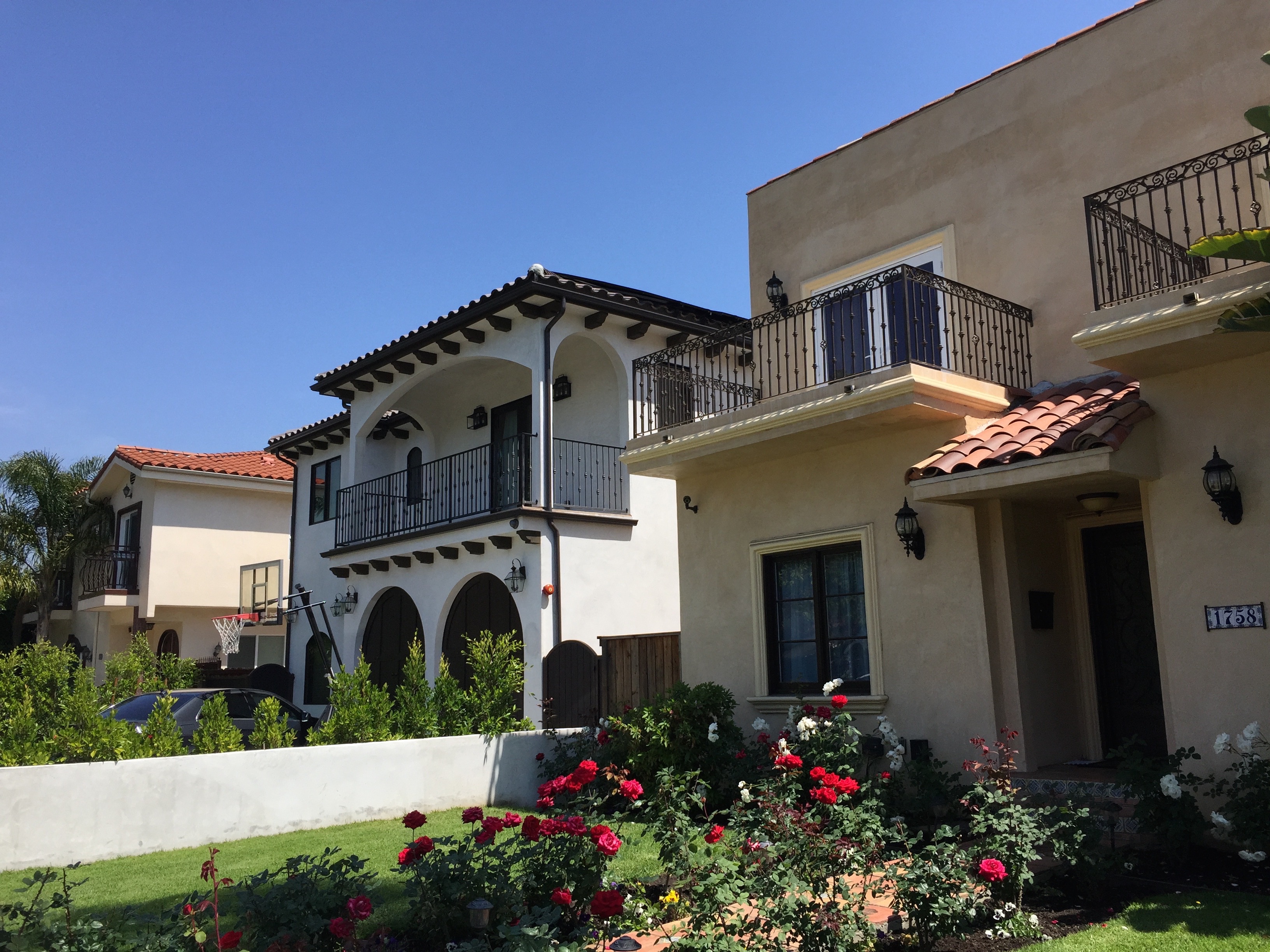
Here is a photo essay that shows the incongruity of a number of teardown McMansions in Los Angeles:

A developer wants to make as much money as he can as quickly as he can, where the only people whose feelings or quality of life he cares about are himself and whoever buys his newly-built mansion. A normal, thinking, feeling person could find many reasons why she would not want to rob her neighbor of privacy or sunlight by building a looming addition onto her house, with perhaps the most powerful reason being that her neighbors would hate her for it. A developer who will never live in a house he has built doesn’t have any relationships with neighbors to preserve. He actually stands to benefit from being indifferent/contemptuous to neighbors’ concerns, especially if it means he is able to build a bigger, more expensive, more obtrusive structure without the impediment of a guilty conscience. And don’t forget the long, noisy, messy, utterly unpleasant experience of living near a house under construction…

And that’s perhaps the biggest danger of mansionization. Regardless of what you think about mansionization and how it should or shouldn’t be regulated, there’s something about it that I’ve found to be consistently true.

When the first mansion goes up on a block of more modestly-sized homes, it sticks out like a garish eyesore. But if a second mansion is built on the same block, that first mansion suddenly doesn’t look nearly as big and out of place as it did before…

2015-07-01-1435742962-2381680-3inaRowGOOD.jpg
Three of a kindAnd at that point, the entire block might as well be mansionized — and chances are it will be. Having one mansion next to you is bad enough, but if the house on the other side of you gets mansionized, blocking sun and privacy from two sides, who would want to stay? Better to take what you can get and sell, leaving the house to a developer or new buyer who would inevitably go big — and another reminder of the now “old” neighborhood will be gone.

The critique of these new homes focuses on three areas:

1. It is often developers, and not neighbors, who go forward with the oversized homes. Neighbors might be more sensitive to the needs of others but developers are simply trying to maximize the property for profit. This may be true though there are plenty of cases where people buy properties with smaller homes and then make the decision to build a huge home. Developers aren’t the only ones to blame here.

2. The architecture and design of these new large homes are lacking. The homes are unnecessarily large and depart from traditional Southern California styles (stucco, clay tile roofs, etc.). These new homes clash with the older, smaller homes.

3. McMansions spread like a contagion: once a neighborhood or block has one, newer ones are soon to follow. The hint is that the teardowns need to be stopped at the start. A number of LA neighborhoods have been pushing for housing restrictions. But, it may be that one of these homes has to be built before neighbors really rally around the cause.

Beijing nearly doubles in population, environmental impact increases 4x

Rapid population growth in Beijing has led to a much larger environmental impact:

Researchers from NASA and Stanford University recently estimated that the area directly affected by Beijing’s urbanization has quadrupled in size from 2000 to 2009. So while the area we call Beijing has remained roughly the same size, its environmental influence has grown far larger. These findings, published this week in the Journal of Geophysical Research: Atmospheres, draw on new computer models and data from NASA’s QuikScat satellite.

From 2000 to 2014, Beijing’s population grew from around 11 million to 21 million—today packing as many people into one city as there are in all of Australia (or North Korea or Syria). Strangely, the study didn’t measure the effect of more greenhouse gas emissions released by these additional residents and their vehicles. Instead, it only measured the growth of physical infrastructure—for instance, new roads and buildings.

The changes in the city’s physical infrastructure had massive, compounding effects on its weather and climate. New roads, for instance, reduce the ground’s albedo, its ability to reflect light and heat away from the city, and buildings prevented air from circulating freely. Those effects have resulted in higher temperatures and lower wind speeds. Researchers found that winter temperatures had increased in the city by 5 to 7 degrees Fahrenheit, while wind speeds were reduced by about 2 to 7 miles per hour, making the city air even more stagnant, according to the American Geophysical Union.

Some have argued that larger cities may be better for the environment in the long run because they use less land (and Beijing did not increase in land mass during this period) and there are economies of scale. Yet, this may primarily apply to (a) cities in the wealthiest countries and/or (b) cities with slower rates of growth. Simply adding ten million people in 14 years probably isn’t good for the environment as even the most advanced cities of today would have a difficult time absorbing that many people in housing, let alone dealing with the environmental impact. For a comparison, see the major infrastructure efforts in the Chicago region to mitigate flooding: the region has grown but this happened over a century and the Chicago region still has 10+ million fewer people than Beijing. And still it is very difficult to get a handle on stormwater and flooding during major storms, let alone in a city adding 10 million people in 14 years.

Chicago Epic marketing cut due to state budget

Chicago rolled out an “Epic” campaign this spring to attract tourists but it is now no more due to a lack of state funding:

Chicago’s latest tourism campaign, Epic, is about to end two months early thanks to epic budget cuts at the state level.

Choose Chicago, the city’s tourism program, is losing 40 percent of its operating budget in the latest set of state budget cuts, according to Crain’s. That means Epic, the (perhaps unimaginative) summer tourism campaign launched in April with a TV ad encouraging viewers to “be part of something epic,” would end July 1 rather than run through the summer. Unless they are talking about an epically rainy June, the campaign ending this early wouldn’t leave much sizzle in the summer tourism industry.

Choose Chicago CEO Don Welsh said in statement that the program will lose most of its funding, from the state hotel tax, unless there is a last-minute approval of the state’s 2016 fiscal budget—increasingly unlikely as the week progresses…

The loss of Epic could deal a blow to Mayor Rahm Emanuel’s vow to boost tourism to 55 million visitors by 2020. Crain’s says Rauner, who was once the chairman of Choose Chicago, believes tourism is a boon to the local economy.

Two quick thoughts:

1. If you go with a catch term like “epic,” it is bound to be used sarcastically if something goes wrong (like the campaign ends early). Not exactly epic…

2. How do we – the public – know that such marketing campaigns work? Even though the Epic campaign is ending early, did it have any influence? Did the slogan catch on? What does this mean for future Chicago marketing campaigns? Just because a big campaign was out there doesn’t mean that it did much in this media and advertising saturated world.

Explaining why four Chicago neighborhoods haven’t had a murder in 3.5 years

Given Chicago’s reputation for violence, why have four Chicago neighborhoods – Mount Greenwood, Edison Park, Forest Glen, and North Park – not had a murder in recent years?

According to census data, 15,228 “law enforcement workers” live in Chicago, including about 12,100 police officers. Mount Greenwood, Edison Park and Forest Glen have some of the highest percentages of residents in the city working in law enforcement.

Crime in general is also low in these communities. For instance, between 2012 and 2014, not a single person was shot in Edison Park, which also reported only one criminal sexual assault. Forest Glen reported two sexual assaults. North Park had just 13 burglaries — which police Supt. Garry McCarthy calls a bellwether crime.

The city’s safest communities also have a high percentage of home ownership…

Another factor that stands out about some of the safest communities is wealth…

People in low-income neighborhoods tend to have a strong sense of community — with families living there for generations and looking out for one another, Papachristos says. But many young men have gravitated over the years toward gangs in those same neighborhoods, he says.

This article reads like a list of reasons for why crime happens in the first place (though at least broken windows theory is not invoked) and social scientists have found a range of reasons that might work in some situations and not others. However, we would suspect that areas that are wealthier have less crime as more people are living comfortably in the formal economy. This doesn’t mean these neighborhoods have no crime; there may be less violent crime but there are still some property crimes and likely crimes that are not caught including drug offenses and white collar crime (these might be even harder to uncover in wealthier areas).

If we follow the logic of this article, we would want to move high-crime areas toward the experiences of wealthier, higher quality of life neighborhoods that do exist in Chicago. Who is willing to take the steps to help this happen?

Obama bypasses Congress and talks to mayors about economic policies

President Obama talked to big city mayors yesterday in efforts to work outside of Congress:

White House aides say the U.S. Conference of Mayors meeting was an ideal opportunity to press the president’s agenda with a more sympathetic audience. White House spokesman Eric Schultz told reporters before the speech that it was a chance to move “forward on priorities helping the middle class despite inaction in Congress.”

The president urged mayors to raise the minimum wage, guarantee paid sick leave, and expand childcare and pre-kindergarten education — all issues with little traction among congressional Republicans…

Since Obama called for an increase to the minimum wage in 2013, 17 states and the District of Columbia have passed raises. Large retailers, including Wal-Mart Stores Inc, IKEA, and Gap Inc. have also pledged to increase the lowest hourly wage for their employees.

This could be viewed as a political ploy to shame Congress or subvert the typical process by which Washington works. In contrast, Obama’s strategy works with one of the standard lines about big-city mayors: they can’t be as partisan as legislators or those in the executive branch because they have to attend to more practical details on a regular basis. In other words, they have to make sure their cities work and can’t afford to get bogged down in ideological standoffs. (Interestingly, I heard this again recently at a conference in Chicago and there was some open laughter.)

That said, economic issues would certainly matter to many mayors as they need jobs for citizens as well as the economic benefits that come with jobs and economic growth (increased population, more tax revenues, increased prestige, etc.). Of course, there is disagreement about how to best do this. Chicago mayor Rahm Emanuel presents some of these contrasts. Is he pro-Walmart? He certainly seems to like attracting big corporations and tech start-ups. Is he truly interested in economic development in poorer neighborhoods? How much influence do wealthy businesspeople have in Chicago? He was behind raising the minimum wage in Chicago. Can he be considered non-partisan?

Whether Congress acts or not, cities and metropolitan regions are large economic engines and their leaders do have some latitude in policies that could encourage or discourage economic growth.

Naperville appoints first mayor emeritus

A new Pradel-less era is underway in Naperville – or not, considering he was just named mayor emeritus

All city council members said they agreed with the sentiment of recognizing Pradel and giving him a title from which to continue volunteering to represent the city at ceremonial events, as he has done so frequently for the past two decades…

The resolution creates the honorary position of “mayor emeritus” specifically for Pradel and only for as long as Steve Chirico, who proposed the position, is mayor. As mayor rmeritus, Pradel, 77, is envisioned to act as a “goodwill ambassador” for the city at ceremonial functions, and to do so without a salary or a budget…

But council member Becky Anderson said she thinks Pradel’s is a special case. He’s the city’s longest-serving mayor who also worked nearly 30 years as a police officer and became known as “Officer Friendly.” Anderson called Pradel Naperville’s “favored son.”

An interesting move that allows Pradel to do what many said was the thing he did best: be a cheerleader for Naperville. Yet, this raises two additional issues for me:

1. This could be viewed either as trying to maintain some continuity with the past (not necessarily a bad thing in a community that has been pretty successful in recent decades) or an inability to move on from the past and seize the new era.

2. Why don’t more local governments have such cheerleader/figurehead positions? This may be written into the jobs for certain people – say, mayors in certain forms of government who don’t have much power or economic development directors – but not everyone has the skills to do this. If countries have these sorts of positions – a president or prime minister who shows the public face but the real work is done elsewhere by other people – why not local governments? My first guess would be that they wouldn’t want another salary to pay.

Getting used to living next to Chicago’s L

WBEZ summarizes how several Chicago residents who live right next to the L tracks have adapted:

Maybe most surprising of all, everyone we spoke to says they’ve adapted to the noise and the shaking the train brings. And there’s a kicker. One expert tells us residents (neighbors to the tracks or not) should expect the CTA train lines to eventually get quieter, as the agency updates to newer train models and lines are revamped with noise mitigation in mind.

I’m not surprised. It is something you notice immediately if you are not used to it but it eventually fades away. I spent 10+ years growing up in a house within 500 feet of a major railroad line. There were 70+ trains, freight and passenger, per day and the noise and vibrations were quite noticeable. Yet, outside of having to turn the TV and radio up or down depending on whether a train was nearby, it just became part of normal life.

Perhaps the more interesting question here is whether these properties have reduced values. If so, and given the ability of many nearby residents to adjust, perhaps these properties are hidden gems?