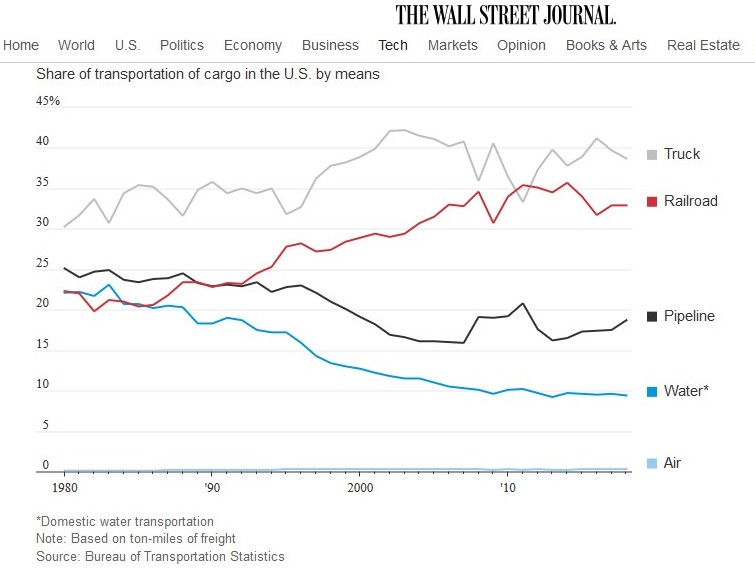
At this point, railroad shipping is very important: roughly one-third of cargo goes via train. This only follows trucks. And I wonder how this data works when cargo goes much of the way via train but then needs to make it “the last mile” from the railyard to specific locations.
So how much might autonomous railroads help? Here is some suggestive data:
A European Union-funded study published in 2020 found that moving to newer systems for managing trains could increase the capacity of existing rail networks by up to 44%. An internal study by Wabtec indicates in the U.S. the increase could be even higher, up to 50%. An increase of that magnitude in the ton-miles carried by America’s rail network would be the equivalent of moving approximately one million fully loaded Boeing 747-10 passenger jet planes from coast to coast every year.
Combine this with autonomous trucks (which, according to this piece, may take longer than moving to autonomous trains) and drones and perhaps more future goods could be moved even more quickly.
The United States has big cities of various sizes. For example, the Wikipedia list of the largest cities in the United States ranges from New York City to #326 on the list, Roanoke, Virginia, at just over 100,000 residents. By important measures, whether population size, density, or land size, some places are definitely bigger than others.
But, a trip this week to Springfield, Illinois reminded me that these absolute measures obscure how different big cities function within their own regions or geographic areas. Take Illinois. The biggest city by far is Chicago and the majority of Illinois residents live within that metropolitan region. Yet, within Illinois there are numerous smaller big cities that anchor sizable areas as well as the big city of St. Louis just over the Mississippi River. If you are in Quincy, Illinois, with roughly 40,000 residents, Springfield at over 114,000 residents might be the big city over an hour away. Chicago is even further away both geographically, five hours by car or train, and culturally. Regional political, economic, cultural, infrastructure, and health systems revolve around these smaller big cities which then have links to the less common truly big cities.
Put these different experiences together and “the big city” can mean different things in different contexts. Is it the regional center an hour away, the truly large city with a major international airport several hours away, the sizable suburb nearby that offers some different options, the tourist magnet that many people visit, or the big city as it is depicted on television and movie screens?
Capitalism is the economic system of the United States and many other parts of the world. Can actors use capitalist means to critique capitalism? Two recent examples.
One of the key things wealth can buy is the ability to make decisions and change your circumstances. Money gives you options and choices. For everyone else in the vicinity of Just Getting By (or worse), choice is often little more than an illusion. Most of us fall into the latter category and perhaps that’s one of the reasons the Netflix Korean series “Squid Game” has become such a global phenomenon since premiering last month, with its brutal critique of capitalist imperatives and the traps therein…
Because is it really a choice — such a slippery word — when you’re this desperate? Is it really a choice when the systems we live by are put in place by the rich and powerful to deliberately create that desperation? Put another way: Scarcity in modern life is as manufactured as the life-or-death scenarios in “Squid Game.”
In the show’s view, we are powerless to band together, to refuse to play along or create a different reality. When pushed to the brink, we become selfish or scared or just beaten down. And ultimately, we turn on one another. Another clear thematic through-line: It is men who run and enforce these games, and it is men who watch them from afar as spectators numb to (or thrilled by) the suffering at hand…
Amazon founder Jeff Bezos — the real-world embodiment of the show’s exploitative VIPs — tweeted congratulations to Netflix’s head honchos before adding: “And I can’t wait to watch the show”? Nothing bizarre or surreal about that, nope, nope, nope. Is this the part where I also mention that Netflix and Amazon are among the studios playing hardball with the union for TV and film crews in the U.S. on issues like livable wages, reasonable work hours and meal breaks? Everything is fine, pay no mind to all the contradictions we live with every day!
So wealthy studios, streaming services, and individuals put together and promote a series critiquing capitalism and there is plenty of money to be made off of this.
Second, consumers are regularly asked to purchase items or experiences that funnel money to worthwhile charities and causes. This could be celebrity-backed lines that donate a portion of the price to charity, religious organizations or civic groups selling items, or companies donating money through purchases. All of this assumes that purchases will be made and that consumers will want to purchase products or experiences that give back as opposed to ones just sold for profit. Consuming is the way to give, as opposed to just giving without the need for consumption.
Perhaps this is a consequence of the fact that anything can be made into a commodity. This includes items needed for daily survival to luxury goods to experiences to things that once were “sacred.” If anything can be bought and sold, including objects that critique the very system under which they are bought and sold, is there hope of a different reality?
Consumerism is also a powerful force. Whether consuming TV shows – binge-watching a critique of capitalism? – or consumer goods, the consumer is in a particular position of taking things in. I like the distinction I have heard from multiple sources over the last decade or so: there is a difference between being a consumer and a citizen. The first primarily takes while the second contains the ideas of duties, responsibilities, and obligations alongside personal or collective benefits.
One thing that does worry me is a move toward doing these things online. We had to do it remotely because of covid-19. But these rituals are designed to happen and work best in the presence of other individuals. When we’re together, our heart rate synchronizes our breath. These mechanisms are leveraging our minds and bodies. Why do people kneel in church? There’s research showing that if you show people information on a screen above them, they place more emphasis and believe more on the higher screen because they’re looking up at it. Physiologically, we interpret something higher verticality as more authoritative. If you’re sitting on your computer or watching on your phone, I worry that we’re going to lose a lot of the power and majesty of certain rituals because we’re doing them remotely. That’s not how they were designed to work.
This train of thought is also part of the reason sociologist Robert Brenneman and I wrote Building Faith. A recent trend is that people interested in religion or spirituality do it on their own and in secular settings. But, this is not what numerous religious traditions have highlighted for thousands of years. They have buildings that are intended to enhance the experience of the transcendent as well as enhance fellowship among believers. They may structure this space in different ways – whether to emphasize the preached Word, music, prayer, viewing other attendees, etc. – but they generally agree that buildings shape religious faith. Move those beliefs and practices to other spaces or to no spaces and it is something different.
Could people eventually have a faith or set of spiritual beliefs and practices and no common rituals whatsoever? Remove the physical structures and a group of people around them doing something similar and it is easier to imagine.
The modern U.S. is thus a decentralized nation, where despite an urban revival in recent years the periphery has kept growing faster than the center. Rural areas aren’t growing; most American counties actually lost population in the 2010s. But low-density suburban counties attached to large metropolitan areas grew faster than either high-density suburbs or urban counties, economist Jed Kolko calculated recently, while the fastest-growing major metro areas (Austin, Orlando, Raleigh, Nashville) aren’t among the largest.
This is a little hard to square with claims that large cities continue to wield great political clout. If it weren’t for the Electoral College, according to one oft-heard argument, voters in New York, Los Angeles and/or Chicago would choose every president. How they would manage to do this with only 4.7% of the nation’s population is a bit of a mystery. True, the three cities’ metro-area populations added up to 13% of the U.S. total in 2020, but that was down from 13.3% in 2010 and traditionally suburbs and cities largely canceled each other out politically — although that has been changing lately.
There’s a stronger argument to be made that economic power and cultural clout remain concentrated in a few places. Gross domestic product grew more slowly in the 10 largest metro areas than the country as a whole from 2010 to 2019 (2020 data aren’t out yet), but per-capita personal income grew faster. New York still dominates finance and the news media, Washington dominates government, Los Angeles rules entertainment and San Jose and San Francisco technology.
Census data suggests that the majority of the American population lives in suburbs. But, population alone cannot explain the importance and persistence of big cities. They will continue to remain powerful and important for multiple reasons. They help anchor broader metropolitan regions. They are centers of finance, innovation, real estate, cultural opportunities, key transportation infrastructure, and other essential activity. They occupy some of the most important and strategic locations. They have long histories.
At the same time, a decentralized landscape means (1) no single city or set of cities may dominate activity and/or (2) residents of the United States may not feel the importance of cities. For example, even with data showing the importance of cities and their regions for economic activity, Americans consistently discuss small businesses and farmers. Or, Manhattan and Washington, D.C. may dominate headlines but many Americans will be more invested in their local regions or communities.
More broadly, it may be safe to describe all of American society as more decentralized than other developed countries. I am thinking of Frank Dobbin’s book Forging Industrial Policy where France is the example of a more centralized state, both in terms of government structure – more power at the state level – and geography – all roads/rails lead to Paris. The United States has had from the beginning a system with distributed powers at the federal, state, and local levels as well as a broad landscape with many kinds of settlements.
In Chicago, one of the country’s largest railyards – the size of 500 football fields – was at one point backed up for 25 miles…Cities like Chicago and San Antonio – the busiest international land gateway in the country – have been particularly affected by the bottlenecks.
With that said, where exactly do the train delays in the Chicago region fit within the larger supply chain problems? Most of the news I have seen on the topic emphasizes the problems at major coastal ports where ships are waiting to be unloaded. If the ports could move through the goods already waiting, would they simply then get stuck in Chicago and similar locations?
If the problems in the Chicago region are confined to railyards and intermodal facilities, I would guess most people in the region have little reason to know about the issue. They may notice empty shelves in stores but not know that some of the goods might just be a few miles away on a railroad track. Unless you happen to drive by such locations and see something – and some of them and their activity are visible from major highways – or hear something specific in the news, the supply chain issues could be anywhere.
What’s missing from these titles are people, but this is arguably part of the fantasy they’re presenting. Citizens are complicated; they have needs and wants, which of course influence the way towns, virtual or otherwise, are laid out. On the one hand, the absence of people could be interpreted as an unintentional but darkly misanthropic view of the city. On the other, perhaps these are exercises in utopian thinking; cities are filled with compromises that these city-builders allow us to calmly transcend.
I have not played any of these games – my video game attention is elsewhere – but I have a lot of experience with SimCity where the role of residents was interesting, to say the least. The people themselves were not often present on the screen. Instead, the focus was on land and how it could be transformed into different uses.
Where citizens tended to show up were in their reactions to your choices as mayor. Perhaps it was demanding a police station or a school. Perhaps it is was in the mayor’s approval rating. Perhaps it was in the construction of new residences, suggesting your community had some attractive features.
But, they were just abstract concepts. If you wanted to deal with people directly, you could play The Sims. SimCity was about systems, not characters. While this broke ground in some ways, it also obscures the real and productive roles residents play in cities. SimCity encourages a top-down view of cities: development happens at the behest of one leader, a mayor/tyrant urban planner or leader, who is only curbed by a budget, complaints, and the occasional disaster. This is not the participatory community building that can help link residents to their neighborhoods and communities.
It is hard to imagine a city-building game that fully incorporates residents and community members as part of the process. The mayor wants to build a new bridge but residents complain about the effects on the environment and demand input? The mayor wants to put a highway through to reduce traffic but the community believes it will scar their neighborhoods? Imagine a virtual reality game where the leader makes decisions, walks through the places they have helped create, and has to interact with the people there. Perhaps this is the next step, games about communities and the people that inhabit them rather than cities as systems easily changed.
Construction of the East-West Tollway and widening of Illinois Route 53 changed the Arboretum landscape, resulting in new lakes, roads, and a staffed gatehouse.
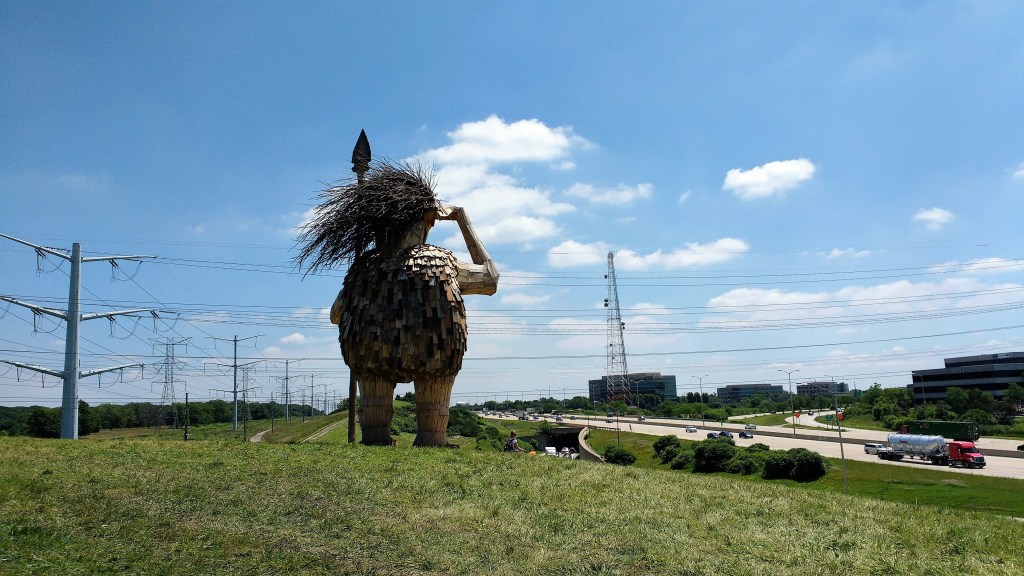
In a recent popular exhibit, the Arboretum even leaned into the nearby development with one installment looming over the highway:
Note the large power lines, the evidence of two major highways nearby (I-88 and I-355), and office buildings.
Recently, I drove around the east side of the property. This land has had a number of office and warehouse properties for years. This makes sense: the properties have access to multiple highways and there are plenty of residents/workers nearby.
However, I have noticed a more recent addition to this set of land uses: there is a parking lot just for Amazon trucks and vehicles. As far as I could see, there was no building next to the lot; just many spaces for vans and trucks. Looking at Google Maps, there is indeed a parking lot there among some other development and some undeveloped land. There is an Amazon facility nearby – one of many in the Chicago region – but it is not directly connected to the parking lot so drivers would have to exit to the main road and then turn back into the Amazon facility.
It is hard to completely escape development when in the Arboretum. Traffic noise can be heard, airplanes fly overhead, and houses and other signs of suburbia are visible from different vantage points. Yet, the presence of an Amazon parking lot reminded me of what nature is in the suburbs: present but often in-between roads, homes, and other buildings that speak to the ways that humans have and continue to transform natural features to their own particular suburban goals.
The lofty idea is the byproduct of a cooperation with CityCoins, a nonprofit that allows people to hold and trade cryptocurrency representing a stake in a municipality. By running software on their personal computers, CityCoins’ users mint new tokens and earn a percentage of the cryptocurrency they create. A computer program automatically allocates 30 percent of the currency to a select city, while miners keep the other 70 percent.
Since the nonprofit unveiled “MiamiCoin” in August, it has sent about $7.1 million to Miami. (City commissioners agreed to accept the donations on Sept. 13.)
While the program is still in its infancy, Suarez (R) estimates the effort could generate as much as $60 million for Miami over the next year and ultimately “revolutionize” how the city funds programs that address poverty and other societal issues…
Over the past year, several financial and tech firms set up offices in the city, including Goldman Sachs, SoftBank and Blackstone, according to Suarez. In June, the crypto wallet Blockchain.com announced it was moving its headquarters from New York City to Miami, citing the city’s “welcoming regulatory environment serving as a hotbed of crypto innovation,” the company revealed in a news release. That same month, the stock-trading platform eToro announced plans to establish offices in the city.
In many ways, this is a continuation of what cities have tried to do for decades: diversify their tax base and/or become a leader in a certain industry or sector, particularly in a new area. All of this helps bring in new tax revenues, jobs, and provides a certain status for the city.
Because of its growth in recent decades plus expectations that it will continue to grow, many American cities want to attract tech companies and grow the tech sector in their own community. If cryptocurrency is the new hot thing, everyone wants that.
On the other hand, chasing after the new thing does not always work out. Some cities will succeed in becoming cryptocurrency hubs, others will not. In a few years or decades, we can better assess Miami’s efforts. How much does cryptocurrency, or any tech business, need to be anchored in a particular place as opposed to conducting their business online or through a more distributed set of locations?
Additionally, cities are also interested in ways to generate easy revenue. When I read this article, I also thought of tourism. Many cities want to play in this game because there is a lot of money involved and visitors come, spend money, and then go home and do not require the long-term services that come with population growth. But, tourism is also dependent on factors like weather, pandemics, broad economic patterns, and more. Is cryptocurrency the newest easy money?
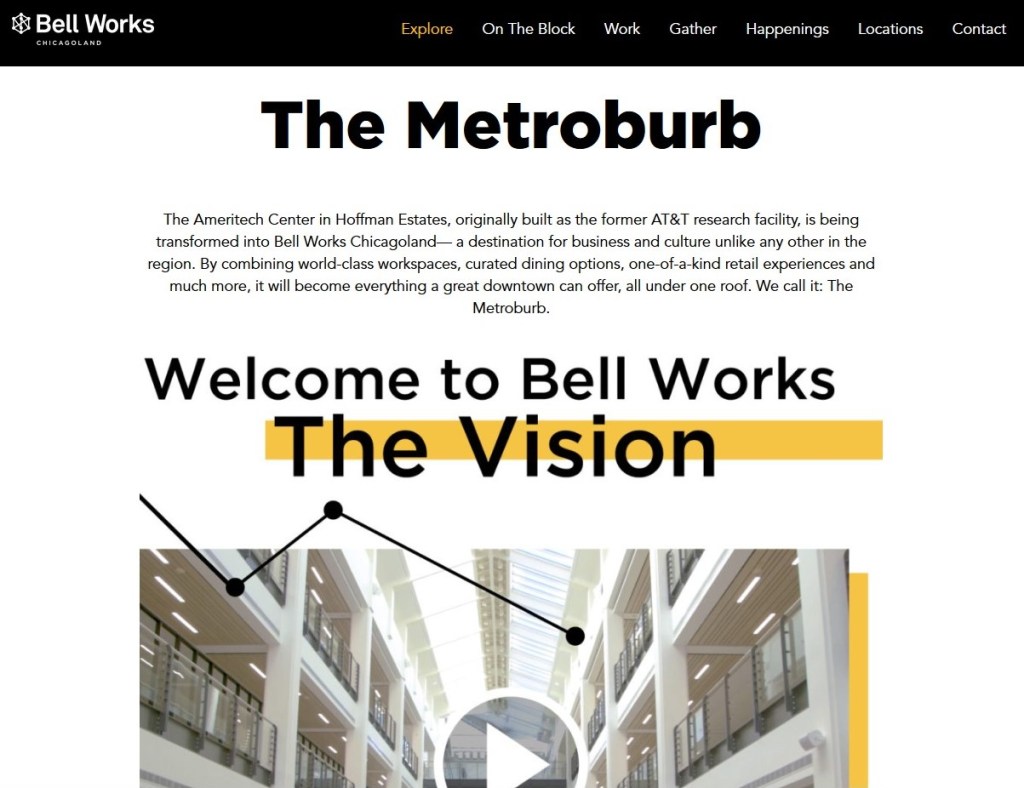
Chicago area suburbs advertising their communities is not unusual; see examples here and here. Far less common are new suburban developments making broad appeals in mass media. This project has been in the works for a while now – see an earlier post – and it is on an intriguing site as Bell Labs was important for the Chicago region (read more about the effects on local development of their Naperville facility) and the country as a whole.