The movements of Iranian diplomats are severely limited in New York, but one proposal being floated would bar them from shopping at big, members-only wholesale stores like Costco and Sam’s Club without first receiving the express permission of the State Department.
Such stores have been a favorite of Iranian diplomats posted to and visiting New York because they are able to buy large quantities of products not available in their economically isolated country for relatively cheap prices and send them home.
It was not immediately clear if or when the proposed shopping ban for Iran would take effect, but the memo said the State Department also was looking at drafting rules that would allow it to impose terms and conditions on memberships in wholesale clubs by all foreign diplomats in the U.S.
Americans may be used to Costco and big box stores but they are not necessarily available all over the world.
When I saw this story, I was reminded of the so-called “Kitchen Debate” between Nixon and Khrushchev in 1959. At an exhibition in Moscow, the United States constructed a model of an American home with the idea of showing off all that an average American household had. Khrushschev did not appear impressed but the display illustrates one of the ways the United States expanded its power and reach in the second half of the twentieth century: through consumerism and a particular lifestyle.
Put another way, pursue policies like the United States and the average home could have a kitchen like that one displayed in 1959 or the average resident could shop at a Costco in 2025. Resist the American way of life or be belligerent toward the United States and those things will not be available.
Just out of curiosity, I searched Google Maps for the Costco locations nearest to the UN Headquarters in Manhattan. There are at least 3 locations within 11 miles. This means when the diplomats and the leaders of the world come together at the UN, getting to Costco might not be too difficult.
It didn’t take long to figure out why there were so many empty units on the market: it turns out nobody wants to rent a condo, and nobody wants to buy one either. Condo rents have dropped over the past two years, and according to a recent report from the Canada Mortgage and Housing Corporation, or CMHC, condo sales have fallen by 75 percent in the Greater Toronto Area and 37 percent in the Vancouver area since 2022. The market has become so dire that buyers of pre-construction condos are having difficulty closing their purchases. Banks lend money depending on the present value of the property, and some condos are worth less now than they were when the buyers made their first deposit. As a result, developers have been cancelling construction projects. Some experts say we should have seen this coming…
The simple answer is that many condos built between the late 2010s and early 2020s were constructed not for living but for investment. Since 2000, there has been a steady increase in the proportion of condos used as investment properties. To my surprise, most of the investors were not faceless corporations or foreign investors. Research done by Statistics Canada shows that the typical condo owner is a middle-aged, middle-class Canadian couple. The reigning logic for the middle class was that buying a condo, renting it out to pay for the mortgage, and eventually selling the unit was a solid way to make money. This was especially true in the late 2010s, a period of low interest rates and weak rent control policies. Steady demand for housing, partially caused by increasing immigration, made real estate seem like a sure bet.
Developers knew that most pre-construction buyers were investors rather than people looking to live in the apartments themselves. As a result, they focused on quantity over quality. Vishakh Alex, an architectural designer working in Toronto, said that the directive from developers in the late 2010s was to squeeze in as many units as possible. It is telling that between 1971 and 1990, the median condo in the city was approximately 1,000 square feet, but between 2016 and 2020, the number dropped to roughly 650 square feet…
Yet, as city populations continue to grow, there’s nowhere to build but up. It hardly bears repeating that there is a housing crisis in Canada. Young middle-class people looking to buy their first homes can rarely afford the kinds of houses that they might have grown up in—a cute triplex on a tree-lined street in Trinity-Bellwoods, Toronto, for example, or a townhouse in Kitsilano, Vancouver, with a view of the ocean. And so it is to the condos we must go.
But it is also true that condo living does not have to be, and perhaps should not be, defined by the biggest developers looking to squeeze every drop of profit from mom-and-pop investors and homebuyers.
One difference here is that more of these condos might have been second homes. In Privileging Place: How Second Homeowners Transform Communities and Themselves, sociologist Meaghan Stiman explains how only a second home influenced how property owners viewed places and themselves with consequences for communities where these second owners were sometimes present.
If people in cities in Canada and the United States have concerns about investors buying too many properties, whether investors from other countries or institutional investors, what do they make of middle- to upper-class residents buying condos for investments? As the author notes above, these cities clearly need housing. American cities and metropolitan regions need housing. Should certain kinds of investors have limits or should developers be limited in how many investment properties they can construct?
One upside could be that the glut of investment condos does provide some attainable housing. The prices might not fall too far given their initial cost but what if investment condos and homes start becoming options for residents for whom they were not originally intended?
In the last two decades, I have had occasions to give walking tours of places. This can require weaving in and our of buildings in order to get out of inclement weather. Whether trying to get out the rain or snow or cold weather, a walk that combines moving outside and inside can be very helpful.
The problem is this: most places are not set up for this. The typical American building is oriented toward the street. You go into the building from a sidewalk or a parking lot and then you exit the same way. It can be difficult to find a pathway across buildings when there is not an easy pathway between them nor multiple entrances and exits to use.
College campuses offer a few more possibilities. These buildings are sometimes oriented toward a street but they are sometimes oriented toward a quad or a path. They often have multiple entry points. And visitors to a campus might be interested to see the interiors of certain buildings; what do classrooms look like? What is in social spaces for students? Where are different important offices and services located?
I found my own paths through campuses and the suburb in which I live. There are ways to take advantage of buildings, awnings, overhangs, and public spaces. It does not always work – I was recently caught in a torrential downpour where my umbrella did little good – but there are options if one is looking.
(Of course, there are cities and places that do offer interior walkways. Take downtown Minneapolis with a series of above ground walkways between buildings or the Pedway in Chicago. In places with consistently unpleasant weather, there need to be consistent options. Shopping malls are all about this as well; lots of walking possibilities once you drive to the mall.)
Case in point: Evanston’s Land Use Commission narrowly voted last Wednesday to recommend denial of a zoning application to build a 31-story, 430-unit apartment building in downtown Evanston. The tower would be among the tallest in all of Chicago’s suburbs. All the apartments would be studios, 1-bedrooms and 2-bedrooms, with 86 of the units deemed “affordable.”
The commission isn’t the last word on the project; the City Council will have that final say. But the 4-3 vote against the project reflected divisions within the community about growth. Speaking at the commission meeting, Chris Dillion, president of Chicago development firm Campbell Coyle (which isn’t developing the 605 Davis project that was the subject of the proceeding), clearly was frustrated: “Downtown Evanston cannot be preserved for only those who already are here. We need to make room for everyone,” he said, according to the Evanston RoundTable.
A majority of commissioners nonetheless thought the project was too big…
In Highland Park, another lakefront community about 14 miles north of Evanston, a fierce debate is underway about the redevelopment of a 28-acre vacant tract once the site of a Solo Cup factory. Prominent Chicago developer The Habitat Co. has proposed building 232 townhomes.
A recent meeting of the village’s Plan Commission on the project featured pointed criticisms, jeering and disruptions from residents complaining about the usual things when substantial residential developments are proposed — traffic and the impact on schools. But one resident complained that because some of the units were envisioned as rentals, the new residents would be “transient” and not invested in the future of Highland Park, according to a Tribune report.
The commission didn’t vote on whether to recommend approval, but a majority of commissioners expressed misgivings. Habitat partner Kathie Jahnke Dale said that any major reduction in the density, which already had been scaled back from a prior proposal, would lead the developer to walk away, likely leaving the site “vacant for another 15 years.”
This resistance is not unusual. For decades, suburbanites in the Chicago and across the United States have often resisted proposed developments that would bring denser and/or affordable units to their communities. Leaders and residents bring up concerns about noise, traffic, density out of line with the surrounding area, threats to property values and local quality of life, and concerns about the residents who would live in new residences.
Given this consistent opposition, what positive outcomes are possible regarding suburban proposals for affordable housing? Some thoughts on the possible options:
Approval of the proposal in its initial form. This is rare. But there must be examples that could serve as models that others could learn from. What factors in suburbs lead to approving needed affordable housing from the start?
A significantly smaller proposal. This happens quite a bit with proposals for suburban development: the initial pitch from the developer is considered and in the discussion with the community, the number of units is reduced. Take the Evanston example above slated for 31 stories and 430 units. Given the concerns expressed, perhaps the community would be okay with 15 stories and 200 or so units. Or with townhouses as in the second example, the density is reduced a bit with more open space provided. These changes can lessen the affordable housing contribution made but at least some affordable housing units are added.
I do not know if proposals that are rejected all together can be positive. Perhaps it encourages an ongoing conversation in the community? Perhaps turning down a reasonable proposal galvanizes local efforts to support affordable housing?
For new affordable housing to be constructed in suburbs, my sense is that significant support needs to come from local leaders and residents who can articulate how this will benefit the community. Since many suburbanites will see such proposals as a threat, what about them adds to the community?
Here is how GOBankingRates.com developed the list:
GOBankingRates analyzed the top 1,000 cities by household mean income across the United States to find the safest and richest cities using data from the US Census American Community Survey, Bureau of Labor Statistics Consumer Expenditure Survey, Zillow Home Value Index, Federal Reserve Economic Data, AreaVibes, and the FBI. The property crime rate per 1,000 residents, violent crime rate per 1,000 residents, livability score, household mean income, and the average total cost of living were scored for each location and sorted to show the safest and richest cities. All data was collected on and is up to date as of August 4th, 2025.
Not all of these are small towns; some might even be considered small cities. All have household mean incomes of over $200,000.
Going further through the top 50 suburbs, few are really large. Naperville comes in at #49, the largest suburb by population on the list by far.
To make this list, a suburb does not have be small and exclusive. It can be slightly larger and exclusive. I wonder if this is due to using the household mean income rather than the median. The mean is more likely to be pulled up by a small number of really high earners while the median gets at the midpoint of the distribution.
Dukakis’s suburban origins and issue-oriented style actually served as a major asset with the other constituency that many strategists recognized as key to his and the Democratic Party’s success in the general election. Political consultant and Dukakis adviser Hank Morris saw Dukakis’s upbringing and ethos as important in galvanizing postindustrial suburban professionals in battleground states such as California, Illinois, and New York. Suburban professionals responded favorably to Dukakis’s record about quality-of-life issues like traffic and air pollution, unregulated commercial growth and sprawl, declining schools, and rising drug and crime problems. Morris urged the campaign to further underscore that “he is the first presidential nominee to grow up in the suburbs and to stay there, commuting to work and mowing the lawn and knowing the concerns of suburbanites.” Taking the advice to heart, Dukakis made frequent references to his 1963 Sears snowblower as an emblem of his suburban sensibility and frugality. (275)
Of course, Dukakis lost the election. But Geismer argues that he represented a shift in the Democratic party toward the educated knowledge workers of suburbia. Whereas suburbs had been viewed as conservative and Republican in the immediate postwar era, by the 1980s there were pockets of suburban liberals and today there are numerous Democratic strongholds in suburban areas outside large cities.
At the same time, Geismer notes that these suburban liberals had particular notions about liberal causes. They tended to promote individual freedom, not addressing structural issues. When asked to transform their own suburban communities for the greater good of the Boston area, these suburban liberals resisted. It is one thing to advocate for liberal causes that might help you; it is another to promote affordable housing in your community.
I would venture that we see a number of these patterns still playing out today. What happened along Route 128 has happened to varying degree across American suburbs with pockets of high-tech, knowledge industry workers clustering in suburban parts of metropolitan areas. The American suburbs are more diverse than they were in the 1980s. Many of wealthy suburbs with white-collar jobs or workers are not fully open to change or to addressing metropolitan issues or regularly resist what they see as threats to the quality of life the enjoy. The choices suburbanites like to have still gives those with resources options to find communities that they like and then push back against change.
And when will the United States have its first suburban president, someone born in the suburbs and who identifies with the suburbs?
In its early history, Chicago’s shoreline with Lake Michigan was marked by railroad lines and activities. Trains pulled right up to the Chicago River, moving goods to the center of the city and its thriving port. You can see a late nineteenth century images of the lines of the Illinois Central right along the water here and here.
Today, it is harder to see evidence of the bustling railroad activity. The city still has sizable railyards and a large amount of railroad traffic. But it is now largely outside of the Loop and more railroad activity has been pushed to the edges of the metropolitan region.
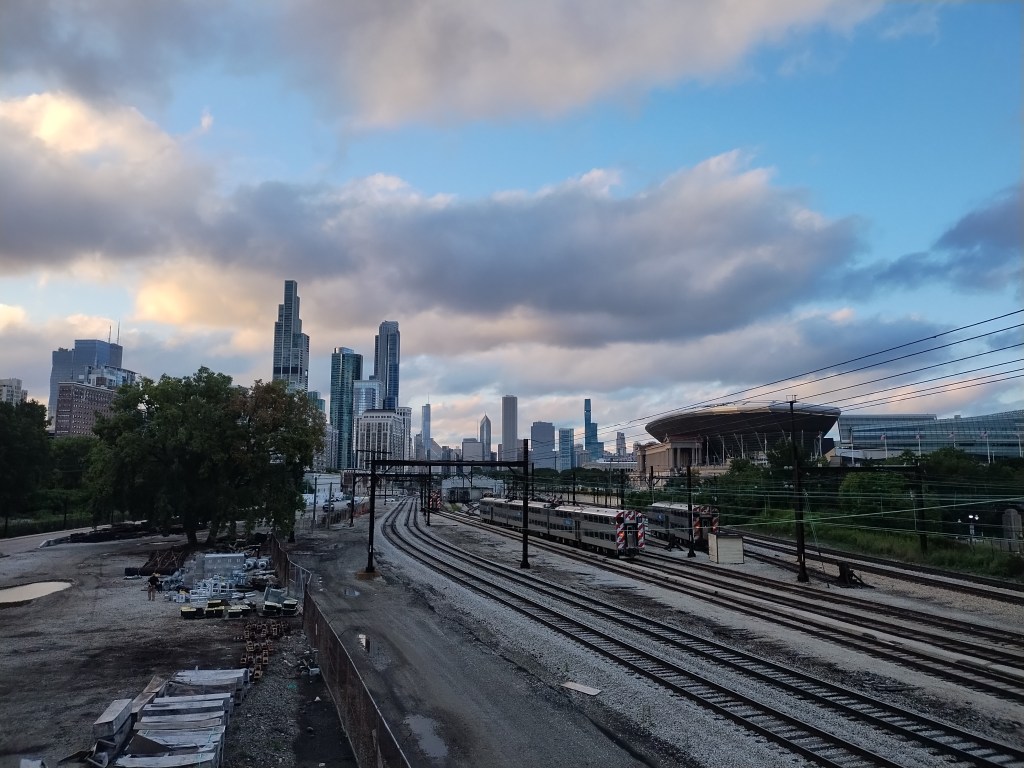
I recently found a spot where an observer can still get a hint of the important railroad activity that marked the lakefront:
This passenger line comes into the central part of the city from the south and its station is underground. This angle gives a broader view of the tracks and the infrastructure needed to move trains and people.
The major cities of the United States, including Chicago, are still dependent on railroad lines. The average resident of a region may only travel via car and visitors from further away may primarily arrive via airplane but the railroad lines continue to deliver large amounts of goods and resources. Their presence may be less visible but keeping the trains running on time in and around cities still matters.
The mayor of Naperville thanked the City Council for not supporting a proposal that regional transit authorities could develop land within half a mile of train stations. He explained his opposition this way (via his Scott Wehrli for Naperville Facebook page):
I’m proud of our City Council for standing together in opposition of this legislation that would give transit agencies the power to control development within a half-mile of our train stations—taking that authority away from the local officials you elected.
In Naperville, development decisions should be made by our community, through our City Council, not by transit agencies in Chicago. Local control has always been the foundation of our city’s success, and we’ll continue to protect it.
This is a good example for why I included local control as one of the seven reasons that Americans love suburbs. Suburban residents and leaders want to be able to make decisions about local land and monies as they see fit. They can resent when decision-making involving their land and money takes place elsewhere, particularly if it goes against what the suburban community wants or is perceived to be a threat to an established way of life.
This particular case involves transportation and land development. A popular idea in numerous cities and suburbs is to construct transit-oriented development which often involves higher residential densities adjacent to mass transit stops and a reduced number of parking spaces required. A number of Chicago suburbs have pursued this in recent decades; trains going in and out of Chicago pass apartments and condos in suburban downtowns.
But the key for many of these suburbs is that they made these decisions regarding development around train stations. These conversations often included debate about the size of new buildings and the number of units involved. How tall is too tall for a suburban downtown? How many units will be erected? What is the target population for these new developments?
Leaders and residents in Naperville and suburbs across the United States might pursue denser development near mass transit but they want to make the decision and steer development in ways they feel is consistent with the existing character and footprint of their community.
(I would also argue that local control is closely linked to the other six reasons Americans love suburbs.)
Some Zoomers like Marmo are ditching four-year degrees in favor of work that unchains them from a desk, puts money in their bank accounts sooner, and — they hope — will survive the artificial intelligence boom that is already starting to change once-hot professions like software engineering, consulting, and marketing. Some are turning to blue collar work like HVAC servicing and wind turbine installation. Others are trying to start their own ventures via influencing and side hustles. And some see the lure in the licensed white-collar job, including working in real estate or insurance.
That shift in licensed jobs is slow, but growing. The share of Realtors younger than 30 grew from 1% to 4% in 2024, according to NAR’s member profile, and sits at 3% in 2025. Among insurance agents, the median age of an insurance principal who owns 20% or more of their agency is 55, with 22% of principals over the age of 66, according to a 2024 study of agencies conducted by the Big “I,” an association for independent insurance agents. Many are likely eying retirement, which could open up a huge amount of demand for young people to take up the trade.
Several Gen Zers I spoke to for this story told me they find appeal in working in real estate because there’s no ceiling on what they can earn. Rather than invest tens or hundreds of thousands of dollars in a four-year degree, they can spend a few weeks or months training to receive licenses and start working in fields where their hustle correlates to their payday…
Because it’s still something of a rarity to see a baby-faced real estate agent or teenager selling life insurance, the young people in licensure jobs I spoke to say that succeeding means not just learning the trade but competing against ageist stereotypes. The median age of a first-time home buyer has risen to an all-time-high of 38, according to NAR. That’s up from an average age of 33 a decade ago, according to a Zillow analysis. The idea of having a newly minted, 18-year-old real estate agent guide you through the biggest financial decision of your life is jarring. Katie Kenny, a 24-year-old Realtor in Chicago’s suburbs, says people meet her and are surprised, as they “expect the real estate agent to be like double my age,” she tells me. “They’re like, ‘oh, you’re young.’ And then when I open my mouth and start talking, they’re actually surprised because I do know a lot more, and I sound a lot more mature than what a normal 24-year-old would sound like.”
This article, like many articles, is trying to get a handle on a possible trend: younger people are pursuing different fields due to the world around them. There are numerous ways to report on this phenomena. This article uses a mix of statistics and interviews, considering broader patterns and hearing people describe their choices.
In the headline to the post, I highlight one way to report the data cited above. 400% growth in young realtors! 400% of anything sounds like a lot of change. A 100% increase or decrease would be noteworthy so 400% must mean a lot.
Another way to do this would be to take the approach above: the percentage of young realtors increased from 1% to 4%. This is not a big jump as both are small percentages. The odds of having a realtor under 30 years old is still 1 in 25.
Both of these options are factually correct. I would argue the second option is a better representation of the full context. Change happened but it is small change. If the same trend continues for 5 to 10 years, then there might be big change to report. Imagine the 30% of realtors under age 30 or 50%.
Someone will continue to track this data. It makes for interesting stories: “In an age of AI, college debt, and global crisis, more young adults in the United States are choosing to be realtors.” How big of a story it becomes partly depends on how it is told.
Sellers are slashing prices at record rates to to lure hesitant buyers put off by soaring mortgage rates and economic uncertainty.
In July alone, 27.4 percent of listings had a price cut — the highest rate ever recorded in Zillow’s monthly data going back to 2018.
It helped push prices down year-over-year in 25 of the 50 largest US cities. Most were in the South and West…
Tampa prices are down 6.2 percent, Austin 6 percent, Miami 4.6 percent, Orlando 4.3 percent and Dallas 3.9 percent, according to Zillow…
Price cuts are more common in the South and the Mountain region, according to Zillow, as homeowners desperately try to offload properties.
Summary of this data: these are “record” cuts, supported by the number of listings with a price cut (27.4%), the number of metro areas with price cuts (half of the largest cities), and four specific cities have had prices drop between 3.9% and 6.2%.
This may be unusual behavior compared to prior years. It might not be what property owners want to see. Is it a “housing panic”?
Here are several indicators I could imagine of a larger panic regarding housing values:
Prices dropping across all or most metro areas. (We read later in the article that values are up in some metros, mostly in the Northeast and Midwest.)
Price drops of more than 10%. This may be an arbitrary cut-off but it is at least double-digits.
Consistent public reporting and/or conversation about a housing panic. If there was truly a panic, wouldn’t it be easy to find that conversation?
An inability to sell many homes even with larger price cuts.
This is worth paying attention to, both for the actual figures and how they are interpreted.








 Legally Sociable