The larger monthly bills could vary quite a bit across suburban homes depending on the size of the home, the costs in each municipality, and whether the home is updated (think insulation, efficient appliances, etc.). Best to check on these costs in each possible residence.
There are multiple ways to get cheaper furniture to reduce costs. Not all rooms have to be fully furnished (perhaps less entertaining during COVID-19 helps with this). Rather than focusing on furniture, why not buy a smaller house? Wait, Americans need somewhere to put all their stuff (including furtniture)…
Yes, most suburban living will require a car unless living within walking distance of needs and work or living in an inner-ring suburb with great public transportation. Cars are not cheap once you add up car payments, insurance, gas, and maintenance. And cars need parking and storage space with many desiring a garage on their property for that, adding to property costs. But, Americans like their driving in the suburbs.
Commuting can be financially costly as well as stressful. The time might not be as much of an issue (though certain routes in certain locations certainly add up) as the inability to do much else while driving.
Thinking more broadly about suburban costs, I wonder if presenting potential suburban residents the full array of problems with suburbs – financial costs, exclusion, limited cultural amenities, moral minimalism – would change people’s minds. The suburbs have a certain appeal in American life and the suburban single-family home is a strong draw to many.
The latest iteration creates dedicated, work-from-home spaces inside apartments. South Bend, Indiana-based Holladay Properties is looking at installing voice-activated elevators to limit touch points. The project also would incorporate small conference rooms and phone booths where residents could take a call or prepare for a presentation.
“It’s hard to ignore the global pandemic,” Holladay Vice President T. Drew Mitchell said. “It’s in front of us everywhere, so some of the things that we’re doing inside of the units is sort of a reaction to that.”…
“What we’ve encountered in our product in suburban Chicago is overwhelming demand,” said Mitchell, who’s based in the firm’s LaGrange office. “We have a waitlist right now at Burlington Station in downtown Downers Grove, and what we’re seeing unfortunately for Chicago is people are returning to the suburbs.”
In Glen Ellyn, rents would range from about $1,400 to nearly $3,000. Glenwood Station amenities would target young professionals working in the city, empty nesters seeking a lower-maintenance lifestyle and other demographic groups.
From the picture provided, this looks like a fairly typical apartment building for a wealthy suburban downtown. The building is not too tall; height is a problem in many suburbs as residents do not want structures to dwarf other buildings, particularly houses). There is room on the sidewalk for pedestrians with streetlights and plantings. While there is some variation to the exterior, the design is not too crazy for a bedroom suburb. The building is not too large; there are just 86 units. There are American flags flying at the street corner.
The changes, according to the article, seem to focus on interior spaces. If you live in an apartment, how do you find space to separate home and work? This may be easier in large homes. What additional spaces could an apartment building or complex contain that gives residents some variety without having to leave? The suggestion above is to provide private spaces elsewhere in the building. It will be interesting to see how apartment developers and owners will in the future modify public spaces – gyms, pools, gardens, dog areas, party rooms, etc. – when restrictions may not allow apartment dwellers to use them in the same way.
In other words, suburban development continues in fairly normal ways: the developer gets TIF financing, the city gets a building that fits its character and aesthetic, and suburban downtowns become a little denser.
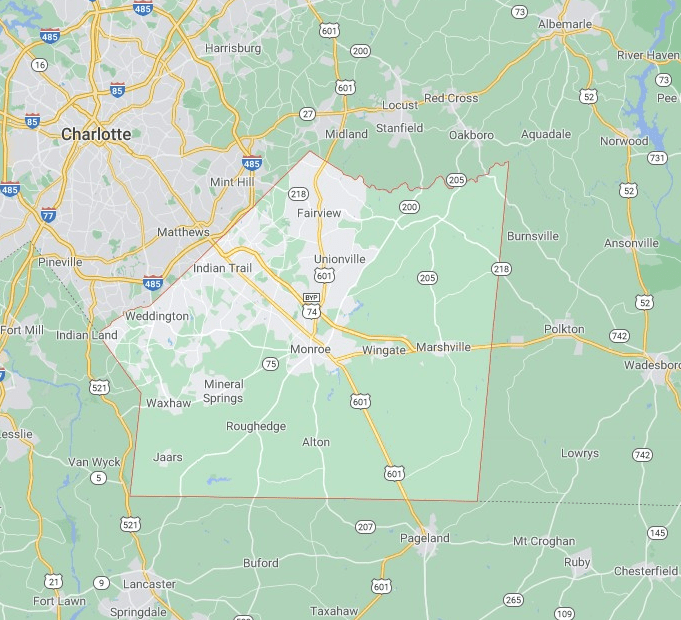
Union County is what one scholar terms a “countrypolitan” place: Under federal government designations, it lies within a metropolitan area, but it also has a strong rural and agricultural history. For the most part, it doesn’t look like a cookie-cutter suburb, nor is it impoverished. In fact, Union is North Carolina’s wealthiest county, according to the Census Bureau. There are places like it around the United States. They are distinct from rural areas, which are mostly Republican, and cities, which are heavily Democratic; many voters in these places are neither die-hard Trump fans nor urban liberals. That makes them pivotal counties, in 2020 and in the future.
Everyone agrees that Union County is changing. The question is how it’s changing, and how fast. There’s no doubt that Republicans will carry the county up and down the ticket this year—Carter, ensconced at East Frank, was the last Democratic presidential candidate to win here, back in 1980—but the GOP’s overall success in the state will hinge largely on how big a margin it is able to run up in exurban counties such as this one. Democrats’ control of inner-ring suburbs continues to strengthen, and the future of the Republican Party nationally depends on keeping firm control over places like Union County…
The reason Union County is changing is simple math. When Helms was born, about 4,000 people lived in Monroe. Today, nearly 36,000 do. Since 1990, the overall county population has almost tripled, from about 84,000 to roughly 240,000. As I traveled around the county, I began to notice something peculiar: Virtually everyone I talked with was a transplant. Some of them had moved only recently, and others had been around for 10 years, or 20…
“Union County when Jesse was in the Senate was a very rural county,” Wrenn says. “Now it’s got a big chunk of suburban in it. If the long-term trends continue, the Republicans are going to have to find a way to compete in the suburbs. It can be done, but you just have to change your whole way of thinking.”
The temptation in such stories about suburban voters is to look at counties and communities and just see political change. And it sounds like Union County has had its share comparing before the Civil Rights Era, after, and today.
The basic explanation for this recent change is new residents. The population has grown and new residents, not as familiar with the ways of Union County, have moved in. What was once a small population with low density is now much larger and in bigger cities and towns.
But, is this all that has changed: new people moved in and they came with some new political views? I suspect there is more going on here that both contributes to the political change and also exists outside of it. Here are a few possible factors at play:
The decline of agriculture, particularly family-owned farms and opportunities, could be at play here. As farming becomes more difficult or less desirable for subsequent generations, the land can be sold off and be turned into subdivisions. This is a significant change in land use as well as who lives there: farmers and those connected to agriculture versus middle-class suburbanites.
Connected to #2, the economic landscape has changed tremendously in the last half-century or so, moving away not just from agriculture but also manufacturing and moving more toward retail, services, and a knowledge economy. Union County and many other locations in the United States are still trying to adapt to these large shifts that affect employment, tax bases, and local businesses.
Numerous local institutions have likely had to adjust in light of growing populations. Schools need more space for kids. Local governments need to provide more services (and they might now have larger tax bases to draw on) and local officials are addressing new issues. Established churches now compete with new congregations. In sum, the civic and social institutions that may have existed for decades in roughly the same form now need to adapt. This can present challenges in any community.
In sum, this is not just about politics. A shift toward a suburban lifestyle in Union County has many consequences and politics may just be one of them.
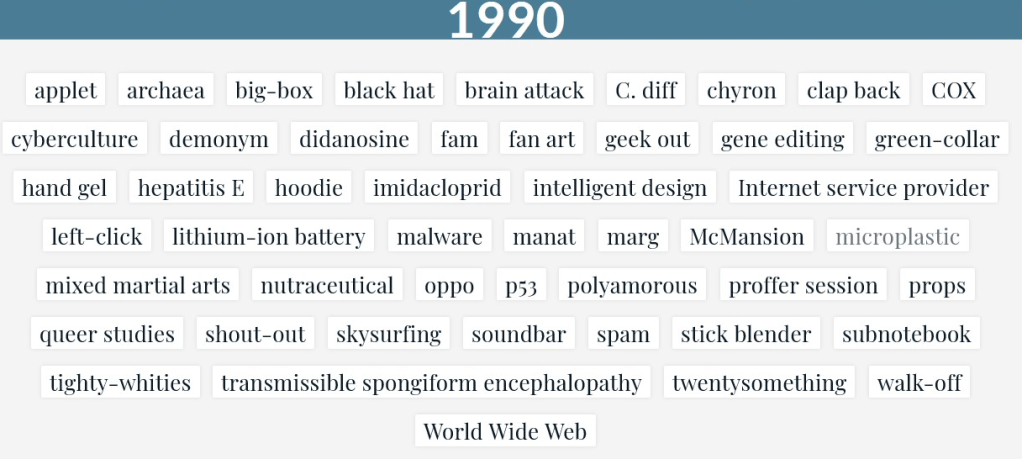
This is an interesting list of terms that have now existed for thirty years. Like the McMansion, these refer to newer phenomena that either did not exist prior to 1990 or did not have a reason to be named.
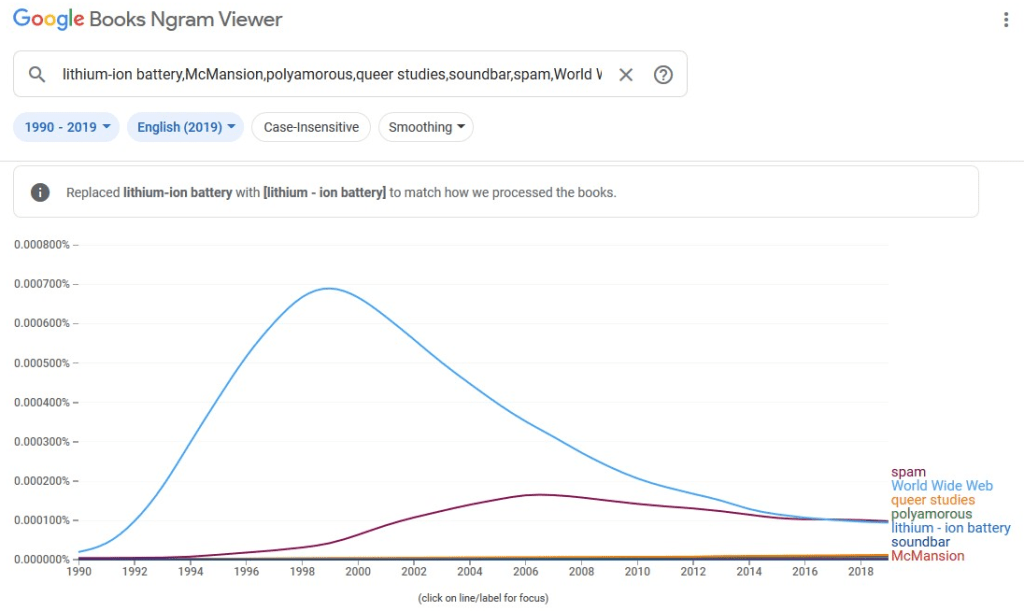
But, just because terms were introduced does not necessarily mean that they were used at the same rate over time. Using Google NGram Viewer, here are some of the terms in comparison:
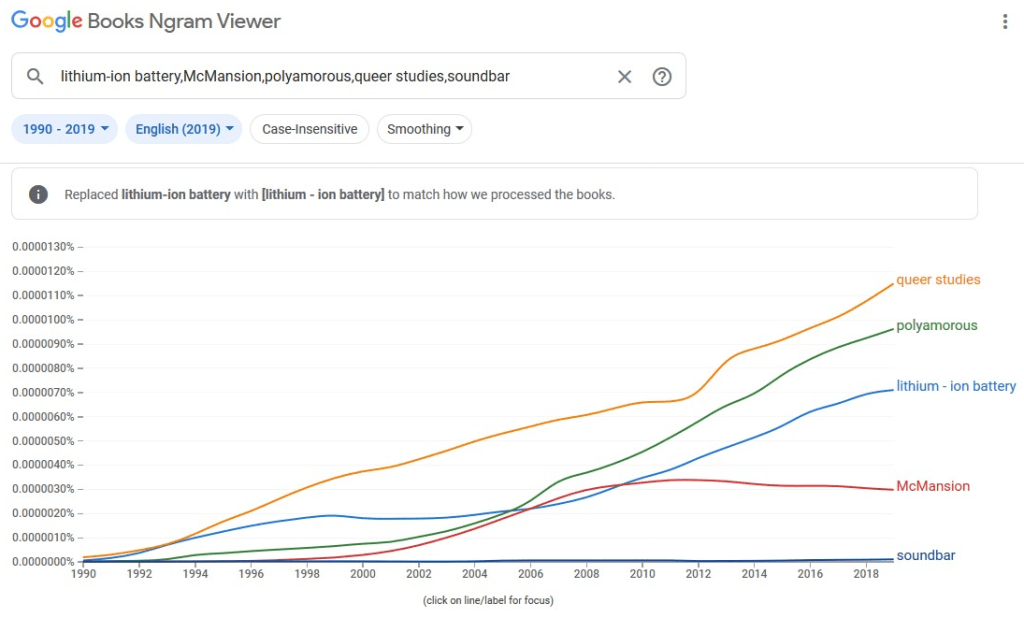
Take out the tech terms – World Wide Web and spam – and now some of the patterns regarding other social phenomena are more clear:
Since this covers books, there might be a lag compared to other sources. For example, my own analysis of the use of the term McMansion in the New York Times and Dallas Morning Newsfound the term had higher rates of usage from roughly 2005 to 2008 (and then plateaus, just as it does with book usages several years later). But, it also takes some time for terms to be used widely. Indeed, three of the five terms above steadily rise in usage.
Given the time travel back to 1990, it might be hard for any new words to compete with computer or Internet related terms. The introduction and spread of the Internet shaped many aspects of society. At the same time, new understandings of sexuality and relationships are pretty influential as well. Perhaps thirty years is not enough to judge the impact of these words just yet.
Now, the pandemic is prompting a wider exodus from the British capital, pushing up real estate values in outlying regions. Months of remote working have made city dwellers reassess their housing priorities. And like many office workers, contemporary artists such as Mr. Allan — who makes art under the moniker “Dominic from Luton” — are also finding that they no longer need to be in a big city…
Hastings, with its scrappy mix of stately but unkempt 19th-century houses, 1970s seafront amusements, poor transportation links and limited employment opportunities, was recently ranked as the most deprived town in southern England by Britain’s housing ministry. But its distinctness and affordability have long been valued by artists…
Supported by a new [Croydon] City Hall-funded initiative called Conditions, 27 such spaces are being offered for £138 to £230 a month in a repurposed bicycle factory and office building. Katie Sheppard, one of the artists based in the complex, makes digitally embroidered portraits based on selfies; another, Felix Riemann, makes sound sculptures for performances…
This vision of an accessible, locally grounded art scene is very different from the elitist flying circus of blockbuster exhibitions, auctions, fairs and biennials in destination cities that has dominated the art world in recent years.
On one hand, as is noted in the story, the Internet and the smartphone make art possible from anywhere.
On the other hand, art is more than just a single genius creating while sitting quietly somewhere. Local conditions, such as housing costs, matter. Having a set of like-minded arts around who provide support and spur creativity may be essential. Funding, local resources, and neighborly or community goodwill help.
One of the biggest barriers to art in these communities may just be the decades of suburban and small town critiques that suggest they are dull and backward locales. Can art only work there when conditions in big cities are too difficult for artists?
More broadly, this speaks to the concept of art worlds in which artists and numerous other actors operate. The creation of art is a social activity involving multiple pieces and social forces. Art can indeed flourish in many locations, including suburbs and small towns, if the conditions are right.
The Democrat presidential primary for 2020 contained occasional talk of housing on the campaign trail or in debates. But, leading up to Election Day 2020, there has been little attention paid to housing. A few notes on this:
Some broader campaign themes could be related to housing: talking about the middle-class, taxes, providing opportunities for more Americans. But, these typically do not directly address housing even if it may be implied (such as being middle-class includes the ability to own a home, often in the suburbs).
COVID-19 has had a direct effect on a number of areas. While there has been much said about jobs and the economy, the connection to housing is missing. For many, employment status directly affects housing status and there have been moratoriums regarding rent and evictions. Yet, the primary focus is on the direct means of making money (jobs, stock market, etc.) rather than what many hope their earnings translate into (a nice residence to own or rent in a good neighborhood). Additionally, the housing and real estate industry contribute to the broader economy but little has been said about activity here outside of some people are leaving cities.
According to StreetEasy, the median rent has fallen below $3,000. That is the lowest price since 2011.
The third quarter of 2020 also marked the first time since 2010 that Manhattan, Brooklyn and Queens all recorded year-over-year rent declines.
StreetEasy says renters are no longer willing to pay the so-called “commute premium” of living in Manhattan, because so many people are working from home.
Any rent drop in Manhattan or in New York could provide opportunities for people who even just a short time ago had little chance to live there.
At the same time, dropping below $3,000 for the median suggests that rent is still pretty high. Who can take advantage of this drop? Those with resources to do so, not necessarily people who need affordable or cheap housing. Indeed, if these lower rents quickly induce a number of people to take advantage, then rents could stabilize and head back up.
Perhaps there is little that could actually move rents and housing prices in certain housing markets to a point where many more residents could take advantage. A pandemic is unlikely to lead to the production of more housing and struggles with employment, among other factors, will limit who would move to big cities with temporarily lower prices. At the same time, COVID-19 could help nudge conversations about housing in a productive direction.
David Latimer of New Frontier Design is creating tiny homes that are more luxurious and more expensive than most you’d find on the market today. His most recent model, the Escher, starts at $180,000 and is designed to fit a family of six full time. Latimer calls this “the future family home.”…
The Escher is unlike most tiny homes, nearing $200,000 and including high-end features. But Latimer said that doesn’t make this model any less of a tiny house.
“Minimalism means different things for different people,” Latimer said. “The bottom line is that downsizing is a tremendous life adjustment and sacrifice for anybody. This tiny house is still a minimalistic lifestyle. It’s still a tiny home.”…
“I believe micro-housing is going to be a substantial part of the future of residential housing,” Latimer said. “Millenials and Gen Z are going to live this way. I would bet my life on this. Micro housing will allow people to live out the American dream.”
I am not surprised there is a perceived market for more expensive tiny houses. At a basic level, perhaps this is just selling the same products to different parts of the market: some people want to pay less for a tiny house, others will pay more. Indeed, from what I can gather about who moves into or at least talks publicly about moving into tiny houses, it looks like there are some educated people with some resources who want tiny houses with upgrades.
More broadly, I am not sure how a more expensive house fits into “the tiny house movement.” Downsizing and having a cheaper home are often connected to anti-consumerist motives and behavior. Some people make the choice to acquire a tiny house in order to move away from having too many items or fixating on a large home or being so financially committed. Does a luxury tiny house try to have it both ways?
If this kind of tiny house – small but still nearly $200,000 – is going to become part of the American Dream, the definition of the American Dream may need to change. For decades now, the American Dream involves owning a single-family home, probably in the suburbs. The Escher could indeed technically fulfill this – provide a single-family home in the suburbs – but it is very different in substance. If anything motivates people to make this the embodiment of the American Dream, it may be financial realities rather than aspirations for a simpler, downsized American Dream. In other words, expensive housing markets and debt may push people toward more luxurious tiny homes rather than a true desire to ditch the big showy house for a high-status small house.
Desirable suburban communities – those with wealthier residents, more white-collar and professional workers, higher quality of life, and stronger economic bases – will do better at attracting and following through on redevelopment.
The “easiest” answer in many suburbs might be to redevelop office or commercial properties for residential units. Given the needs for affordable housing or cheaper housing in many metropolitan areas, many suburbs could fill residential units. They may not want to for several reasons: residences do not bring in sales tax money and services are different for residences, including having more students in local schools. Plus, “affordable housing” implies certain things about the residents and the units that might not be palatable to some communities. But, if the primary goal is to put property to use, this might be the way to go.
Mixed-use redevelopment that combines residential and retail or office space will continue to be attractive. However, these opportunities might be limited to already-advantages suburbs or particular properties that have certain advantages (large enough to create a self-contained community, access to highways and other transportation options, etc.).
Certain properties may just present particular problems. Three come to mind quickly: shopping malls, empty big box stores, and sizable office parks or campuses. A number of communities have tried to tackle each of these (as one example among many, see this shopping mall post here) but the size of the property and their particular configuration present problems. There may a glut of new kinds of suburban properties that present their own issues: restaurants (both sit-down and fast food), strip malls, and movie theaters. Again, the ways the space was initially configured for these specific uses can make it difficult to pursue retrofitting.
Converting private spaces into more public spaces. Imagine the shopping mall to public skating rink or office campus to park. These may have very positive long-term benefits including spaces for civic engagement, leisure, and interaction with nature. Yet, given the state of municipal budgets with COVID-19, it might be very hard to find money to purchase or use what was once private property.
If there are numerous vacant properties in suburban areas post-COVID-19, this will present a challenge for communities. Are there enough uses for these properties? How willing are suburbs to convert land from one use to another as they consider the “best use” for the community?
In the last week, I have run into two potentially interesting news stories that cite studies. Yet, when I looked into what kind of studies these were, they were not what I expected.
Chicago’s population has been on the decline for years, with the metropolitan area suffering some of the greatest losses of any major U.S. city. But new research suggests that the pandemic might be exacerbating the exodus.
For the first time in four years, moving concierge app Updater has helped more people move out of Chicago than to it, the company said. The catch-all moving service estimates that it takes part in one-third of all U.S. moves, providing unique, real-time insight into pandemic-driven trends, said Jenna Weinerman, Updater’s vice president of marketing.
“All these macro conditions — job insecurity, remote work, people wanting to gain more space — are coming together to create these patterns,” Weinerman said.
The Chicago figures are based on approximately 39,000 moves within city limits from March 1 to Sept. 30. Compared to 2019, this year saw more moving activity in general, with an 8% jump in moves into the city — but a 19% increase in the number of people leaving.
According to the latest available US Census data, the average size of single family homes built in the US was trending upwards from 2010 until 2017, when sizes hit a peak of 2,643 square feet. Since then, single family homes began decreasing in size, with homes built in 2019 averaging 2,611 square feet…
Location matters when it comes to average home size. Some urban hotspots follow the national trend, while others move in the opposite direction. Here’s how single family home and apartment sizes look in the country’s top 20 largest cities, based on Yardi Matrix, Property Shark and Point2Homes data.
As an academic, here is what I expect when I hear the word study:
Peer-reviewed work published in an academic outlet.
Rigorous methodology and trusted data sources.
These steps do not guarantee research free from error but it does impose standards and steps intended to reduce errors.
In both cases, this analysis does not meet those standards. Instead, they utilize more proprietary data and serve the companies or websites publicizing the findings. This does not necessarily mean the findings are untrue. It does, however, make it much more difficult for journalists or the public to know how the study was conducted, what the findings are, and what it all means.
Use of the term study is related to a larger phenomena: many organizations, businesses, and individuals have potentially interesting data to contribute to public discussions and policy making. For example, without official data about the number of people moving out of cities, we are left searching for other data sources. How reliable are they? What data is anecdotal and what can be trusted? Why don’t academics and journalists find better data?
If we use the word “study” to refer to any data analysis, we risk making it even harder for people to discern what is a trustworthy study and what is not. Call it an analysis, call it a set of findings. Make clear who conducted the research, how the analysis was conducted, and with what data. (These three steps would be good for any coverage of an academic study.) Help readers and interested parties put the findings in the context of other findings and ongoing conversations. Just do not suggest that this is a study in the same way that other analyses are studies.