Secretariat as the sports figure with the most streets named after them

A few years ago, ESPN looked at how many American roads are named after athletes. Secretariat led the field:

Photo by Mu00eddia on Pexels.com

But perhaps nothing drives home the impact of Secretariat’s life more than looking at a map. Like, any map. We know because we’ve looked at them. All of them. In an effort to identify roads in the U.S. named for athletes, ESPN cross-referenced 2010 Census data with Google Maps. We were stunned to uncover 263 roads named after the horse — far more than for any other athlete, human or otherwise. “I’m not that surprised,” says Kate Chenery Tweedy, whose mother, Penny, raised and owned Secretariat. “Secretariat came along at a time of great crisis in this country — Watergate, the Vietnam War, Nixon’s impeachment. And unlike any other athlete ever has, he restored our sense that there is beauty and good in the world.”…

Born in Virginia. Won Triple Crown races in Kentucky, Maryland and New York. So it makes perfect sense that the states with the most Secretariat streets are … Florida and Texas?…

Road experts say there is little rhyme or reason to the way our streets get their names. It’s mostly just real estate developers who submit names to their town, there’s usually a relatively easy approval process, and voilà. Case in point: Somebody in Butte, Alaska, sure likes horse racing. You can take Sea Biscuit Lane to E. Man o’ War Drive, then hang a right onto E. Secretariat Drive — the most northerly road named for Secretariat. And if you wanted to ride Secretariat the 3,920 miles back to his burial site? At the record 37.8 mph he ran the Belmont in, he’d have gotten you there in a little over four days.

As someone who studies suburbs, here is my own theory for this naming pattern. Developers often want names for nicer subdivisions connected to tradition, certain lifestyles, and success. Why not reference both horse racing and one of the most successful horses ever? Horse racing requires money to participate and the audience for horse racing might fit particular demographics. Additionally, horse racing hints at nature. Secretariat is a well-known athlete. Such names will help establish their subdivision as an exciting place for people with means.

My own community has at least a few street names that connect to horse racing. This is not just a connection to racing in the abstract; our suburb has links to horse racing near these sites with a racetrack that was in existence in the early 1900s and another farm with wealthy owners who bred and raced horses in the second half of the twentieth century.

By linking single-family homes to horses and one of the most famous American athletes, how can a developer go wrong?


Chasing development: give big tax breaks to Foxconn, then to Microsoft…

American municipalities want growth and jobs. Hence, they give tax breaks to corporations to locate there. In southern Wisconsin, they first gave big money to Foxconn. When that fell through, now they are giving money to Microsoft:

Photo by Jonathan Borba on Pexels.com

Taiwan-based Foxconn Technology Group forged an agreement in 2017 with former Gov. Scott Walker to manufacture LCD screens in Mount Pleasant, investing $10 billion and employing 13,000, in return for billions in subsidies. But the company, a top manufacturer of Apple’s iPhones, downsized its plans and created few jobs, forcing government officials to find other users.

Data centers process and store huge volumes of computer data, forming the backbone of the internet. Although these facilities typically don’t create large numbers of permanent jobs, local leaders and tech experts say Microsoft’s arrival signals the Foxconn land, along with infrastructure improvements already complete, won’t go to waste…

Residents on the land promised to Foxconn were displaced from their homes, but the company, blaming “unanticipated market fluctuations,” canceled the mega-factory. In 2021, it signed a new deal with Gov. Tony Evers, who beat Walker after criticizing the original agreement. Instead of up to $3 billion in subsidies, Foxconn agreed to collect $80 million for creating 1,454 jobs and investing $676 million in a set of smaller facilities by 2026.

Microsoft’s agreement with Mount Pleasant and Racine County requires it to launch construction by 2026. The company can recover 42% of its property taxes, but no more than $5 million per year. The local governments can also repurchase the land at the same price if Microsoft fails to hit the deadline.

The logic for this is provided in the story. Attracting big companies and jobs is viewed as important. If growth does not come here, it will go to other communities who will benefit. The deal with Foxconn fell through but having some deal and a few jobs is better than nothing. Growth must continue as must the tax breaks.

Do they really have to continue in this fashion? The final paragraphs hint at one of the possible motivating factors for these companies locating in southern Wisconsin: they are just over the Illinois border and can service the Chicagoland region. If Chicago area municipalities will not compete with each other in these same ways, just go over the border and find plenteous tax breaks. Another motivating factor seems to be a fixation on big companies and tech companies. What community would not want to boost they have a Microsoft facility (even if it is just a data center)?

I hope some people keep following up this story and similar ones to find out what communities and residents actually get out of these tax break deals. How much is spent per job? How does the business growth help the community? What does a data center contribute to a community? Years down the road, who benefits the most from these deals?

The pedestrians’ school of defensive (and hopefully enjoyable) walking

Walking is good for you and can contribute to health and sociability. Walking can also be dangerous, particularly in the United States where life is optimized for those in cars and trucks. Given this context plus my own experiences walking, here are my rules for the pedestrian:

Photo by Uriel Mont on Pexels.com

-Always be aware of your surroundings. Do not walk distracted to the point where you do not know what is going on.

-Take in and enjoy what is going on around you involving people, buildings, nature, and more.

-Keep at the speed of other pedestrians around you. There are times to go slower (strolling areas, tourist areas) and times to go faster (going with rush hour traffic to the train station). Know the purpose of your walk and act accordingly.

-Do not stop suddenly in the middle of walking.

-Do not block the middle of a walking path.

-Anticipate the actions of others, particularly vehicles.

-Be clear and decisive in your movements. Do not make others guess at your intentions as a pedestrians.

-Make eye contact with drivers.

-If walking in a space shared with vehicles, walk against traffic and stay to the side.

In roughly two hundred years, humans have gone from primarily walking to traveling much faster speeds on a regular basis. Let us not completely lose our walking skills and enjoyment.

Removing a tree that predated Chicago

Before Chicago, there stood at least one oak tree:

Photo by Valeria Boltneva on Pexels.com

For almost three hours, crews from Fernandez Tree Service hacked away at one of Chicago’s oldest trees, a centuries-old, sprawling bur oak that had reached the end of its life span. The nearly 70-foot giant was here long before the zoo was built in 1868, when the area was just a lakeshore covered with tall grass, and possibly even predating the incorporation of the city of Chicago.

Director of horticulture at Lincoln Park Zoo Katrina Quint said the tree is 250 to 300 years old. The caramel cross-sections of the trunk have diameters of 60 inches…

Scott said that in northeastern Illinois, about 1 million acres of land used to be oak forests. There are only 17% of those oak ecosystems left, and 70% are in private ownership, meaning that they’re not in protected status, she said…

Morton Arboretum’s Robert Fahey wrote about this native species loss in the 2015 Oak Ecosystems Recovery Plan, led by the Chicago Wilderness and the Oak Ecosystems Recovery Working Group. Fahey overlaid 1830s public land survey data with 1939 aerial photography and 2010 analysis to see where oak ecosystems used to exist and where they exist now.

The Chicago area now has many trees, but losing one of its oldest trees both harms the ecosystem and severs a connection to the past. Trees are an important part of the landscape and can outlive development and people.

One thing that cities and suburbs tend to do is level the landscape, plop buildings, roads, and more on the ground, and place all sorts of infrastructure underground. It is hard to imagine that prior to the Chicago region, there existed sand dunes, waterways that operated differently (the Chicago River, in particular), groves of trees, swamps, and prairie spaces. The growth of Chicago was bad news for these natural settings as the city consumed land and resources, produced much pollution, and recreated “nature” along the lakefront and in parks.

I hope more people can see what areas looked like before mass development in the United States. This can help prompt thinking and action about what we might do with land beyond building houses and providing pathways for vehicles.

Celebrating property owners who hold on to their land even as development surrounds them

The movie Up starts with a portrayal based on a true story: property owners continue to live in their home even as it becomes surrounded by new buildings. Their home is now isolated amidst change.

Here is a similar recent story from Australia:

https://www.facebook.com/7NEWSsydney/videos/790734838563206/

Their large five bedroom property with a sprawling 200 metre-long drive is located in The Ponds area in west Sydney, where hundreds of new homes have popped up in recent years…

The home looks bizarrely out-of-place wedged between identical chock-a-block newbuilds, where its 1.99 hectare garden could fit over 50 of the matching new homes inside.

However, when their neighbours upped and left – choosing to sell to the developers – the Zammits made a last hold out.

They refused to sell, despite being offered millions, and prevented the developers snatching up the last plot of land.

“The fact that most people sold out years and years ago, these guys have held on. All credit to them,” local agent Taylor Bredin told 7News

In short, the land could be worth over £25million, especially after ten years of their private rebellion.

The valiant resident holds on to their land despite possible riches; all they have to do is move. Such a story fits the image of the sacrosanct property owner. A home is their castle. No one can tell them what to do. If they want to stay, they can stay. The government or private actors should not be able to move them.

At the same time, we believe growth is good. If even just a few property owners hold out, they can interrupt larger plans for new buildings and activity. Imagine an important highway project or mass transi line or new tall building that need several properties to make it better for others but those owners will not sell. Are there limits to whether a property owner can hold on?

In the Seattle story referenced by Up and in this Australian suburban story, developers could not force the issue but they could build right around them. Edith Macefield’s Seattle home was boxed in on three sides. The suburban property above is surrounded on all four sides by dense single-family homes. The property owner has stayed but the surrounding area has been radically transformed.

For now, the single-family home owner reigns supreme. That there are relatively few similar cases also tells us something. It is nice to hold on to a property but it is also nice to profit tremendously from selling it. Some may not like teardowns but the initial homeowner can make a lot of money. Housing and land is an investment. Few can hold out against the available money and resulting changes.

Want to see adults attached to their phones? Go to a local park

I am at neighborhood parks quite a bit with my kids. I have noticed that while kids are playing, the adults there with them are often on their phones.

Photo by Ju00c9SHOOTS on Pexels.com

I get why. It is indeed tempting. The kids are running around and occupied. Their activity means that parents might have a few moments to themselves. The park often has benches or places to relax. Why not catch up on some texts or social media activity?

Even without kids around, parks feature plenty of phone use. Walk the dog and read the phone along the way. Try biking and phone use together. Lots of walking with earbuds in or headphones on.

However, parks can be inherently interesting places without phones. Kids are learning and developing skills. There are often hints of nature around, birds to spot, bodies of water to observe. There is plenty of people-watching to be done. If the park is a lively one, perhaps one envisioned by Jane Jacobs where people are using it in multiple ways and it is situated among other interesting uses, there is plenty to see and do.

Additionally, if people are concerned with phone and social media use for kids and adults, could parks be phone free zones or at least spaces where we work to use them less? It is not because it is immediately dangerous in parks – at least, not at the level where I consistently look around and spot drivers around me with their heads tilted down to their phones – but because good parks offer the potential for a respite from other parts of life. If parks, preserves, and green spaces can help restore our minds and bodies, are smartphones part of that equation?

(To be fair, adults are on their phones all over the place. I have just noticed it recently in parks amid my own efforts to use my phone less in this setting.)

Pew Research calculator to determine your location-controlled social class

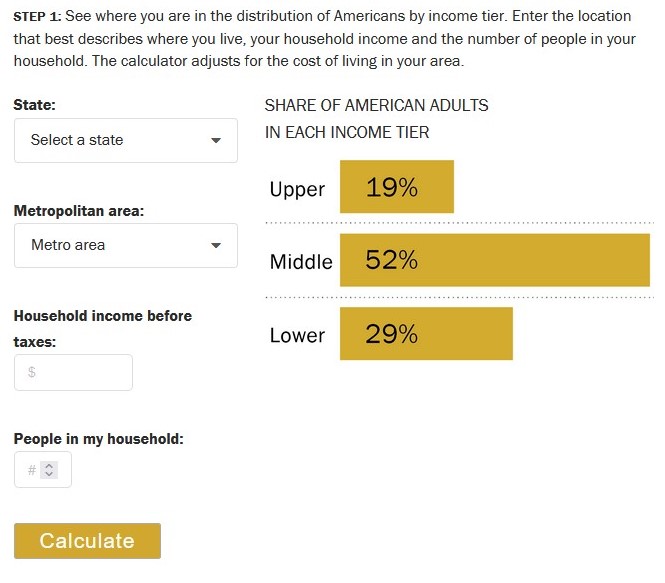
This calculator offered by the Pew Research Center factors in your location to determine which social class you belong in:

On how the calculator considers location:

The calculator takes your household income and adjusts it for the size of your household. The income is revised upward for households that are below average in size and downward for those of above average size. This way, each household’s income is made equivalent to the income of a three-person household (the whole number nearest to the average size of a U.S. household, which was 2.5 in 2018)…

Your size-adjusted household income and the cost of living in your area are the factors we use to determine your income tier. Middle-income households – those with an income that is two-thirds to double the U.S. median household income – had incomes ranging from about $48,500 to $145,500 in 2018. Lower-income households had incomes less than $48,500 and upper-income households had incomes greater than $145,500 (all figures computed for three-person households, adjusted for the cost of living in a metropolitan area, and expressed in 2018 dollars).

The following example illustrates how cost-of-living adjustment for a given area was calculated: Jackson, Tennessee, is a relatively inexpensive area, with a price level in 2018 that was 19.0% less than the national average. The San Francisco-Oakland-Hayward metropolitan area in California is one of the most expensive areas, with a price level that was 31.6% higher than the national average. Thus, to step over the national middle-class threshold of $48,500, a household in Jackson needs an income of only about $39,300, or 19.0% less than the national standard. But a household in the San Francisco area needs a reported income of about $63,800, or 31.6% more than the U.S. norm, to join the middle class.

Key here is the idea that incomes go further in some places and have less purchasing power elsewhere. By itself, income may not be that great of a measure for determining social class. Including location helps get at local variations in class.

Of course, there are other factors that go into assessing social class. This includes education, wealth, social networks, and more.

(Note: this calculator is based on 2018 data so there could be some important changes here in 2023.)

Even chickens can have McMansions

One TikTok user put together a McMansion for chickens:

I believe this best fits McMansion Trait #1 referring to the structure’s size. It could provide a lot of space for a few chickens or house a lot of chickens. It is probably larger than a lot of backyard coops.

At some point the chicken structure becomes too large to be a McMansion. If it is for large-scale operations, does it qualify as a chicken mansion?

It is less clear what the neighbors – human or animal – think about the relative size of this coop, the architectural quality or style of the structure, or the larger social issues a large chicken coop can symbolize.

Do all mayors feel this way: “We’re the envy of what most cities want to be”

The outgoing mayor of Naperville considered his legacy and summed up his community compared to others:

Photo by Matheus Bertelli on Pexels.com

Q: What will be your legacy as mayor of Naperville?

A: It has to be the financial impact on the city. Eight years seems like a long time, but it’s not when you’re trying to turn a ship like that. To turn over the city with tons of cash, not to mention federal money we didn’t touch, they’re going to be able to do a lot. And that’s my gift, to make sure the city was on the right trajectory. We’re the envy of what most cities want to be.

One of the jobs of a mayor is to champion their community. They are often the chief booster. In many American communities, professional staff – a city manager and others – address day-to-day concerns while mayors work with a council and act as cheerleader. The outgoing mayor earlier in the interview described the suburb’s success in planning, development, and revenues. Yet, always highlighting the best of the community is key and Naperville has a precedent: former mayor George Pradel did this for decades. I assume mayors will say their community is great.

Yet, it can be interesting when mayors make statements that involve other communities, implied or otherwise. It is one thing to say your community is great; it is another to say that it compares well to other communities. Some communities can be leaders or models for others. In the United States, this might involve growth or a high quality of life or economic opportunities or tackling particular issues.

Do most cities want to be Naperville or like Naperville? This might be hard to answer, particularly if leaders elsewhere will tend to focus on the good things in their own communities.

Nashville, you do not have to commit $1.2 billion in public financing for a new Titans stadium

Leaders in Nashville approved a lot of public financing for a new dome for the Titans and other uses:

Photo by Pixabay on Pexels.com

The Metro Nashville City Council approved by a 26-12 vote early Wednesday morning on the final reading to allow its sports authority to issue $760 million in bonds. That combines with $500 million in state bonds for more than $1.2 billion in public financing committed to the Titans’ enclosed stadium…

The stadium’s total cost is estimated at $2.1 billion. The Titans, with help from the NFL and personal seat licenses, will provide the remaining $840 million. The new stadium will feature a translucent roof with a capacity of approximately 60,000.

This stadium will allow Nashville and the Titans to bid for a Super Bowl, Final Fours, College Football Playoff games and more. Burke Nihill, the Titans’ president and CEO, said they are excited at the chance to host some of the world’s best events…

A new 1% hotel/motel tax, all of in-stadium sales tax and 50% of sales taxes from 130 acres around the stadium will pay off the bonds. The Titans and city officials announced an agreement in December that includes a new 30-year lease. The team agreed not to leave Nashville during that lease.

If I am reading this correctly:

  1. More than half of the costs of the stadium are coming through public financing.
  2. A number of new revenue sources – hotel tax, sales taxes from the stadium and the surrounding property – will pay off the bonds.
  3. The city thinks this deal will be good because it keeps the team and allows for additional events in Nashville.

My question: who benefits the most from this arrangement? The Titans and their owners. One source has them valued at $3.5 billion August 2022. This puts them toward the bottom of the NFL rankings. A new stadium boosts their value.

Research shows that while political and business leaders tout the advantages of new stadiums (jobs, status, energy, events, tourists, etc.), the money spent at the stadium would be spent elsewhere in Nashville. The city already has a lot going for it. The Titans and the stadium are part of the scene but they are relatively new in the city and there are plenty of other entertainment and tourist options for residents and visitors. Were the Titans really going to leave? (Of course, this is a team that left their previous city…)

But, the NFL generally gets what it wants for its owners. Nashville will try to sell this as a win for the city and region but the ultimate winners are the team owners.