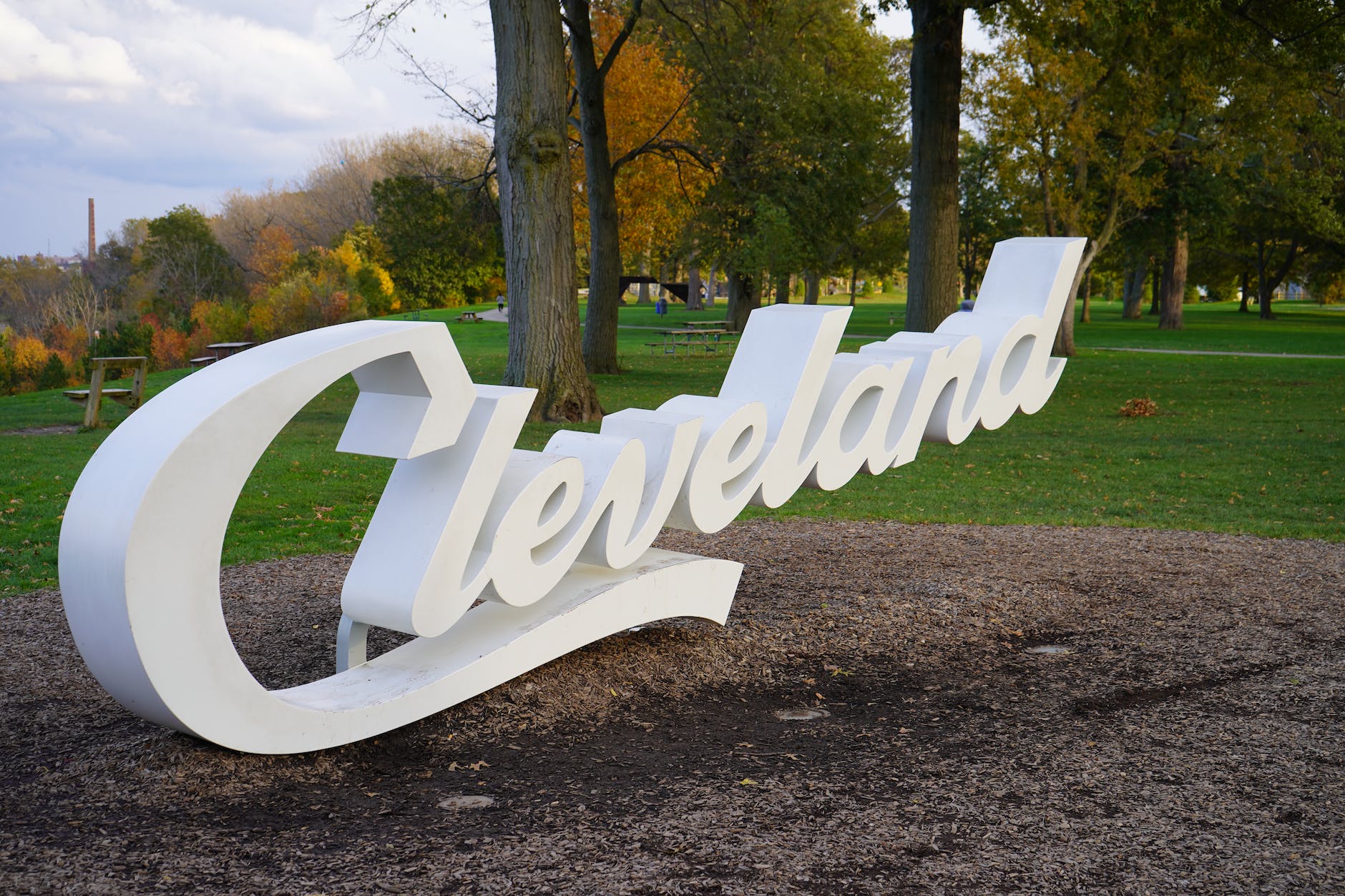
Leaning into “Everywhere else is Cleveland”

A recent ad from the New Orleans Police Department tried to set their city apart from other cities, namely, Cleveland:

Photo by DAVID Mercado on Pexels.com

The NOPD posted the commercial—”Everywhere Else Is Cleveland”—to its social media accounts at 9 a.m. Wednesday…

“Everywhere Else Is Cleveland”—which features women, people of color and members of the local LGBTQ community—was commissioned by the foundation as part of a broader recruitment push to help fortify the city’s shrinking police force. To broaden their applicant pool, the department recently relaxed restrictions around past marijuana use, credit scores and physical appearance—including tattoos, facial hair and nail polish.

The commercial’s title is a play on the famous Tennessee Williams quote: “America has only three cities: New York, San Francisco, and New Orleans. Everywhere else is Cleveland.”

See an earlier post about this quote.

This quote referenced above hints at a larger issue for those who study American cities. When is it helpful to lump cities together as similar enough or helpful to put them in different categories because they have unique traits? All big cities share some common characteristics but they are also different in certain ways. Is size, the time of settlement or rapid population growth, density, political system, cultural opportunities, or something else the factor we should use to analyze cities?

The quote above suggests there are four categories of cities: three that stand on their own then a much larger category represented by Cleveland. Cleveland is the stand-in here for all nondescript cities compared to three American cities that have unique personalities and settings. The ad suggests New Orleans is a very different kind of place.

Is this objectively true? As far as I know, there is no New Orleans School of urban thought, but this does not mean there should not be. Urban sociologists and theorists tend to squabble more about the biggest cities and whether New York, Chicago, or Los Angeles are the best models for understanding urban processes.


When the values of homes quintuple over 5 decades by just being there

I recently saw a house near me that was for sale. Checking the online property history, I found that the home is now worth roughly 5 times more than what it sold for in the early 1980s. By just being there for the last four decades, the home has quintupled in value.

Photo by Nataliya Vaitkevich on Pexels.com

This is not a phenomena restricted to our suburban area. Recently following an Internet rabbit trail, I was looking up property values in Levittowns on the East Coast. I remember seeing that their values had at least tripled or quadrupled over a similar span. What were once cheap and simple suburban homes became homes with values significantly above the median value for owner-occupied homes.

Homeowners would likely say that the values have increased because of the maintenance and upgrades in the homes and properties. There has been change; the homes near us have been updated and added to over the last fifty years while the Levittown houses have been transformed in numerous ways over the decades.

But, those positive changes do not add up to such an increase in value. Much of the increase in value has come from just being there. Being in the right location. The owners who lived in such homes benefited financially from a positive return on investment and could roll that new found wealth into other homes, investments, or opportunities.

The fear that people will be trapped in 15 minute cities

Online actors are suggesting leaders want to limit people to living in 15 minute cities:

Photo by Plato Terentev on Pexels.com

“Never have there been proposals for restrictions — on the contrary, this is a new opportunity: more choice, more services, more desire to thrive in one’s neighbourhood,” he said.

“Since the start of 2023, the concept of the 15-minute city has been subject to conspiracy theories, produced and shared by people already well known for spreading disinformation about Covid, the climate, vaccines and politics,” he said…

Particular claims debunked by AFP Fact Check in recent weeks have targeted the English city of Oxford and Edmonton, Canada. Claims surfaced in various languages, including English, French and Portuguese.

“You can’t leave a 15-minute city whenever you please … The city walls or restrictions or zones or whatever you want to call them won’t be used to keep others out, they’ll be used to lock everyone in,” says one man in a video viewed more than 59,000 times on Facebook, commenting on the Edmonton plan…

Supporters of 15-minute cities include the worldwide C40 cities alliance plus the United Nations and the World Economic Forum -– targets of numerous false claims that are subject to frequent fact-checks.

Would these particular fears about denser communities fit under long-running fears that a globalist structure wants to restrict the everyday lives and freedoms of workers? One way to control people is to restrict geographic mobility. Doing so would increase population densities and limit what people could access.

These fears likely find a stronger foothold in the United States where frontier and suburban motifs are strong. Americans like suburbs, in part, because they are able to have private property, can drive where and when they choose, and have closer connections to local government. Denser areas do not appeal to many Americans.

The mixed messages of a new subdivision sign with red brick but a modern font

A new subdivision I drive by regularly has this as its sign at the entrance off a busy road:

I think I get what the sign is trying to signal:

-Tradition and permanence with the red brick. It signals this is an impressive community that is here to stay. This is not a small sign either; it will be noticeable from a road on which people are driving 45 mph.

-The modern font suggests the neighborhood is not stuck in the past, even if other parts of the sign suggestion a connection to the past. The clean, crisp lines of the letters plus the all-caps first word and not capitalized second suggest dynamism, not stodginess.

Can a subdivision sign have it both ways? Can the font push one direction while the structure of the sign push another?

(Bonus features of the picture: the sales sign for the subdivision is more standard emphasizing “MODELS OPEN” and the starting prices, this is a good encapsulation of what February in the Chicago suburbs often looks like.)

Is American car culture changing due to the different preferences of younger adults?

Americans like driving and have woven it in to many aspects of life. However, younger adults are driving less:

Photo by Peter Fazekas on Pexels.com

Gen Zers point to many reasons they are turning their backs on cars: anxiety, finances, environmental concern.Many members of Gen Z say they haven’t gotten licensed because they’re afraid of getting into accidents or of driving itself. Madison Morgan, a 23-year-old from Kennewick, Wash., had multiple high school classmates pass away in driving accidents. Those memories loomed over her whenever she was behind the wheel…

Others point to driving’s high cost. Car insurance has skyrocketed in price in recent years, increasing nearly 14 percent between 2022 and 2023. (The average American now spends around 3 percent of their yearly income on car insurance.) Used and new car prices have also soared in the last few years, thanks to a combination of supply chain disruptions and high inflation…

E-scooters, e-bikes and ride-sharing also provideGen Zers optionsthat weren’t available to earlier generations. (Half of ride-sharing users are between the ages of 18 and 29, according to a poll from 2019.) And Gen Zers have the ability to do things online — hang out with friends, take classes, play games — which used to be available only in person…

But, he added, data has shown that U.S. car culture isn’t as strong as it once was. “Up through the baby boom generation, every generation drove more than the last,” Dutzik said. Forecasters expected that trend to continue, with driving continuing to skyrocket well into the 2030s. “But what we saw with millennials, I think very clearly, is that trend stopped,” Dutzik said.

Is less need for driving causing this or is driving viewed as less enjoyable and even reprehensible (climate change concerns)?

While per capita driving has plateaued, have other driving activities increased driving and traffic? For example, the number of deliveries from Amazon and similar companies did not exist in the same way nor did ride-sharing. Younger adults are driving less than older Americans but the world today depends on driving more than ever?

The last paragraph of the article emphasizes how planning could change based on less interest for driving. It would be interesting to see how planners and others work with both populations – younger Americans who do not drive as much and older Americans who drive a lot – to reach possible solutions.

Fewer than 10% of homes sold via virtual real estate transactions

A small percentage of homes are sold without the buyer seeing the property in person:

Photo by Kampus Production on Pexels.com

The National Association of Realtors first started collecting data on virtual real estate transactions in April 2020, according to Jessica Lautz, deputy chief economist and vice president of research. Virtual home sales, which are sometimes referred to as “blind offers” or “sight unseen sales,” peaked at 13% of all transactions in January 2022. By November 2022, that number dropped to 9%.

Lautz sees two drivers for virtual sales, beyond the pandemic. “It’s not only because inventory is tight, but people are moving longer distances. It might be very difficult to make your way to that home before it is under contract,” she said. “If you’re moving to a different state, the ability to quickly book a flight because that perfect home has just come onto the market may be impossible.”…

Lautz sees virtual transactions continuing, even if they’re less frequent. “If you had asked me that at the start of the pandemic, I would have thought it was a fluke. But it seems to be here to stay.”

Virtual transactions may reflect another shift, as the National Association of Realtors sees the median distance folks relocate increasing to 50 miles. “It makes sense because of housing affordability, people are moving farther out because of hybrid or remote work,” Lautz said. Being close to friends and family is top priority for so many buyers today, so they may be moving to a different area to seek that.”

Several thoughts in reaction to these numbers:

-I thought the percentage might have been higher during the pandemic. But, even then, seeing a property in person matter mattered.

-How much can technology remedy the desire to see a property in person? How long until prospective buyers could walk through a housing unit in the virtual realm? This is related to the biggest question I have: how well could technology substitute for being in a space? One matter is feeling like you were in person and could experience everything. Another matter is whether the technology allows you to consider everything. If that technology could be improved, maybe it can provide enough or all of the experience.

-Would more virtual showings increase the need for realtors or reduce them? If the main issue is technology being able to show everything about a unit, I could imagine it done without a realtor. If the main issue is about knowing a community and having connections, then the realtor continues even if the technology improves.

Build it – the residential and commercial development around a suburban football stadium – and they will profit?

What if the new football stadium is less of a draw in the long run than the development right around the stadium? Here is one report about what has changed in Glendale, Arizona, home to today’s Super Bowl, where the stadium opened in 2006:

Photo by Pixabay on Pexels.com

Far out? The site of Sunday’s Super Bowl is about 13 miles northwest of downtown Phoenix. Arlington Heights is about 30 miles northwest of downtown Chicago.

The distance is less of an issue than it was when State Farm Stadium was built, said Kevin Phelps, Glendale’s city manager. Some projections show that two out of three newcomers to the Phoenix area will live in the West Valley…

The last time Glendale hosted a Super Bowl, it had about 800 hotel rooms near the stadium. By next year, that number will be 3,000. The city has found that most people spend money on dinner and shopping within two miles of their hotel. But a new development has to deliver.

“You have to have a ‘there’ there,” Phelps said. “I don’t care how good your advertising is. If we told everyone to come to Glendale and they got here and there was an ice cream shop and a Denny’s and that’s all there is, you’d never get them back again.”

Just having a superb stadium experience is not enough. The stadium can anchor a larger entertainment district where people come for a variety of events, enjoy food and other experiences, and are willing to spend a few nights or a long day. The real activity and money is in the year-round potential of the property that at the center has a recognizable stadium but also has enough to attract people when there is not a big game.

Still, the more important question is this: who benefits from the new development? Does the suburb of Glendale? Do its residents? Or, does this primarily enrich the team owners who see the value of their franchise increase?

The suburbs as the perfect places for drone deliveries

Where might drones make deliveries? One project in Texas suggests the suburbs make a lot of sense for such deliveries:

Photo by Darrel Und on Pexels.com

Flytrex, which specializes in on-demand, ultrafast delivery for food and retail, is bringing food and grocery orders via drone to front and backyards.

According to a release, the service will be based in Granbury, in a partnership with restaurant chain Brinker International, home of Chili’s Grill & Bar, Maggiano’s Little Italy, and two virtual brands: It’s Just Wings and Maggiano’s Italian Classics.

The service is operating in cooperation with longtime partner Causey Aviation Unmanned under a newly granted Federal Aviation Administration (FAA) waiver allowing a delivery radius of one nautical mile – reaching thousands of potential homes. Eligible households can order food via the Flytrex app.

Their focus is on the suburbs, where on-demand delivery has previously been viewed as commercially unviable, since traditional couriers can make only two deliveries per hour in such areas. They have a video showing a drone at work on YouTube.

Granbury is a small town of just over 11,000 residents roughly 30 miles southwest of Fort Worth and on the edge of the Dallas metropolitan area.

More broadly, it is interesting to note that the population densities of Granbury and the suburbs are what might make delivery by drone viable. Americans tend to like suburbs and driving. But, this is not as good for delivering food or other items. The same kind of space Americans like for their suburban homes does not work well with quick deliveries.

How many deliveries can drones make in an hour compared to vehicles? Are there also advantages to suburban deliveries from not having to encounter many tall buildings or obstacles?

If drones are better for suburban deliveries, are suburbanites open to drones flying above their homes to bring them things they have ordered? Suburbanites also like a connection to nature and drones may not provide that if they are flying or they can be heard above homes. The same drones that enable a consumer lifestyle do not necessarily fit with an image of quiet suburban properties.

“Anybody can be suburban. It just takes money…” misses the intersection of class, race, and local control

As some states pursue affordable housing guidelines for communities, one critic argues it just requires money to live in the suburbs:

Photo by Travis Saylor on Pexels.com

Racial discrimination is abhorrent and should be prosecuted. But as a Brookings Institution analysis of the 2020 census shows, race isn’t a barrier to suburban living. Blacks are moving to the suburbs at a faster pace than whites. Anybody can be suburban. It just takes money — especially in Connecticut. In 2017, developer Arnold Karp purchased a colonial house on tree-lined Weed St. in small, ultra-wealthy New Canaan. There are no commercial or multifamily buildings on the street. He now wants to build a five-story, 102-unit apartment complex with 30% set aside for affordable housing.

The data does suggest people in all racial and ethnic groups are moving to suburbs. Here is what William Frey concluded from 2020 Census data:

This analysis of suburban and primary city portions of the nation’s major metropolitan areas shows that these big suburbs are more racially diverse than the country as a whole. Moreover, in contrast to how white flight fueled growth there in the past, most big suburbs have shown declines in their white populations over the 2010-20 decade. Their greatest growth came from Latino or Hispanic Americans, Asian Americans, persons identifying as two or more races, as well as Black Americans—continuing the “Black flight” to the suburbs that was already evident the 2000-10 decade. 

Today, a majority of major metro area residents in each race and ethnic group now lives in the suburbs. And for the first time, a majority of youth (under age 18) in these combined suburban areas is comprised of people of color.

But, as a sociologist of suburbs, here is what is missing from the critics’ analysis: people of different racial and ethnic groups are not evenly distributed across suburbs and not all racial and ethnic groups have the same wealth, income, and resources to obtain suburban homeownership.

In other words, because social race and race and ethnicity in the United States are connected, it is not just about money in reaching the suburbs.

What is really at stake? From the critic:

Local control will be obliterated. Albany will call the shots on what your town looks like, how much traffic there is and ultimately what your home is worth…

Ensuring a supply of affordable housing within a region is more reasonable than demanding every town alter its character.

Suburbanites like local control and local government. These arrangements allow leaders and residents means by which to decide who can live in their community. This is often done through housing values and prices; ensure the land and homes or rental units expensive enough and the community can be exclusive.

Additionally, one of the problems of affordable housing – and other land uses less desired by suburban homeowners (including drug treatment centers and waste transfer facilities) – is that few suburban communities want it. Communities with means and political voices will keep affordable housing out. This means affordable housing is not plentiful often and is often clustered in particular locations. One reason states are pursuing this at a metropolitan level is that there is not enough affordable housing in the current system that prioritizes local decision making over what is good for the region.

Suburban residents may not like the idea of affordable housing arriving in their community. However, the legacy of housing in the United States is often one of exclusion and restriction, not about communities and residents coming together to provide housing for all.

State of Illinois has grant money to help develop megasites of 200+ acres, including suburban locations

A new grant from the state of Illinois makes money available to develop “megasites”:

Photo by Jahoo Clouseau on Pexels.com

Gov. J.B. Pritzker on Monday announced the creation of a $40 million grant program to help businesses find and build on large development-ready areas known as “megasites” across the state, including several in the suburbs.

Megasites are large swaths of land intended for businesses such as factories, warehouses and distribution centers. Pritzker said developing these sites will help make Illinois more competitive, especially as sectors including clean energy and manufacturing are rapidly expanding in the U.S…

Intersect Illinois, an independent economic development nonprofit working with the state on the program, lists among 151 megasites two in Hoffman Estates, one in West Chicago, four in Lake County and five in the Fox Valley. Several more are in South and Southwest suburbs, and more than two dozen are southwest of Joliet around Minooka, Channahon and Morris…

The program is open to private entities, nonprofits and local governments, and the application portal is open through April 6. Those receiving the grant must match each dollar granted by the state with other private or local funding.

This is a good example of how governments and private interests work together in the United States to develop land. The state government provides money in concert with more local funding in order to help spur development. Without the government money, the development may not happen.

This money is marked to help with large projects. Is the assumption that it is difficult to entice companies to such sites in Illinois or that local governments do not have enough resources to address needs for properties this large?

If these properties are not developed as megasites (versus being developed in parts), how much is lost?

This will be worth checking on in a decade or two to see what exactly emerges on these megasites.