Trying to make a better Walmart parking lot experience

I have driven through many Walmart parking lots and while doing this, I often wonder how a better parking lot experience could help avoid regular issues. Here are some of the big concerns:
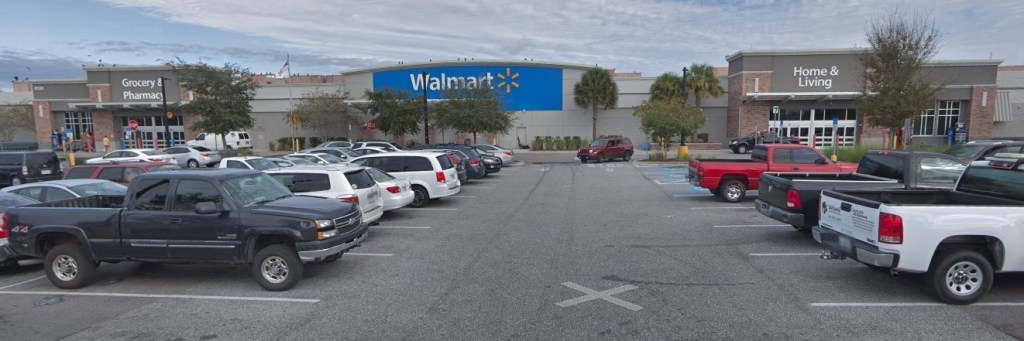
  1. There are often a lot of vehicles, people, and carts moving around. It is hard to keep track of all the activity.
  2. Depending on the traffic flow of the location, some of the traffic can be routed right in front of the store as vehicles turn in from a street or adjoining parking lot.
  3. At least a few cars always seem to be lingering right at the front doors or nearby, waiting for people.
  4. Carts are strewn throughout the parking lot; most are in corrals but there are often other ones on medians, in parking spots, and even several parking lots over. (Imagine if the Walmart lot had Costco sized shopping carts!)

A few solutions come to mind:

  1. Everyone needs to be very attentive. Having to pay close attention is not necessarily bad for drivers or pedestrians.
  2. It is better to have the majority of drivers enter the parking lot area from the back rather than from the sides and drive directly in front of the store.

I started thinking about this recently after realizing that I have been in multiple parking garages at Target locations but never at a Walmart. In these locations, there are advantages to having the parking further away from the store and/or having the store on a different level from the traffic flows.

Figuring this out could have multiple benefits including: drivers and pedestrians would feel safer, the parking lot experience could be less fraught and more pleasant, and fewer work hours might need to be devoted to the parking lot.

Perhaps this is just the price Americans are willing to pay for their love of driving and sprawl: complicated parking lots. This is not an issue exclusive to Walmart as many big box stores demonstrate similar patterns. But, since Walmart has so many locations and so many customers, solving issues there could be a big deal.

Local TV market ad celebrities, Bob Rohrman edition

For decades, American television viewers have been treated to (or subjected to, depending on one’s point of view) recurring characters in local television ads. In the Chicago region, Bob Rohrman was a mainstay:

Of all the Chicago auto dealers who ever graced the small screen as their own TV pitchman, few were as delightfully campy as Bob Rohrman.

Rohrman’s low-budget commercials radiated good humor and bad production, featuring his mustachioed and bespectacled face peering out from a variety of goofy costumes, a uniquely awkward delivery and flubbed lines that often devolved into a joyous cackle.

The spots were punctuated by a cheesy cartoon lion and the tag line: “There’s only one Bob ROHRRRR-man!”

Somehow it all worked, turning the Bob Rohrman Auto Group into one of the largest family-owned dealership groups in the Midwest, and its spokesman/founder into something of a Chicago celebrity.

In the era of cable and satellite television, streaming options, declining network television and local radio, and targeted commercials on particular platforms, we may be at the end of local advertising like this. All the advertising then becomes more corporate, slick, tied to national or multinational corporations. And we lose a few public characters who few people may have actually met but who many could recognize.

We purchased a vehicle from a Rohrman dealership several years ago. At no point, did I think about the commercials in that process. But, given the number of Rohrman commercials I have seen and heard over the years, who knows if it influenced me. (I can safely say that other auto pitchmen or dealers, including Max Madsen or the Webb boys, did not lead me to visit their lots.)

Carmageddon in Los Angeles vs. Carmageddon in New York City

Remember Carmageddon and Carmageddon II in Los Angeles? Now, Carmageddon has come to New York City:

In Chicago and in other cities with robust transit systems, people who have never owned cars before are suddenly buying them. In New York City, some are calling it “carmaggedon,” as residents there registered 40,000 new cars in July, the highest monthly total in years. Meanwhile, NYC subway ridership is still down more than 75% from last year.

pexels-photo-1116244.jpeg

Photo by Jack Gittoes on Pexels.com

The difference in what leads to carmageddon in each city is striking. In Los Angeles, closing a section of a major highway is a problem for the entire system. Because of the emphasis on driving and the various chokepoints in the road system, a single closure has ripple effects. In New York City, the opposite is the case: high mass transit use, particularly in Manhattan and denser parts of the city, is necessary. If something threatens the mass transit lines – here, it is an unwillingness to use mass transit when there is a pandemic – then too many cars may be on roads that cannot handle the increased volume.

Fortunately for Los Angeles and unfortunately for New York, the length of Carmageddon matters. Closing a major highway for just a few days is survivable. Indeed, Los Angeles got out ahead of the problem and enough drivers were able to make alternate plans. Decreased mass transit use due to COVID-19 is another story. How long will the virus be around? Will there be a point where residents return to mass transit even with the threat of the virus present? Carmageddon in New York might prove more lengthy and much more difficult to remedy.

Advertising yourself through your vehicle

What does your car say about you? It can say a lot according to one Washington police department:

RichlandPDcars

The emphasis here is on limiting exposure to crime. Put a lot of information on your car, people might see it and take advantage.

But, this goes against what Americans argue is a feature of consumerism: the products purchased plus their customization and deployment reflects individuals and their personality. Americans do not just buy cars to get from one place to another. Instead, what model and trim and color buyers select reflects something about them. The pick-up truck reflects rugged individualism. The Toyota Prius reflects different sensibilities as does the Nissan Versa or the Subaru Outback. And then owners can modify the vehicle in a myriad of ways, including adding stickers or decals or a vanity plate to the back. And driving is essential to the American way of life.

Not all information given in public will lead to a crime. Of course, the tweet above does not cover all of the information one could add to their car. This includes messages about particular religions (think Coexist or fish emblems), political bumper stickers, and sports teams, just to name a few.

Reminder of Chicago’s vital position in the American railway network

I recently saw a map on Reddit that displayed four maps of railway networks: Europe, North America, Southeast Asia, and Australia.RailwayNetworksJul2320

There is a lot that could be said with these maps. When I looked at the North America map, one thing jumped out at me: the centrality of Chicago to the passenger network (and to railroads more broadly). Not surprisingly, given the density of population and major population centers, there are more passenger trains between Washington, D.C. and Boston. The rest of the country is relatively sparse except for the convergence of lines in and out of Chicago. This is partly the result of geography – Chicago’s position at the base of the Great Lakes helps – but also the result of decisions to route traffic and develop infrastructure in and around Chicago and not elsewhere (like in St. Louis or Memphis or Cincinnati or other options). And a lot of rail traffic and freight runs through the region as well.

If a more robust passenger rail system develops in the United States, this map suggests Chicago will be in the thick of it. This would present an opportunity for a city that is already a transportation center with busy airports, crowded roads, and potentially more rail traffic and visitors. It is a little surprising that Chicago and Illinois leaders do not talk more about potential railroad options – consider the decades-long focus on a potential third airport, plans for highways that do not get off the ground, or the slow speed at which railroad congestion is addressed – as this could only add to what Chicago already has.

Addressing more Chicago traffic when fewer people take mass transit

With COVID-19, few may be willing to ride mass transit even as everyday life slowly returns to some normalcy. This has consequences for traffic:

man standing beside train

Photo by Trace Hudson on Pexels.com

World Business Chicago, a public-private nonprofit agency that promotes the city, estimates that on a given workday there about 406,000 office workers in downtown Chicago, making it the country’s second-biggest central business district after Manhattan.

Many of those people arrive by trains and buses, with the CTA and Metra providing almost 1.9 million rides combined on an average, pre-coronavirus weekday. That includes 1.6 million total one-way CTA rides and 263,000 Metra trips…

Riders’ hesitation may come in part from the Centers for Disease Control and Prevention’s recommendation in May that people drive to work alone. That guidance rankled public transportation advocates and created concerns of major traffic and environmental impacts in densely populated cities…

“We’re hearing stories from New York and (Washington) D.C. about employers saying if you’ve taken public transportation you can’t come in the building,” Lavin said. “We want to be sure there’s nothing against public transportation here. In order to do that, we need to have a dialogue.”

Chicago has heavy traffic even with mass transit use because it is a transportation center with plenty of highways and intermodal facilities.

As noted in an earlier blog post, this does present an opportunity to reduce traffic long-term or make a choice to continue to rely on a sprawling landscape full of drivers in their own private vehicles. There are multiple options to pursue:

1. More people working from home. This would reduce traffic on major roads.

2. Stagger work times more so that “rush hour” is more spread out.

3. Find ways to make sure mass transit is safe and/or people feel confident riding it. This might require more resources or better PR or new ideas.

4. Pushing for more people to be able to work closer to their workplaces (meaning more housing options throughout a metropolitan region).

5. Pushing for denser areas in the city or suburbs. (This might be a hard sell right at the moment due to concerns about COVID-19.)

6. Providing more incentives for fleets of vehicles (electric or otherwise) so that not every household has so many cars.

Any one of these or several of them could be pursued at multiple levels with actions from individuals, local groups and municipalities, states, regions, and the federal government.

Bringing the Texas U-turn to Chicago

An innovation is coming to a particularly difficult Chicago road construction site: a Texas U-turn will be in place for drivers hoping to get on the northbound Kennedy from the eastbound Eisenhower.

Google Maps image of Meachem Road and Illinois Route 390

Kennedy-bound traffic will be detoured onto the far-right Eisenhower lane and steered to the outbound Dan Ryan Expressway. From there, motorists will take a “Texas U-turn” at the Taylor Street interchange and go from there to the westbound Kennedy…

“The detour will be a dedicated lane separated by a barrier wall to restrict merging into the regular Dan Ryan lanes and requiring drivers to use the Taylor Street interchange,” IDOT engineers said.

What’s a Texas U-turn? It “refers to a roadway that allows vehicles to make a 180-degree maneuver to go in the opposite direction, usually without traffic signals,” IDOT spokeswoman Maria Castaneda said. “They were first widely used in Texas on one-way frontage roads that paralleled expressways.

“The free flow U-turn improves traffic flow and reduces congestion in certain situations because it keeps the U-turning traffic out of the cross road intersections. An example of this is at the Meacham Road interchange on Route 390.”

According to Wikipedia, the Texas U-turn is present in a number of states.

Two additional thoughts:

1. A precondition for the Texas U-turn seems to be having frontage roads along highways. There are some areas in the Chicago region where this is common – such as long the Dan Ryan Expressway – but many other areas where frontage roads are not present and properties back up to the highway. In Chicago, I wonder if the frontage roads are the result of fitting highways into the existing street grid (such as the Congress Street Expressway, later the Eisenhower).

2. It would be interesting to see how different road innovations spread across states. How do highway innovations diffuse across the United States? They may arise because of particular local conditions but then engineers and planners elsewhere see how they are applicable. At some point, there is federal intervention regarding safety and regulations. Having driven on highways across the United States, there is both familiarity with the system – similar signage, the roadways themselves look similar – as well as local peculiarities – exits on different sides, the size of on and off-ramps as well as the space between them, HOV lanes, etc.

Related post: the coming of the diamond interchange to the Chicago area.

Returning to a traffic-filled world – or moving to reduce traffic in the future

With activity picking back up, traffic and driving is trending up. Will people go back to accepting the typical commute at just over 27 minutes one way? Or, will people get behind options that might reduce traffic?

Here are a few alternatives:

  1. More working from home would reduce traffic. This seems popular and limits the need for commuting. (Bonus: no one is changing roadways like some of the below options.)
  2. Closing streets to allow more space in cities could extend further. Indeed, cities have already tried this in small doses before COVID-19.
  3. Road diets try to limit the lanes available to drivers. Fewer lanes means more congestion which could discourage driving.
  4. Continuing to close major highways in urban areas (like Seoul and Seattle) and instead devoting the land to pedestrians, bicyclists, and local users.
  5. Promoting more mass transit options and/or coverage throughout regions.
  6. Providing more opportunities for pedestrians and bicyclists – or at least trying to keep them safe.
  7. Providing more housing close to jobs so that commutes do not have to be so long.

Americans like driving yet COVID-19 does provide an opportunity to rethink how much driving Americans do on a daily basis. Is this the system people want or is it more of what happened given American interests in suburbs and single-family homes?

Chicago’s rail and intermodal facilities, pollution, and COVID-19

One of Chicago’s advantages is its transportation sector, particularly the railroad and truck traffic that passes in and through the region. But, the railyards and intermodal facilities where rail and truck traffic converge can cause a lot of pollution, even during COVID-19:

But for reasons that have yet to be fully explained, people in Chicago and its suburbs aren’t breathing dramatically cleaner air during the pandemic…

Likely culprits include buildings, factories and diesel engines that burn coal, oil or natural gas. Diesel emissions in particular remain a chronic problem in Chicago, a racially segregated freight hub where rail yards, warehouses and intermodal facilities are concentrated in low-income, predominantly African American and Latino neighborhoods.

“We already have roughly double the amount of heavy-duty traffic than other major cities in the country,” said Zac Adelman, executive director of the Lake Michigan Air Directors Consortium, a group of state officials from Illinois, Indiana, Michigan, Ohio, Minnesota and Wisconsin…

During the past decade, scientists at the U.S. EPA have discovered daily spikes of soot pollution near intermodal facilities in Chicago and other cities that far exceed average urban concentrations.

The article primarily focuses on Chicago where intermodal and railroad facilities tend to be located near poorer residents. Leaders have sought to move traffic away from the center of Chicago and more to the edges of the region, but this means this is also a problem for the entire region. With numerous facilities far from Chicago, such as in Will County or as far as New Rochelle near Rockford, the air quality for millions is affected. It would also be worth looking at where the suburban and exurban facilities are located; what residents are most affected? How far away are these facilities from wealthier communities?

The article also suggests new regulations mandating cleaner locomotives and trucks would help. How this would play within a region that relies on the transportation industry – Chicago was not only the convergence center for Midwest commodities, it also developed the capacity to move those goods throughout the United States and world – would be interesting to watch. Suburbanites would not like the pollution if they knew about it or were concerned about it in their own neighborhoods or elsewhere nor do they like the inconveniences of a lot of rail and truck traffic. Yet, they like cheaper goods and jobs, perhaps even more so if the immediate problems of pollution are borne by other residents of the region.

NYC plans to provide social distancing space for pedestrians by closing more streets to cars

Sidewalks may not provide enough room to keep distance from others so New York City is planning to close more roads to vehicles:

New York City will close 40 miles (64 kilometers) of streets to cars, mostly near parks, to expand the amount of space that pedestrians have to keep social distance, Mayor Bill de Blasio said.

The ultimate goal will be to have 100 miles of “open streets” during the coronavirus outbreak, de Blasio said Monday at a press briefing.

The mayor has been pressed by the City Council and bike advocates to open more streets to pedestrians and bikers, and to give more recreation possibilities to New Yorkers. De Blasio had resisted these proposals, saying they would create challenges for law enforcement. The mayor also said he was concerned that drivers might not obey the street closing, placing pedestrians and bikers in danger.

As a temporary measure, this seems like it makes some sense given the need for space to get outside within denser communities. It does raise other issues, such as delivering packages in certain areas or, as the article notes, law enforcement concerns.

Perhaps more interesting is the long-term consequences of such a move. In the last one hundred years or so, American cities and communities have often prioritized moving vehicles through cities. Manhattan already had a problem with crowded sidewalks before COVID-19. Pedestrian and bicyclist safety is already an issue. More cities were already considering closing streets to cars. Road closures might be motivated in the short-term by COVID-19 but this could also be part of a growing movement to provide for human-powered means of transportation.